
Imagine a couple in their mid-30s weighing a move to Oldsmar. One partner works remotely three days a week; the other commutes to Tampa. They’re drawn to the strong schools and parks, the mix of walkable pockets and quiet streets. But they’re unsure: will their combined income feel stretched or stable? Will they spend weekends running errands by car, or can they walk to grab groceries on a weeknight?
That uncertainty is common—and it’s not really about the number on a paycheck. It’s about whether the rhythm of life in Oldsmar matches what your income can comfortably support, day after day.
What “Living Comfortably” Means in Oldsmar
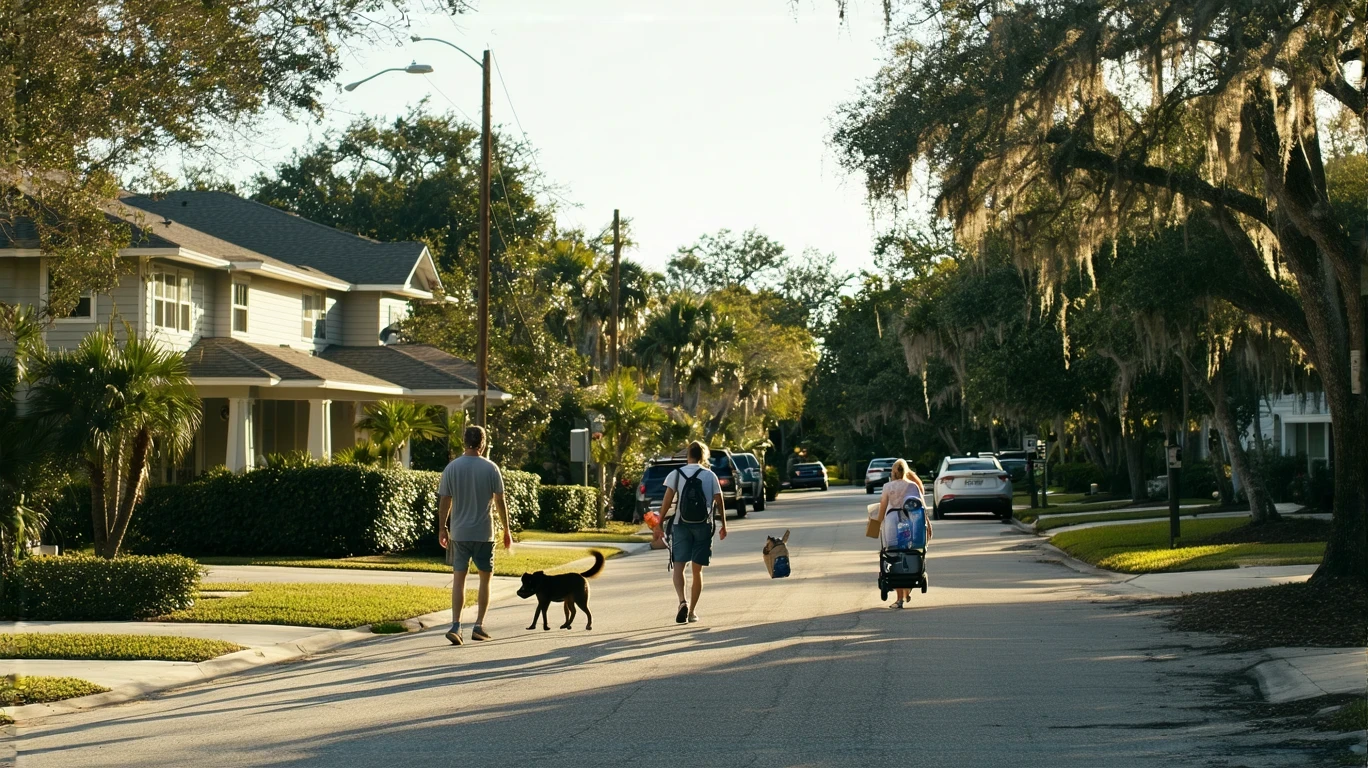
Comfort in Oldsmar isn’t defined by a single income figure. It’s the ability to secure stable housing without constant tradeoff anxiety, absorb seasonal utility swings during Florida’s long cooling season, and manage the logistics of getting around—whether that means a predictable commute, coordinating two-car households, or planning errand routes in advance.
Locals expect space: single-family homes with yards, room for kids to play, and enough separation from neighbors to feel settled. They expect reliable air conditioning through triple-digit summer heat. And they expect time—time that isn’t entirely consumed by commuting (25 minutes on average, but over 41% of workers face longer trips) or by driving between scattered errands.
Comfort here is contextual. It’s not about luxury; it’s about predictability. Can you cover your housing costs without month-to-month stress? Can you handle a high electric bill in August without reshuffling other expenses? Can you get to work, school, and the pharmacy without logistical friction eating into your evenings?
If those questions feel answerable without hesitation, you’re likely living comfortably. If they require constant recalculation, you’re not—regardless of what you earn.
Where Income Pressure Shows Up First
In Oldsmar, income pressure doesn’t announce itself with a single breaking point. It accumulates across a few recurring friction points that define daily life.
Housing tradeoffs: The median home value sits at $323,200, and median rent is $1,330 per month. Neither figure is prohibitive on paper, but both demand consistency. Renters face annual lease renewals with potential increases; owners navigate property taxes, insurance that reflects Florida’s storm exposure, and maintenance costs that don’t pause for tight months. The pressure isn’t the initial cost—it’s the inability to absorb changes without reworking everything else.
Utility volatility: Electricity rates run 15.02¢ per kWh, and cooling dominates household energy use for much of the year. A mild spring month might feel manageable; a brutal July or August can double usage. Households operating near their limit feel that swing immediately. Comfort means having enough margin that a high utility month doesn’t force you to skip something else.
Transportation time vs. money: Oldsmar’s layout—walkable pockets, notable bike infrastructure, but corridor-clustered errands and bus-only transit—creates a tradeoff. Some neighborhoods support car-light living; most don’t. The average commute is 25 minutes, but over 41% of workers face longer trips. Gas prices at $3.93 per gallon add up quickly for multi-car households. The hidden cost isn’t just fuel—it’s the time spent coordinating pickups, planning grocery runs, and managing a household that can’t easily walk to what it needs.
Family-specific planning burden: Oldsmar offers strong infrastructure for families—schools and playgrounds meet density thresholds across the city. But where money goes becomes more complex when healthcare access is limited (no hospital or clinics detected locally) and errands require intentional routing. Families don’t just budget for expenses—they budget for logistics, and that takes time, fuel, and mental load.
How the Same Income Feels Different by Household
Households at similar income levels often experience very different pressure depending on structure, expectations, and daily patterns.
Single adults: Housing costs dominate. A single income covering $1,330 in rent (or a mortgage tied to a $323,200 home) leaves less room for error. Oldsmar’s walkable pockets—areas where the pedestrian-to-road ratio exceeds typical suburban thresholds—offer some relief. In those neighborhoods, a single adult can reduce car dependency, walk to a few errands, and lower transportation costs. Elsewhere, a car is non-negotiable, and that adds insurance, fuel, and maintenance to an already tight equation. Comfort for singles depends heavily on location within Oldsmar and whether their income can absorb both housing and mobility costs without constant recalibration.
Couples: Dual income eases housing pressure significantly, but it introduces coordination complexity. With only 3.3% of workers remote full-time and over 41% facing long commutes, most couples default to two vehicles. That means two sets of insurance, two fuel budgets, and two commute schedules to manage. The upside: couples can more easily handle utility swings, split errands, and build savings. The downside: if one partner loses income or changes jobs, the whole structure tightens quickly. Comfort for couples often hinges on commute alignment and whether both incomes feel stable simultaneously.
families: Families benefit from Oldsmar’s strong school and playground density, which reduces the logistical burden of finding safe, accessible spaces for kids. But medium-density grocery and food access—and the absence of local hospital or clinic facilities—means families spend more time planning. Errands aren’t spontaneous; they’re routed. Doctor visits aren’t nearby; they require a drive. Comfort for families isn’t just about covering costs—it’s about whether your income supports the time and fuel required to manage a household that can’t walk to most of what it needs. Families at the median income level often feel stable, but those below it report constant tradeoff fatigue.
The Comfort Threshold (Qualitative)
There’s a transition point in Oldsmar where income pressure shifts from constant to occasional. It’s not a number—it’s a set of conditions.
You’ve crossed the comfort threshold when:
- Housing costs feel fixed and predictable, not month-to-month variable
- A high utility bill in August doesn’t force you to defer something else
- You can absorb an unexpected car repair without panic
- Commute time feels like a known tradeoff, not a daily negotiation
- Errands don’t require constant route optimization to save gas
- You’re saving something most months, even if it’s modest
Below that threshold, every decision is reactive. Above it, you’re making choices instead of managing crises. The threshold isn’t income-based—it’s outcome-based. Two households earning the same amount can sit on opposite sides depending on housing type, commute length, vehicle count, and whether their daily errands align with Oldsmar’s corridor-clustered layout.
Why Online Cost Calculators Get Oldsmar Wrong
Most cost-of-living calculators treat Oldsmar as a data point: plug in the rent, add utilities, multiply commute distance, and output a total. But totals mislead.
They don’t capture that Oldsmar’s errands are corridor-clustered, meaning grocery and food access exists but requires intentional planning. They don’t reflect that walkable pockets offer car-light living in some neighborhoods but not others. They don’t account for the fact that 41.4% of workers face long commutes, even though the average is only 25 minutes—a gap that hides significant variation.
Calculators assume uniform experience. Oldsmar delivers differentiated experience. A household in a walkable pocket near a grocery cluster will spend less on gas and time than a household three miles away in a car-dependent area—even if both pay identical rent.
People feel surprised after moving because they optimized for a number instead of a pattern. Comfort in Oldsmar depends on whether your daily routine aligns with the city’s infrastructure, not whether your income meets a generic threshold.
How to Judge Whether Your Income Fits Oldsmar
Instead of asking “Do I earn enough?” ask these:
How sensitive are you to housing tradeoffs? If you need to rent and expect stable lease renewals, Oldsmar works. If you’re buying and can handle Florida insurance volatility and maintenance seasonality, it works. If either of those feels like a stretch, pressure will show up quickly.
Can you absorb seasonal utility swings? Cooling costs dominate summer months. If a doubled electric bill in July would force you to defer other expenses, you’re operating without enough margin.
Is time or money your limiting factor? Oldsmar’s layout rewards households that can trade time for lower transportation costs (biking, busing, walking in specific pockets) and penalizes those who can’t. If your schedule is already tight, expect to spend more on gas and vehicle costs to buy back time.
How much logistical complexity can you manage? Families benefit from strong schools and playgrounds, but limited healthcare access and medium-density errands mean more planning. If you prefer spontaneous errands and nearby services, Oldsmar will feel friction-heavy.
How much flexibility do you expect month to month? If you’re building savings and can handle occasional surprises, Oldsmar offers stability. If you’re already at your limit, the city’s cost structure—steady housing, volatile utilities, variable transportation—will feel unforgiving.
These questions don’t produce a pass/fail score. They surface whether your income, expectations, and daily patterns align with what Oldsmar actually delivers.
How this article was built: In addition to public economic data, this article incorporates location-based experiential signals derived from anonymized geographic patterns—such as access density, walkability, and land-use mix—to reflect how day-to-day living actually feels in Oldsmar, FL.
FAQs About Living Comfortably in Oldsmar
Is the median household income enough to live comfortably in Oldsmar?
The median household income is $73,984 per year. For many households—especially couples and families—that income supports stable housing, predictable utility costs, and manageable transportation expenses. But comfort depends on household size, commute length, and whether your daily errands align with Oldsmar’s corridor-clustered layout. Singles and one-income families at the median often report tighter margins.
Can you live in Oldsmar without a car?
In specific walkable pockets where pedestrian infrastructure is strong and errands are nearby, a car-light lifestyle is possible. But most of Oldsmar requires a vehicle for grocery runs, healthcare access, and reliable commuting. Bus service exists, and bike infrastructure is notable, but neither fully replaces car dependency for most households.
How do utility costs affect comfort in Oldsmar?
Utility costs vary significantly by season. Cooling dominates expenses during Florida’s long, hot months, and electricity rates at 15.02¢ per kWh mean high-usage months can strain budgets. Comfort depends on whether your income includes enough margin to absorb those swings without forcing tradeoffs elsewhere.
What income level supports a family comfortably in Oldsmar?
There’s no single number. Families benefit from strong school and playground infrastructure, but they also face higher logistical costs—two vehicles, more errands, and limited local healthcare access. Families at or above the median income generally report stability, but those below it often feel pressure from the combination of housing, transportation, and planning complexity.
Why do some people feel financially stretched in Oldsmar even with decent income?
Because comfort isn’t just about earnings—it’s about alignment. A household earning well above the median can still feel stretched if they’re in a car-dependent area with a long commute, high cooling costs, and errands that require constant driving. Conversely, a household slightly below the median in a walkable pocket with a short commute may feel stable. What a budget has to handle in Oldsmar depends as much on location and logistics as on income.
Oldsmar can work well for some households—but only if expectations match reality.
—