
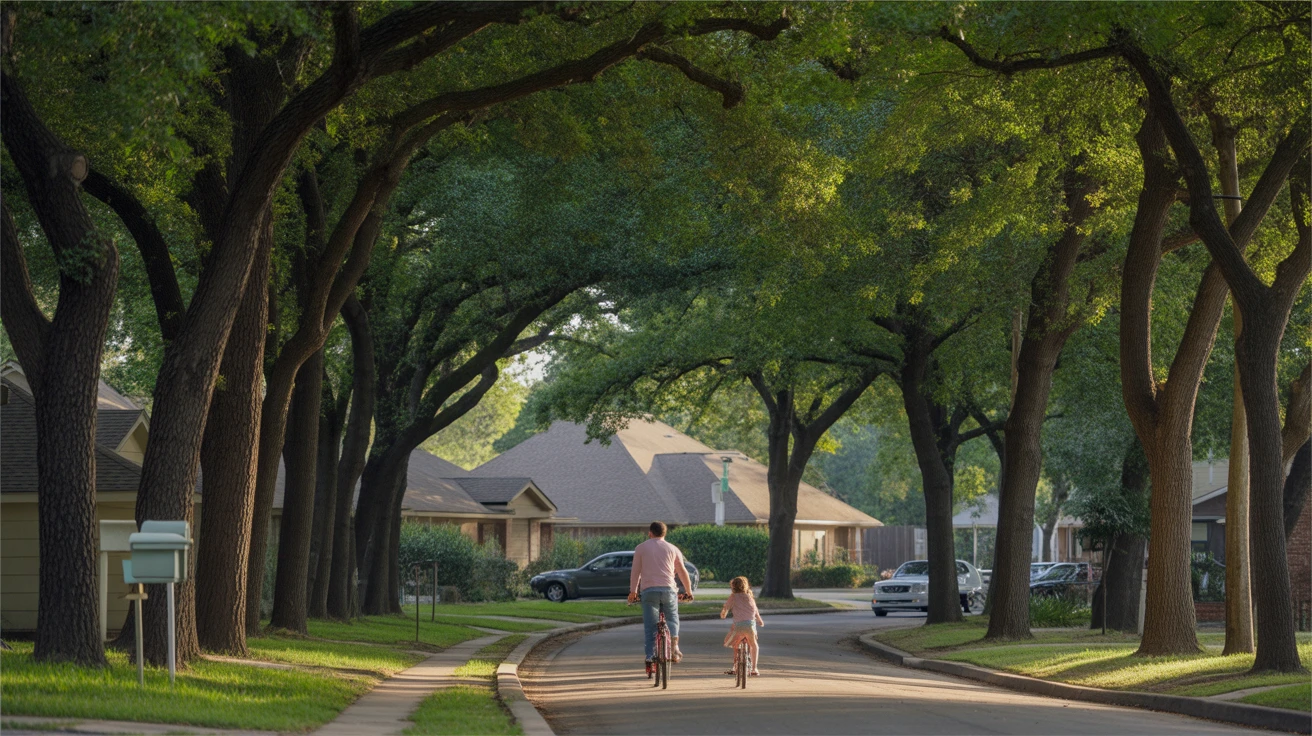
Carrollton: $327,300 median home, 24-minute commute, walkable pockets with rail transit. Garland: $229,000 median home, 29-minute commute, 55.8% long-commute exposure. Same metro, same utility rates, radically different cost structures.
Both cities sit in the Dallas metro, share the same regional price environment, and draw from overlapping job markets. Yet the decision between them hinges less on total affordability and more on which cost pressures a household can absorb—and which ones create friction in daily life. For families prioritizing space and entry price, Garland offers a lower threshold. For households valuing shorter commutes, transit access, and where money goes in day-to-day errands without constant car dependence, Carrollton’s infrastructure delivers measurable convenience at a higher upfront cost.
This comparison explains how housing, transportation, utilities, groceries, and taxes behave differently in each city in 2026—not to declare a winner, but to clarify which households feel cost pressure where, and why the same income can feel stable in one place and tight in another.
Housing Costs
Carrollton’s median home value of $327,300 and median gross rent of $1,555 per month reflect a market where housing entry costs run substantially higher than Garland’s $229,000 median home value and $1,421 per month median rent. The difference isn’t marginal—it’s structural. Carrollton’s housing stock skews toward neighborhoods with established infrastructure, proximity to rail transit, and walkable access to grocery and food establishments. Garland’s lower entry threshold reflects a different tradeoff: more single-family home availability at accessible price points, but with greater reliance on car-based access and longer average commutes.
For renters, the $134 monthly gap between median rents may seem modest, but it compounds over lease cycles and interacts with transportation costs. Carrollton renters gain proximity to transit and denser errands infrastructure, which can reduce car dependence and associated costs. Garland renters face lower baseline rent but higher exposure to commute time and fuel consumption, particularly given that 55.8% of workers experience long commutes compared to 36.5% in Carrollton. For buyers, the nearly $100,000 difference in median home values represents a fundamental choice: pay more upfront for location-driven convenience, or accept lower entry costs with higher ongoing time and transportation exposure.
Housing type matters significantly in both cities. Carrollton’s mixed land use and higher-density pockets support more apartment and townhome options near transit corridors, which appeal to singles, couples, and small families prioritizing walkability and shorter commutes. Garland’s housing market leans more heavily toward single-family detached homes, which offer more space per dollar but require car ownership and longer travel times for most daily needs. Families seeking yard space and larger floor plans find Garland’s housing structure more accommodating; those prioritizing time savings and reduced transportation friction find Carrollton’s higher housing costs offset by lower logistical burden.
| Housing Type | Carrollton | Garland |
|---|---|---|
| Median Home Value | $327,300 | $229,000 |
| Median Gross Rent | $1,555/month | $1,421/month |
| Primary Housing Form | Mixed (apartments, townhomes, single-family) | Single-family dominant |
| Transit Proximity | Rail present, walkable pockets | Limited transit infrastructure |
Housing takeaway: Carrollton imposes higher entry costs but delivers infrastructure that reduces ongoing transportation and time burdens. Garland offers lower housing thresholds but shifts cost pressure toward commute exposure and car dependence. First-time buyers with limited down payment capacity may find Garland more accessible; dual-income households prioritizing commute efficiency and walkability will find Carrollton’s premium justified by reduced friction in daily logistics.
Utilities and Energy Costs
Both cities share identical utility rate structures: 16.11¢/kWh for electricity and $30.71/MCF for natural gas. This reflects their position within the same regional energy market and infrastructure grid. The cost difference, therefore, isn’t driven by rates—it’s driven by housing stock, home size, and cooling exposure. North Texas summers generate extended cooling seasons with triple-digit heat, making air conditioning the dominant utility cost driver for most households. Heating needs remain modest, with only occasional cold snaps requiring natural gas usage.
Carrollton’s housing mix includes more apartments and townhomes, which typically exhibit lower cooling exposure due to shared walls and smaller square footage. Single-family homes in Carrollton’s walkable pockets often feature newer construction with better insulation and energy-efficient HVAC systems, reducing baseline electricity consumption. Garland’s housing stock skews older and larger on average, with more single-family detached homes that expose households to higher cooling costs during summer months. Older homes in Garland may lack modern insulation standards, increasing both electricity usage and volatility during peak heat periods.
Household size and home type interact significantly with utility exposure. A single adult or couple in a Carrollton apartment may experience predictable, moderate electricity bills year-round. A family of four in a larger Garland single-family home faces higher baseline usage and greater seasonal swings, particularly if the home was built before recent energy efficiency standards took effect. Renters in both cities typically pay electricity separately, but water and trash may be bundled differently depending on landlord arrangements. Homeowners in both cities manage all utilities directly, with Garland homeowners more likely to encounter higher cooling costs due to larger home footprints and older construction.
Utility takeaway: Utility rates don’t differ, but housing form and age create divergent cost experiences. Carrollton households in newer, smaller, or shared-wall housing enjoy more predictable utility costs. Garland households in older, larger single-family homes face higher cooling exposure and greater seasonal volatility. Families planning to stay long-term in Garland should factor in potential insulation upgrades or HVAC replacement as ongoing cost risks; Carrollton renters and buyers in newer stock face fewer surprises.
Groceries and Daily Expenses
Carrollton exhibits high food and grocery establishment density, with both metrics exceeding high thresholds according to experiential signals derived from geographic patterns. This means households can access multiple grocery options, prepared food outlets, and convenience stores without long drives, reducing both time cost and the temptation to rely on expensive last-minute purchases. The presence of walkable pockets and mixed land use supports errand consolidation—picking up groceries, grabbing takeout, and handling household needs in a single trip or even on foot.
Garland’s grocery and daily expense landscape is less documented in the available data, but the structural differences in commute patterns and car dependence suggest a different experience. Households in Garland likely rely more heavily on big-box stores and planned grocery runs, as the lower density of food establishments and greater car orientation make spontaneous errands less convenient. This can reduce impulse spending on prepared foods but increases the logistical burden of planning and batching trips, particularly for working parents or dual-income couples managing tight schedules.
Price sensitivity varies by household type and shopping strategy. Single adults and couples in Carrollton benefit from proximity to diverse grocery options, including discount chains, ethnic markets, and specialty stores, which allows price comparison and flexibility. Families managing larger grocery volumes may find Garland’s big-box access more efficient for bulk purchasing, though the time cost of driving to consolidated shopping areas offsets some savings. Convenience spending—coffee shops, quick meals, household goods—runs higher in Carrollton due to accessibility, but this also reflects a tradeoff: paying slightly more per item in exchange for reduced time and transportation friction.
Groceries takeaway: Carrollton’s high grocery and food density reduces logistical friction but may increase convenience spending for households prone to frequent small purchases. Garland’s structure favors planned, consolidated shopping trips, which can lower per-item costs but requires more time and car dependence. Single adults and couples prioritizing walkability and errands flexibility will find Carrollton’s accessibility worth the potential premium; families with predictable routines and bulk shopping habits may prefer Garland’s big-box orientation.
Taxes and Fees
Property taxes in both cities reflect Texas’s reliance on property tax revenue to fund schools, infrastructure, and municipal services, as the state imposes no income tax. While specific tax rates aren’t provided in the data, the structural difference in median home values creates divergent property tax exposure. Carrollton homeowners pay taxes on a base of $327,300, while Garland homeowners pay on $229,000. Even at identical millage rates, Carrollton’s higher assessed values translate to higher annual property tax bills—a predictable, ongoing cost that doesn’t fluctuate month-to-month but compounds over years of ownership.
Sales taxes apply uniformly across the Dallas metro, so neither city holds an advantage in consumption tax burden. However, the interaction between housing costs and property taxes creates different long-term exposure profiles. Carrollton homeowners face higher upfront costs and higher ongoing tax obligations, but they also benefit from infrastructure investments—rail transit, walkable corridors, parks—that those taxes help fund. Garland homeowners enjoy lower property tax bills in absolute terms, but they may face higher transportation costs and time burdens that offset the tax savings.
Fees and assessments vary by neighborhood and housing type. Homeowners associations (HOAs) are common in both cities, particularly in newer subdivisions. Carrollton’s mixed-use developments and townhome communities may include HOA fees that bundle landscaping, shared amenities, and exterior maintenance, adding predictability but also fixed monthly costs. Garland’s single-family neighborhoods may have lower or no HOA fees, giving homeowners more control but also more responsibility for upkeep and repairs. Renters in both cities typically avoid direct property tax and HOA exposure, though these costs are embedded in rent levels.
Taxes and fees takeaway: Carrollton’s higher home values generate higher property tax bills, which fund infrastructure that reduces transportation and time costs. Garland’s lower tax base results in lower annual tax obligations but shifts cost pressure toward car dependence and commute exposure. Long-term homeowners in Carrollton pay more in taxes but gain location-driven convenience; Garland homeowners save on taxes but absorb higher transportation and time costs. Renters feel these differences indirectly through rent levels, with Carrollton’s higher rents reflecting both property taxes and infrastructure access.
Transportation & Commute Reality
Carrollton’s 24-minute average commute and 36.5% long-commute exposure reflect a city where rail transit, walkable pockets, and proximity to employment centers reduce travel time for a significant share of workers. Rail service is present, and the pedestrian-to-road ratio exceeds high thresholds in parts of the city, meaning some households can manage daily errands and even commute segments without a car. Only 3.1% of workers report working from home, suggesting most residents commute, but the infrastructure supports shorter, more predictable trips.
Garland’s 29-minute average commute and 55.8% long-commute exposure tell a different story. More than half of workers face extended travel times, and the 7.4% work-from-home rate—more than double Carrollton’s—suggests that remote work serves as a partial mitigation strategy for households managing long commutes. The lack of rail transit and lower walkability mean nearly all trips require a car, increasing both fuel costs and time exposure. Gas prices are identical at $2.42/gal, so the cost difference comes from distance and frequency, not price per gallon.
For single adults and couples, Carrollton’s shorter commutes and transit access reduce daily friction and create flexibility for car-free or one-car households. Garland’s longer commutes and car dependence make two-car ownership nearly essential for dual-income couples, adding insurance, maintenance, and depreciation costs beyond fuel. Families with school-age children face similar tradeoffs: Carrollton’s walkable pockets and transit options support more independent mobility for teens, while Garland’s car-oriented layout requires more parental driving for school, activities, and errands.
Transportation takeaway: Carrollton’s infrastructure supports shorter commutes and reduced car dependence, lowering both time and transportation costs for households that value convenience. Garland’s longer commutes and higher car reliance increase time exposure and require two-car ownership for most dual-income households. Remote workers and families with flexible schedules may find Garland’s lower housing costs offset commute friction; daily commuters and single-car households will find Carrollton’s transit access and walkability worth the housing premium.
Cost Structure Comparison
Housing dominates the cost experience in Carrollton, with median home values and rents running substantially higher than Garland. This upfront and ongoing housing pressure is the price of infrastructure: rail transit, walkable errands access, shorter commutes, and integrated green space. Households that absorb the housing premium gain measurable reductions in transportation time, car dependence, and daily logistical friction. Garland’s lower housing entry costs shift pressure toward transportation and time exposure, with longer commutes, higher car reliance, and greater need for planned, consolidated errands trips.
Utilities introduce similar exposure in both cities due to identical rate structures, but housing form creates divergent experiences. Carrollton’s newer, smaller, and shared-wall housing stock reduces cooling costs and volatility. Garland’s older, larger single-family homes increase seasonal utility swings and baseline usage. Families in Garland managing larger homes should expect higher summer electricity bills and potential HVAC upgrade costs; Carrollton households in apartments or newer construction face more predictable utility expenses.
Daily living and groceries reflect Carrollton’s high food and grocery density, which reduces time cost and supports flexible shopping habits but may increase convenience spending. Garland’s structure favors big-box shopping and planned trips, which can lower per-item costs but requires more time and car use. Single adults and couples benefit most from Carrollton’s errands accessibility; families managing bulk purchases may find Garland’s layout more efficient despite the time investment.
Transportation patterns matter more in Garland, where 55.8% of workers face long commutes and car dependence is near-universal. Carrollton’s rail transit, walkable pockets, and shorter average commute reduce both time and fuel costs, making one-car or car-free living viable for some households. The decision isn’t about which city is cheaper—it’s about which cost structure aligns with a household’s priorities, schedule, and tolerance for time versus money tradeoffs.
Households sensitive to housing entry costs may prefer Garland’s lower thresholds, accepting longer commutes and higher car dependence as manageable tradeoffs. Households sensitive to time, commute friction, and daily logistics complexity will find Carrollton’s higher housing costs offset by reduced transportation burden and greater infrastructure convenience. For remote workers and families with flexible schedules, Garland’s lower housing costs and higher work-from-home prevalence create a viable path. For daily commuters and households prioritizing walkability and transit access, Carrollton’s premium delivers measurable quality-of-life returns.
How the Same Income Feels in Carrollton vs Garland
Single Adult
In Carrollton, housing becomes the non-negotiable cost, with rent absorbing a larger share of gross monthly income. Flexibility exists in transportation, as rail transit and walkable errands access reduce car dependence and associated costs. The time cost is lower—shorter commutes and consolidated errands leave more discretionary hours for work, socializing, or rest. In Garland, housing costs less upfront, creating more breathing room in the budget. Flexibility disappears in transportation, as car ownership, fuel, and longer commute times become fixed burdens. The tradeoff is front-loaded savings on rent versus ongoing exposure to time and transportation friction.
Dual-Income Couple
In Carrollton, housing pressure intensifies for couples seeking more space, but shorter commutes for both partners reduce cumulative time lost to travel. One-car households remain viable if both partners work near transit or within walkable distance. Predictability is higher—less time spent driving means more control over schedules and errands. In Garland, lower housing costs free up income for other priorities, but two-car ownership becomes essential for most couples. Long commutes for one or both partners create scheduling friction and reduce flexibility for errands, childcare, or social commitments. The same gross income feels tighter in Garland when time scarcity compounds financial pressure.
Family with Kids
In Carrollton, housing and school proximity become the primary non-negotiables, with families paying more for access to walkable neighborhoods and shorter commutes. Flexibility exists in transportation for older children, as transit and pedestrian infrastructure support independent mobility. The time cost is distributed—parents spend less time driving to work and errands, freeing hours for family logistics. In Garland, housing costs less, allowing families to afford larger homes and yard space. Flexibility disappears in transportation, as parents manage more driving for school, activities, and errands. The ongoing cost is time—longer commutes and car-dependent errands create logistical complexity that compounds as children’s schedules grow more demanding.
Decision Matrix: Which City Fits Which Household?
| Decision Factor | If You’re Sensitive to This… | Carrollton Tends to Fit When… | Garland Tends to Fit When… |
|---|---|---|---|
| Housing entry + space needs | Down payment limits, upfront costs, or need for yard space | You prioritize location and infrastructure over square footage and can absorb higher entry costs | You need lower entry thresholds and more space per dollar, accepting car dependence as a tradeoff |
| Transportation dependence + commute friction | Time lost to commuting, car ownership costs, or transit access | You value shorter commutes, rail access, and reduced car dependence enough to pay more for housing | You work remotely or have flexible schedules that reduce commute exposure and can manage longer trips when needed |
| Utility variability + home size exposure | Seasonal bill swings, cooling costs, or older home inefficiency | You prefer newer or smaller housing with predictable utility costs and lower cooling exposure | You can manage higher summer bills and potential HVAC upgrades in exchange for larger home footprints |
| Grocery strategy + convenience spending creep | Time spent on errands, impulse purchases, or access to diverse food options | You value walkable errands access and grocery flexibility, even if convenience spending runs slightly higher | You prefer planned, consolidated shopping trips and big-box efficiency, accepting longer drive times as routine |
| Fees + friction costs (HOA, services, upkeep) | Predictable monthly obligations versus variable maintenance responsibility | You accept higher property taxes and potential HOA fees in exchange for infrastructure and bundled services | You prefer lower property tax exposure and more control over maintenance, managing upkeep independently |
| Time budget (schedule flexibility, errands, logistics) | Cumulative hours lost to commuting, errands, and household logistics | You prioritize time savings and reduced daily friction, valuing infrastructure that consolidates errands and shortens commutes | You have schedule flexibility or remote work options that reduce time pressure and can batch errands efficiently |
Lifestyle Fit
Carrollton’s walkable pockets, rail transit, and integrated green space create a lifestyle where daily errands, commuting, and outdoor access require less planning and less driving. Park density exceeds high thresholds, and water features add recreational variety. The pedestrian-to-road ratio supports walking for some trips, and mixed land use means residential and commercial areas overlap, reducing the need to drive across town for groceries, dining, or services. Families with school-age children benefit from moderate playground density, though school density falls below thresholds, suggesting some families may need to drive to preferred schools. Healthcare access is strong, with hospital presence and pharmacies available locally.
Garland’s lifestyle centers more heavily on car-based access and planned trips. The 29-minute average commute and 55.8% long-commute exposure mean many residents spend significant time in transit, which can limit discretionary hours for recreation, socializing, or family activities. The higher work-from-home rate of 7.4% suggests some households have adapted by reducing commute frequency, but for daily commuters, the time cost is substantial. Outdoor and recreational amenities aren’t documented in the available data, but the lower density and car orientation suggest parks and green space require intentional trips rather than walkable access.
Both cities experience North Texas heat, with extended cooling seasons and occasional winter cold snaps. Carrollton’s denser, more walkable areas may feel more oppressive in summer heat for pedestrians, while Garland’s car-dependent layout means most residents move between air-conditioned spaces. Cultural and recreational differences reflect infrastructure: Carrollton’s mixed land use and transit access support spontaneous outings, while Garland’s layout favors planned activities and weekend trips. Families prioritizing independent mobility for teens, walkable errands, and shorter commutes will find Carrollton’s lifestyle more accommodating. Families valuing yard space, lower housing costs, and tolerance for longer commutes will find Garland’s structure more aligned with their priorities.
Carrollton quick facts: Rail transit present, walkable pockets with high pedestrian-to-road ratio, park density exceeds high thresholds, hospital and pharmacies available locally.
Garland quick facts: 55.8% of workers face long commutes, 7.4% work from home (more than double Carrollton’s rate), lower housing entry costs support larger single-family homes.
Common Questions About Carrollton vs Garland in 2026
Is Carrollton or Garland more affordable for renters in 2026? Garland’s median gross rent of $1,421 per month runs lower than Carrollton’s $1,555, reducing baseline housing costs for renters. However, Garland’s longer average commute and higher car dependence mean renters may spend more on transportation and time. Carrollton renters pay more upfront but gain access to rail transit, walkable errands, and shorter commutes, which can reduce car ownership costs and time lost to travel. The better choice depends on whether a household prioritizes lower rent or reduced transportation friction.
Which city has lower housing costs for first-time homebuyers in 2026? Garland’s median home value of $229,000 creates a substantially lower entry barrier than Carrollton’s $327,300, making down payments and mortgage qualification more accessible for first-time buyers. Buyers in Garland gain more space per dollar and lower property tax exposure, but they absorb higher commute times and car dependence. Carrollton buyers pay nearly $100,000 more for median homes but gain infrastructure—rail transit, walkable neighborhoods, shorter commutes—that reduces ongoing transportation and time costs. Buyers with limited down payment capacity may find Garland more accessible; those prioritizing location and convenience may find Carrollton’s premium justified.
How do commute times differ between Carrollton and Garland in 2026? Carrollton’s average commute of 24 minutes and 36.5% long-commute exposure reflect shorter, more predictable travel times supported by rail transit and proximity to employment centers. Garland’s 29-minute average commute and 55.8% long-commute exposure mean more than half of workers face extended travel times, with car dependence nearly universal. The five-minute difference in average commute time compounds over weeks and months, creating measurable time cost differences. Households prioritizing shorter commutes and reduced time exposure will find Carrollton’s infrastructure advantageous; remote workers and those with flexible schedules may find Garland’s longer commutes manageable.
Do Carrollton and Garland have the same utility costs in 2026? Both cities share identical electricity rates of 16.11¢/kWh and natural gas prices of $30.71/MCF, as they draw from the same regional energy infrastructure. The difference in utility costs comes from housing form and home size, not rates. Carrollton’s newer, smaller, and shared-wall housing stock reduces cooling exposure and creates more predictable bills. Garland’s older, larger single-family homes increase summer electricity usage and seasonal volatility. Families in Garland managing larger homes should expect higher cooling costs; Carrollton households in apartments or newer construction face lower baseline usage and fewer surprises.
Which city is better for families with kids in 2026, Carrollton or Garland? Families prioritizing walkability, shorter commutes, and independent mobility for older children will find Carrollton’s infrastructure more supportive, despite higher housing costs. Carrollton offers rail transit, walkable pockets, and integrated green space, reducing the need for parents to drive constantly. Families valuing larger homes, yard space, and lower entry costs will find Garland’s housing market more accommodating, though they’ll manage longer commutes and higher car dependence. School density in Carrollton falls below thresholds, suggesting some families may need to drive to preferred schools in both cities. The decision hinges on whether a family prioritizes space and affordability or location and reduced logistical friction.
Conclusion
Carrollton and Garland present fundamentally different cost structures, not because one is universally cheaper, but because they distribute financial and time pressure differently. Carrollton imposes higher housing entry costs and ongoing rent or mortgage obligations, but it delivers infrastructure that reduces transportation time, supports walkable errands, and provides rail transit access. Garland offers lower housing thresholds and more space per dollar, but it shifts cost pressure toward longer commutes, higher car dependence, and greater logistical complexity in daily life. Both cities share identical utility rates and regional price environments, so the meaningful differences emerge in monthly budget allocation and household logistics.
The better choice depends entirely on which costs a household can absorb and which tradeoffs align with their priorities. First-time buyers with limited down payment capacity, families seeking yard space, and remote workers with flexible schedules will find Garland’s lower housing costs and larger homes compelling, even with longer commutes and higher car reliance. Daily commuters, single adults or couples prioritizing walkability, and families valuing time savings over square footage will find Carrollton’s higher housing costs justified by reduced transportation friction and infrastructure convenience. Neither city wins on all dimensions—each fits different households at different life stages, and the decision requires honest assessment of income, schedule flexibility, and tolerance for time versus money tradeoffs in 2026.
How this article was built: In addition to public economic data, this article incorporates location-based experiential signals derived from anonymized geographic patterns—such as access density, walkability, and land-use mix—to reflect how day-to-day living actually feels in Carrollton, TX.