
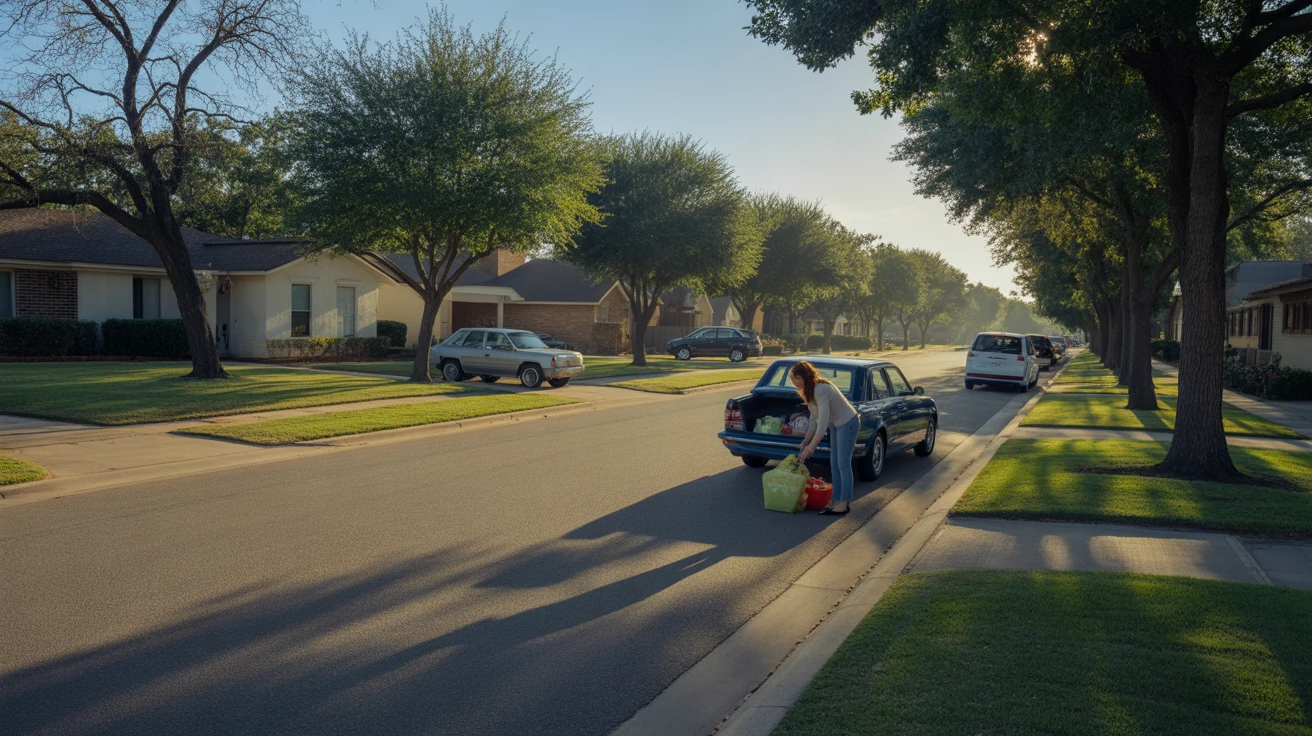
Allen vs Plano in 2026: Allen shows a median home value of $390,200 and median gross rent of $1,747 per month, while Plano’s median home value reaches $412,500 with median gross rent at $1,699 per month. Allen’s median household income stands at $121,259 per year compared to Plano’s $105,679 per year. Both cities share the same utility rates, gas prices, and 30-minute average commute times, but Allen reports 7.7% of workers operating from home versus Plano’s 5.9%.
People compare these two Dallas-area suburbs because both offer established neighborhoods, strong employment access, and similar regional cost pressures—but the structure of how costs show up differs in ways that matter for specific households. Allen presents a lower barrier to homeownership entry alongside higher rental costs, while Plano reverses that pattern. Beyond housing numbers, Allen’s infrastructure reveals walkable pockets, notable cycling paths, broadly accessible grocery and food options, and integrated park systems—features that reduce car dependency for errands and daily logistics in certain neighborhoods. Plano lacks comparable infrastructure data, making direct lifestyle comparisons harder to draw.
The decision between Allen and Plano in 2026 isn’t about which city costs less overall. It’s about where cost pressure concentrates for your household type, how much flexibility you have in housing and transportation, and whether the infrastructure that shapes daily routines aligns with how you actually live. This article breaks down housing, utilities, groceries, transportation, taxes, and lifestyle fit to explain which structural differences matter most—and for whom.
Housing Costs in Allen vs Plano
Allen’s median home value of $390,200 creates a lower entry threshold for buyers compared to Plano’s $412,500, a difference that affects down payment requirements, mortgage qualification, and the speed at which households can transition from renting to owning. For first-time buyers or households stretching to enter the market, that gap represents months of additional saving or a different loan structure. Allen’s median gross rent of $1,747 per month runs higher than Plano’s $1,699 per month, a reversal that shifts pressure toward renters in Allen while homeownership becomes more accessible.
This split creates distinct cost profiles depending on tenure. Renters in Allen face slightly higher monthly obligations but benefit from neighborhoods where walkable pockets and broadly accessible errands reduce the need for a second car or constant driving—a structural advantage that doesn’t show up in rent alone but affects household logistics and transportation spending. Plano’s lower rent offers immediate monthly relief, but without comparable infrastructure data, it’s harder to assess whether that savings translates into lower overall friction or simply shifts costs elsewhere. Homebuyers in Allen enter at a lower price point, which matters for households prioritizing equity accumulation or long-term stability over monthly cash flow flexibility.
Housing stock in both cities skews toward single-family homes, but Allen’s mixed building height profile and presence of both residential and commercial land use suggest more variation in housing form—townhomes, smaller-lot homes, and denser pockets that can offer entry points below the median. Plano’s housing market remains less defined in the available data, though its higher home values suggest concentration in larger single-family properties or neighborhoods with fewer compact alternatives. For families seeking space, both cities deliver; for singles or couples prioritizing walkability and lower car dependence, Allen’s infrastructure makes that trade more viable without sacrificing access to daily needs.
| Housing Type | Allen | Plano |
|---|---|---|
| Median Home Value | $390,200 | $412,500 |
| Median Gross Rent | $1,747/month | $1,699/month |
| Entry Barrier | Lower for buyers | Lower for renters |
| Housing Form Variety | Mixed height, land use present | Data limited |
Housing takeaway: Renters face slightly higher monthly costs in Allen but gain access to neighborhoods where errands, parks, and some daily trips don’t require driving—reducing transportation friction and time costs. Buyers in Allen enter the market at a lower price point, which matters for households prioritizing ownership timelines or equity growth. Plano’s lower rent benefits households prioritizing immediate monthly flexibility, while its higher home values create a steeper entry barrier for ownership. Households sensitive to housing entry costs and long-term equity may prefer Allen; those prioritizing rental affordability and willing to navigate higher purchase thresholds may find Plano’s structure more aligned with their near-term budget.
Utilities and Energy Costs
Both Allen and Plano share identical electricity rates at 16.11¢/kWh and natural gas prices at $30.71/MCF, eliminating any rate-based cost advantage between the cities. What differs is how housing stock, building age, and household routines interact with those rates to produce actual monthly exposure. Allen’s mixed building height profile and presence of newer construction in some pockets suggest variation in insulation quality and HVAC efficiency—older single-family homes with larger square footage will drive higher cooling costs during extended Texas summers, while newer townhomes or smaller-footprint properties reduce baseline usage.
Plano’s housing data remains less granular, but its higher median home value often correlates with larger homes, which increases cooling and heating surface area and extends seasonal utility volatility. Households in larger homes—regardless of city—face higher summer cooling exposure due to Texas heat, with air conditioning dominating monthly bills from May through September. Winter heating needs remain modest in both cities, with natural gas usage spiking only during occasional cold snaps rather than sustained heating seasons. This seasonal pattern creates predictable high-cost months but limits year-round volatility compared to climates with severe winters.
Households in Allen benefit from infrastructure that reduces driving frequency for errands and daily trips, which indirectly lowers gasoline consumption and shifts more of the transportation budget toward predictable costs rather than variable mileage. That structural advantage doesn’t change utility rates but does affect how much flexibility remains in the household budget after housing and transportation obligations are met. In Plano, without comparable infrastructure data, it’s harder to assess whether households experience similar friction relief or whether car dependency increases baseline transportation costs enough to tighten discretionary spending—including the ability to absorb utility spikes during peak cooling months.
Utility takeaway: Households in older or larger homes in either city will experience higher cooling exposure during summer months, with Allen’s mixed housing stock offering more variation in baseline usage depending on property type. Plano’s higher home values suggest larger average square footage, which increases seasonal utility volatility. Families with multiple occupants and high daytime occupancy face the most exposure in both cities, while singles or couples in smaller, newer homes maintain more predictable bills. The primary difference isn’t rates—it’s how housing form and daily logistics interact with energy consumption to create more or less flexibility when bills spike.
Groceries and Daily Expenses
Both Allen and Plano share a regional price parity index of 103, meaning grocery staples and everyday goods cost roughly the same at checkout in both cities. What differs is how access structure and household routines shape spending patterns. Allen’s infrastructure shows high food establishment density and high grocery density, with both metrics exceeding thresholds that indicate broadly accessible options throughout the city. This means households can reach multiple grocery stores, discount chains, and specialty markets without long drives, reducing the friction that often leads to convenience spending—grabbing takeout or overpaying at the nearest option because planning a grocery trip feels like a separate errand.
Plano lacks comparable infrastructure data, so it’s unclear whether grocery access follows a similar pattern or concentrates along specific corridors, requiring more intentional trip planning. In cities where grocery options cluster rather than distribute broadly, households often default to the closest store regardless of price competitiveness, or they batch errands into longer weekend trips that increase the temptation to add convenience purchases—prepared foods, coffee stops, or dining out—to justify the drive. Allen’s structure reduces that friction, making it easier to shop frequently, compare prices across stores, and avoid the convenience-spending creep that inflates grocery budgets without adding value.
For single adults, grocery costs remain manageable in both cities as long as routines favor cooking over takeout, but Allen’s walkable pockets and accessible errands make it easier to pick up fresh items on foot or by bike without dedicating time to a full shopping trip. Couples experience similar benefits, with the added advantage that splitting meal planning and errands becomes less burdensome when stores sit within short distances. Families managing larger grocery volumes feel the difference most acutely—Allen’s broadly accessible food and grocery infrastructure means fewer trips where “we’re already out” turns into unplanned restaurant meals or impulse buys, while Plano’s structure (undefined in available data) may require more discipline to avoid convenience-driven budget drift.
Grocery takeaway: Households sensitive to convenience spending and routine friction will find Allen’s broadly accessible grocery and food infrastructure reduces the small, repeated costs that inflate monthly budgets—fewer emergency takeout meals, fewer trips to overpriced corner stores, and more flexibility to shop by price rather than proximity. Plano’s grocery structure remains unclear from available data, but households willing to plan trips intentionally and resist convenience drift can manage similar costs. Families with kids and tight schedules benefit most from Allen’s access density, while singles or couples with flexible routines can navigate either city without significant cost pressure differences.
Taxes and Fees
Both Allen and Plano sit within the same regional tax environment, sharing exposure to Texas property taxes, which fund local schools, infrastructure, and services without a state income tax to offset the burden. Property tax rates in Texas suburbs typically range between 2% and 2.5% of assessed home value annually, meaning homeowners in both cities face substantial recurring obligations that scale with home prices. Allen’s lower median home value of $390,200 translates to a lower baseline property tax bill compared to Plano’s $412,500 median, though actual rates depend on specific school districts, municipal utility districts, and county apportionment.
For homeowners, this difference compounds over time. A household in Allen pays property taxes on a lower assessed value, which reduces annual obligations and frees up cash flow for maintenance, utilities, or discretionary spending. A household in Plano faces higher annual property tax bills due to the higher home value, which increases the total cost of ownership beyond the mortgage payment itself. Renters in both cities remain insulated from direct property tax exposure, but landlords pass those costs through in rent pricing—Plano’s lower median rent of $1,699 per month may reflect competitive rental supply, while Allen’s higher rent of $1,747 per month could incorporate property tax passthrough alongside demand for neighborhoods with better infrastructure access.
Beyond property taxes, both cities likely impose standard fees for trash collection, water, and sewer services, though specific structures aren’t detailed in available data. HOA fees vary widely depending on neighborhood amenities—some communities bundle landscaping, pool access, and common area maintenance into monthly dues, while others keep fees minimal and leave upkeep to individual homeowners. Allen’s mixed land use and presence of denser housing forms suggest more variation in HOA structures, with some neighborhoods offering lower fees in exchange for fewer shared amenities. Plano’s higher home values often correlate with established subdivisions that include HOA-managed amenities, which can add predictability but also lock in recurring costs that don’t fluctuate with usage.
Tax and fee takeaway: Homeowners in Allen face lower baseline property tax exposure due to lower median home values, which reduces annual obligations and increases long-term cost predictability. Homeowners in Plano pay higher property taxes tied to higher home values, which increases the total cost of ownership and reduces flexibility for unexpected expenses. Renters in both cities experience indirect tax exposure through rent pricing, with Plano offering slightly lower monthly rent despite higher property values—suggesting competitive rental supply or different landlord cost structures. Households planning to stay long-term should weigh property tax scaling against home value appreciation potential, while short-term renters benefit more from Plano’s lower monthly rent unless Allen’s infrastructure advantages reduce transportation and convenience costs enough to offset the difference.
Transportation and Commute Reality
Both Allen and Plano report identical average commute times of 30 minutes, with 21.5% of workers in each city facing long commutes. Gas prices sit at $2.41/gal in both cities, eliminating any fuel cost advantage. What differs is how infrastructure and work patterns shape transportation pressure. Allen reports 7.7% of workers operating from home, compared to Plano’s 5.9%, a gap that suggests more flexibility in Allen for households to reduce commute frequency or eliminate it entirely on certain days. That flexibility doesn’t just cut fuel costs—it reduces wear on vehicles, lowers the risk of unexpected repair expenses, and frees up time that would otherwise go to sitting in traffic.
Allen’s experiential signals reveal walkable pockets with a high pedestrian-to-road ratio and notable bike infrastructure, meaning some neighborhoods support errands, coffee runs, and short trips without requiring a car. This doesn’t eliminate the need for vehicle ownership in a suburban context, but it reduces the frequency of short, inefficient trips that add up over the month—grabbing groceries, picking up prescriptions, or meeting friends at a nearby park. Households in these pockets can treat the car as a tool for longer trips rather than the default for every movement, which lowers mileage, extends vehicle lifespan, and reduces the baseline transportation budget.
Plano lacks comparable infrastructure data, so it’s unclear whether similar walkable pockets exist or whether car dependency remains uniform across the city. In suburbs where every trip requires driving, households face higher baseline transportation costs even when gas prices stay low—more frequent fill-ups, higher maintenance intervals, and less flexibility to defer vehicle replacement when budgets tighten. The 30-minute average commute in both cities suggests most workers travel to jobs in the broader Dallas metro, but Allen’s higher remote work rate and walkable infrastructure create more opportunities to reduce total vehicle miles traveled without sacrificing access to daily needs.
Transportation takeaway: Households in Allen benefit from higher remote work rates and walkable pockets that reduce car dependency for errands and short trips, lowering baseline transportation costs and increasing schedule flexibility. Plano’s transportation structure remains less defined, but identical commute times and slightly lower remote work rates suggest more uniform car reliance. Families with multiple drivers or tight schedules may find Allen’s infrastructure reduces the need for a second vehicle in some neighborhoods, while singles or couples in Plano should plan for consistent car dependency unless they live near specific corridors with better pedestrian access. The difference isn’t dramatic, but it shifts whether transportation feels like a fixed cost or a flexible one.
Where Cost Pressure Concentrates Differently
Housing dominates the cost experience in both cities, but the structure of that pressure differs. Allen’s lower median home value of $390,200 reduces the barrier to ownership entry, making it easier for first-time buyers or households prioritizing equity growth to transition from renting. Plano’s higher median home value of $412,500 delays that transition, requiring more savings or higher income to qualify for a mortgage. Renters face the opposite dynamic—Allen’s median gross rent of $1,747 per month runs higher than Plano’s $1,699 per month, shifting immediate monthly pressure toward renters in Allen while Plano offers near-term affordability for households not yet ready to buy.
Utilities introduce similar seasonal volatility in both cities due to identical electricity and natural gas rates, but housing stock differences affect baseline exposure. Allen’s mixed building height profile and presence of newer construction in some areas create variation in cooling costs, with smaller or more efficient homes reducing summer bills. Plano’s higher home values often correlate with larger square footage, which increases cooling surface area and extends peak-season utility exposure. Families in larger homes in either city face the highest volatility, while singles or couples in compact properties maintain more predictable bills year-round.
Transportation patterns matter more in Allen due to infrastructure that supports walkable errands and notable bike presence, reducing car dependency for short trips and lowering baseline vehicle costs. Plano’s transportation structure remains less defined, but identical commute times and slightly lower remote work rates suggest more uniform car reliance. Households in Allen can treat vehicle ownership as a tool for longer trips rather than the default for every movement, which reduces mileage, extends vehicle lifespan, and frees up budget flexibility. In Plano, without comparable infrastructure data, households should plan for consistent car dependency unless specific neighborhoods offer better pedestrian access.
Groceries and daily expenses cost roughly the same at checkout in both cities due to shared regional price parity, but Allen’s broadly accessible food and grocery infrastructure reduces convenience-spending creep—fewer emergency takeout meals, fewer trips to overpriced corner stores, and more flexibility to shop by price rather than proximity. Plano’s grocery structure remains unclear, but households willing to plan trips intentionally can manage similar costs. The difference shows up in how much discipline it takes to avoid small, repeated expenses that inflate monthly budgets without adding value.
The better choice depends on which costs dominate your household. Households sensitive to housing entry barriers and long-term equity growth may prefer Allen’s lower home values, while those prioritizing immediate rental affordability may find Plano’s lower rent more aligned with near-term budgets. Households that value walkable infrastructure, reduced car dependency, and broadly accessible errands will find Allen’s structure reduces friction and lowers transportation and convenience costs over time. Households willing to navigate higher home purchase thresholds and more uniform car reliance may find Plano’s cost structure manageable, especially if rental savings offset other expenses.
How the Same Income Feels in Allen vs Plano
Single Adult
Housing becomes the first non-negotiable cost, with Allen’s higher rent of $1,747 per month consuming more of gross monthly income compared to Plano’s $1,699 per month. Flexibility exists in transportation if living in one of Allen’s walkable pockets, where errands and short trips don’t always require driving—reducing fuel, maintenance, and the urgency of vehicle replacement. In Plano, car dependency remains more uniform, locking in baseline transportation costs that don’t fluctuate with effort or planning. Allen’s broadly accessible grocery and food infrastructure reduces convenience-spending drift, making it easier to cook at home without dedicating weekends to meal prep.
Dual-Income Couple
Housing pressure splits depending on tenure—buyers in Allen enter at a lower threshold, while renters face slightly higher monthly costs but gain access to neighborhoods where one partner might bike to work or run errands on foot. Plano’s lower rent offers immediate monthly relief, but higher home values delay ownership transitions unless both incomes remain stable and savings accumulate faster. Flexibility shows up in how much time and fuel go toward errands—Allen’s infrastructure reduces the need to batch trips or drive everywhere, while Plano’s structure (undefined in available data) may require more intentional planning to avoid convenience costs that creep into the budget without adding value.
Family with Kids
Housing dominates, with Allen’s lower home values making ownership more accessible and reducing annual property tax exposure compared to Plano’s higher home values. Utilities become less predictable in larger homes, with summer cooling costs spiking in both cities but hitting harder in Plano’s larger-square-footage properties. Transportation friction matters most for families juggling school, activities, and errands—Allen’s walkable pockets and broadly accessible grocery infrastructure reduce the frequency of trips where “we’re already out” turns into unplanned restaurant meals or impulse buys. Plano’s structure remains less defined, but families should plan for consistent car dependency and more discipline to avoid convenience-driven budget drift that compounds over time.
Decision Matrix: Which City Fits Which Household?
| Decision Factor | If You’re Sensitive to This… | Allen Tends to Fit When… | Plano Tends to Fit When… |
|---|---|---|---|
| Housing entry + space needs | Down payment timelines, equity growth, or monthly rent flexibility | You prioritize lower home purchase entry and can absorb slightly higher rent for infrastructure benefits | You need lower monthly rent now and can navigate higher home values later or indefinitely |
| Transportation dependence + commute friction | Vehicle costs, time spent driving, or ability to reduce car trips | You value walkable pockets and bike infrastructure that reduce short trips and support remote work flexibility | You accept uniform car dependency and prioritize proximity to specific job centers over daily trip reduction |
| Utility variability + home size exposure | Seasonal bill spikes, cooling costs, or predictability in monthly obligations | You choose smaller or newer homes that reduce baseline cooling exposure and increase year-round predictability | You accept higher cooling costs in larger homes and can absorb seasonal volatility without budget strain |
| Grocery strategy + convenience spending creep | Meal planning discipline, takeout frequency, or impulse purchase control | You benefit from broadly accessible grocery options that reduce friction and make price comparison effortless | You plan trips intentionally and resist convenience drift regardless of access density or store proximity |
| Fees + friction costs (HOA, services, upkeep) | Recurring obligations, property tax scaling, or long-term cost predictability | You prefer lower property tax exposure tied to lower home values and accept variation in HOA structures | You accept higher property taxes tied to higher home values and prefer established neighborhoods with bundled amenities |
| Time budget (schedule flexibility, errands, logistics) | How much time goes to driving, trip planning, or managing household logistics | You value infrastructure that reduces trip frequency and supports remote work or flexible schedules | You tolerate more driving and trip batching in exchange for lower rent or specific neighborhood preferences |
Lifestyle Fit: What Daily Life Feels Like
Allen’s infrastructure reveals walkable pockets with notable bike presence and broadly accessible errands, meaning households in certain neighborhoods can run daily errands, grab coffee, or reach parks without defaulting to the car for every trip. Integrated green space access—with park density exceeding high thresholds—creates more opportunities for outdoor recreation, dog walking, and casual exercise without driving to trailheads or regional parks. A hospital is present alongside pharmacies, reducing travel time for routine healthcare and urgent needs. The mixed building height profile and presence of both residential and commercial land use suggest variation in housing form, with townhomes, smaller-lot homes, and denser pockets offering alternatives to large single-family properties.
Plano’s lifestyle structure remains less defined in available data, though its higher median home value of $412,500 and established reputation suggest concentration in larger single-family neighborhoods with mature landscaping and subdivision amenities. Without comparable infrastructure signals, it’s harder to assess walkability, errands accessibility, or park integration—households should verify specific neighborhoods rather than assume uniform access. Both cities share a 30-minute average commute, indicating strong employment connectivity to the broader Dallas metro, but Allen’s higher remote work rate of 7.7% (versus Plano’s 5.9%) suggests more flexibility to reduce commute frequency or eliminate it on certain days.
For families, Allen’s integrated parks and accessible errands reduce the logistical burden of managing kids’ activities and daily routines, though limited family infrastructure—with school and playground density below thresholds—means households should verify proximity to specific schools and recreational facilities rather than assume walkable access. Plano’s higher home values often correlate with established school districts and neighborhood amenities, though without infrastructure data, it’s unclear whether those benefits come with walkable access or require driving. Singles and couples in Allen benefit most from walkable pockets and bike infrastructure, which reduce car dependency and support active lifestyles without requiring gym memberships or dedicated workout time. Plano’s lifestyle fit depends more on specific neighborhood selection, with less data to guide expectations around daily movement patterns.
Quick fact: Allen’s pedestrian-to-road ratio exceeds high thresholds in certain pockets, meaning sidewalks, crosswalks, and pedestrian paths are dense enough to support walking as a practical transportation mode—not just recreation.
Quick fact: Allen’s food and grocery establishment density both exceed high thresholds, indicating multiple options within short distances rather than reliance on a single anchor store or distant shopping corridor.
How this article was built: In addition to public economic data, this article incorporates location-based experiential signals derived from anonymized geographic patterns—such as access density, walkability, and land-use mix—to reflect how day-to-day living actually feels in Allen, TX.
Common Questions About Allen vs Plano in 2026
Is it cheaper to rent in Allen or Plano in 2026? Plano’s median gross rent of $1,699 per month runs slightly lower than Allen’s $1,747 per month, offering near-term affordability for renters. Allen’s higher rent comes with infrastructure benefits—walkable pockets, broadly accessible errands, and integrated parks—that reduce car dependency and convenience spending for households in certain neighborhoods. The better choice depends on whether you prioritize immediate monthly savings or infrastructure that lowers transportation and friction costs over time.
Which city has lower home prices, Allen or Plano? Allen’s median home value of $390,200 sits below Plano’s $412,500, creating a lower barrier to ownership entry and reducing down payment requirements, mortgage qualification thresholds, and annual property tax exposure. Buyers in Allen can transition from renting to owning sooner, while Plano’s higher home values delay that transition unless income or savings grow faster. The difference matters most for first-time buyers or households prioritizing equity growth over monthly rent flexibility.
How do transportation costs compare between Allen and Plano in 2026? Both cities share identical gas prices at $2.41/gal and average commute times of 30 minutes, but Allen’s walkable pockets and notable bike infrastructure reduce car dependency for errands and short trips—lowering baseline vehicle costs, extending vehicle lifespan, and increasing schedule flexibility. Plano’s transportation structure remains less defined, but slightly lower remote work rates suggest more uniform car reliance. Households in Allen can reduce total vehicle miles traveled without sacrificing access to daily needs, while Plano households should plan for consistent car dependency unless specific neighborhoods offer better pedestrian access.
Do Allen and Plano have the same utility costs? Yes—both cities share identical electricity rates at 16.11¢/kWh and natural gas prices at $30.71/MCF, eliminating any rate-based cost advantage. What differs is how housing stock and home size interact with those rates to produce actual monthly bills. Allen’s mixed building height profile and presence of newer construction create variation in cooling costs, while Plano’s higher home values often correlate with larger square footage that increases summer cooling exposure. Families in larger homes in either city face the highest seasonal volatility, while singles or couples in compact properties maintain more predictable bills year-round.
Which city is better for families, Allen or Plano, based on cost structure in 2026? Allen’s lower home values reduce ownership entry barriers and annual property tax exposure, while integrated parks and broadly accessible errands reduce logistical friction for managing kids’ activities and daily routines. However, limited family infrastructure—low school and playground density—means households should verify proximity to specific schools and recreational facilities. Plano’s higher home values create a steeper entry barrier but often correlate with established school districts and neighborhood amenities, though without infrastructure data, it’s unclear whether those benefits come with walkable access or require driving. Families sensitive to ownership timelines and equity growth may prefer Allen, while those prioritizing established school reputations and willing to navigate higher purchase thresholds may find Plano’s structure more aligned with long-term goals.
Final Takeaway: Structure Over Totals
Allen and Plano don’t split neatly into “cheaper” and “more expensive”—they split into different cost structures that fit different household priorities. Allen’s lower median home value of $390,200 makes ownership more accessible, reducing entry barriers and annual property tax exposure, while its higher median gross