
Do you really need a car to live in Apache Junction? For most residents, the answer is yes—but not for the reasons you might assume. Apache Junction’s transportation landscape reflects a structure common to many Arizona communities: bus service exists and connects key corridors, but the city’s layout, errand distribution, and daily logistics still tilt heavily toward driving. Understanding transportation options in Apache Junction means recognizing both what’s available and what’s practical for your household.
How People Get Around Apache Junction
Apache Junction operates primarily as a car-oriented community, but with moderate pedestrian infrastructure and bus service woven into specific corridors. The pedestrian-to-road ratio sits in a middle band—enough to support walking in certain neighborhoods, but not enough to eliminate driving for most trips. Both residential and commercial land use appear throughout the city, creating pockets where errands and housing sit closer together, yet these areas remain the exception rather than the rule.
What newcomers often misjudge is the role of distance and clustering. Food and grocery options concentrate along corridors rather than spreading evenly across neighborhoods. That means even if you live near a bus stop, your daily errands may still require a car to access multiple destinations efficiently. The city’s mixed building character—neither uniformly low-rise nor densely vertical—reinforces this pattern: Apache Junction feels suburban in texture, with occasional nodes of higher activity, but without the continuous walkable fabric that would make car-free living broadly viable.
Public Transit Availability in Apache Junction
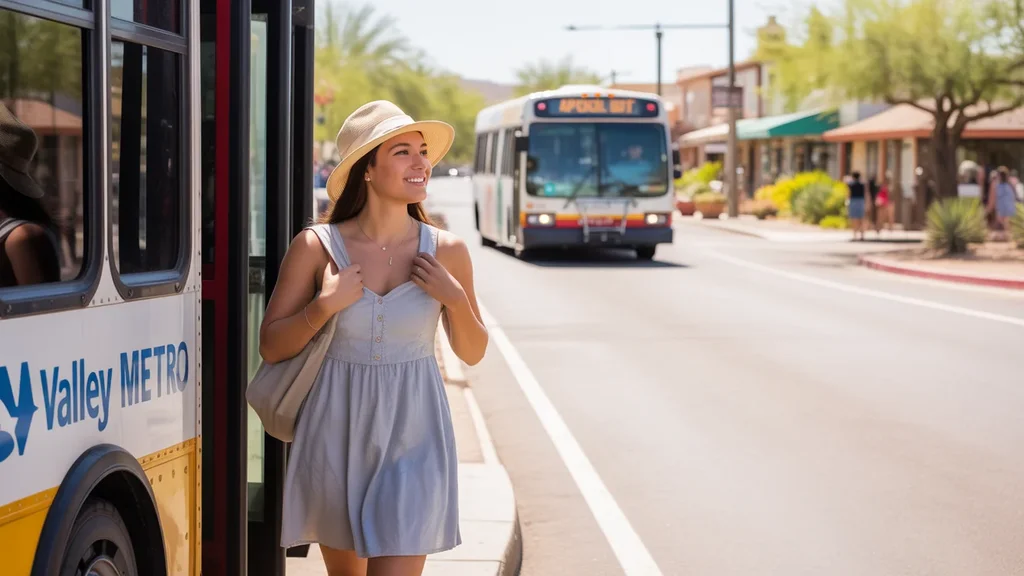
Public transit in Apache Junction centers around bus service, with no rail options present. Bus stops appear throughout the city, providing access to regional routes that connect Apache Junction to neighboring communities and employment centers. For residents living near these routes and commuting to a single, fixed destination, transit can serve as a practical option—particularly for those willing to plan around schedules and accept longer travel times compared to driving.
Where transit works best is along the corridors where service is concentrated. Riders who live within walking distance of a stop and work near another stop can build a routine around the bus. Where it falls short is in coverage breadth and flexibility. Off-corridor neighborhoods see limited or no service, late-night and weekend frequencies tend to be sparse, and multi-stop errands—picking up groceries, dropping off dry cleaning, stopping at the pharmacy—become logistically difficult without a car. Transit exists, but it functions as a commute tool for a subset of residents rather than a comprehensive mobility system.
Driving & Car Dependence Reality
For the majority of Apache Junction households, driving isn’t optional—it’s structural. The city’s layout, the distribution of services, and the realities of daily logistics all point toward car ownership as the default. Errands are corridor-clustered rather than neighborhood-distributed, meaning a trip to the grocery store, bank, and hardware store often requires driving even if each destination is relatively close.
Parking pressure remains low in most areas, and the road network accommodates car travel without the congestion common in denser metros. That makes driving predictable and relatively low-friction, but it also means households absorb the full cost and responsibility of vehicle ownership, maintenance, and fuel. For families managing multiple schedules—school drop-offs, medical appointments, weekend activities—the car becomes the only tool flexible enough to handle the complexity. The city’s infrastructure assumes you’ll drive, and most residents do.
Commuting Patterns & Daily Mobility
Commuting in Apache Junction typically means either driving to a job within the metro area or using a car to reach a transit connection point. Single-destination commuters who work along a bus route and live near a stop can make transit work, but this describes a narrow slice of the workforce. Most residents face multi-stop days, off-peak hours, or destinations not well-served by the bus network, all of which push them toward driving.
The city’s position within the broader Phoenix metro area means some residents commute outward to employment centers in Mesa, Tempe, or Phoenix proper. Without rail service, these commutes depend on either personal vehicles or a combination of driving to a park-and-ride and transferring to regional bus service. The lack of work-from-home data in the current snapshot makes it difficult to quantify how many residents avoid commuting altogether, but the infrastructure itself suggests that those who do commute are largely doing so by car.
Daily mobility isn’t just about the commute—it’s about how you string together the errands, appointments, and obligations that fill a week. In Apache Junction, that stringing-together almost always involves a car. Cycling infrastructure exists in pockets, and the bike-to-road ratio sits in a moderate range, but cycling remains a recreational or supplemental option rather than a primary transportation mode for most households.
Who Transit Works For—and Who It Doesn’t
Transit in Apache Junction works best for individuals with predictable, single-destination commutes who live within walking distance of a bus stop and can tolerate longer travel times. This might include renters in corridor-adjacent apartments commuting to a fixed workplace, retirees using the bus for specific errands, or households deliberately minimizing car use for environmental or financial reasons.
Transit doesn’t work well for families managing multiple stops, shift workers with non-standard hours, or residents living in neighborhoods away from bus routes. It also struggles to serve households where both adults work in different directions, where children’s activities require evening or weekend travel, or where errands demand flexibility and speed. The car remains the tool that handles complexity, and in Apache Junction, daily life tends to be complex.
Renters closer to the city’s commercial corridors have the best shot at reducing car dependence, but even then, most find themselves driving for at least some trips. Homeowners in peripheral neighborhoods face near-total car reliance. The distinction isn’t about preference—it’s about proximity, schedule, and the structure of the city itself.
Transportation Tradeoffs in Apache Junction
Choosing between transit and driving in Apache Junction isn’t a pure either-or decision for most households—it’s a question of how much driving you can avoid and what you’re willing to trade for that reduction. Transit offers lower direct costs and eliminates the need to own, insure, and maintain a vehicle, but it requires proximity to routes, tolerance for longer trips, and the ability to structure your life around fixed schedules.
Driving offers control, flexibility, and the ability to handle multi-stop days, but it comes with the full burden of vehicle ownership and the exposure to fuel prices, maintenance, and depreciation. In Apache Junction, the city’s layout and service distribution mean that even households trying to minimize driving often find themselves needing a car for at least some trips. The tradeoff isn’t transit versus driving—it’s how much friction you’re willing to absorb in exchange for lower transportation costs.
For households weighing these tradeoffs, the key variables are proximity to bus routes, commute destination, household size, and schedule complexity. A single person commuting to a fixed job along a bus line faces a very different calculus than a family of four managing school, work, and activities across multiple locations.
FAQs About Transportation in Apache Junction (2026)
Is public transit usable for daily commuting in Apache Junction?
Yes, but only for a narrow set of circumstances. If you live near a bus stop, commute to a single destination also near a stop, and can work around the schedule, transit can function as a daily commute tool. For most residents, though, the combination of limited coverage, corridor-focused routes, and the need for flexibility makes driving the more practical choice.
Do most people in Apache Junction rely on a car?
Yes. The city’s layout, errand distribution, and infrastructure all assume car ownership. While bus service exists and some residents use it regularly, the majority of households depend on a car for daily logistics, errands, and commuting. The structure of the city makes car-free living difficult for all but a small subset of residents.
Which areas of Apache Junction are easiest to live in without a car?
Neighborhoods close to commercial corridors with bus service offer the best chance of reducing car dependence. Even in these areas, though, most residents find they need occasional car access for errands, appointments, or trips outside the immediate corridor. Peripheral neighborhoods and areas away from bus routes require near-total car reliance.
How does commuting in Apache Junction compare to nearby cities?
Apache Junction shares the car-oriented structure common to many Phoenix metro communities, but with less transit density than core cities like Tempe or Mesa. Commuters traveling into those areas for work often drive the full distance or drive to a transit connection point. The city’s position within the metro means commute patterns vary widely depending on job location.
Can you get by with just a bike in Apache Junction?
Not for most households. Cycling infrastructure exists in pockets, and the bike-to-road ratio suggests some support for cycling, but the distances between destinations, the summer heat, and the corridor-clustered layout of services make biking a supplemental option rather than a primary mode. Recreational cycling is common; bike-dependent living is rare.
How Transportation Fits Into the Cost of Living in Apache Junction
Transportation isn’t just a line item—it’s a structural factor that shapes where you can live, how you spend your time, and what tradeoffs you face in daily life. In Apache Junction, the reality of car dependence means most households must budget for vehicle ownership, fuel, insurance, and maintenance as non-negotiable costs. The city’s layout and transit limitations make it difficult to avoid these expenses, even for households actively trying to minimize transportation costs.
For a fuller picture of what a budget has to handle in Apache Junction, including how transportation costs interact with housing, utilities, and other expenses, the Monthly Budget article provides detailed context. Understanding how mobility shapes your day-to-day costs helps clarify whether Apache Junction’s transportation structure aligns with your household’s needs and constraints.
The key takeaway: Apache Junction offers bus service and moderate walkability in specific areas, but the city’s structure still centers on the car. If you’re moving here, plan for vehicle ownership unless your circumstances—proximity, schedule, and destinations—align with the narrow set of conditions where transit works. Most residents drive, and the city’s infrastructure reflects that reality.
How this article was built: In addition to public economic data, this article incorporates location-based experiential signals derived from anonymized geographic patterns—such as access density, walkability, and land-use mix—to reflect how day-to-day living actually feels in Apache Junction, AZ.