
What does it actually feel like to live in Glendale, AZ? If you ask around online or listen to the conversations happening in local Facebook groups and community forums, you’ll hear a range of voices—some deeply satisfied, others restless, many somewhere in between. According to a composite sentiment snapshot, roughly 74 out of 100 residents say they’re happy in Glendale. But that number doesn’t tell you much about the tradeoffs, the texture, or whether this city will feel like home to you.
Glendale sits in the northwest corner of the Phoenix metro, a sprawling suburban city known for affordable housing, strong family amenities, and a quieter pace than downtown Phoenix or Scottsdale. It’s a place where parks are plentiful, playgrounds are everywhere, and you can still find a house with a yard without stretching your budget to the breaking point. But it’s also a place where the summer heat is relentless, where getting around usually means getting in the car, and where the vibe skews more “settled” than “energetic.” Understanding how Glendale feels means understanding who thrives here—and who starts looking for the exit.
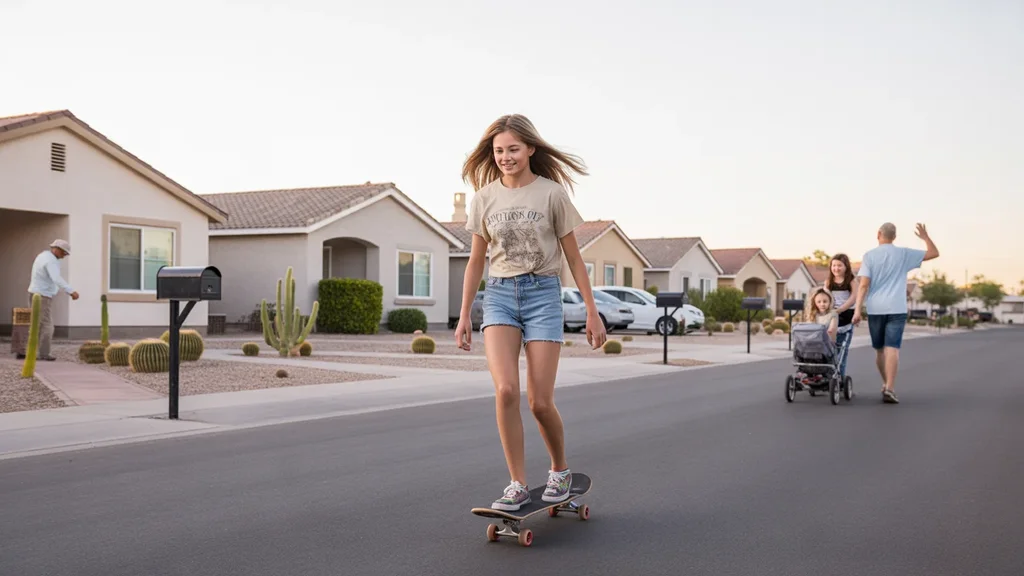
The Emotional Landscape of Glendale
Glendale’s overall sentiment is shaped by a few recurring themes: affordability, family-friendliness, and a slower suburban rhythm. People who wanted space, safety, and a place to raise kids without financial panic tend to feel vindicated. Those who moved here hoping for walkable neighborhoods, vibrant nightlife, or easy car-free living often feel friction.
The city has pockets of walkability—higher pedestrian infrastructure in some areas than you’d expect in suburban Arizona—and it even has rail transit, a rarity in this part of the metro. But the dominant experience is still low-rise, car-dependent, and spread out. Parks are integrated throughout the city, grocery stores are broadly accessible, and there’s a hospital and plenty of clinics. For families, retirees, and budget-conscious households, that’s often enough. For younger professionals, remote workers craving variety, or anyone who finds suburban sprawl emotionally draining, Glendale can feel limiting.
“It’s not flashy, but it works,” one long-time resident might say. “You get a lot of house for the money, the parks are great, and it’s quiet.” Another voice counters: “It’s too quiet. Everything closes early, there’s not much to do unless you drive to Phoenix, and the summer heat makes you feel trapped indoors half the year.”
The city’s identity sits in that tension: practical and affordable, but not particularly exciting. Comfortable, but not dynamic. A place where you can build a stable life, but maybe not the life you imagined if you grew up somewhere denser or more walkable.
Social Media Buzz in Glendale
On platforms like Reddit, Facebook neighborhood groups, and X (formerly Twitter), Glendale discussions tend to cluster around a few recurring topics: housing affordability compared to the rest of the Phoenix metro, frustration with summer heat and utility bills, pride in local parks and schools, and debates about growth and development.
There’s a protective tone when outsiders dismiss Glendale as “just another Phoenix suburb.” Locals push back, pointing to the city’s sports venues, its historic downtown district, and its relative affordability. But there’s also fatigue—especially around traffic, long commutes, and the sense that the city is growing without gaining much character.
“I love that I can afford a house here, but I hate that I have to drive 30 minutes to feel like I’m somewhere interesting.”
“The parks are honestly amazing. We’re at the playground or splash pad almost every weekend.”
“Summer is brutal. If you’re not prepared for $300+ electric bills and staying inside from June to September, you’re going to struggle.”
The tone is rarely angry, but it’s often resigned. People appreciate what Glendale offers—space, affordability, family infrastructure—but they’re clear-eyed about what it doesn’t offer: density, walkability, nightlife, or relief from the heat.
Local News Tone
Local coverage of Glendale tends to frame the city through a few recurring lenses: growth and development, community identity, infrastructure debates, and efforts to distinguish itself within the Phoenix metro. Headlines and story themes often sound like this:
- “New Retail and Dining Options Arrive as City Grows”
- “Residents Debate What Growth Should Look Like”
- “Community Celebrates Local Parks and Family Events”
- “Commuters Weigh Convenience vs. Affordability”
- “City Works to Balance Suburban Calm with Urban Amenities”
The framing is generally optimistic but cautious. There’s pride in what’s been built—sports stadiums, shopping districts, improved transit connections—but also awareness that Glendale is still defining itself. It’s not Phoenix, it’s not Scottsdale, and it’s not Tempe. It’s somewhere in between: affordable, family-oriented, and still figuring out its personality.
Review-Based Public Perception
On Google reviews, Yelp, and Nextdoor-style platforms, Glendale’s public perception splits along expectation lines. People who wanted suburban comfort, good schools, and affordable housing tend to leave positive reviews. People who wanted walkable streets, diverse dining, or a vibrant social scene tend to feel disappointed.
Praise often centers on parks, playgrounds, and family amenities. The city has strong infrastructure for kids—playgrounds exceed density thresholds, schools are present throughout, and there are plenty of recreational options. Grocery stores and food establishments are broadly accessible, which makes daily errands manageable even in a car-dependent layout.
Complaints tend to focus on sameness, sprawl, and heat. Newer planned areas feel generic to some residents, while older pockets lack the polish and walkability that would make them feel distinctive. The low-rise building character means there’s not much vertical variety, and the mixed land use, while present, doesn’t create the kind of texture you’d find in denser cities.
“Great place to raise a family. Safe, affordable, lots of parks.”
“It’s fine if you like driving everywhere and don’t mind chain restaurants.”
“The heat is no joke. If you’re not used to Arizona summers, it’s a real adjustment.”
The reviews reflect a city that delivers on suburban fundamentals but doesn’t surprise or delight beyond that.
Comparison to Nearby Cities
| Aspect | Glendale, AZ | Peoria, AZ | Tempe, AZ |
|---|---|---|---|
| Overall Vibe | Affordable, family-oriented, low-rise suburban calm | Newer, more polished, slightly higher cost, very car-dependent | Younger, denser, walkable pockets, college-town energy |
| Walkability | Pockets of high pedestrian infrastructure, but not uniform | Minimal pedestrian texture, heavily car-oriented | Strong walkability near ASU, mixed elsewhere |
| Transit | Rail present, adding transit option | Bus service only, limited coverage | Light rail access, better transit connectivity |
| Family Appeal | Strong parks, playgrounds, schools | Strong family infrastructure, newer amenities | Less family-focused, more geared toward students and young professionals |
| Social Scene | Quiet, limited nightlife, family-oriented events | Very quiet, minimal nightlife, suburban rhythm | Vibrant, diverse dining and nightlife, college-driven energy |
If you’re choosing between Glendale, Peoria, and Tempe, the decision comes down to what you’re willing to trade. Glendale offers affordability and family infrastructure without the higher price tag of Peoria or the density and energy of Tempe. Peoria feels newer and more polished but lacks transit and walkability. Tempe delivers urban texture and walkability but costs more and skews younger. If you want suburban calm with a transit option and don’t need nightlife, Glendale makes sense. If you want the newest developments and don’t mind total car dependency, Peoria might fit better. If you want walkability, dining variety, and social energy, Tempe is the stronger match—but you’ll pay for it.
What Locals Are Saying
“We moved here from California for the space and the cost. The house we got in Glendale would’ve been impossible back home. The heat took some getting used to, but the parks and schools make it worth it.”
“I work remotely, and honestly, Glendale feels a little isolating. There’s not much to do within walking distance, and driving everywhere gets old. I miss having a neighborhood I could just wander around in.”
“Retired here five years ago. It’s quiet, the healthcare is solid, and we’re close enough to Phoenix when we want something different. No complaints.”
“The commute is rough. I drive to Scottsdale for work, and it’s almost an hour each way. The affordability helps, but the time in the car wears on you.”
“Great for families. Our kids are at the playground constantly, and there are always community events. It’s not fancy, but it’s stable.”
“I thought the rail line would mean I could ditch my car. It helps sometimes, but you still need to drive for most things. It’s not a walkable city.”
“The summer heat is intense. If you’re not ready for triple-digit temperatures and high AC bills, it’s going to be a shock. But the rest of the year is beautiful.”
Does Glendale Feel Like a Good Fit?
Glendale doesn’t try to be something it’s not. It’s a sprawling, low-rise suburban city with strong family infrastructure, affordable [housing](/glendale-az/housing-costs/), and a quieter pace than much of the Phoenix metro. It has pockets of walkability, rail transit access, and broadly accessible grocery and food options—features that set it apart from purely car-dependent suburbs. But it’s still fundamentally suburban, still heavily reliant on driving, and still shaped by the realities of desert heat and sprawl.
This city tends to work well for families seeking space and stability without financial strain, for retirees wanting calm and healthcare access, and for budget-conscious households willing to trade density for affordability. It tends to frustrate young professionals craving nightlife and walkability, remote workers sensitive to heat and isolation, and anyone hoping transit will replace car ownership.
If you value parks, playgrounds, and a slower rhythm, Glendale delivers. If you need urban texture, social energy, or consistent walkability, you’ll likely feel the limits. The city’s emotional tone isn’t about excitement—it’s about comfort, predictability, and making your money go further. Whether that feels like home depends entirely on what you’re looking for.
For a clearer picture of how [monthly expenses](/glendale-az/monthly-budget/) break down or what [lifestyle tradeoffs](/glendale-az/lifestyle-requirements/) look like day to day, exploring those details can help you decide if Glendale’s version of suburban life aligns with yours.
How this article was built: In addition to public economic data, this article incorporates location-based experiential signals derived from anonymized geographic patterns—such as access density, walkability, and land-use mix—to reflect how day-to-day living actually feels in Glendale, AZ.
The perspectives shown reflect commonly expressed local sentiment and recurring themes in public discussion, rather than individual accounts.