
Residents who rely primarily on public transit in Chandler can save thousands annually compared to owning and maintaining a personal vehicle—but that savings comes with significant tradeoffs in coverage, flexibility, and trip planning. Understanding how people actually get around Chandler, and which transportation options work for whom, is essential for anyone considering a move or evaluating their household’s mobility needs.
How People Get Around Chandler
Chandler operates primarily as a car-oriented suburb within the Phoenix metro area, but the city’s transportation landscape is more textured than that label suggests. While most residents depend on personal vehicles for work commutes and daily errands, the city has developed walkable pockets—areas where pedestrian infrastructure is dense enough to support routine trips on foot. These pockets tend to cluster near commercial corridors and mixed-use developments, where grocery stores, restaurants, and services sit within reasonable walking distance of residential neighborhoods.
What newcomers often misunderstand is that Chandler’s layout rewards proximity and planning. The city’s low-rise building character and sprawling footprint mean that trip distances add up quickly outside of these walkable zones. A household located near a commercial hub may find that errands, dining, and even some healthcare needs are accessible without a car. A household just a few miles away, in a purely residential subdivision, will likely find that nearly every trip requires driving.
Cycling infrastructure is notably present throughout parts of Chandler, with bike-to-road ratios that exceed typical suburban benchmarks. However, the city’s triple-digit summer heat and long distances between destinations constrain the practical utility of biking for most residents. Cycling works best as a recreational option or a short-distance commute supplement during cooler months, rather than as a primary year-round transportation mode.
Public Transit Availability in Chandler
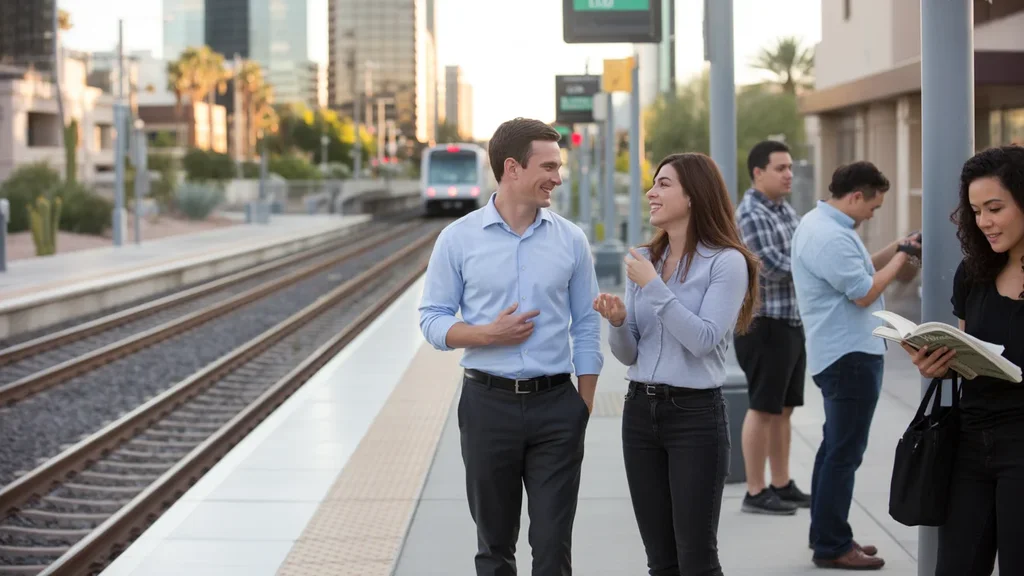
Public transit in Chandler centers around bus service, with no rail options currently serving the city. Bus stops are present throughout the area, and the service connects Chandler to the broader Phoenix metro region. However, the role transit plays here is limited by coverage gaps, schedule constraints, and the realities of a low-density, spread-out city.
Transit tends to work best for residents living near major corridors and whose destinations align with established routes. For someone commuting to a job along a bus line, or accessing services clustered near transit stops, the system can provide a functional, if slower, alternative to driving. For residents in peripheral neighborhoods, or those whose daily routines involve multiple stops across different parts of the city, transit becomes impractical.
Late-hour service, weekend frequency, and coverage in residential subdivisions are common pain points. The system is designed to serve regional commuters and corridor-based trips, not the full spectrum of daily mobility needs across Chandler’s sprawling geography. Households considering transit as a primary option should evaluate their specific address, work location, and daily routines against actual route maps and schedules before committing.
Driving & Car Dependence Reality
For most Chandler residents, driving is not optional—it’s the default structure of daily life. The city’s layout, with residential areas separated from employment centers and commercial districts, means that even short errands often require a car. Parking is generally abundant and free, which removes one friction point common in denser cities, but it also reinforces car dependency by making driving the path of least resistance.
Commute flexibility is a key advantage of car ownership in Chandler. Residents can chain errands, adjust routes in real time, and access employment across the Phoenix metro without being constrained by transit schedules. However, this flexibility comes with exposure to fuel costs, maintenance, insurance, and the time burden of driving itself. Gas prices in Chandler currently sit at $3.14 per gallon, a data point that shapes household budgets but doesn’t determine whether driving is necessary—it usually is.
The tradeoff is predictability versus control. Transit offers lower direct costs but requires households to adapt their schedules and destinations to the system’s limitations. Driving offers control and speed but introduces variable costs and time commitments that compound over months and years.
Commuting Patterns & Daily Mobility
Commuting in Chandler typically involves single-destination trips to employment centers within the Phoenix metro, though multi-stop routines—dropping kids at school, running errands, picking up groceries—are common and heavily favor car use. The city’s position within the broader metro means that many residents commute outward to Tempe, Phoenix, or Mesa, while others work locally in Chandler’s growing tech and corporate sectors.
Proximity matters more than mode. Residents who live near their workplace, whether in Chandler or a neighboring city, experience less daily friction regardless of whether they drive or take transit. Those facing longer distances or multi-stop routines find that transit’s limitations—transfer times, limited coverage, schedule gaps—make it difficult to rely on exclusively.
Remote workers and households with flexible schedules benefit disproportionately from Chandler’s walkable pockets and errands accessibility. When work commutes are removed from the equation, the city’s infrastructure supports a less car-intensive lifestyle, particularly for those who prioritize proximity to grocery stores, parks, and services when choosing where to live.
Who Transit Works For — and Who It Doesn’t
Public transit in Chandler is most viable for single adults or couples without children, living near major bus routes, whose work and errands align with transit corridors. These households can structure their routines around the system’s constraints and benefit from the cost savings of not owning a car—or owning just one instead of two.
Families with children, particularly those managing school drop-offs, extracurriculars, and multi-stop errands, will find transit impractical for daily use. The time cost and logistical complexity of coordinating multiple trips via bus, especially with young children, outweighs the financial savings for most households.
Renters in walkable pockets near commercial corridors have the best chance of reducing car dependency, particularly if they work remotely or have flexible schedules. Homeowners in peripheral subdivisions, by contrast, are effectively locked into car ownership by geography. The distance between residential areas and services, combined with limited transit coverage, makes driving the only realistic option for most trips.
Retirees and older adults face a mixed picture. Those who no longer commute daily and live near grocery stores and healthcare facilities may find that a combination of walking, occasional transit use, and ride-hailing services can reduce or eliminate the need for a personal vehicle. Those in car-dependent subdivisions will continue to rely on driving or will need to plan for mobility changes as driving becomes less feasible.
Transportation Tradeoffs in Chandler
The choice between transit and driving in Chandler is less about cost optimization and more about lifestyle fit and control. Transit offers lower direct expenses—no fuel, no maintenance, no insurance—but it demands flexibility, patience, and a willingness to adapt daily routines to the system’s limitations. Driving offers speed, convenience, and the ability to structure your day on your terms, but it introduces ongoing costs and exposure to fuel price volatility.
Predictability differs sharply between the two modes. Transit schedules are fixed, which can simplify planning but also constrain spontaneity. Driving is inherently flexible but introduces variability in travel time due to traffic, as well as unpredictable maintenance and repair costs over time.
For households evaluating these tradeoffs, the question is not which mode is cheaper in the abstract, but which mode aligns with their daily routines, work locations, and tolerance for planning friction. A household that values control and speed will absorb the costs of driving without hesitation. A household that prioritizes lower fixed costs and is willing to structure life around transit’s constraints can make it work—but only if their address and destinations align with the available service.
How this article was built: In addition to public economic data, this article incorporates location-based experiential signals derived from anonymized geographic patterns—such as access density, walkability, and land-use mix—to reflect how day-to-day living actually feels in Chandler, AZ.
FAQs About Transportation in Chandler (2026)
Is public transit usable for daily commuting in Chandler?
Public transit is usable for some commuters in Chandler, particularly those living near major bus routes and whose work destinations align with transit corridors. However, coverage gaps, limited frequency, and schedule constraints make it impractical for many residents, especially those in peripheral neighborhoods or with multi-stop daily routines. Households considering transit as a primary commute option should evaluate their specific address and work location against actual route maps before committing.
Do most people in Chandler rely on a car?
Yes. The vast majority of Chandler residents depend on personal vehicles for daily transportation. The city’s low-density, sprawling layout and the separation of residential areas from employment and commercial centers make driving the default mode for most trips. While walkable pockets and bus service exist, they serve a minority of residents and trip types.
Which areas of Chandler are easiest to live in without a car?
Areas near commercial corridors and mixed-use developments, where grocery stores, restaurants, and services cluster within walking distance of residential neighborhoods, offer the best chance of reducing car dependency. These walkable pockets benefit from higher pedestrian infrastructure density and better access to errands. However, even in these areas, most residents still own at least one car for commuting and trips outside the immediate neighborhood.
How does commuting in Chandler compare to nearby cities?
Chandler’s commuting reality is similar to other Phoenix-area suburbs: car-oriented, with limited but present public transit options. Compared to Tempe or central Phoenix, Chandler has less transit coverage and fewer walkable neighborhoods. Compared to more distant suburbs, Chandler offers slightly better infrastructure for non-car trips, particularly in its commercial corridors. The key difference is proximity—residents who live and work within Chandler face shorter commutes than those traveling across the metro.
Can cycling replace driving for daily trips in Chandler?
Cycling infrastructure is notably present in Chandler, but practical utility is constrained by climate and distance. Triple-digit summer heat makes biking uncomfortable and unsafe for much of the year, and the distances between residential areas and destinations are often too long for routine cycling. Biking works best as a recreational activity or a short-distance supplement during cooler months, not as a year-round replacement for driving.
How Transportation Fits Into the Cost of Living in Chandler
Transportation is not just a line item—it’s a structural factor that shapes where you can live, how you spend your time, and what flexibility you retain in daily life. In Chandler, the dominance of car dependency means that most households must budget for vehicle ownership, fuel, insurance, and maintenance as non-negotiable costs. Transit offers an alternative for some, but only when geography, schedule, and daily routines align with the system’s limitations.
The real cost of transportation in Chandler is not captured by fuel prices or bus fares alone. It’s the time spent commuting, the constraints on housing choice imposed by proximity needs, and the tradeoff between control and predictability. Households that prioritize walkability and transit access will pay a location premium to live near commercial corridors. Households that accept car dependency gain access to a wider range of housing options but absorb the ongoing costs and time burden of driving.
For a fuller picture of how transportation costs interact with housing, utilities, and other expenses, see the Monthly Spending in Chandler: The Real Pressure Points article. Understanding transportation in Chandler means recognizing that mobility is not just about getting from point A to point B—it’s about how much control you have over your time, your budget, and your daily routines.
—