
It’s 7:15 a.m. on a Tuesday in Spring Valley, and Maria is standing at a bus stop on a quiet residential street, checking her phone against the posted schedule. Her bike leans against the shelter pole. She’s heading to a shift across town, and while the bus will get her there, she knows most of her neighbors are already in their cars, engines running, ready to merge onto the highway toward Las Vegas. Spring Valley sits in the heart of the Las Vegas metro, a low-rise suburban community where the car is king—but not the only option. For those who know where to look, and who live in the right pockets, public transit and walkable errands can reduce the need to drive every single day. But for most households, especially those farther from commercial corridors or commuting beyond Spring Valley’s borders, a personal vehicle remains the practical foundation of daily life.
How People Get Around Spring Valley
Spring Valley is a car-first community. The layout is classic suburban: residential streets branch off arterial roads, commercial centers cluster along major corridors, and distances between home, work, and errands typically exceed comfortable walking range. Most residents drive for most trips. That’s the baseline expectation, and it’s reflected in the infrastructure—wide roads, ample parking, and limited pedestrian crossings outside of specific zones.
But the reality is more textured than “everyone drives everywhere.” Spring Valley has pockets where the pedestrian-to-road ratio is notably higher, meaning sidewalks, crosswalks, and pedestrian pathways are denser relative to the street network. In these areas—often near grocery stores, pharmacies, and local retail—residents can and do walk for errands. Food and grocery density in Spring Valley exceeds typical suburban thresholds, meaning that for households living near these commercial nodes, daily necessities are accessible without a car. This doesn’t eliminate driving, but it reduces the frequency and urgency of car trips for routine tasks.
Public transit exists in the form of bus service. There is no rail. The buses connect residential areas to commercial corridors and provide links to the broader Las Vegas metro, but coverage is uneven. Service works best along main roads and during standard commute windows. For someone living near a bus line and working along a route, transit can be a viable supplement. For someone living in a cul-de-sac a mile from the nearest stop, or commuting to a job with irregular hours, the bus becomes impractical.
What newcomers often misunderstand is that Spring Valley’s transportation reality is not binary. It’s not “transit city” or “car prison.” It’s a place where your specific address, your work location, and your daily routine determine whether you can reduce car dependency or whether you’re locked into driving for nearly everything. The city’s structure creates different realities for different households, and understanding which reality applies to you is essential before committing to a lease or a mortgage.
Public Transit Availability in Spring Valley
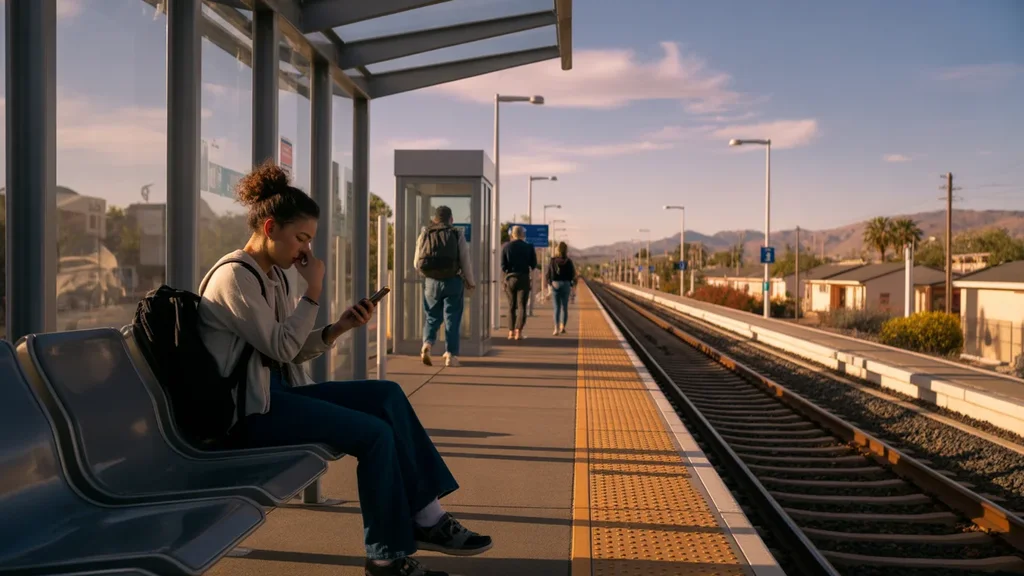
Public transit in Spring Valley often centers around systems such as the Regional Transportation Commission of Southern Nevada (RTC), which operates bus routes throughout the Las Vegas metro area. Spring Valley is served by several bus lines that run along major east-west and north-south corridors, connecting residential neighborhoods to commercial districts, medical facilities, and employment centers both within Spring Valley and in neighboring areas of the metro.
Transit works best for residents living within a few blocks of a bus stop on a primary route. If your home and your destination both sit along the same corridor, and your schedule aligns with service hours, the bus can be a practical option. This is especially true for errands, medical appointments, or part-time work within the metro area. Some residents use transit to avoid parking costs or to reduce wear on a vehicle, even if they own a car.
Where transit falls short is in coverage and frequency. Spring Valley’s residential streets are not blanketed with bus stops. Service is concentrated along arterials, leaving many neighborhoods a significant walk—or a short drive—from the nearest stop. Frequency varies by route and time of day, and evening or weekend service may be limited. For someone working a night shift, or someone whose job requires travel to an industrial area not served by a direct route, the bus becomes a poor fit.
There is no rail service in Spring Valley. All public transit is bus-based, which means travel times are subject to traffic conditions, and connections between routes can add significant time to a trip. For commuters heading into the Las Vegas core or to employment centers on the Strip, buses provide access, but the trip will take longer than driving during off-peak hours.
Transit in Spring Valley is supplemental, not foundational. It exists, it functions, and it serves specific use cases well. But it does not replace the need for a car for most households.
Driving & Car Dependence Reality
Driving is the default mode of transportation in Spring Valley, and the city’s layout reinforces that reality. Residential subdivisions are designed around internal streets that feed into collector roads, which in turn connect to arterials. Distances between home and work, home and school, or home and shopping are typically measured in miles, not blocks. Sidewalks exist in many areas, but they often lead to intersections without crosswalks, or they terminate at the edge of a parking lot rather than continuing to a building entrance.
Parking is abundant and typically free. Grocery stores, medical offices, and retail centers provide large surface lots. Street parking in residential areas is generally unrestricted. This removes one of the friction points that makes car ownership costly or inconvenient in denser cities, but it also reflects the assumption that nearly everyone arrives by car.
For households with two working adults, two cars are common. For families with teenagers, three cars are not unusual. The car is not just transportation; it’s the enabler of schedule flexibility. One adult can drop off kids while the other commutes in the opposite direction. One partner can run errands during lunch while the other picks up groceries after work. Without that flexibility, coordinating daily logistics becomes significantly harder.
Commuters traveling beyond Spring Valley—especially those working on the Las Vegas Strip, in Henderson, or in North Las Vegas—face a choice between driving and accepting longer, less predictable transit times. The average commute in Spring Valley is around 22 minutes, and just over 27% of workers experience what’s classified as a long commute. Only about 3.2% of workers work from home, meaning the vast majority are making a daily trip to a physical workplace. For these households, the car is not optional.
Driving dependence also means exposure to fuel prices, which in Spring Valley currently sit at $4.86 per gallon. This is a variable cost, and it fluctuates with regional and national market conditions. Households that drive extensively feel this volatility directly, and it’s one of the few transportation costs that changes week to week.
Commuting Patterns & Daily Mobility
Commuting in Spring Valley is shaped by the metro’s geography. Spring Valley is not an employment center; it’s a residential community within the larger Las Vegas metro. Many residents commute to jobs in other parts of the metro—retail and hospitality on the Strip, offices in Summerlin or Henderson, warehouses and distribution centers in North Las Vegas. The commute is often a cross-metro trip, not a neighborhood-to-downtown trip.
For single-job commuters with predictable schedules, driving offers control and speed. The trip is direct, and timing is under the driver’s control. For multi-stop commuters—parents dropping kids at school, workers running errands on the way home—the car is essential. Public transit does not accommodate complex trip chains efficiently.
Some residents structure their lives to minimize commuting. They choose jobs closer to home, or they choose homes closer to work. This is easier for renters, who can relocate more frequently, than for homeowners locked into a mortgage. But even with intentional proximity, most daily needs—groceries, medical care, social activities—still require some form of motorized transportation.
Commute time in Spring Valley is moderate by metro standards, but it’s not negligible. Twenty-two minutes each way adds up to nearly four hours per week, or roughly 200 hours per year. For households where both adults commute, that’s 400 hours annually spent in transit. This is time that could be spent on childcare, meal preparation, rest, or leisure, and it’s a cost that doesn’t appear on a budget spreadsheet but shapes quality of life nonetheless.
Who Transit Works For—and Who It Doesn’t
Public transit in Spring Valley works best for a specific subset of residents: those living near a bus line, working along a served route, and maintaining a schedule that aligns with service hours. This might include part-time workers, retirees running errands during midday, or students commuting to a campus accessible by bus. It also works for households that own a car but want to reduce usage for cost or environmental reasons, using transit for some trips while driving for others.
Transit does not work well for households in peripheral neighborhoods far from bus stops, for workers with irregular hours, or for anyone whose job requires travel to multiple sites during the day. It also doesn’t work for families managing complex logistics—school drop-offs, daycare pickups, grocery runs with young children. The time cost and coordination burden make transit impractical, even if the route technically exists.
Renters living in apartments near commercial corridors have the best chance of integrating transit into their routine. They’re closer to stops, closer to destinations, and more likely to live in areas where walking for errands is feasible. Homeowners in subdivisions farther from arterials face a different reality. Their neighborhoods were designed around car access, and retrofitting a transit-dependent lifestyle onto that infrastructure is difficult.
The distinction is not about income or preference. It’s about location within Spring Valley and the alignment between where you live, where you need to go, and where the bus actually runs.
Transportation Tradeoffs in Spring Valley
Choosing between transit and driving in Spring Valley is not a question of cost alone—it’s a question of time, predictability, and control. Driving offers speed and flexibility. You leave when you want, take the route you prefer, and adjust on the fly if plans change. You’re not waiting for a bus, and you’re not limited by service hours. But driving also means exposure to fuel price swings, vehicle maintenance, insurance, and the mental load of navigation and parking.
Transit offers lower direct costs for individual trips, and it removes the need to own or maintain a vehicle—if you can structure your entire life around it. But transit in Spring Valley requires compromise. Trips take longer. Schedules are fixed. Coverage is limited. For someone whose life fits within those constraints, transit can work. For someone whose job, family, or routine doesn’t align, transit becomes a source of friction rather than freedom.
The tradeoff is not equal for all household types. A single adult working a 9-to-5 job along a bus route can make transit work. A parent managing school pickups, daycare, and a job with variable hours cannot. A retiree running errands during the day might find transit pleasant and practical. A night-shift worker will find service sparse or nonexistent.
Understanding these tradeoffs before moving to Spring Valley helps avoid the mistake of assuming you can replicate a car-free lifestyle from a denser city, or the opposite mistake of assuming you’ll need to drive literally everywhere. The reality is more granular, and it depends on where in Spring Valley you land.
How this article was built: In addition to public economic data, this article incorporates location-based experiential signals derived from anonymized geographic patterns—such as access density, walkability, and land-use mix—to reflect how day-to-day living actually feels in Spring Valley, NV.
FAQs About Transportation in Spring Valley (2026)
Is public transit usable for daily commuting in Spring Valley?
Public transit is usable for daily commuting if you live near a bus stop, work along a served route, and maintain a schedule that aligns with service hours. For residents meeting those conditions, the bus provides a practical option. For those living farther from stops, commuting to areas without direct service, or working irregular hours, transit becomes impractical and driving is necessary.
Do most people in Spring Valley rely on a car?
Yes. Spring Valley is a car-oriented community, and the majority of residents drive for most trips. The layout, distances, and limited transit coverage make car ownership the practical default for most households, especially those with children, multiple jobs, or commitments across the metro area.
Which areas of Spring Valley are easiest to live in without a car?
Areas near major commercial corridors with bus service and higher pedestrian infrastructure are easiest to navigate without a car. Residents in these pockets can walk to grocery stores, pharmacies, and other daily necessities, and they have better access to transit. Peripheral residential subdivisions farther from arterials require a car for nearly all trips.
How does commuting in Spring Valley compare to nearby cities?
Commuting in Spring Valley is shaped by the broader Las Vegas metro geography. Average commute times are moderate, but many residents travel across the metro for work, which can extend trip length depending on destination. Compared to denser urban cores with rail access, Spring Valley offers faster driving commutes but longer, less frequent transit options. Compared to more isolated suburban areas, Spring Valley benefits from proximity to the Las Vegas core and better bus coverage.
Can you reduce transportation costs in Spring Valley without a car?
You can reduce transportation costs by relying on transit and walking, but only if your housing, work, and daily needs align geographically with bus routes and walkable commercial areas. For most households, eliminating car ownership entirely is not practical. However, households in well-located areas can reduce driving frequency, lowering fuel and maintenance exposure while still keeping a vehicle for trips that transit cannot serve.
How Transportation Fits Into the Cost of Living in Spring Valley
Transportation is not just a line item—it’s a structural factor that shapes where you can live, how you spend your time, and what flexibility you have in daily life. In Spring Valley, your monthly budget will reflect either the cost of car ownership (fuel, insurance, maintenance) or the time cost of transit dependence (longer trips, limited schedules, reduced flexibility). Most households absorb the financial cost of driving because the time cost of transit is too high.
For renters, transportation should influence housing decisions. Living closer to a bus line or within walking distance of groceries and pharmacies can reduce the need for a second car, lowering monthly expenses. For homeowners, proximity to work or to major corridors can reduce commute time and fuel consumption, even if a car remains necessary.
Transportation also interacts with housing affordability. Cheaper rent farther from the core may seem attractive, but if it requires a longer commute or eliminates transit access, the savings can be offset by higher fuel costs and lost time. Conversely, paying slightly more for a location near a bus line or within walking distance of errands can reduce overall transportation burden.
The key is to evaluate transportation as part of the whole picture, not in isolation. Spring Valley offers options, but those options are unevenly distributed across the city. Your specific address determines whether you can reduce car dependency or whether you’re locked into driving for nearly everything. Choose your location with that reality in mind, and you’ll avoid costly surprises and daily frustration.
—