
“I’m thinking about moving to Spring Valley—will I actually like living here, or am I going to feel stuck?”
It’s a fair question. Spring Valley sits just west of the Las Vegas Strip, close enough to feel the gravitational pull of the metro but far enough to maintain a distinctly suburban rhythm. The city’s emotional tone reflects that duality: convenience and accessibility run high, but the tradeoff is a community that can feel more functional than deeply rooted. People who thrive here tend to value easy errands, healthcare access, and proximity to Vegas entertainment without living in the thick of it. People who struggle often wanted more—more parks, more school options, more walkable neighborhood texture, or a stronger sense of place identity beyond “near Las Vegas.”
Spring Valley’s vibe isn’t about charm or grit; it’s about logistics working smoothly. The city offers broadly accessible grocery and food options, a hospital for healthcare security, and pockets of walkability that make some commercial corridors feel less car-trapped than others. But school and playground density remain low, and the overall built environment leans heavily on driving, even as certain areas support pedestrian life better than you’d expect. If you’re an adult without school-age kids who prioritizes convenience and access over community depth, Spring Valley tends to deliver. If you’re a family seeking robust infrastructure for children, or someone hoping for a tight-knit neighborhood feel, the city’s structure may leave you wanting.
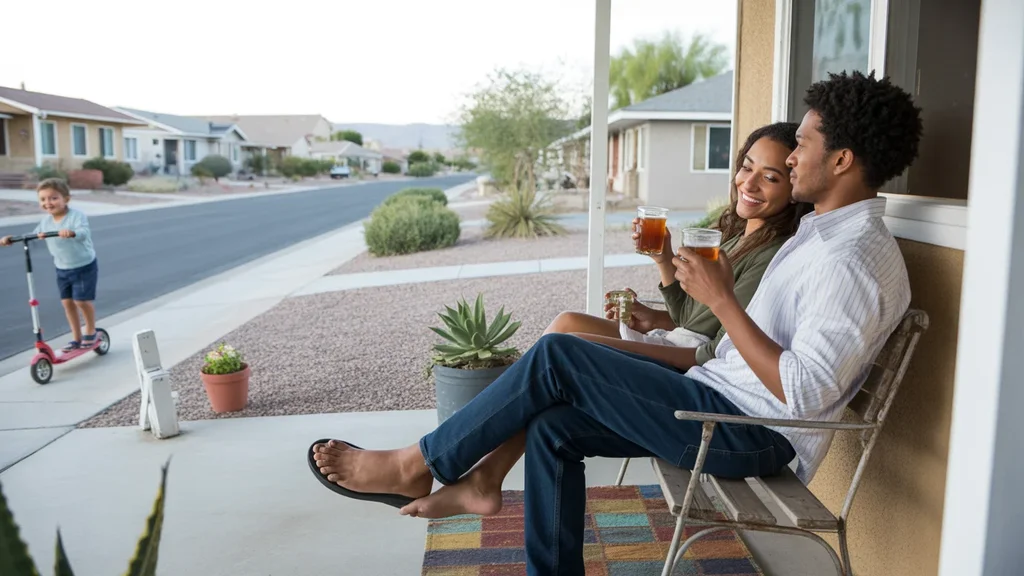
The Emotional Landscape of Spring Valley
Spring Valley’s social media presence reflects a community negotiating its identity. On platforms like Reddit and local Facebook groups, residents often describe the city as “practical but not particularly memorable.” There’s appreciation for how easy it is to grab groceries, fill a prescription, or get to a doctor—food and healthcare access rank high in everyday conversation. But there’s also a recurring sense that the city lacks a center, a gathering place, or a defining character that makes it feel like more than a bedroom community for Las Vegas workers.
Composite sentiment from public discussion reveals this tension clearly:
“It’s convenient, and that matters when you’re busy. But I wouldn’t say I feel connected to the place—it’s more like a base of operations.”
“If you need a hospital or a grocery store, you’re covered. If you need a playground or a good school nearby, it’s hit or miss.”
“I like that it’s quieter than living on the Strip side, but sometimes it feels like there’s nothing here except houses and shopping centers.”
The tone isn’t hostile, but it’s not enthusiastic either. People tend to frame Spring Valley as a reasonable choice rather than an exciting one—a place that meets baseline needs without inspiring strong loyalty.
What Shapes Daily Life: Access, Logistics, and Movement
One of Spring Valley’s defining features is how unevenly walkability and accessibility are distributed. Because food and grocery density exceeds high thresholds across much of the city, running errands rarely requires long drives or careful planning. Supermarkets, convenience stores, and restaurants cluster along commercial corridors, and many residents can reach multiple options within a few minutes. This shapes daily routines in practical ways: fewer “big stock-up” trips, more flexibility to grab what you need when you need it, and less friction around meal planning or last-minute purchases.
At the same time, the pedestrian-to-road ratio is high in certain pockets, meaning some neighborhoods support walking to nearby shops or services more naturally than others. But the overall mobility texture remains car-oriented, and public transit is limited to bus service. For households that rely on driving, this isn’t a problem—parking is abundant, and traffic within Spring Valley itself tends to move steadily. For households that hoped to reduce car dependency or raise kids who could bike to school, the infrastructure doesn’t consistently support that vision. School and playground density fall below thresholds, so parents often find themselves driving to extracurriculars, playdates, and school drop-offs even when they live relatively close.
Healthcare access provides a counterbalance: the presence of a hospital and pharmacies means that medical needs—from urgent care to routine prescriptions—can be handled locally without long drives or coordination across city lines. For older adults, people managing chronic conditions, or anyone who values proximity to medical infrastructure, this is a meaningful quality-of-life factor.
How Local Coverage Frames the City
Local news and community coverage tend to frame Spring Valley through the lens of growth, change, and identity negotiation. Headlines and discussion topics often circle around these recurring themes:
- “New Retail and Dining Options Arrive as Neighborhoods Expand”
- “Residents Weigh Convenience Against Quiet”
- “Community Debates What Growth Should Look Like”
- “Healthcare Access Strong, but Families Seek More School Options”
- “Spring Valley’s Role in the Las Vegas Metro Continues to Evolve”
The tone is generally pragmatic rather than celebratory or critical. Coverage reflects a community that’s functional and evolving but hasn’t yet settled into a strong collective identity. There’s less focus on civic pride or neighborhood character and more attention to infrastructure gaps, service availability, and how the city fits into the broader Las Vegas economy.
What Reviews and Public Perception Reveal
On platforms like Google Reviews, Yelp, and Nextdoor-style forums, Spring Valley earns steady marks for convenience and accessibility but mixed feedback on neighborhood feel and family fit. People who moved here expecting suburban ease and proximity to Vegas amenities tend to feel satisfied. People who moved here hoping for a cohesive neighborhood culture, strong schools, or abundant parks often feel let down.
Positive sentiment clusters around:
- Easy access to groceries, pharmacies, and restaurants
- Healthcare availability without needing to drive into central Las Vegas
- Quieter residential streets compared to areas closer to the Strip
- Reasonable commute times for those working in the metro
Critical sentiment tends to focus on:
- Limited school and playground options, especially in newer planned areas
- Lack of a defined downtown or community gathering space
- Car dependency for most trips, despite pockets of walkability
- A sense that the city feels more like a collection of subdivisions than a cohesive place
Neighborhood variation exists, but it’s often described in broad terms: newer planned areas versus older pockets, commercial corridors versus residential streets. The city’s low-rise character and mixed land use mean that residential and commercial zones sit close together, which some residents appreciate for convenience and others find visually monotonous.
Spring Valley Compared to Nearby Cities
| Dimension | Spring Valley | Henderson | Paradise |
|---|---|---|---|
| Overall Vibe | Functional suburban base, convenience-focused | More established suburban identity, family-oriented | Urban-adjacent, denser, more transient feel |
| Errands & Access | Broadly accessible, high grocery/food density | Strong access, more planned commercial centers | Very high density, urban-style accessibility |
| Family Infrastructure | Limited school and playground density | Stronger school options, more parks | Limited, more adult-oriented |
| Walkability | Pockets of high pedestrian infrastructure | Planned trails and paths, but still car-oriented | More walkable overall, mixed-use zones |
| Community Feel | Practical, less cohesive identity | Stronger neighborhood cohesion, civic pride | Transient, service-worker heavy, less rooted |
Spring Valley occupies a middle ground: more accessible and convenient than many outer suburbs, but less defined and family-focused than Henderson. It’s quieter and more residential than Paradise, but it lacks Paradise’s urban energy and density. If you value easy errands and healthcare access over school quality and park systems, Spring Valley may fit better than Henderson. If you want walkability and urban texture over suburban quiet, Paradise might feel more aligned. The choice hinges on what you’re willing to trade.
Voices from the Community
“I moved here for work and stayed because it’s easy. I can get groceries in five minutes, my doctor’s office is nearby, and I’m close enough to the Strip when I want to go out. But I don’t know my neighbors, and I’m not sure I ever will.” — Young professional, renting
“We thought this would be a good place to raise kids, but the school options are limited and there aren’t many playgrounds within walking distance. We end up driving everywhere, which wasn’t what we wanted.” — Parent of two, homeowner
“For retirees, it’s pretty solid. The hospital is close, the weather is warm, and you’re not dealing with the chaos of living right in Vegas. It’s not exciting, but it’s comfortable.” — Retiree, longtime resident
“I work remotely and honestly feel a bit isolated here. There aren’t a lot of coffee shops or coworking spaces, and the community doesn’t seem built for people who spend a lot of time at home.” — Remote worker, renting
“It’s fine. That’s the best way I can describe it. Nothing’s broken, but nothing’s special either.” — Long-time local, homeowner
“If you don’t have kids and you like being near Vegas without the noise, it works. Just don’t expect a lot of neighborhood character or things to do locally.” — Newcomer, renting
“The walkable areas are nice when you find them, but they’re not everywhere. Some streets feel suburban and car-heavy, others feel more mixed. It’s inconsistent.” — Mid-career professional, homeowner
Does Spring Valley Feel Like a Good Fit?
Spring Valley doesn’t ask you to fall in love with it. It asks whether you value logistical ease, healthcare security, and proximity to Las Vegas amenities more than you value cohesive neighborhood identity, robust family infrastructure, or a strong sense of place. The city works well for adults without school-age children who prioritize convenience and access. It works less well for families seeking abundant parks and schools, or for remote workers hoping for community texture and third spaces.
The emotional profile here is pragmatic, not passionate. People tend to describe Spring Valley as reasonable, functional, and convenient—but not memorable or deeply satisfying. If that tradeoff aligns with where you are in life, the city will likely meet your needs without friction. If you’re hoping for more—more connection, more infrastructure for kids, more walkability across the board—you may find yourself restless.
Understanding where money goes each month and what drives housing pressure can help clarify whether Spring Valley’s practical strengths outweigh its emotional gaps. And exploring what “enough” actually means in terms of amenities and quality of life can help you decide whether this city’s structure fits the life you’re trying to build.
How this article was built: In addition to public economic data, this article incorporates location-based experiential signals derived from anonymized geographic patterns—such as access density, walkability, and land-use mix—to reflect how day-to-day living actually feels in Spring Valley, NV.
The perspectives shown reflect commonly expressed local sentiment and recurring themes in public discussion, rather than individual accounts.