
Is San Antonio the kind of place you grow roots—or just pass through? The answer depends less on what the city offers and more on what you need it to feel like. San Antonio carries a distinct emotional texture: proud of its heritage, protective of its identity, and caught between the pull of rapid growth and the comfort of tradition. For families drawn to strong infrastructure, retirees seeking warmth and affordability, and anyone who values cultural depth over cutting-edge urbanism, the city tends to deliver a sense of belonging. For those expecting dense walkability, mild summers, or a fast-moving metro pace, the friction shows up quickly.
This isn’t a city that tries to be Austin or Dallas. It leans into what makes it different—Tex-Mex authenticity, multi-generational neighborhoods, a slower cadence—and that clarity creates strong alignment for some, and quiet disappointment for others.
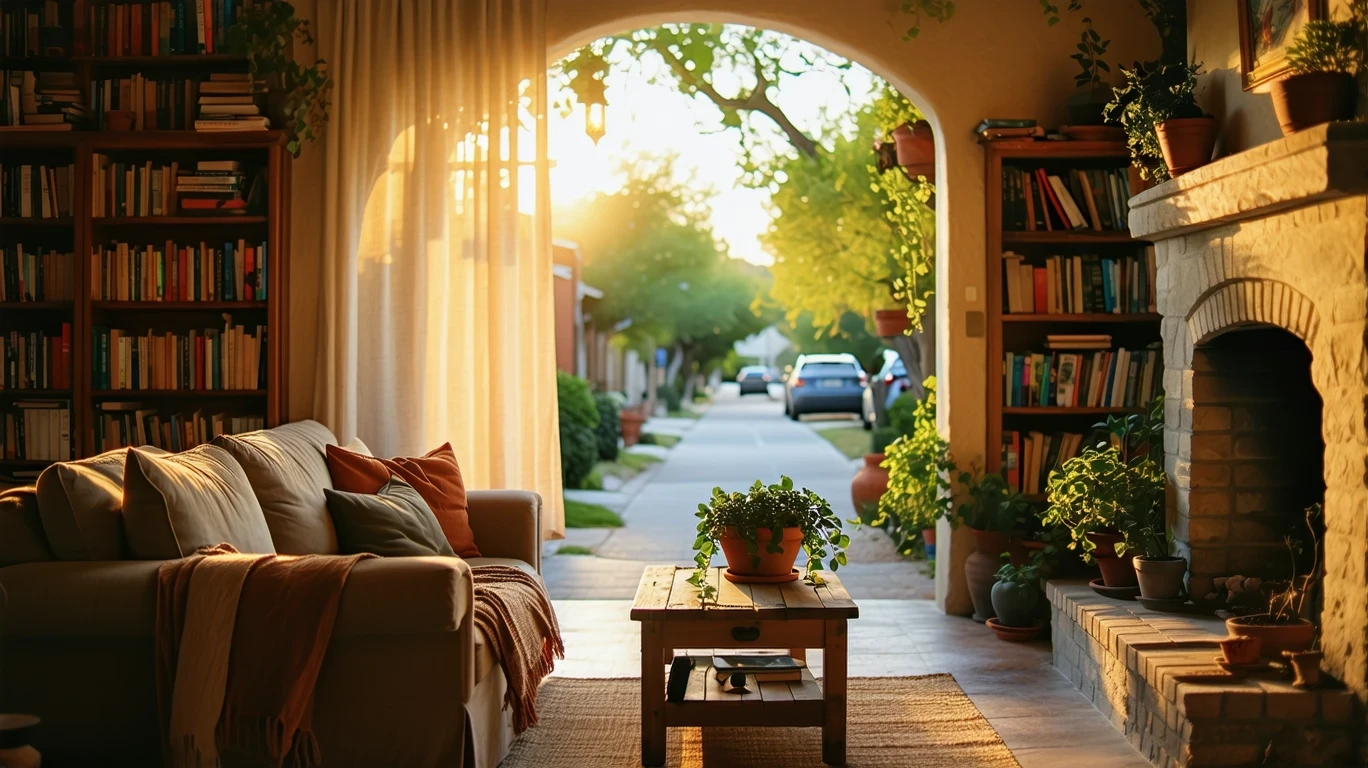
What It Feels Like to Live Here
San Antonio’s vibe is rooted in cultural pride and family orientation. The experiential structure of the city reflects this: school and playground density meet strong thresholds across much of the metro, and park access exceeds high density benchmarks, meaning families and retirees encounter green space and kid-friendly infrastructure without hunting for it. The city’s building height profile skews more vertical than many Texas metros, and mixed land use is present, giving certain corridors a layered, lived-in feel rather than pure residential sprawl.
But daily mobility tells a more complex story. While rail transit is present and pedestrian infrastructure creates walkable pockets in parts of the city, the ratio of car-oriented roads to pedestrian paths means most households still depend on driving for errands, work, and social life. Food and grocery access clusters along corridors rather than spreading evenly, so convenience varies sharply by neighborhood. People who live near these corridors describe ease; those outside them describe planning.
What this means in practice: families running weekend errands, retirees managing medical appointments, or remote workers seeking a coffee shop often find themselves driving 10–15 minutes even for routine tasks. The city rewards those who treat the car as default and frustrates those who hoped to walk or bike as primary modes. It’s not that the infrastructure is absent—it’s that it exists in pockets rather than as a continuous network.
The heat is another constant. Triple-digit summer temperatures aren’t occasional; they define the season. Households adjust by shifting outdoor activity to early morning or evening, budgeting for air conditioning as a non-negotiable expense, and accepting that certain months simply feel restrictive. For people drawn to year-round warmth and outdoor winters, this tradeoff works. For those sensitive to heat or expecting temperate summers, it becomes a daily negotiation.
Social Media Buzz in San Antonio
Public discussion on platforms like Reddit, Facebook groups, and X tends to circle around a few recurring themes: pride in the city’s cultural identity, frustration with traffic and sprawl, and ongoing debate about what growth should look like. The tone is protective—residents push back when San Antonio is compared unfavorably to Austin or dismissed as “just the Riverwalk.” There’s a strong sense that the city has its own logic, and newcomers who don’t respect that tend to feel out of step.
“People move here expecting Austin vibes and get confused when it’s not that. San Antonio is its own thing—you either get it or you don’t.”
“The food is unmatched, the people are genuine, but you’re going to sit in traffic on 1604 and wonder why they didn’t plan better.”
“I love that my kids can walk to the park and we’re ten minutes from good tacos. It’s not flashy, but it works for us.”
The emotional range is wide: pride in authenticity, annoyance with infrastructure lag, and cautious optimism about new development. What’s mostly absent is apathy—people care about how the city is changing, and that care shows up as both celebration and criticism.
Local News Tone
Local coverage tends to frame San Antonio through the lens of growth, identity preservation, and infrastructure strain. Headlines don’t declare crises, but they reflect ongoing tension between expansion and character retention. The tone is community-focused, with an emphasis on how change affects daily life rather than abstract policy.
Simulated topic buckets that capture this framing:
- “New Development Brings Amenities—and Traffic Concerns”
- “Residents Debate How to Preserve Neighborhood Character”
- “Schools and Parks Expand to Meet Growing Family Demand”
- “Cultural Heritage Celebrated as City Grows”
- “Infrastructure Investment Struggles to Keep Pace”
The framing is rarely celebratory or alarmist. Instead, it reflects a city in transition, where growth is acknowledged as inevitable but not universally welcomed. The emotional undertone is cautious: hopeful about opportunity, wary of losing what makes the city distinct.
Review-Based Public Perception
On platforms like Google Reviews, Yelp, and Nextdoor-style forums, San Antonio earns praise for affordability, family friendliness, and cultural texture. Complaints center on heat, traffic, and the gap between walkable pockets and car-dependent sprawl. The pattern is consistent: people who wanted suburban comfort with cultural depth tend to feel satisfied; people who wanted urban density or temperate weather tend to feel let down.
Newer planned areas draw positive comments for parks, schools, and safety, but also mild criticism for sameness and distance from central amenities. Older pockets near downtown or established neighborhoods earn praise for character and walkability, but concerns about upkeep and variability in services appear more often.
“We found a great neighborhood with a park two blocks away and solid schools. It’s exactly what we needed after living in a cramped apartment up north.”
“The Riverwalk is fun for visitors, but day-to-day life here is just driving everywhere. If you’re not near the right corridor, even groceries feel like a trip.”
“Summer is brutal. We basically live indoors from June to September. If you’re not prepared for that, it’s going to wear on you.”
The expectation-matching dynamic is sharp. Families, retirees, and remote workers seeking space and lower costs tend to describe the city as a relief. Young professionals expecting nightlife variety, walkable urbanism, or mild weather tend to describe it as limiting.
Comparison to Nearby Cities
| Dimension | San Antonio | Austin | New Braunfels |
|---|---|---|---|
| Overall Vibe | Culturally rooted, family-oriented, slower pace | Fast-moving, tech-driven, younger energy | Small-town charm, quieter, recreation-focused |
| Walkability | Pockets exist, but car-dependent overall | Stronger urban core, more bike/walk options | Limited; car required for most errands |
| Cost Pressure | Moderate housing costs, rising but manageable | High and accelerating, especially rent | Lower than San Antonio, but fewer job options |
| Cultural Identity | Strong Tex-Mex heritage, multi-generational | Transplant-heavy, evolving rapidly | German heritage, tourist-season rhythm |
| Heat Exposure | Intense summers, long cooling season | Similar intensity, slightly more variability | Comparable, with river access as relief |
San Antonio sits between Austin’s high-energy urbanism and New Braunfels’ small-town ease. If you want housing tradeoffs that favor space over trendiness, and you value cultural continuity over rapid reinvention, San Antonio tends to fit better than Austin. If you want a true small-town feel and can handle limited job options, New Braunfels offers quieter rhythms. If you need walkable density, cutting-edge amenities, and don’t mind paying significantly more, Austin pulls ahead—but you’ll sacrifice the cultural rootedness that defines San Antonio.
The choice isn’t about which city is “better.” It’s about whether you want a place that feels established and culturally distinct, or one that feels like it’s still becoming something else.
What Locals Are Saying
“We moved here from California and finally feel like we can breathe. The house we bought would’ve cost three times as much back home, and the neighborhood has parks everywhere.”
— Family with young children, relocated from the West Coast
“I grew up here and it’s hard to watch it change so fast. The traffic is worse, the new developments all look the same, but I still wouldn’t leave. It’s home.”
— Long-time resident, native San Antonian
“If you’re expecting a walkable city, this isn’t it. You’ll drive to the gym, drive to the store, drive to meet friends. But if you’re okay with that, it’s affordable and the food is incredible.”
— Young professional, remote worker
“Retirement here has been great. The weather lets us stay active most of the year, healthcare access is solid, and we’re not spending half our income on housing.”
— Retiree, moved from the Midwest
“I thought I’d love it because it’s cheaper than Austin, but I miss being able to bike places and having more going on at night. It’s just not the same energy.”
— Newcomer from Austin, early 30s
“The summer heat is no joke. We plan our whole lives around it—errands before 10 a.m., parks after 7 p.m. If you’re not ready for that, it’s going to be a tough adjustment.”
— Parent of school-age kids, native Texan
“People here are genuinely friendly. It’s not performative—it’s just how the city feels. That’s worth more than any amenity list.”
— Transplant from the Northeast, living here five years
Does San Antonio Feel Like a Good Fit?
San Antonio works for people who want cultural authenticity, strong family infrastructure, and day-to-day costs that don’t dominate every financial decision. It works for retirees drawn to warmth and medical access, for families who prioritize parks and schools over nightlife, and for remote workers who value space over walkability. The city rewards those who accept car dependency as the default, who treat summer heat as a fact rather than a dealbreaker, and who appreciate a slower, more rooted pace.
It frustrates people who expected urban density, who wanted to bike or walk as primary modes, or who underestimated how much the heat shapes daily routines. It frustrates those who compare it constantly to Austin and find it lacking in energy or innovation. And it frustrates newcomers who arrive without understanding that San Antonio’s identity is protective, not aspirational—it’s not trying to become something else.
The question isn’t whether San Antonio is happy. The question is whether its tradeoffs match what you need from a place. If you value heritage over hype, space over walkability, and community continuity over rapid change, the alignment tends to hold. If you need temperate weather, dense urbanism, or a city that feels like it’s still inventing itself, the friction will show up early and often.
For those considering a move, it’s worth exploring quality of life factors that shape daily experience beyond cost alone. San Antonio offers a specific kind of fit—and for the right household, that fit runs deep.
How this article was built: In addition to public economic data, this article incorporates location-based experiential signals derived from anonymized geographic patterns—such as access density, walkability, and land-use mix—to reflect how day-to-day living actually feels in San Antonio, TX.
The perspectives shown reflect commonly expressed local sentiment and recurring themes in public discussion, rather than individual accounts.