
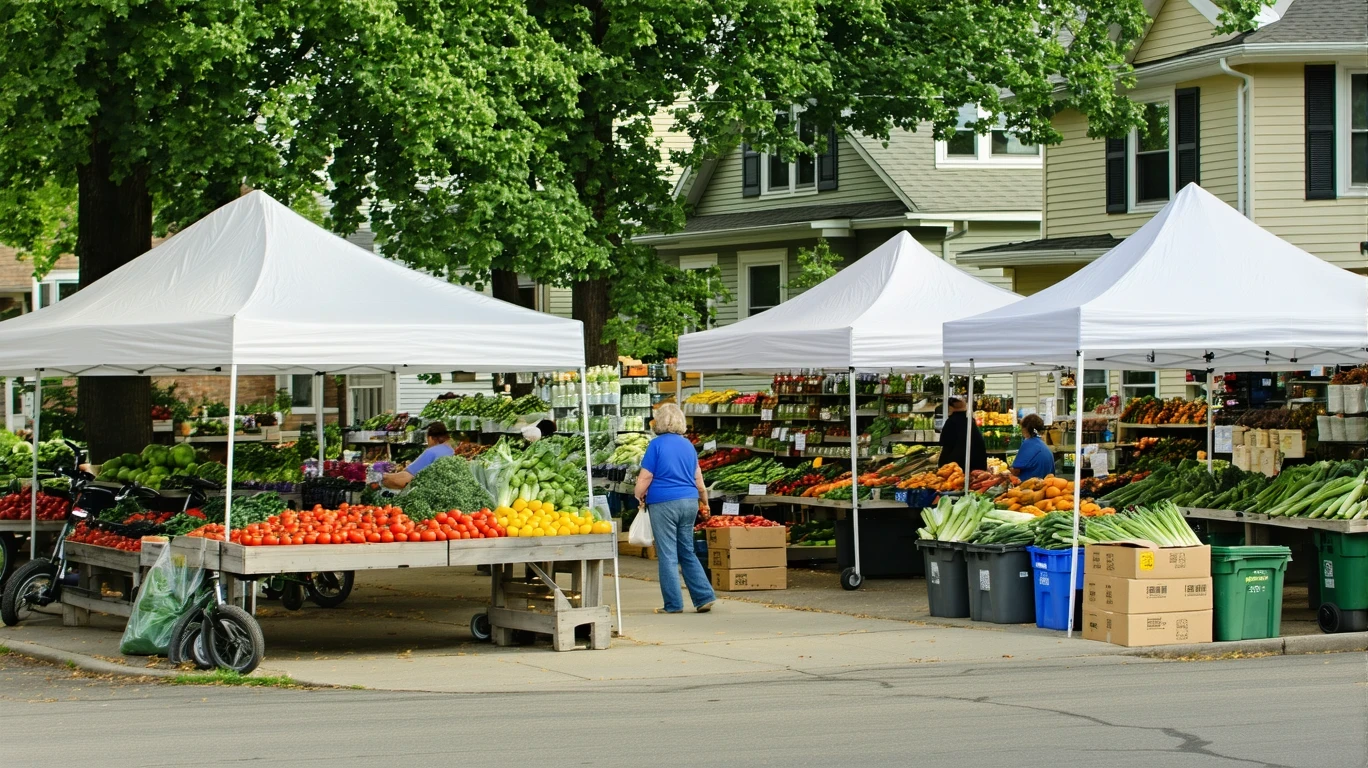
How Grocery Costs Feel in Saint Paul
Grocery prices in Saint Paul track closely to the national baseline, meaning the city doesn’t impose a regional premium or offer a structural discount compared to the rest of the country. For households evaluating a move or budgeting locally, this parity shifts the pressure point: what you pay at checkout depends less on where you live and more on where you shop and how many people you’re feeding. Singles and couples often find grocery costs manageable and predictable, especially when they can access multiple store tiers without long drives. Families with children, however, feel the weight differently—not because Saint Paul is expensive, but because volume amplifies every per-unit price difference, and the gap between discount and premium store tiers becomes a recurring budget variable rather than an occasional splurge.
Saint Paul’s grocery landscape is broadly accessible, with food and grocery establishments distributed at high density across the city. This isn’t just about convenience—it’s about friction. When errands are easy to run and store options are plentiful, households gain leverage: the ability to compare, to switch, to time purchases around sales, and to avoid the car-dependent routine that locks shoppers into a single store by default. The city’s walkable pockets and rail transit further reduce the transportation overlay on grocery costs, particularly for younger professionals and urban-core residents who can fold a grocery stop into a commute or errand loop without burning fuel or parking fees. For cost-sensitive households, this accessibility is structural relief, but it requires intentional store selection to translate into actual savings.
The experience of grocery costs in Saint Paul is less about sticker shock and more about cumulative sensitivity. A household buying for one or two people can absorb variability across categories—splurging on organic produce one week, stretching with rice and beans the next—without destabilizing a monthly budget. A household buying for four or five loses that flexibility. Every dollar-per-pound difference scales, every bulk decision carries weight, and every trip to a mid-tier or premium store instead of a discount grocer compounds over the month. Saint Paul’s at-parity pricing means the city doesn’t make groceries harder, but it also doesn’t make them easier. The pressure is real, and it’s most visible in families where volume, frequency, and variety collide.
Grocery Price Signals (Illustrative)
The table below shows illustrative prices for common staple items in Saint Paul, derived from national baselines adjusted by regional price parity. These figures are not store-specific or week-specific—they represent typical pricing patterns across the city and are meant to anchor understanding of relative cost positioning, not to simulate a shopping cart or receipt. Prices vary by store tier, season, and promotional cycles, and no single number captures the full range a shopper might encounter on any given trip.
| Item | Illustrative Price |
|---|---|
| Bread (per pound) | $1.81/lb |
| Cheese (per pound) | $4.78/lb |
| Chicken (per pound) | $2.03/lb |
| Eggs (per dozen) | $2.35/dozen |
| Ground Beef (per pound) | $6.70/lb |
| Milk (per half-gallon) | $4.07/half-gallon |
| Rice (per pound) | $1.06/lb |
Derived estimate based on national baseline adjusted by regional price parity; not an observed local price.
These prices illustrate how staple items tend to compare locally—not a full shopping list. Ground beef and cheese sit at the higher end of the per-pound spectrum, while rice and bread anchor the lower end, a pattern common across most U.S. markets. Eggs and milk fall in the middle, sensitive to seasonal and supply-chain variability but generally stable in Saint Paul’s competitive retail environment. What matters for household planning is not whether these exact prices appear on your receipt, but how they interact with your shopping habits: a family buying five pounds of chicken weekly feels the $2.03/lb differently than a single person buying one pound every two weeks. Volume turns per-unit pricing into budget architecture.
For households comparing Saint Paul to other cities, the takeaway is this: you’re starting from a neutral baseline. The city neither inflates nor deflates grocery costs structurally, so differences in your experience will come from store choice, household size, and purchasing behavior—not from a regional tax or premium baked into every transaction. That’s useful information for budgeting, but it also means there’s no geographic shortcut to lower grocery bills. The work happens at the store level, not the city level.
Store Choice & Price Sensitivity
Grocery price pressure in Saint Paul varies sharply by store tier, and understanding that variation is more useful than fixating on a single “average” price. Discount grocers—chains and independents focused on private-label goods, limited selection, and no-frills environments—anchor the low end of the pricing spectrum. These stores strip out service, ambiance, and brand variety to deliver staple items at the lowest per-unit cost available in the city. For households willing to plan around a narrower selection and tolerate less convenience, discount grocers offer meaningful relief, especially on high-volume categories like dairy, grains, and frozen staples. The tradeoff is rigidity: fewer organic options, limited specialty items, and a shopping experience built for efficiency rather than exploration.
Mid-tier grocers occupy the middle ground, balancing competitive pricing with broader selection, cleaner stores, and more consistent inventory. These are the chains most households default to—recognizable names, reliable layouts, frequent sales, and enough variety to support diverse diets without requiring multiple stops. Prices at mid-tier stores run higher than discount grocers on most items, but the gap is often smaller than expected, particularly on sale cycles and store-brand equivalents. For families managing both budget and convenience, mid-tier grocers represent the compromise: not the cheapest option, but close enough to avoid financial strain while preserving flexibility and reducing trip frequency.
Premium grocers—whether national chains emphasizing organic and natural products or local independents with curated selections—serve a different function. Prices here run visibly higher across nearly every category, reflecting not just product quality but also store experience, staffing levels, and specialty inventory. For households prioritizing organic produce, sustainable sourcing, or hard-to-find ingredients, premium grocers are often the only option, and the cost premium becomes a fixed budget line rather than a discretionary choice. For everyone else, premium stores are occasional destinations, not weekly anchors, and the decision to shop there is a conscious tradeoff between values and expense.
In Saint Paul, the density and accessibility of grocery options mean most households can reach all three tiers without significant transportation burden. That access creates leverage, but only if used intentionally. A family that defaults to mid-tier convenience for every trip will spend more than a family that splits volume staples to a discount grocer and reserves mid-tier stops for perishables and variety. The city’s structure supports that flexibility, but the household has to execute it. Store choice isn’t just about preference—it’s about recognizing which categories tolerate downgrading and which don’t, and building a routine that reflects that distinction.
What Drives Grocery Pressure Here
Household size is the single largest driver of grocery cost variability in Saint Paul, and it operates as a multiplier rather than a fixed increment. A single person buying chicken at $2.03/lb might purchase one pound per week, a modest and absorbable expense. A family of four buying the same item at the same price might need five or six pounds weekly, turning a small per-unit cost into a recurring budget anchor. This scaling effect applies across nearly every category—dairy, produce, grains, proteins—and it compounds when households shop at mid-tier or premium stores instead of discount grocers. The city’s at-parity pricing means there’s no regional cushion to soften that multiplication; every per-pound or per-unit difference hits at full weight.
Income interaction shapes how grocery costs feel, even when the prices themselves don’t change. For higher-income households, grocery spending is a line item, visible but rarely constraining. Store choice becomes a matter of convenience and preference rather than necessity, and the premium for organic, specialty, or prepared items doesn’t force tradeoffs elsewhere in the budget. For cost-sensitive households, grocery spending is a negotiation: every decision about store tier, brand choice, and category prioritization ripples into other expenses. The city’s strong family infrastructure and high grocery density reduce logistical friction, but they don’t reduce price sensitivity. Access to options is not the same as affordability of options, and households without income buffer feel that distinction every week.
Regional distribution and competitive density also influence grocery pressure, though more subtly. Saint Paul’s broadly accessible food and grocery landscape means most neighborhoods support multiple store options within a short distance, reducing the transportation cost overlay and preventing any single retailer from capturing a captive audience. This competition tends to stabilize prices and increase promotional frequency, particularly at mid-tier chains where market share depends on perceived value. For households willing to track sales, use apps, and shift purchasing timing, this competitive environment creates opportunity. For households without the time, attention, or transportation flexibility to exploit it, the theoretical savings remain theoretical.
Seasonal variability affects certain categories more than others, though Saint Paul’s grocery market doesn’t experience the dramatic swings seen in more isolated or supply-constrained regions. Produce prices fluctuate with national growing seasons, dairy and eggs respond to supply-chain disruptions, and proteins shift with commodity cycles, but the city’s integration into regional and national distribution networks smooths most volatility. What remains is predictable seasonality—berries cost more in winter, root vegetables cost less in fall—and households that cook seasonally can reduce per-unit costs without sacrificing nutrition or variety. The savings aren’t transformative, but they’re consistent, and consistency matters when managing a tight budget over months rather than weeks.
Practical Ways People Manage Grocery Costs
Store splitting—buying different categories at different retailers—is one of the most effective behavioral strategies for managing grocery costs in Saint Paul, and the city’s high grocery density makes it logistically feasible. A household might purchase shelf-stable staples, grains, and frozen items at a discount grocer, then buy fresh produce, dairy, and proteins at a mid-tier chain with better turnover and selection. This approach requires planning and an extra stop, but it allows households to capture the lowest per-unit prices on high-volume items while preserving quality and variety on perishables. The tradeoff is time and transportation, which matters more for car-dependent households or those with limited schedule flexibility, but for urban-core residents with walkable or transit-accessible options, the friction is minimal.
Buying in bulk reduces per-unit costs on non-perishables, but it requires upfront capital and storage space, making it more accessible to families with larger homes and stable income than to singles or renters in smaller units. Warehouse clubs and bulk sections at mid-tier grocers offer meaningful discounts on items like rice, pasta, canned goods, and frozen proteins, but the savings only materialize if the household can use the volume before spoilage or waste erodes the advantage. For families with predictable consumption patterns and room to store a 25-pound bag of rice or a flat of canned tomatoes, bulk buying is a reliable cost lever. For smaller or more variable households, the math is less forgiving, and the risk of over-purchasing turns a discount into a loss.
Tracking sales and using digital coupons requires attention and discipline, but it directly lowers per-unit costs without requiring store switching or bulk commitments. Most mid-tier grocers in Saint Paul run weekly promotional cycles, and many offer app-based discounts that stack with in-store sales. Households that plan meals around what’s on sale—rather than shopping from a fixed list—can reduce grocery spending without sacrificing nutrition or variety. The limitation is time: building a sale-aware shopping routine takes effort, and the savings per trip are incremental rather than transformative. Over a month, however, those increments add up, particularly for families buying high volumes of proteins, dairy, and packaged goods.
Cooking from scratch instead of buying prepared or convenience items is the oldest and most effective cost-control strategy, and it scales with household size. A rotisserie chicken costs more per pound than raw chicken; pre-cut vegetables cost more than whole produce; boxed meals cost more than their component ingredients. The premium for convenience is consistent and significant, and households willing to invest time in meal prep can reduce grocery costs substantially without eating less or worse. The tradeoff, again, is labor and skill: not everyone has the time, energy, or knowledge to cook efficiently from raw ingredients, and for single-person households or dual-income families, the time cost of scratch cooking can outweigh the financial benefit. But for families with predictable schedules and someone able to manage meal planning, the savings are real and recurring.
Groceries vs Eating Out (Directional)
The tradeoff between cooking at home and eating out is less about absolute cost and more about time, convenience, and household composition. Cooking at home almost always costs less per meal than restaurant dining or takeout, but the gap varies widely depending on what you cook, where you shop, and how much food waste you generate. A household that buys ingredients at a discount grocer, cooks in volume, and uses leftovers strategically can prepare meals for a fraction of the cost of even casual dining. A household that shops at premium stores, buys small quantities that spoil, and relies on convenience items narrows that gap considerably, and in some cases, the per-meal cost of home cooking approaches the price of budget takeout.
For families, the math tilts heavily toward home cooking. Feeding four people at a restaurant—even a fast-casual chain—adds up quickly, and doing so multiple times per week becomes a significant budget line. Feeding the same four people at home, even with mid-tier grocery prices, costs a fraction as much, and the savings compound over the month. The challenge is time and labor: cooking for a family requires planning, prep, and cleanup, and for dual-income households or single parents, that time burden is real. The financial advantage of home cooking doesn’t disappear, but it competes with exhaustion, schedule constraints, and the appeal of convenience after a long day.
For singles and couples, the tradeoff is more nuanced. Cooking at home still costs less per meal, but the time investment per serving is higher, and the risk of food waste increases when buying perishables in quantities designed for families. A single person cooking from scratch might spend less than eating out, but the difference per meal is smaller, and the convenience penalty is steeper. For younger professionals with limited cooking skills or unpredictable schedules, the cost savings of home cooking can feel abstract, while the immediacy and simplicity of takeout feel tangible. The decision becomes less about pure economics and more about lifestyle fit, and in Saint Paul’s broadly accessible food environment, both options are viable without requiring long drives or limited selection.
The key insight is that groceries and dining out aren’t binary opposites—they’re points on a spectrum, and most households operate somewhere in the middle. A family might cook at home five nights a week and order pizza on Friday. A single professional might meal-prep on Sunday and grab lunch out twice during the week. The cost impact depends on where the balance sits, and in Saint Paul, the city’s competitive grocery density and diverse restaurant options mean households can adjust that balance without facing access barriers or price shocks. The pressure comes from discipline and intentionality, not from the city’s cost structure.
FAQs About Grocery Costs in Saint Paul (2026)
Is it cheaper to shop in bulk in Saint Paul? Buying in bulk reduces per-unit costs on shelf-stable items like grains, canned goods, and frozen proteins, but it requires upfront capital and storage space. For families with predictable consumption and room to store large quantities, bulk buying delivers consistent savings. For smaller households or renters in tight spaces, the risk of spoilage or waste can erode the advantage.
Which stores in Saint Paul are best for low prices? Discount grocers focused on private-label goods and no-frills environments anchor the low end of the pricing spectrum, offering the lowest per-unit costs on staples. Mid-tier chains balance competitive pricing with broader selection and convenience, while premium grocers charge visibly more for organic, specialty, and curated products. Store choice depends on whether you prioritize cost, variety, or values.
How much more do organic items cost in Saint Paul? Organic products typically carry a noticeable premium over conventional equivalents, with the gap widest on produce, dairy, and proteins. The premium reflects certification, sourcing, and retailer positioning rather than regional markup, and it’s consistent across most U.S. markets. For households prioritizing organic options, the cost becomes a fixed budget line rather than a discretionary choice.
How do grocery costs for families in Saint Paul compare to singles? Household size acts as a multiplier on grocery costs. A single person buying staples at baseline prices experiences modest, absorbable expense. A family of four buying the same items at the same per-unit prices faces significantly higher weekly totals, and the gap between discount and mid-tier store pricing becomes a recurring budget variable rather than an occasional difference.
How do households in Saint Paul think about grocery spending when cooking at home? Most households balance cost, convenience, and quality by splitting purchases across store tiers, tracking sales, and cooking from scratch on high-volume staples while reserving convenience items for time-constrained weeks. The city’s broadly accessible grocery landscape supports flexible routines, but the savings depend on intentional planning rather than default shopping habits.
Does Saint Paul’s grocery market experience seasonal price swings? Produce prices fluctuate with national growing seasons, and certain proteins shift with commodity cycles, but Saint Paul’s integration into regional distribution networks smooths most volatility. Predictable seasonality remains—berries cost more in winter, root vegetables less in fall—and households that cook seasonally can reduce per-unit costs without sacrificing nutrition.
How does store density in Saint Paul affect grocery costs? High grocery density increases competitive pressure, stabilizes prices, and raises promotional frequency, particularly at mid-tier chains. For households willing to track sales and switch stores by category, this density creates opportunity. For those without time or transportation flexibility, the theoretical savings remain harder to capture, but the baseline accessibility reduces logistical friction across all income levels.
How Groceries Fit Into the Cost of Living in Saint Paul
Grocery costs in Saint Paul sit in the middle tier of household expense, below housing and roughly comparable to utilities and transportation for most families. Unlike rent or mortgage payments, which are fixed and non-negotiable month to month, grocery spending is variable and responsive to behavior, making it one of the few cost categories where households retain direct control. That control is real, but it requires intentionality: store choice, meal planning, and purchasing discipline all influence where money goes, and households that treat grocery shopping as a passive routine rather than an active budget lever will spend more than those who engage strategically.
For families, grocery costs scale with household size and become a larger share of monthly outflow, particularly when combined with the time and labor burden of feeding multiple people daily. The city’s strong family infrastructure and broadly accessible grocery landscape reduce logistical friction, but they don’t reduce price sensitivity. A family buying for four or five people feels every per-unit price difference, and the cumulative impact of store tier choice, brand selection, and waste management compounds over weeks and months. The pressure is structural, not regional, and it’s most visible in households where income doesn’t provide a buffer against variability.
For singles and younger professionals, grocery costs are more manageable in absolute terms but still require attention. The risk of food waste, the temptation of convenience items, and the tradeoff between cooking at home and eating out all influence monthly spending, and the city’s competitive dining and grocery options make both paths viable. The key is recognizing that grocery costs don’t exist in isolation—they interact with transportation, time, and lifestyle preferences, and optimizing one category without considering the others can shift pressure rather than relieve it.
Saint Paul’s at-parity pricing means the city neither inflates nor deflates grocery costs structurally, so the experience of affordability depends almost entirely on household composition, income, and behavior. For detailed guidance on how groceries fit into your overall monthly budget—including housing, utilities, transportation, and discretionary spending—see Your Monthly Budget in Saint Paul: Where It Breaks. That article provides the full cost structure and helps you understand where grocery spending sits relative to other fixed and variable expenses, so you can build a realistic plan that reflects your household’s actual needs and constraints.
How this article was built: In addition to public economic data, this article incorporates location-based experiential signals derived from anonymized geographic patterns—such as access density, walkability, and land-use mix—to reflect how day-to-day living actually feels in Saint Paul, MN.