
Can you live in Round Rock without a car? For most households, the answer is no—but the reality is more textured than a simple yes or no. Round Rock sits in the northern arc of the Austin metro, where suburban growth, corridor-based development, and limited transit coverage create a transportation landscape that rewards car ownership and penalizes those who rely solely on public options. Understanding transportation options in Round Rock means recognizing that mobility here is shaped less by choice and more by infrastructure: where you live, where you work, and how far you’re willing to stretch your daily logistics.
This article explains how people actually get around Round Rock in 2026—what transit exists, where driving becomes non-negotiable, and which household types can realistically function without a car. It does not calculate commute costs or transit fares; it explains access, coverage, and the practical tradeoffs that define daily movement in this city.
How People Get Around Round Rock
Round Rock is a car-first city. The pedestrian-to-road ratio exceeds high thresholds in certain pockets, meaning walkability exists—but it’s localized, not universal. Most daily errands, school runs, and commutes require a vehicle. Food and grocery options cluster along commercial corridors rather than spreading evenly across neighborhoods, and both residential and commercial land use are present, but that mix doesn’t eliminate the friction of distance.
What newcomers often misunderstand is that Round Rock’s layout rewards proximity to specific corridors. If you live near a commercial spine with grocery stores, pharmacies, and services, you can reduce some car dependency for errands. But work commutes, especially those heading into Austin or other parts of the metro, almost universally require a car. Only 5.3% of workers in Round Rock work from home, meaning the vast majority leave the house for employment. And with 33.8% of workers facing long commutes, the time-distance burden is real.
The city’s structure reflects decades of suburban growth: single-family neighborhoods branch off arterial roads, parks and schools are accessible but not always walkable from every block, and the street grid prioritizes vehicle throughput over pedestrian convenience. This isn’t a criticism—it’s the reality that shapes how people move.
Public Transit Availability in Round Rock
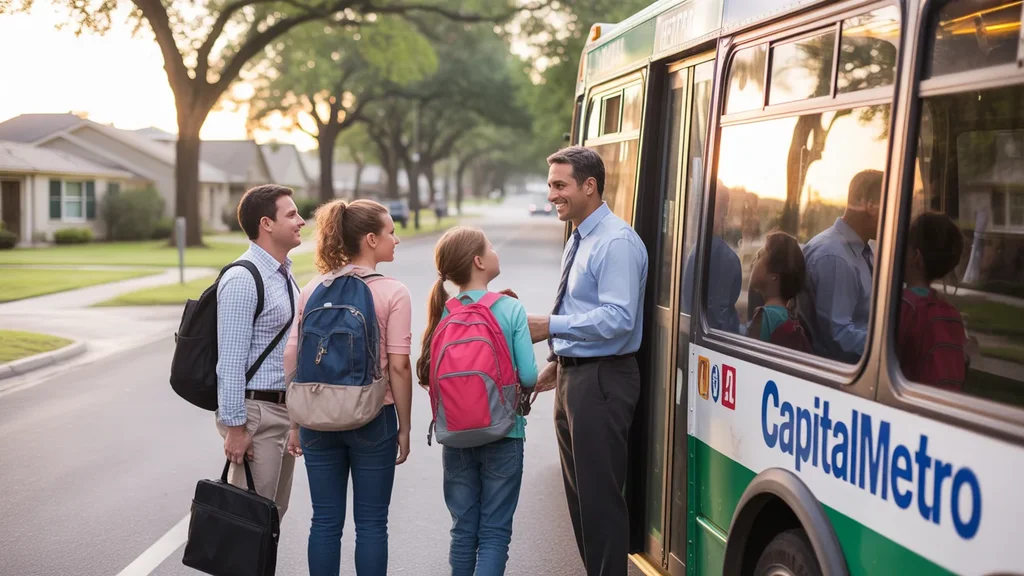
Public transit in Round Rock often centers around systems such as Capital Metro, which provides bus service connecting parts of Round Rock to the broader Austin metro. Bus stops are present throughout the city, but coverage is uneven. Transit works best along established corridors where residential density, commercial activity, and commuter demand align. It falls short in peripheral neighborhoods, late-night hours, and for multi-stop errands that require flexibility.
Bus service is the only rail-free transit option here. There is no light rail, commuter rail, or subway access within Round Rock itself. For residents commuting into Austin, express bus routes can provide a viable alternative to driving—but only if your origin and destination align with existing routes, and only if your schedule tolerates fixed departure times.
Transit’s role in Round Rock is supplemental, not foundational. It serves a minority of households well and leaves the majority reliant on cars. The absence of rail infrastructure limits the speed and reach of public transportation, and the corridor-clustered nature of errands accessibility means that even residents near transit stops often need a car for grocery runs, medical appointments, or family logistics.
Driving & Car Dependence Reality
For the vast majority of Round Rock households, driving is non-negotiable. The city’s layout, the distance between home and work, and the limited reach of public transit make car ownership the default. Parking is abundant and typically free at residential properties, shopping centers, and workplaces, which removes one friction point common in denser cities but reinforces car dependence.
Sprawl is a structural feature here, not an accident. Neighborhoods extend outward from commercial cores, and the distance between daily destinations—home, work, school, grocery store—often spans several miles. Even in areas with higher pedestrian infrastructure density, walking to work is rare. The average commute in Round Rock is 25 minutes, a figure that reflects both intra-city travel and longer trips into Austin or surrounding suburbs.
Car reliance also shapes household expenses indirectly. Owning a vehicle means exposure to fuel prices (currently $3.74 per gallon), maintenance, insurance, and registration costs. But the alternative—trying to patch together a life without a car—introduces time costs, logistical complexity, and access barriers that most households find untenable.
Commuting Patterns & Daily Mobility
Commuting in Round Rock typically follows one of two patterns: single-destination trips (home to work, work to home) or multi-stop chains (drop kids at school, commute to work, pick up groceries on the way back). The latter is far more common among families, and it’s nearly impossible to execute without a car.
The 25-minute average commute masks significant variation. Some residents work locally and face short drives; others commute into Austin or beyond, absorbing 45 minutes or more each way. The 33.8% long-commute figure captures this tail—households for whom distance and time are daily realities, not occasional inconveniences.
Proximity to employment centers matters enormously. Residents who work in Round Rock itself—or in nearby suburbs like Pflugerville or Cedar Park—face shorter, more predictable commutes. Those commuting into central Austin or farther south encounter heavier traffic, longer travel times, and greater exposure to congestion variability.
Who Transit Works For — and Who It Doesn’t
Transit works for a narrow slice of Round Rock households: single adults or couples without children, living near a bus corridor, commuting to a single fixed destination that aligns with existing routes, and willing to trade time flexibility for lower transportation costs. Even within that group, transit is more viable for those whose work hours align with peak service times.
Transit does not work well for families managing school drop-offs, after-school activities, and multi-stop errands. It does not work for shift workers whose hours fall outside standard service windows. And it does not work for residents in peripheral neighborhoods where bus stops are sparse and walking distances to transit are prohibitive.
Renters in corridor-adjacent apartments may find transit more practical than homeowners in detached single-family neighborhoods several miles from commercial spines. But even renters face limitations: grocery shopping via bus is cumbersome, medical appointments require schedule coordination, and any deviation from routine—picking up a sick child, attending an evening event—often necessitates a car.
Transportation Tradeoffs in Round Rock
The tradeoff between transit and driving in Round Rock is not primarily about cost—it’s about control, predictability, and flexibility. Driving offers door-to-door convenience, the ability to chain errands, and immunity to service gaps. Transit offers lower direct costs but imposes time penalties, route constraints, and logistical friction.
For households weighing these tradeoffs, the question is not “Can I save money by using transit?” but “Can I realistically structure my life around fixed routes and schedules?” For most, the answer is no. The city’s layout, the clustering of errands along corridors, and the prevalence of long commutes all favor car ownership.
Households that do choose transit-oriented living must accept narrower housing options (corridor-adjacent rentals), longer trip times, and reduced spontaneity. Those who choose car dependence accept fuel exposure, maintenance unpredictability, and the financial weight of vehicle ownership—but gain time, flexibility, and access.
FAQs About Transportation in Round Rock (2026)
Is public transit usable for daily commuting in Round Rock?
Public transit is usable for a minority of commuters whose routes align with existing bus service and whose schedules tolerate fixed departure times. For most households, especially those with children or multi-stop daily routines, transit is impractical.
Do most people in Round Rock rely on a car?
Yes. The vast majority of Round Rock households depend on cars for commuting, errands, and family logistics. Only a small fraction of residents can function without vehicle access.
Which areas of Round Rock are easiest to live in without a car?
Areas near commercial corridors with bus service, higher pedestrian infrastructure density, and proximity to grocery stores and services offer the best chance of reducing car dependence. Even in these areas, most households still own vehicles.
How does commuting in Round Rock compare to nearby cities?
Round Rock’s average commute of 25 minutes is moderate for the Austin metro. Residents commuting into Austin face longer times and heavier congestion, while those working locally experience shorter, more predictable trips.
Can families realistically use public transit in Round Rock?
Families face the steepest barriers to transit use. School drop-offs, after-school activities, grocery shopping, and medical appointments all require flexibility and multi-stop capability that bus service cannot provide. Most families in Round Rock rely entirely on cars.
How Transportation Fits Into the Cost of Living in Round Rock
Transportation in Round Rock is not just a line item—it’s a structural force that shapes where you can live, how you spend your time, and what tradeoffs you accept. Car dependence is the norm, and that dependence creates exposure to fuel prices, maintenance unpredictability, and insurance costs. But it also unlocks access to housing, employment, and services that would otherwise remain out of reach.
For households evaluating your monthly budget in Round Rock, transportation is a fixed cost in practice, even if it varies in magnitude. The question is not whether you’ll pay for mobility, but how much control you’ll have over that cost and what flexibility you’ll gain in return.
Round Rock rewards those who can absorb the cost of car ownership and penalizes those who cannot. Transit exists, but it serves as a supplement, not a substitute. Understanding that reality—before you move, before you choose a neighborhood, before you commit to a commute—gives you the clarity to make decisions that fit your household’s actual needs, not an idealized version of urban mobility.
How this article was built: In addition to public economic data, this article incorporates location-based experiential signals derived from anonymized geographic patterns—such as access density, walkability, and land-use mix—to reflect how day-to-day living actually feels in Round Rock, TX.