
What does it actually feel like to live in Round Rock? The answer depends less on statistics and more on what you’re trading up for — and what you’re willing to give up. Round Rock sits in the gravitational pull of Austin, offering more space, lower housing pressure, and excellent parks, but it asks residents to navigate growth, traffic, and a car-dependent errand landscape in return. According to sentiment patterns across public discussion, 74 out of 100 residents say they’re happy in Round Rock — but that happiness is textured, not uniform, and it hinges on whether the tradeoffs match your priorities.
The Emotional Landscape of Round Rock
Round Rock’s vibe is defined by a central tension: it’s close enough to Austin to feel connected, but far enough to require intentional effort. People who thrive here tend to value outdoor access, homeownership affordability relative to the metro core, and a family-friendly suburban structure. Those who struggle often cite the day-to-day costs of car dependency, the time burden of commuting, and the lack of walkable urban texture for spontaneous errands or nightlife.
The city’s park system is a consistent bright spot — with park density exceeding high thresholds and water features woven throughout, outdoor recreation feels integrated rather than bolted on. But school and playground density fall below expectations for a family-oriented suburb, creating friction for households with young children who want nearby, walkable access to those amenities.
Growth is both a promise and a source of fatigue. Newcomers appreciate the expanding retail options and job growth tied to Austin’s economy. Long-time residents express ambivalence: they wanted the city to grow, but not necessarily this fast, and not always in ways that preserve the quieter, small-town feel they remember.
“It’s a great place if you have kids and want a yard, but you’re going to spend a lot of time in your car. Everything’s spread out.”
“We moved here for the parks and the schools, and the parks delivered. The schools are fine, but there’s not much within walking distance for the kids.”
What People Talk About Online
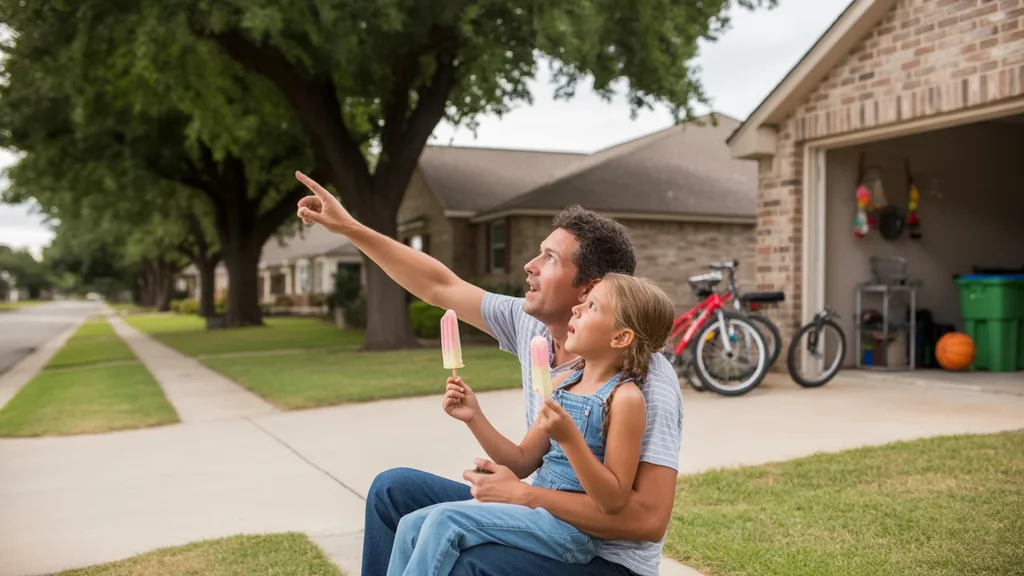
On platforms like Reddit, Facebook groups, and neighborhood forums, Round Rock residents cycle through a few recurring themes: commute strategy, where to eat, how fast the city is changing, and whether it still “feels like Round Rock” or just “North Austin.”
There’s pride in local identity — people defend Round Rock when outsiders dismiss it as a bedroom community — but there’s also self-awareness about its limitations. Conversations about errands and logistics reveal a pragmatic acceptance: you plan trips, you batch stops, you drive. Food and grocery density fall in the medium band, clustered along corridors rather than distributed throughout neighborhoods, which means convenience depends heavily on where you live and whether you’re near one of those commercial spines.
“I love it here, but I miss being able to walk to a coffee shop. Everything requires getting in the car.”
“If you work in Austin, the commute is the price you pay. But you get a lot more house for the money, and the parks are legitimately great.”
“It’s growing so fast. I’m glad we have more restaurants now, but the traffic is getting worse every year.”
Transit discussions are minimal — bus service exists, but it’s not framed as a primary mobility option. The pedestrian-to-road ratio is high in pockets, suggesting some neighborhoods support walking, but the overall errand structure still leans heavily on cars.
How Local Coverage Frames the City
Local news and community outlets tend to frame Round Rock through the lens of growth management, infrastructure catch-up, and identity preservation. Coverage doesn’t dwell on crisis, but it does reflect ongoing negotiation: how to absorb new residents, where to build, what the city should prioritize next.
Simulated topic themes that capture the tone of recurring local coverage:
- “City Weighs New Development Against Neighborhood Character”
- “Traffic Concerns Rise as Population Grows”
- “Residents Celebrate Park Expansions, Ask for More Walkability”
- “Austin Commuters Debate Whether Round Rock Is Worth the Drive”
- “Local Businesses Thrive as Retail Corridors Expand”
The overall editorial tone is neither boosterish nor alarmist — it’s procedural, focused on managing change rather than celebrating or resisting it outright.
Review-Based Public Perception
On Google Reviews, Yelp, and Nextdoor-style platforms, Round Rock earns praise for being clean, safe, and family-friendly, but it also absorbs criticism for being “generic,” “car-dependent,” and “lacking personality.” The divide often breaks along expectation lines: people who wanted suburban comfort tend to be satisfied; people who wanted walkable urbanism or cultural texture tend to feel underwhelmed.
Positive sentiment clusters around:
- Parks, trails, and outdoor amenities
- Relative affordability compared to Austin
- Low unemployment and job access
- Newer housing stock in planned communities
Frustration clusters around:
- Commute times and traffic congestion
- Limited walkability for daily errands
- Perceived sameness in retail and dining
- Rapid growth outpacing infrastructure
Neighborhood variation exists but is often described in broad strokes: newer planned areas offer amenities and HOA structure, while older pockets feel more lived-in and less polished. Mixed residential and commercial land use is present, but it doesn’t translate into the kind of dense, walkable main street experience some residents expect from a city this size.
“It’s a solid suburb. You won’t be wowed, but you won’t be disappointed if you know what you’re getting.”
How Round Rock Compares to Nearby Cities
| Dimension | Round Rock | Austin | Cedar Park |
|---|---|---|---|
| Overall Vibe | Suburban, family-focused, park-rich | Urban, eclectic, culturally dense | Quieter, newer, more insulated |
| Walkability | Pockets exist, but car-dependent overall | Strong in core, weak in sprawl | Minimal; designed for driving |
| Commute Burden | Moderate to high for Austin workers | Varies widely by neighborhood | Similar to Round Rock |
| Growth Tension | Visible, ongoing, debated | Intense, polarizing, expensive | Managed, less contentious |
| Outdoor Access | Excellent parks, integrated green space | Strong but crowded | Good, but less dense |
Round Rock occupies a middle position: it’s more affordable and spacious than Austin, but less walkable and less culturally textured. It’s more established and park-rich than Cedar Park, but also more congested and faster-growing. The choice between them isn’t about “better” — it’s about whether you prioritize access to Austin’s core, tolerance for traffic, and how much you value outdoor amenities versus urban spontaneity.
If you need to be in Austin frequently and want a yard, Round Rock works. If you want to avoid the car entirely, Austin’s core is the better fit. If you want the quietest, newest suburban experience and don’t mind being further out, Cedar Park may feel more insulated.
What Locals Are Saying
“We moved here from California and it’s been great for our budget. The parks are amazing, and we actually have a backyard. The commute to Austin is rough, but we knew that going in.”
— Family with two kids, relocated 2021
“I grew up here and it’s changed so much. It’s not bad, just different. More crowded, more traffic, more chain restaurants. I miss the small-town feel.”
— Long-time resident, 30s
“If you work remotely, it’s perfect. You get space, good internet, and access to Austin when you want it. If you commute every day, it’s going to wear on you.”
— Remote tech worker, early 40s
“The parks are legitimately the best thing about living here. We’re at the trails or the lake almost every weekend. But running errands is a chore — everything’s a drive.”
— Young professional couple, no kids
“It’s fine. It’s safe, it’s clean, the schools are decent. But there’s not much to do unless you drive to Austin, and at that point, why not just live there?”
— Renter, late 20s, considering a move
“We love it. It’s affordable, the neighbors are friendly, and we’re close enough to Austin for work and entertainment. The traffic is the only real downside.”
— Dual-income household, mid-30s
“I thought it would feel more walkable than it does. There are sidewalks in some areas, but you still need a car for groceries, errands, everything. It’s very suburban.”
— Transplant from a walkable city, early 30s
Does Round Rock Feel Like a Good Fit?
Round Rock works best for people who want proximity to Austin without Austin’s housing pressure, who value outdoor access and space, and who are comfortable with car dependency as the default mode of daily life. It tends to frustrate people who want walkable urbanism, dense cultural amenities, or minimal commute burden.
The city’s emotional profile is pragmatic rather than passionate. Residents appreciate what it offers — parks, affordability relative to the metro core, job access, safety — but they’re also clear-eyed about what it lacks: spontaneity, walkable texture, transit viability, and the kind of neighborhood-scale infrastructure (schools, playgrounds) that would make family life feel less car-reliant.
If you’re deciding whether Round Rock fits, ask yourself:
- Do I need to be in Austin regularly, and am I willing to spend time commuting?
- Do I prioritize outdoor recreation and green space?
- Am I comfortable planning errands around driving, or do I need walkable access?
- Do I value space and homeownership affordability over urban amenities?
Round Rock doesn’t try to be Austin. It offers a different set of tradeoffs — and for the right household, those tradeoffs feel like wins. For others, they feel like compromises that add up over time.
To explore how these tradeoffs translate into quality of life factors or financial planning, consider reviewing related guides on income pressure, monthly budgets, and housing costs in Round Rock.
How this article was built: In addition to public economic data, this article incorporates location-based experiential signals derived from anonymized geographic patterns—such as access density, walkability, and land-use mix—to reflect how day-to-day living actually feels in Round Rock, TX.
The perspectives shown reflect commonly expressed local sentiment and recurring themes in public discussion, rather than individual accounts.