
Transit Coverage & Ride Time Overview
| Transit Mode | Coverage Pattern | Best Fit |
|---|---|---|
| Rail | Present; serves key corridors | Core areas, predictable schedules |
| Bus | Available; coverage varies | Flexible routes, neighborhood access |
| Bike Infrastructure | Notable presence throughout | Short trips, active commuters |
| Driving | Dominant for peripheral areas | Multi-stop errands, off-peak travel |
Note: Coverage reflects infrastructure presence; actual service frequency and reach vary by neighborhood and time of day.
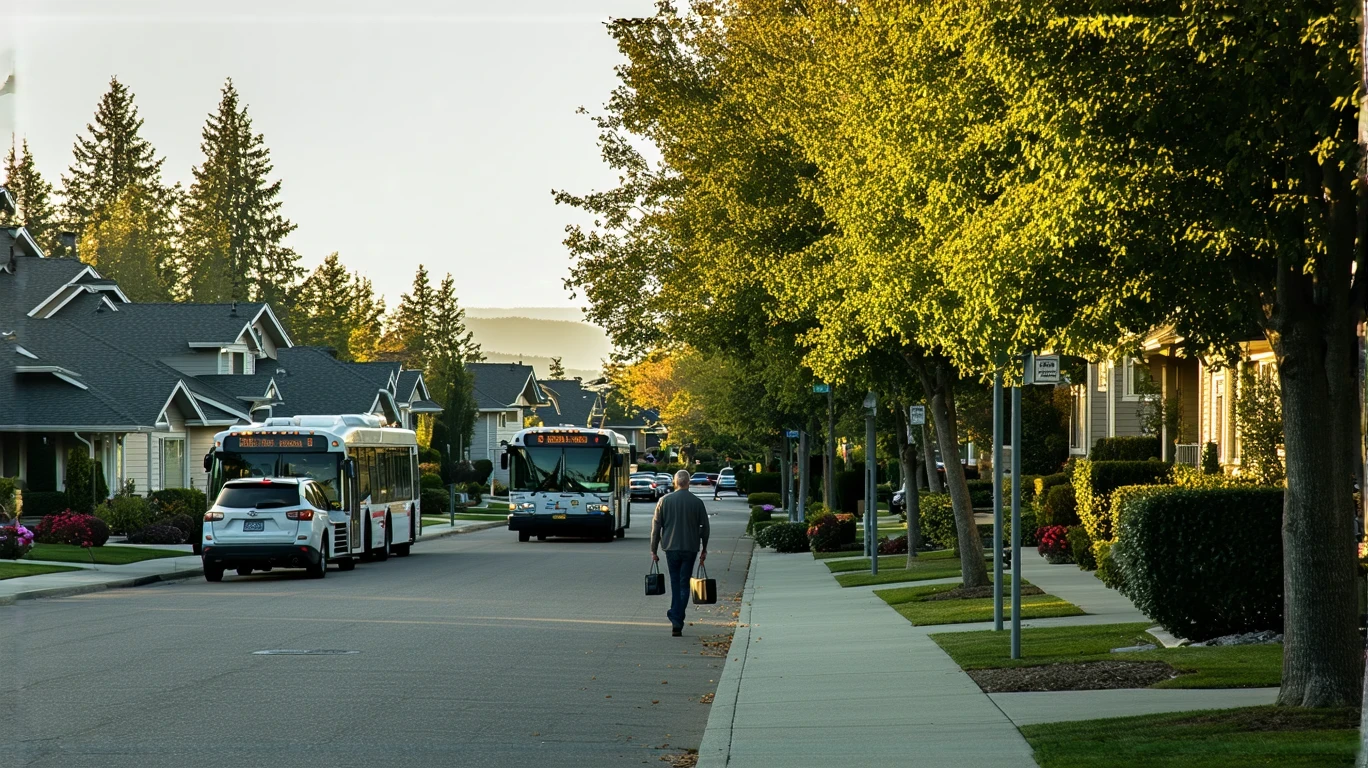
How People Get Around Redmond
Understanding transportation options in Redmond starts with recognizing that this is a city built around choices, not constraints. Unlike purely car-dependent suburbs or transit-saturated urban cores, Redmond offers a mixed mobility landscape where rail service, substantial pedestrian infrastructure, and notable bike networks coexist with the practical realities of driving. The city’s structure supports different transportation strategies in different neighborhoods, and what works for one household may not suit another.
Newcomers often assume Redmond operates like a typical suburban sprawl where everyone drives everywhere, or conversely, that proximity to Seattle means seamless transit access citywide. Neither assumption holds. The presence of rail transit and high pedestrian-to-road ratios in certain areas creates pockets where car-optional living is genuinely viable, while other parts of the city remain oriented around vehicle access. The key is understanding where those boundaries fall and how your daily routine intersects with the city’s infrastructure.
Redmond’s layout reflects its evolution from a bedroom community into a regional employment hub. That shift has shaped how people move: some residents commute inbound to tech campuses or downtown Seattle, others work locally and rarely leave the city, and still others navigate multi-stop days that mix errands, childcare, and flexible work schedules. The transportation system accommodates all of these patterns, but not equally well in every neighborhood.
Public Transit Availability in Redmond
Public transit in Redmond often centers around systems such as Sound Transit and King County Metro, though coverage and service patterns vary significantly by area. Rail service is present and plays a meaningful role for residents near stations, particularly those commuting to Seattle or Bellevue. The existence of rail infrastructure distinguishes Redmond from many suburban cities and creates genuine alternatives to driving for certain trips.
Transit tends to work best along established corridors where density, mixed-use development, and pedestrian infrastructure converge. In these areas, residents can realistically structure their day around scheduled service, especially for predictable commutes or regular errands. The presence of both residential and commercial land use in walkable zones means that transit users often have grocery stores, pharmacies, and other daily needs within reach of stations or bus stops.
Where transit falls short is in peripheral neighborhoods, late-hour coverage, and multi-stop trips that don’t align with fixed routes. Families managing school pickups, evening activities, or weekend errands often find that transit adds friction rather than convenience. The system is designed to move people efficiently along specific paths, not to replicate the flexibility of a personal vehicle.
Bus service complements rail by extending reach into residential areas and providing connections between neighborhoods. However, frequency and span of service vary, and riders in less central areas may face longer waits or limited evening and weekend options. The practical question isn’t whether transit exists in Redmond—it does—but whether it aligns with your specific routine and location.
Driving & Car Dependence Reality
For many Redmond households, driving remains the primary mode of transportation, not out of preference but because the city’s geography and development pattern make it the most practical choice. Parking is generally abundant and free in most residential areas, which removes one of the major disincentives to car ownership that exists in denser cities. This ease of parking reinforces driving as the default option, even for trips that could theoretically be made by transit or bike.
Car dependence in Redmond is less about sprawl and more about the mismatch between where people live, where they work, and where they run errands. Even in neighborhoods with good pedestrian infrastructure, the distance between home and workplace—or between home and a child’s school, or between multiple errands—often exceeds what’s walkable or bikeable in a reasonable timeframe. The city’s layout assumes that most residents have access to a vehicle, and infrastructure reflects that assumption.
Driving also offers control over timing and routing that transit cannot match. For households with irregular schedules, multiple jobs, or caregiving responsibilities, the ability to leave on your own timeline and take the most direct route is not a luxury—it’s a necessity. This is especially true for families managing complex logistics or workers with shifts that don’t align with peak transit hours.
The tradeoff is exposure to fuel costs, maintenance, insurance, and the time spent in traffic during peak hours. Redmond’s proximity to major employment centers means that commute congestion is real, particularly on routes toward Seattle or Bellevue. Drivers absorb that friction in exchange for flexibility, and for many, the calculation still favors the car.
Commuting Patterns & Daily Mobility
Commuting in Redmond reflects the city’s dual role as both a residential community and an employment hub. Some residents work locally, often at one of the major tech campuses, and experience short, predictable commutes that may or may not involve a car. Others commute outbound to Seattle, Bellevue, or other parts of King County, and their transportation choices hinge on whether they live near transit or in areas where driving is the only viable option.
Single-job commuters with fixed schedules are the most likely to benefit from transit, especially if they live in walkable pockets near rail stations. For these households, the daily routine becomes structured around departure times and station access, and the predictability of rail service can reduce stress compared to navigating traffic. The presence of mixed-use development near transit hubs also means that some errands can be handled on foot before or after the commute.
Multi-stop commuters—those who need to drop off children, pick up groceries, or manage appointments in addition to getting to work—face a different reality. Transit works poorly for trips that require flexibility or multiple destinations, and these households typically rely on driving even if they live in transit-accessible areas. The structure of the day dictates the mode, not the other way around.
Proximity matters more in Redmond than in cities with ubiquitous transit coverage. Living within walking distance of a rail station or a frequent bus route fundamentally changes your options, while living a mile away often means driving to the station or skipping transit altogether. The difference between car-optional and car-dependent living in Redmond often comes down to a few blocks.
Who Transit Works For — and Who It Doesn’t
Transit in Redmond works best for individuals or couples without children, particularly those who work predictable hours at a single location and live in core areas near rail or high-frequency bus routes. These households can structure their lives around transit schedules, and the presence of grocery stores, pharmacies, and other daily needs within walking distance of stations makes car-optional living genuinely feasible.
Renters in mixed-use neighborhoods near transit hubs often find that they can go days or even weeks without needing a car, especially if they work remotely part of the time or have flexible schedules. The high pedestrian-to-road ratio in these areas means that walking feels safe and practical, and the presence of bike infrastructure offers another option for short trips. For this group, transit is not a compromise—it’s a functional, cost-effective choice.
Families with children face a different calculus. School locations, activity schedules, and the logistics of managing multiple people with different needs make transit far less practical. Even in transit-rich neighborhoods, the complexity of coordinating pickups, drop-offs, and errands typically pushes families toward car ownership. The flexibility of driving outweighs the cost savings of transit when time and convenience are at a premium.
Homeowners in peripheral neighborhoods, regardless of household composition, are almost universally car-dependent. These areas were built around vehicle access, and transit service—if it exists at all—is limited to infrequent bus routes that don’t support daily commuting. For these residents, the question isn’t whether to own a car, but whether to own one or two.
Transportation Tradeoffs in Redmond
Choosing between transit and driving in Redmond is less about cost and more about control, predictability, and how much friction you’re willing to absorb in exchange for flexibility. Transit offers lower direct expenses and eliminates the need to navigate traffic or find parking, but it requires living in the right location and accepting fixed schedules. Driving offers autonomy and convenience but exposes you to fuel volatility, maintenance costs, and the time lost to congestion.
For households that can structure their lives around transit, the tradeoff often favors public transportation, especially when combined with walkability and bike infrastructure. The ability to avoid car ownership entirely removes a significant fixed cost and simplifies daily logistics. However, this option is only viable for a subset of Redmond residents—those in core areas with access to rail and frequent bus service.
For everyone else, the tradeoff tilts toward driving. The flexibility to leave when you want, take the route you prefer, and handle multiple stops in a single trip is difficult to replicate with transit. This is especially true for households managing complex schedules or living in areas where transit coverage is sparse. The cost of driving becomes the price of maintaining control over your time and routine.
Biking occupies a middle ground in Redmond. The notable presence of bike infrastructure makes it a viable option for short trips, especially in neighborhoods with mixed land use and low-stress routes. However, biking is rarely a complete substitute for either transit or driving—it works best as a complement, reducing the number of car trips without eliminating the need for a vehicle altogether.
FAQs About Transportation in Redmond (2026)
Is public transit usable for daily commuting in Redmond?
Yes, but it depends heavily on where you live and where you work. Residents in walkable pockets near rail stations can realistically use transit for predictable, single-destination commutes, especially to Seattle or Bellevue. Those in peripheral neighborhoods or with multi-stop routines will find transit far less practical.
Do most people in Redmond rely on a car?
Most households in Redmond own at least one car, and many own two. While transit and bike infrastructure exist and serve certain populations well, the city’s layout and the complexity of daily logistics mean that driving remains the dominant mode of transportation for the majority of residents.
Which areas of Redmond are easiest to live in without a car?
Neighborhoods near rail stations with high pedestrian infrastructure and mixed-use development offer the most car-optional living. These areas combine transit access with walkable errands and often include bike infrastructure, making it possible to structure daily life without a vehicle. Peripheral residential areas are far more car-dependent.
How does commuting in Redmond compare to nearby cities?
Redmond offers more transit options than typical suburban cities but less coverage than Seattle or Bellevue. The presence of rail service and notable bike infrastructure distinguishes it from purely car-dependent suburbs, but the city’s layout still assumes vehicle access for most residents. Commute patterns vary widely based on neighborhood and employment location.
Can you get by with just a bike in Redmond?
Biking works well for short trips in neighborhoods with strong bike infrastructure and mixed land use, but it’s rarely sufficient as a sole mode of transportation. Weather, distance, and the need to carry groceries or manage family logistics typically require either transit or a car as a backup. Biking is most effective as part of a multi-modal strategy.
How Transportation Fits Into the Cost of Living in Redmond
Transportation in Redmond is not just a line item in a budget—it’s a structural factor that shapes where you can live, how you spend your time, and what tradeoffs you’re willing to accept. Households that can access transit and walkable infrastructure gain flexibility in housing choice and reduce fixed costs, while those who rely on driving absorb fuel, maintenance, and insurance expenses in exchange for control and convenience.
The presence of rail service, high pedestrian-to-road ratios in certain areas, and notable bike infrastructure means that car-optional living is genuinely possible for some Redmond residents. However, this option is tied to location, and the neighborhoods where it works tend to command higher rents or home prices. The cost savings from avoiding car ownership may be offset by higher housing costs, and the tradeoff depends on your priorities and household structure.
For a fuller picture of how transportation costs interact with housing, utilities, and other expenses, see A Month of Expenses in Redmond: What It Feels Like. That article breaks down where money goes and how different household types navigate the city’s cost structure.
Understanding transportation in Redmond means recognizing that the city offers real choices, but those choices are unevenly distributed. Where you live determines what’s practical, and what’s practical shapes how you experience daily life. The key is matching your transportation strategy to your location, routine, and tolerance for friction—not assuming that one mode works for everyone.
How this article was built: In addition to public economic data, this article incorporates location-based experiential signals derived from anonymized geographic patterns—such as access density, walkability, and land-use mix—to reflect how day-to-day living actually feels in Redmond, WA.