
You’re standing in a Pearland driveway, keys in hand, and the question hits: Will I actually like living here? Not just tolerate it—but feel like this place fits the rhythm of your life, the things you value, the tradeoffs you’re willing to make?
Pearland sits in the Houston metro with a median household income of $111,123 per year and a median home value of $311,100. It’s a city that many families move to for space, newer construction, and a suburban refuge from Houston’s intensity. But sentiment here isn’t one-note. What feels like relief to some—low-rise neighborhoods, car-oriented errands, economic stability—feels like limitation to others. The vibe depends heavily on what you’re escaping and what you’re hoping to find.
The Emotional Landscape of Pearland
Pearland’s overall tone is comfortable but car-dependent, with pockets of walkable infrastructure but a structure that assumes you’ll drive for nearly everything. The pedestrian-to-road ratio sits in a medium band, meaning sidewalks exist and some streets feel pleasant to walk, but spontaneous errands on foot aren’t the norm. Food establishment density falls below low thresholds, and grocery density is moderate—so running out for milk or grabbing takeout requires a plan and a vehicle, not a quick stroll.
For families drawn to the idea of suburban ease, this can feel freeing: wide streets, parking at every destination, low-rise homes with yards. But for households expecting the convenience narrative often attached to suburbs—walk to the park, bike to school, grab coffee on the corner—Pearland’s infrastructure doesn’t fully deliver. School and playground density both fall below thresholds, which surprises some newcomers who assumed “family-friendly” meant saturated access to those amenities.
The city’s low-rise character is consistent and strong. Average building levels stay well below thresholds, creating a horizontal, residential feel. There’s a mix of residential and commercial land use, but it’s scattered rather than tightly woven. You’ll find what you need, but it’s spread out, and the errands that feel effortless in denser places require more logistical thought here.
Park density sits in a moderate range, and water features add some natural texture. Green space exists, but it’s not saturated—access is present, not automatic. For some, that’s enough. For others, it’s a gap they didn’t expect.
What People Talk About Online
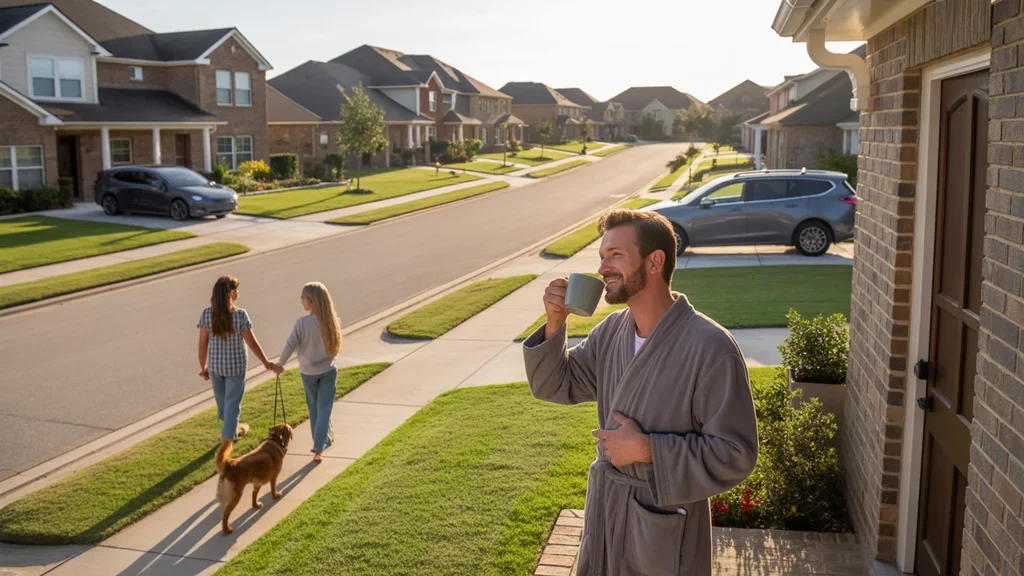
In local Facebook groups and on platforms like Reddit, Pearland residents tend to talk about growth, identity, and the tension between convenience and quiet. There’s pride in the city’s economic stability and its role as a Houston bedroom community, but there’s also fatigue around traffic, development pace, and the feeling that the city is “still figuring out what it wants to be.”
“It’s a great place to raise kids if you’re okay with driving everywhere. But don’t expect to walk to anything—that’s just not how it’s set up.”
“I love that it feels calmer than Houston, but sometimes I miss being able to just pop out for something without planning the whole trip.”
“Newer areas feel really polished, but some of the older pockets have more character. It depends what you’re looking for.”
Recurring themes include appreciation for space and safety, frustration with day-to-day costs (especially rent, which has a median of $1,622 per month), and ambivalence about whether Pearland feels like “home” or just a practical landing spot. There’s affection here, but it’s often conditional—tied to life stage, income level, and tolerance for car dependency.
How Local Coverage Frames the City
Local news and community outlets tend to frame Pearland through the lens of growth management, infrastructure catch-up, and suburban identity evolution. Coverage doesn’t dwell on crises, but it does reflect ongoing negotiation: what should growth look like, who benefits, and what gets left behind?
Simulated topic frames you might see:
- “Community Debates What Growth Should Look Like”
- “New Retail and Dining Options Arrive as Development Continues”
- “Residents Weigh Convenience Against Preserving Neighborhood Quiet”
- “Schools and Infrastructure Expansion Discussed at City Meetings”
- “Pearland’s Role in the Houston Metro: Bedroom Community or Something More?”
The tone is generally constructive but not celebratory. There’s acknowledgment of success—low unemployment at 4.4%, strong household incomes—but also recognition that infrastructure, accessibility, and identity are still in flux.
What Reviews and Public Perception Reveal
On platforms like Google Reviews, Yelp, and Nextdoor-style forums, Pearland gets high marks for safety, space, and schools—but more mixed feedback on walkability, spontaneity, and local character.
Positive sentiment often centers on:
- Newer homes with modern layouts and yards
- Proximity to Houston without the intensity
- Low crime and family-oriented reputation
- Access to big-box retail and chain dining
Critiques tend to focus on:
- Car dependency for every errand
- Limited walkable texture or pedestrian-friendly districts
- Sparse local dining and entertainment compared to denser suburbs
- Rent and housing pressure that doesn’t always match the amenity level
- Feeling more like a collection of subdivisions than a cohesive town
Neighborhood variation exists but is often described in broad strokes: newer planned areas feel polished and uniform, while older pockets offer more established trees and varied architecture. Neither is objectively better—it’s about preference.
Healthcare access is routine and local. Clinics and pharmacies are present, but there’s no hospital within city limits, so serious medical needs require a drive. For most households, that’s manageable. For others—especially aging residents or those with chronic conditions—it’s a friction point.
How Pearland Compares to Nearby Cities
| Dimension | Pearland | League City | Missouri City |
|---|---|---|---|
| Overall Vibe | Suburban comfort, car-dependent, growth in progress | Coastal proximity, slightly more recreational feel | Diverse, established, mixed density pockets |
| Walkability | Mixed infrastructure, limited errands on foot | Similar car dependency, some trail access | Varies by neighborhood, some denser areas |
| Family Infrastructure | Limited density despite family branding | Moderate school and park access | Stronger established school presence |
| Housing Character | Newer builds dominate, low-rise, planned feel | Mix of older and newer, more waterfront options | More varied ages, established neighborhoods |
| Commute Role | Houston bedroom community, car-heavy | Similar commuter role, some NASA proximity | Fort Bend commuter base, diverse employment ties |
Pearland, League City, and Missouri City all serve Houston-area households seeking suburban space, but the texture differs. Pearland leans newer and more uniform, with strong income levels but infrastructure still catching up. League City offers slightly more recreational and coastal character. Missouri City feels more established, with greater neighborhood variation and denser pockets in some areas.
If you want the newest construction and don’t mind car dependency, Pearland fits. If you want more neighborhood texture or slightly better walkable moments, Missouri City might feel more lived-in. If water access or trail networks matter, League City could edge ahead. None is objectively superior—it’s about aligning expectations with structure.
Voices from Different Life Stages
“We moved here for the schools and the space, and we got both. But I didn’t realize how much I’d miss being able to walk anywhere. Everything requires getting in the car.”
— Parent of two, relocated from inner-loop Houston
“Pearland works if you have a solid income and a reliable car. If either of those is shaky, it gets hard fast. Rent isn’t cheap, and you can’t really function without a vehicle.”
— Young professional, renting near Highway 288
“I like the quiet and the newer homes, but it does feel a little… samey? Like every block looks like the last one. It’s comfortable, just not very distinctive.”
— Remote worker, moved from Austin
“It’s a great landing spot if you work in Houston but want to come home to something calmer. Just know you’re trading walkability and spontaneity for space and safety.”
— Long-time resident, originally from League City
“The parks are nice, but they’re not everywhere. You have to drive to most of them, which kind of defeats the purpose of ‘neighborhood green space.’”
— Retiree, downsized from a larger home in Sugar Land
“I thought ‘family-friendly’ meant playgrounds and schools on every corner. That’s not really the case here. They exist, but they’re spread out.”
— Newcomer with young children
“If you’re okay with chain restaurants and big-box stores, you’ll be fine. If you want local spots or walkable districts, you’ll probably feel like something’s missing.”
— Transplant from a denser East Coast suburb
Does Pearland Feel Like a Good Fit?
Pearland doesn’t ask you to love it unconditionally—it asks whether you can work with its tradeoffs. It tends to work well for families with stable incomes, reliable vehicles, and a preference for low-rise residential calm. It rewards those who value space over spontaneity, who are comfortable planning errands rather than walking to them, and who see Houston proximity as an asset rather than a daily burden.
It tends to frustrate households expecting walkable convenience, renters facing pressure from median rents above $1,600, and families assuming “family-friendly” means saturated access to schools and playgrounds. The infrastructure exists, but it’s not dense. The amenities are present, but they’re scattered. The city works, but it requires a car, a plan, and often a higher income than newcomers expect.
If you’re moving to Pearland, the question isn’t whether it’s happy or sad—it’s whether the things that feel limiting to some are acceptable to you, and whether the things that feel rewarding to others align with what you actually need day-to-day. The city’s vibe is stable, suburban, and still evolving. Whether that feels like home depends on what you’re hoping to escape and what you’re willing to drive for.
For a clearer picture of what daily life requires or how the financial pieces fit together, exploring related budget and housing contexts can help sharpen the decision.
How this article was built: In addition to public economic data, this article incorporates location-based experiential signals derived from anonymized geographic patterns—such as access density, walkability, and land-use mix—to reflect how day-to-day living actually feels in Pearland, TX.
The perspectives shown reflect commonly expressed local sentiment and recurring themes in public discussion, rather than individual accounts.