
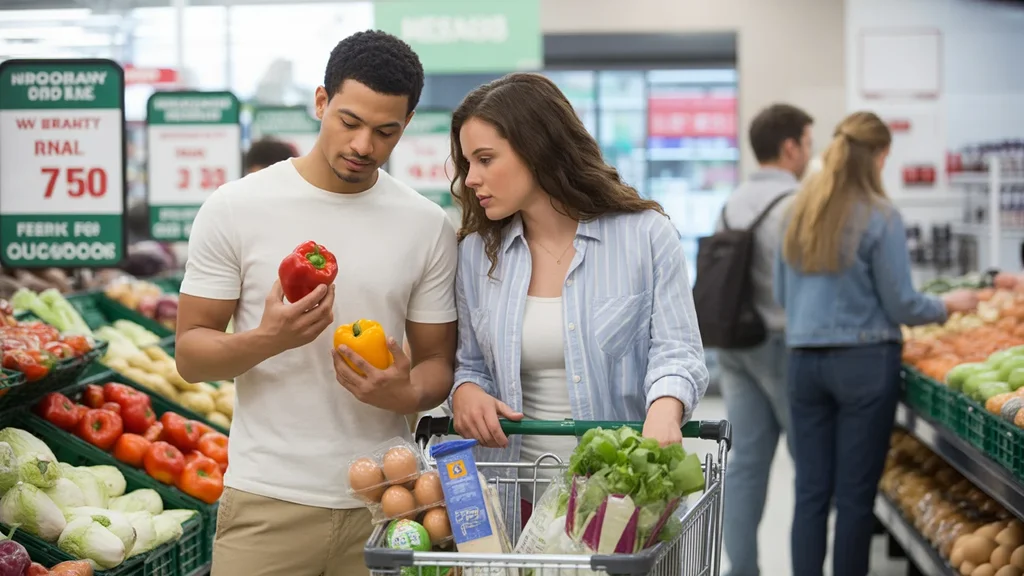
How Grocery Costs Feel in Norman
Grocery prices in Norman sit comfortably below the national average, reflecting the city’s broader cost structure. With a regional price parity index of 91, Norman offers meaningful relief on staple items compared to higher-cost metros. For households earning near the median income of $62,849 per year, food costs don’t typically dominate the budget the way housing or transportation might. That said, the experience of grocery shopping here isn’t shaped by price alone—it’s also shaped by where you shop, how far you’re willing to drive, and how much planning you’re prepared to do.
Singles and young professionals often notice grocery costs most acutely, not because prices are high, but because smaller households can’t spread fixed trip costs or bulk discounts across as many meals. A carton of eggs at $2.27/dozen or a pound of chicken at $1.86/lb feels reasonable in isolation, but when you’re shopping for one or two people, the per-meal math doesn’t always favor home cooking over convenience. Families with children, on the other hand, face a different calculus: lower per-item prices help, but household size amplifies sensitivity to store choice and trip frequency. Retirees on fixed incomes benefit from Norman’s below-average pricing, though access patterns—how close the right store is, and whether it’s reachable without a long drive—often matter more than the per-pound price of ground beef.
The city’s grocery landscape reflects a pattern common to college towns and mid-sized Oklahoma communities: options exist, but they’re not always evenly distributed or densely clustered. That creates friction for households that prioritize convenience, variety, or specialty items. It also means that grocery costs in Norman are less about sticker shock and more about the tradeoffs you’re willing to make between price, proximity, and product selection.
Grocery Price Signals (Illustrative)
These prices illustrate how staple items tend to compare locally—not a full shopping list. They’re derived estimates based on national baselines adjusted for Norman’s regional cost structure, and they reflect typical pricing patterns rather than store-specific or week-specific snapshots. Use them as anchors for understanding relative affordability, not as checkout-accurate figures.
| Item | Typical Price |
|---|---|
| Bread | $1.68/lb |
| Cheese | $4.26/lb |
| Chicken | $1.86/lb |
| Eggs | $2.27/dozen |
| Ground Beef | $6.13/lb |
| Milk | $3.66/half-gallon |
| Rice | $0.98/lb |
Protein and dairy—chicken, ground beef, eggs, and milk—anchor most household grocery budgets, and Norman’s pricing on these items trends noticeably lower than what you’d find in higher-cost metros or coastal markets. Rice at under a dollar per pound and bread at $1.68/lb reinforce the broader affordability picture. Cheese, while higher in absolute terms, still reflects the same regional discount. These aren’t rock-bottom prices, but they’re competitive enough that most households won’t feel squeezed by the cost of staples alone.
What these numbers don’t capture is variability across store types. A pound of chicken at a discount grocer might come in well below $1.86/lb, while the same cut at a premium or specialty market could easily exceed it. The illustrative figures above represent a middle ground—useful for understanding Norman’s position relative to other cities, but not a substitute for comparing actual shelf tags when you’re deciding where to shop.
Store Choice & Price Sensitivity
Grocery price pressure in Norman varies more by store tier than by any single “average” experience. Discount grocers—both regional chains and national operators—anchor the low end of the pricing spectrum, offering the tightest margins on staples and the most predictable savings for households willing to trade ambiance and selection for lower checkout totals. Mid-tier stores, including familiar national chains, occupy the middle ground: competitive pricing on everyday items, broader selection, and more convenient locations. Premium and specialty grocers—whether focused on organic, natural, or prepared foods—charge noticeably more, but they serve households that prioritize quality, variety, or specific dietary needs over price.
For families with children or retirees managing fixed incomes, the difference between discount and mid-tier pricing can add up quickly over the course of a month. A household that consistently shops at a discount grocer might see meaningful savings on proteins, dairy, and pantry staples compared to one that defaults to a mid-tier or premium option. Singles and young professionals, especially those with less predictable schedules or smaller storage capacity, often find themselves splitting trips between tiers: discount stores for bulk staples, mid-tier chains for fill-ins, and occasional premium stops for specialty items or prepared meals.
Norman’s grocery density sits below thresholds that would make every neighborhood equally accessible to every store type. That means store choice isn’t always a pure price decision—it’s also a function of proximity, trip frequency, and whether you’re willing to drive farther to access a specific tier. Households that live near a discount grocer have a structural advantage in managing food costs. Those who don’t face a tradeoff: accept higher per-item prices at a nearby mid-tier store, or build longer trips into the weekly routine. For some households, the time and fuel cost of driving to a cheaper store erases part of the savings. For others, especially larger families, the math still favors the longer trip.
What Drives Grocery Pressure Here
Income plays a quieter role in Norman than it does in higher-cost metros, but it still shapes how grocery costs feel. At a median household income of $62,849 per year, most families have enough margin to absorb typical grocery spending without severe tradeoffs—but that margin tightens for households earning below the median, especially when housing and transportation costs are already claiming a large share of the budget. Grocery spending doesn’t scale linearly with income; a household earning half the median doesn’t spend half as much on food. That asymmetry means lower-income households feel price changes more acutely, even when absolute prices are below the national average.
Household size amplifies sensitivity in both directions. A single adult might spend less in absolute terms but faces higher per-meal costs because bulk discounts and multi-pack pricing don’t deliver the same value. A family of four or five can leverage volume purchasing more effectively, but total grocery spending rises sharply, and any price increase on high-frequency items—milk, eggs, bread, chicken—compounds quickly. Larger households also face more friction when trying to shift between store tiers, because the time cost of an extra trip doesn’t shrink just because you’re buying more.
Access patterns—how grocery options are distributed across Norman—create uneven pressure. Sparse grocery density means some households live within easy reach of multiple store types, while others face longer drives or fewer choices. That geographic friction doesn’t show up in item-level pricing, but it shapes the lived experience of grocery shopping. Households with limited transportation options, whether due to vehicle access or time constraints, often pay a convenience premium by defaulting to the nearest store rather than the cheapest one. Seasonal variability, while less pronounced in Oklahoma than in regions with extreme weather, still affects availability and pricing on fresh produce, especially during late winter and early spring when local growing seasons haven’t yet resumed.
Practical Ways People Manage Grocery Costs
Store rotation—splitting trips between discount grocers for staples and mid-tier chains for fill-ins—gives households more control over total spending without sacrificing variety or convenience entirely. It requires more planning than defaulting to a single store, but it lets you capture lower prices on high-frequency items while still accessing a broader selection when needed. Households that treat discount grocers as the anchor and mid-tier stores as the supplement tend to see the most consistent savings over time.
Buying in bulk works best for larger households or those with adequate storage, but it’s not a universal solution. Non-perishables—rice, pasta, canned goods—offer the clearest advantage, because they don’t spoil and per-unit costs drop meaningfully at higher volumes. Proteins and dairy are trickier; bulk purchasing only pays off if you have freezer space and a clear plan for using what you buy before quality degrades. Singles and smaller households often find that bulk pricing doesn’t align with their consumption patterns, and the upfront cost can strain weekly budgets even when the per-pound math looks favorable.
Meal planning reduces waste and smooths out spending by aligning grocery trips with actual consumption rather than impulse or convenience. It also makes it easier to take advantage of sales and seasonal pricing without over-purchasing. Households that plan meals around what’s already on sale—rather than building a list first and hoping prices cooperate—tend to experience less volatility in weekly grocery costs. Cooking from scratch, especially for proteins and prepared foods, lowers per-meal costs substantially, but it requires time, skill, and consistent access to a functional kitchen. For households with unpredictable schedules or limited cooking infrastructure, the time cost can outweigh the financial benefit.
Loyalty programs and digital coupons offer modest savings, but they work best when combined with other strategies rather than relied upon in isolation. They’re most effective for households that already shop frequently at a specific chain and can absorb the planning overhead of checking apps or clipping offers before each trip. The savings aren’t transformative, but they add up over time, especially on higher-priced items like meat and dairy.
Groceries vs Eating Out (Directional)
The tradeoff between cooking at home and eating out in Norman isn’t purely financial—it’s also about time, convenience, and how much friction you’re willing to tolerate in exchange for lower per-meal costs. Cooking at home almost always costs less per meal than restaurant dining or takeout, but the gap narrows when you factor in the time required to shop, prep, cook, and clean. For singles and young professionals with unpredictable schedules, the convenience premium of eating out can feel justified, especially when grocery trips require longer drives or when perishables spoil before they’re used.
Families with children face a different calculus. Eating out for a household of four or five gets expensive quickly, even at mid-tier or casual dining spots. Home cooking offers much clearer savings at that scale, but it also demands more planning, more trips, and more labor. The households that manage this tradeoff most effectively tend to treat eating out as occasional rather than routine, reserving it for nights when time or energy is scarce rather than defaulting to it as a convenience baseline.
Retirees and fixed-income households often find that cooking at home is the only sustainable option, not because eating out is unaffordable in absolute terms, but because the frequency required to replace home-cooked meals would claim too large a share of the monthly budget. For these households, grocery costs—even at Norman’s below-average price levels—become the primary lever for managing food spending, and store choice, meal planning, and waste reduction take on outsize importance.
FAQs About Grocery Costs in Norman (2026)
Is it cheaper to shop in bulk in Norman? Bulk purchasing lowers per-unit costs on non-perishables and some proteins, but it requires upfront cash and adequate storage. Larger households benefit most; singles often find that bulk pricing doesn’t align with their consumption patterns.
Which stores in Norman are best for low prices? Discount grocers consistently offer the lowest prices on staples, while mid-tier chains balance price and selection. Premium and specialty stores charge more but serve households prioritizing quality or specific dietary needs over cost.
How much more do organic items cost in Norman? Organic and specialty items typically carry a noticeable premium over conventional equivalents, though the gap varies by store tier and product category. Households that prioritize organic options should expect higher checkout totals, even in a below-average cost market like Norman.
How do grocery costs for two adults in Norman tend to compare to nearby cities? Norman’s below-average regional price parity means grocery costs for two adults generally run lower than in higher-cost metros or coastal markets. Compared to nearby Oklahoma City, the difference is modest, but Norman’s pricing remains competitive across most staple categories.
How do households in Norman think about grocery spending when cooking at home? Most households treat grocery spending as a controllable expense, using store choice, meal planning, and bulk purchasing to manage costs. The focus is less on per-item prices—which are already below the national average—and more on reducing waste, trip frequency, and convenience premiums.
Does Norman’s college-town character affect grocery prices? College towns often see higher demand for convenience items and prepared foods, which can push prices up at stores near campus. Away from the university core, pricing tends to reflect broader regional patterns rather than student-driven demand.
How does sparse grocery density affect food costs in Norman? Low grocery density doesn’t raise item prices directly, but it increases the time and fuel cost of reaching the right store. Households that live farther from discount grocers often face a choice: pay a convenience premium at a nearby mid-tier store, or build longer trips into the weekly routine.
How Groceries Fit Into the Cost of Living in Norman
Groceries occupy a smaller share of the typical household budget in Norman than housing or transportation, but they’re one of the few categories where behavior and planning can shift costs meaningfully in the short term. Unlike rent or a mortgage—which reset annually at best—or utilities, which fluctuate with weather and usage, grocery spending responds quickly to changes in store choice, meal planning, and waste reduction. That makes it a useful lever for households trying to create margin elsewhere in the budget, especially when income is fixed or when other costs are rising.
That said, grocery costs don’t exist in isolation. A household that saves money by driving farther to a discount grocer might offset part of that savings with higher fuel costs. A household that reduces grocery spending by cooking at home more often gains financial margin but loses time and convenience. The tradeoffs are real, and they vary by household type, income level, and how much friction you’re willing to absorb in exchange for lower costs.
For a complete picture of how grocery spending fits into your monthly budget in Norman, including housing, utilities, transportation, and other recurring expenses, the Monthly Budget article provides the full breakdown. Groceries are one piece of the puzzle, but understanding how all the pieces interact—and where your household has the most control—requires looking at the whole structure, not just individual line items.
Norman’s below-average grocery prices offer real relief compared to higher-cost metros, but the experience of shopping here is shaped as much by access, store choice, and planning as it is by per-item pricing. Households that treat grocery costs as a controllable expense—rather than a fixed obligation—tend to find the most margin, especially when they’re willing to rotate between store tiers, plan meals around what’s on sale, and minimize waste. The city’s sparse grocery density adds friction, but it doesn’t eliminate the structural affordability advantage that comes with living in a below-average cost market. For most households, grocery costs in Norman feel manageable, as long as you’re prepared to do the work of managing them.
How this article was built: In addition to public economic data, this article incorporates location-based experiential signals derived from anonymized geographic patterns—such as access density, walkability, and land-use mix—to reflect how day-to-day living actually feels in Norman, OK.