
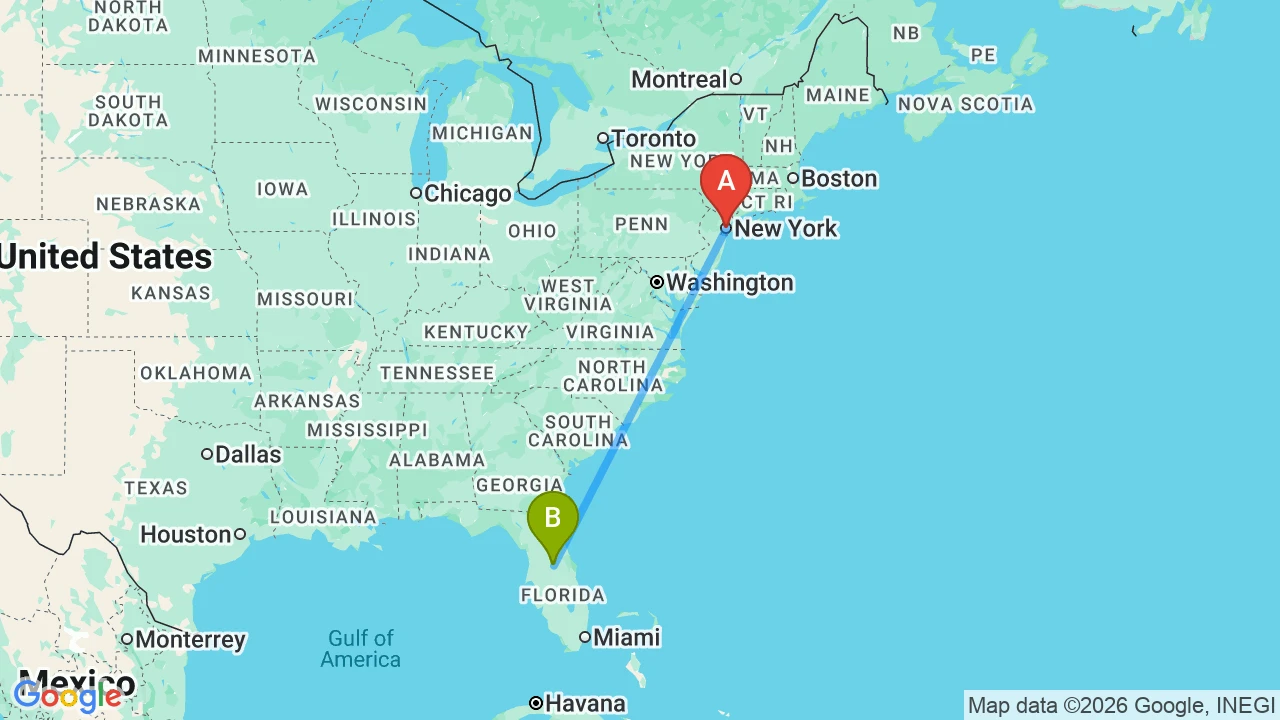
Moving from New York, NY to Winter Garden, FL represents one of the more dramatic relocations in the U.S.—not just in distance, but in how daily costs concentrate, how neighborhoods function, and how households manage logistics. This guide explains where financial pressure shifts, how lifestyle rhythms change, and which household types tend to feel relief versus new friction after the move.
This is not a savings calculator or affordability verdict. It’s a structural comparison of where costs show up, how they behave, and who experiences the greatest change in day-to-day financial texture.
Cost Pressure Shifts: Where Money Concentrates Differently
The most immediate financial shift is the collapse of housing entry barriers. New York’s median home value sits at $732,100, while Winter Garden’s stands at $408,700—a substantial reduction in the capital required to enter ownership. Renters see a smaller but still meaningful gap: New York’s median gross rent is $1,714 per month, compared to Winter Garden’s $1,590 per month.
But the headline housing numbers tell only part of the story. In New York, housing costs dominate household budgets so completely that other expenses often compress into whatever margin remains. In Winter Garden, housing takes a smaller share—but that freed capacity gets redirected into categories that barely registered in New York: transportation infrastructure (car ownership, insurance, maintenance), climate control (extended cooling seasons in hot, humid summers), and spatial maintenance (larger homes, yard upkeep, HOA dues in many neighborhoods).
Utilities illustrate this redirection clearly. New York’s electricity rate is 26.95¢/kWh, while Winter Garden’s is 15.70¢/kWh—a lower per-unit cost. But Winter Garden’s long cooling season and typical single-family home construction mean households often use far more electricity overall. The result: lower rates don’t necessarily translate to lower bills, especially in summer months when air conditioning runs continuously.
Transportation costs flip entirely. In New York, 26.5% of workers operate from home, and the city’s transit infrastructure allows many households to avoid car ownership altogether. Winter Garden sits within the Orlando metro, where car dependence is the norm. Gas prices are slightly lower ($2.86/gal vs. $2.97/gal), but that marginal savings disappears quickly once you account for insurance, registration, maintenance, and the reality that most errands require driving.
Income dynamics add another layer. Winter Garden’s median household income is $101,953 per year—substantially higher than New York’s $76,607. This might suggest greater financial breathing room, but it reflects selection bias: Winter Garden attracts households who already cleared New York’s income thresholds and are seeking spatial expansion. For movers who don’t bring remote income or transferable high earnings, Winter Garden’s job market may not replicate New York wages, and the car-dependent lifestyle can erode income gains faster than expected.
Housing & Neighborhood Patterns: Entry vs. Ongoing Obligations
New York’s housing market is defined by scarcity and vertical density. Entry costs are punishing, but once you’re in—especially as a renter—ongoing obligations can feel predictable, if relentless. You’re paying for proximity, access, and the ability to function without a car. Ownership in New York often means condos or co-ops with strict boards, high maintenance fees, and limited control over building-level decisions.
Winter Garden’s housing market operates on entirely different logic. Entry barriers are lower, but ongoing obligations multiply. Many neighborhoods are organized around homeowners associations (HOAs) that bundle landscaping, amenities, and community standards—adding monthly dues that renters in New York never encountered. Homes are larger, which means more space to heat, cool, furnish, and maintain. Yards require upkeep. Roof repairs, HVAC replacements, and pest control become routine budget items rather than landlord problems.
The rental market in Winter Garden exists but functions as a secondary option. Most inventory is single-family homes or townhomes, often in communities designed for ownership. Renters may find fewer choices, less walkable access, and leases that assume car ownership. For households testing the market before committing, this can feel isolating compared to New York’s dense rental infrastructure.
Neighborhood form also shapes daily costs in ways that aren’t immediately visible. Winter Garden’s infrastructure reflects a mix of suburban development patterns: some areas feature walkable pockets with higher pedestrian-to-road ratios, while others require driving for every errand. Food and grocery density sits in the medium band—options exist, but they’re concentrated along corridors rather than distributed evenly. This means households in certain subdivisions may drive 10–15 minutes for routine shopping, adding time and fuel costs that never appeared in a New York budget.
Lifestyle & Daily Rhythms: Pace, Access, and Car Dependence
New York’s rhythm is defined by density, transit, and the assumption that most needs are within walking distance or a short subway ride. Errands layer into commutes. Social plans don’t require coordination around parking. The city’s infrastructure absorbs logistical friction, but it extracts payment through rent, noise, crowds, and the constant hum of proximity.
Winter Garden operates at a fundamentally different tempo. The built environment spreads horizontally, and daily life requires a car for nearly everything. Commutes aren’t measured in subway stops but in highway miles. Errands become distinct trips rather than layered stops. This shift doesn’t just change transportation costs—it restructures how households allocate time, plan routines, and manage spontaneity.
For families, this can feel liberating. Yards, parks (Winter Garden’s park density exceeds high thresholds, with integrated green space and water features), and quieter streets offer a pace that’s hard to access in New York without extreme wealth. For singles or couples who thrived on New York’s walkability and density, Winter Garden can feel logistically exhausting—every coffee run, every social plan, every forgotten grocery item requires getting in the car.
Climate exposure also inverts. New York’s winters demand heating, but most renters don’t control the system or pay directly for fuel. Summers are hot but manageable without central air in many apartments. Winter Garden’s climate is defined by heat and humidity: long, intense summers where air conditioning isn’t optional, and mild winters that rarely require heating. Households accustomed to layering for cold weather must now budget for cooling systems that run from April through October, with electric bills spiking during peak summer months.
The social texture shifts, too. New York’s density creates accidental community—you see neighbors on the subway, in the bodega, on the stoop. Winter Garden’s suburban form requires intentional effort to build social connection. Neighborhoods may feel quiet, even isolated, especially for movers who don’t immediately plug into schools, HOAs, or local groups.
Relocation Logistics & Practical Friction
The physical act of moving from New York to Winter Garden involves more than hiring movers. It’s a transition between two infrastructure systems that assume entirely different household behaviors.
In New York, many households don’t own cars. Moving to Winter Garden means acquiring one (or two), navigating Florida’s insurance market (which can be volatile and expensive), registering vehicles, and learning new commute patterns. For households moving with children, school districts become a primary search filter—something that barely registered in New York’s neighborhood-level school assignment system.
Utility setup in Winter Garden often involves more direct relationships with providers. In New York, many renters never touch a gas or electric account—it’s bundled or managed by the landlord. In Winter Garden, especially for homeowners, you’re setting up electric, water, trash, and possibly gas accounts independently. You’re also inheriting maintenance responsibilities that landlords previously absorbed: HVAC servicing, pest control, irrigation systems, and HOA compliance.
Healthcare access shifts from hospital-dense urban infrastructure to a more distributed suburban model. Winter Garden has clinics and pharmacies, but no hospital within city limits. For routine care, this may not matter. For households with chronic conditions or anyone accustomed to having multiple specialists within a short subway ride, the change can feel like a loss of security.
The timeline for adjustment varies widely. Households moving with remote income, families seeking space, and retirees leaving behind New York’s intensity often feel immediate relief. Singles, couples without kids, and anyone whose career depends on in-person urban networks may spend months feeling unmoored, questioning whether the lower housing costs justify the logistical overhead and social isolation.
Frequently Asked Questions
- Does Winter Garden, FL feel more or less expensive than New York, NY?
- Winter Garden’s lower housing entry costs create immediate relief, but the shift isn’t a simple reduction—it’s a redistribution. Money that once went to rent or mortgage in New York now spreads across car ownership, insurance, utilities (driven by extended cooling seasons), and home maintenance. Households with remote income or high transferable earnings often feel less financial pressure overall. Those relying on local wages or accustomed to New York’s car-free lifestyle may find that savings evaporate faster than expected once transportation and climate control costs accumulate.
- How do housing markets differ between New York and Winter Garden?
- New York’s market is defined by scarcity, vertical density, and punishing entry costs, with median home values at $732,100 and rents at $1,714/month. Winter Garden’s median home value ($408,700) and rent ($1,590/month) are lower, but the market assumes car ownership, larger homes, and often HOA participation. Ownership in Winter Garden means taking on maintenance, utilities, and spatial obligations that landlords absorbed in New York. Renters in Winter Garden face fewer options and less walkable access compared to New York’s dense rental infrastructure.
- What feels different about daily life after moving from New York to Winter Garden?
- The most immediate shift is car dependence—nearly every errand, social plan, and commute requires driving, replacing New York’s layered, transit-enabled routines. The pace slows, neighborhoods spread out, and spontaneity requires more planning. Families and remote workers often appreciate the space, quiet, and access to parks. Singles and couples who thrived on New York’s density may feel isolated, especially in subdivisions where social connection requires intentional effort rather than accidental proximity.
- When does the move from New York to Winter Garden tend to feel easiest or hardest?
- Timing ease depends more on household readiness than season. Families moving before a school year, remote workers with income stability, and retirees seeking a slower pace tend to adjust quickly. The hardest transitions happen when movers underestimate car dependence, overestimate local wage replacement, or arrive without social infrastructure in place. Summer’s heat and humidity can feel oppressive for those unprepared for months of air conditioning costs, while winter’s mildness offers a gentler introduction to Florida’s climate.
- What are the most common challenges when relocating from New York to Winter Garden?
- Car acquisition and insurance costs surprise many movers, especially those who never owned a vehicle in New York. The logistical overhead of driving everywhere—errands, social plans, healthcare—can feel exhausting compared to New York’s transit-enabled layering. Social isolation is common in suburban subdivisions where neighbors drive into garages and community requires intentional effort. Households also underestimate ongoing home maintenance costs, HOA dues, and the reality that lower housing costs don’t always translate to lower overall expenses once transportation and utilities are factored in.
- Who does this move work best for—and who might struggle?
- This move tends to benefit families seeking space and schools, remote workers with stable income, and retirees leaving behind New York’s intensity and cost pressure. Households who value yards, quiet, and car-enabled flexibility often thrive. The move is harder for singles and couples without kids, anyone whose career depends on in-person urban networks, and households relying on local wages to replace New York income. Those who loved New York’s walkability, density, and accidental community may find Winter Garden’s suburban form logistically and socially isolating, even if housing costs drop.
Conclusion: Where Pressure Moves, Not Whether It Disappears
Relocating from New York to Winter Garden isn’t a simple cost reduction—it’s a structural shift in how money, time, and logistics organize daily life. Housing entry barriers drop significantly, but ongoing obligations multiply: car ownership, insurance, utilities shaped by long cooling seasons, and maintenance responsibilities that landlords once absorbed. Income patterns look favorable on paper, but they reflect selection bias toward households who already cleared New York’s thresholds and are seeking spatial expansion rather than career growth.
Families, remote workers, and retirees often find Winter Garden’s slower pace, green space, and lower housing costs align well with their priorities. Singles, couples without kids, and anyone whose career depends on dense urban networks may struggle with car dependence, social isolation, and the realization that freed housing capacity gets consumed by transportation and climate control faster than expected.
The move works best for those who understand they’re trading New York’s intensity and access for space, quiet, and a fundamentally car-dependent lifestyle—and who have the income stability and household structure to absorb that shift without financial or social strain.
For deeper city-specific context, explore Winter Garden’s full cost breakdown and New York’s cost profile on IndexYard.
How this article was built: In addition to public economic data, this article incorporates location-based experiential signals derived from anonymized geographic patterns—such as access density, walkability, and land-use mix—to reflect how day-to-day living actually feels in Winter Garden, FL.