
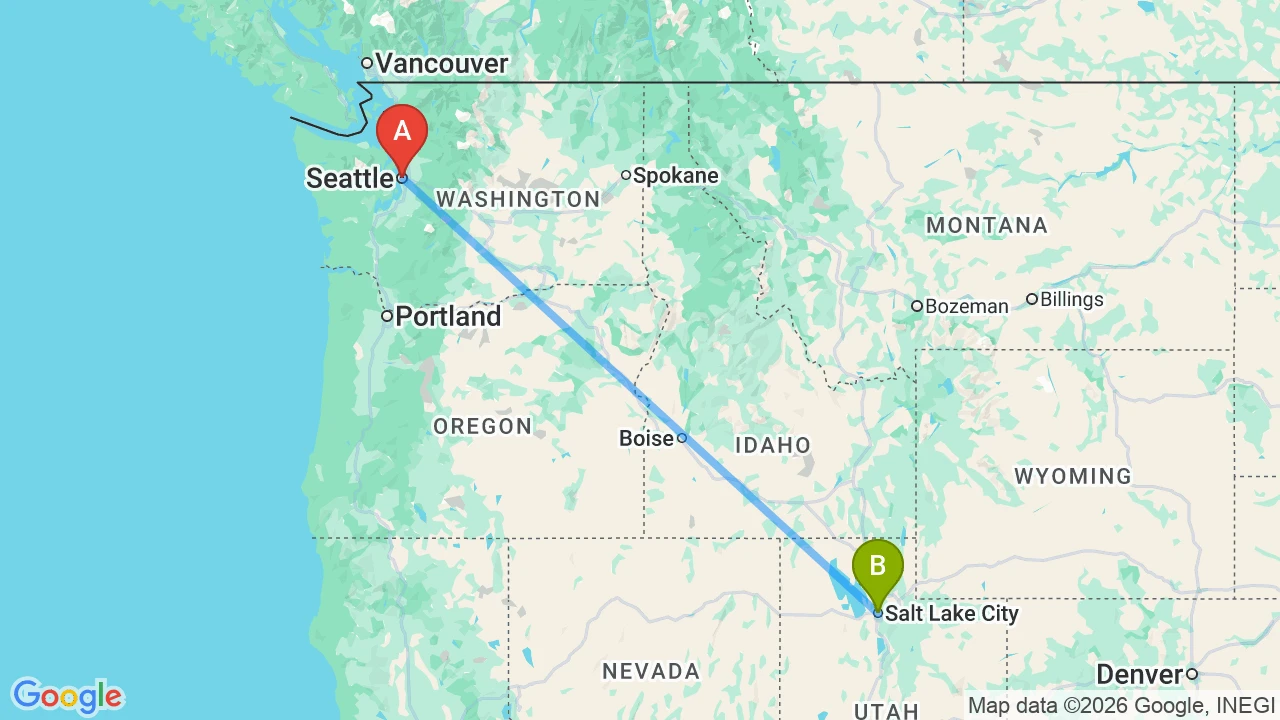
The move from Seattle to Salt Lake City represents one of the more dramatic housing cost resets available within cities that still offer urban infrastructure, transit access, and walkable neighborhoods. But this isn’t a simple “everything costs less” story. While housing entry barriers drop substantially, the income context shifts downward too, and the texture of daily expenses changes in ways that don’t always track with the headline savings.
This guide explains how cost pressure, lifestyle rhythms, and household logistics typically shift when relocating from Seattle to Salt Lake City in 2026. It’s not about declaring a winner or calculating total savings—it’s about understanding where costs concentrate differently, and which household types tend to feel relief versus new friction.
Where Cost Pressure Moves
The most immediate change is housing. Seattle’s median home value sits at $879,900, while Salt Lake City’s is $458,600. For renters, the gap is similarly wide: Seattle’s median gross rent is $1,945 per month compared to Salt Lake City’s $1,254. That’s a substantial reduction in the single largest monthly obligation for most households, and it opens doors—literally—for buyers who’ve been priced out of Seattle’s market entirely.
But housing relief doesn’t exist in isolation. Seattle’s median household income is $116,068 per year, while Salt Lake City’s is $72,357. That’s a $43,711 difference, and it matters deeply for households whose earning power is tied to Seattle’s tech-heavy economy. If you’re moving with a job that pays Seattle wages remotely, the cost reset feels dramatic. If you’re starting fresh in Salt Lake City’s local labor market, the income adjustment can absorb much of the housing savings.
Transportation costs shift favorably. Gas prices drop from $4.36 per gallon in Seattle to $2.79 in Salt Lake City, and the average commute shortens from 27 minutes to 19 minutes. Fewer Salt Lake City workers face long commutes—19.4% compared to Seattle’s 43.2%—which suggests less time and fuel burned on daily logistics. For households running multiple errands or managing school drop-offs, that time compression adds up.
Grocery costs also trend lower. Derived estimates suggest bread drops from around $2.08 per pound in Seattle to $1.77 in Salt Lake City, ground beef from $7.63 to $6.48 per pound, and milk from $4.63 to $3.94 per half-gallon. These are regional price parity adjustments, not observed retail prices, but they reflect the broader cost environment: Salt Lake City’s overall price level sits at 96 relative to the national baseline, compared to Seattle’s 113.
Utilities present a mixed picture. Electricity rates are nearly identical—13.33¢ per kWh in Seattle versus 12.99¢ in Salt Lake City—but natural gas costs drop significantly, from $16.72 per MCF in Seattle to $10.21 in Salt Lake City. For households heating with gas during cold months, that’s meaningful relief. Both cities experience cold weather, but Salt Lake City’s longer, more intense heating season means gas bills can still add up despite the lower rate.
Housing and Neighborhood Patterns
Both Seattle and Salt Lake City offer urban infrastructure that supports daily life without total car dependence. Location-based signals show that both cities feature walkable pockets with substantial pedestrian infrastructure, rail transit systems, broadly accessible food and grocery options, and integrated green space. Family infrastructure—schools and playgrounds—meets density thresholds in both places, and hospital access is present.
What changes isn’t the presence of these amenities, but the price you pay to live near them. In Seattle, proximity to transit, parks, and walkable commercial corridors commands a steep premium. In Salt Lake City, similar neighborhood qualities exist at a lower entry cost, which means households can access urban conveniences without stretching as far financially.
For renters, the $691 monthly difference in median rent translates to more breathing room in the budget or the ability to afford a larger unit, extra bedroom, or better-located apartment. For buyers, the $421,300 gap in median home value can mean the difference between renting indefinitely and building equity, or between a condo and a single-family home.
But ownership in Salt Lake City still requires navigating a market where demand has been rising and inventory remains tight in desirable neighborhoods. The lower entry price doesn’t guarantee easy access—it just shifts the threshold from “nearly impossible” to “challenging but feasible” for many households.
Lifestyle and Daily Rhythms
Seattle and Salt Lake City both support mixed mobility patterns. You can walk, bike, and use transit in both cities, particularly in denser neighborhoods. But the commute culture differs. Seattle’s longer average commute and higher percentage of long-distance commuters suggest a more sprawling metro area where people often live far from work. Salt Lake City’s shorter average commute and lower long-commute percentage indicate a more compact daily radius for many residents.
Work-from-home prevalence drops from 6.3% in Seattle to 3.5% in Salt Lake City, which suggests a more in-person work culture. If you’re relocating with a remote job, that won’t affect you directly, but it does shape the broader rhythm of the city—rush hour intensity, midday foot traffic, and the availability of daytime services.
Both cities experience cold weather, but the seasonal texture differs. Seattle’s climate is milder and wetter, with extended cool, drizzly periods. Salt Lake City faces colder winters with more snow and hotter, drier summers. That shift affects utility exposure—more intense heating and cooling seasons—and also changes outdoor routines, from what you wear to when you’re comfortable spending time outside.
Access to outdoor space remains strong in both cities. Parks and water features are integrated into the urban fabric, and both places support active lifestyles. The difference is less about availability and more about climate context: Seattle’s year-round moderate temperatures versus Salt Lake City’s sharper seasonal swings.
Relocation Logistics and Practical Friction
The physical move from Seattle to Salt Lake City covers roughly 840 miles, typically a 12–13 hour drive or a short flight. For households moving themselves, that’s a multi-day drive with at least one overnight stop. For those hiring movers, it’s a long-haul interstate move, which tends to cost more than regional relocations.
Timing matters. Both cities experience winter weather that can complicate moving logistics—snow in Salt Lake City, ice and rain in Seattle. Summer and early fall tend to offer the most predictable conditions, though that’s also peak moving season, which can mean higher costs and less availability for trucks and labor.
What surprises many movers is the income adjustment period. If you’re arriving without a job lined up, Salt Lake City’s lower median income means salary expectations need recalibration. Even for remote workers, the shift in local price context can feel disorienting—you’re paying less for housing, but you’re also surrounded by a labor market where $72,357 is the median household income, not $116,068.
Another common friction point: the cultural and social reset. Seattle and Salt Lake City are both urban centers with access to arts, dining, and recreation, but the social fabric differs. Seattle skews more secular and politically progressive; Salt Lake City has a strong religious community presence that shapes everything from alcohol availability to weekend rhythms. That’s not a cost issue, but it affects how quickly you feel at home.
How this article was built: In addition to public economic data, this article incorporates location-based experiential signals derived from anonymized geographic patterns—such as access density, walkability, and land-use mix—to reflect how day-to-day living actually feels in Seattle, WA and Salt Lake City, UT.
Frequently Asked Questions
- Does Salt Lake City feel more or less expensive than Seattle?
- Salt Lake City concentrates costs differently. Housing—both rent and purchase price—drops substantially, which creates immediate relief for most households. But the income context also shifts downward, and some categories like utilities (due to seasonal intensity) and transportation (despite lower gas prices) don’t shrink proportionally. The move feels cheaper if your income stays constant or close to Seattle levels; it feels more neutral if you’re earning within Salt Lake City’s local wage structure.
- How do the housing markets differ between Seattle and Salt Lake City?
- Seattle’s housing market is defined by scarcity and high entry costs, with a median home value approaching $880,000 and median rent near $1,945. Salt Lake City’s market is still competitive, but the median home value of $458,600 and rent of $1,254 make ownership and larger rentals accessible to households who’d be priced out in Seattle. Both cities offer walkable neighborhoods and urban amenities, but Salt Lake City delivers them at a lower price threshold.
- What feels different about daily life after moving from Seattle to Salt Lake City?
- Commutes tend to shorten, errands feel less congested, and the pace of daily logistics often eases. But the climate shifts from Seattle’s mild, wet winters to Salt Lake City’s colder, snowier winters and hotter, drier summers, which changes seasonal routines and utility exposure. The work culture also skews more in-person, and the social and cultural environment differs in ways that go beyond cost.
- When does this move tend to feel easiest or hardest?
- Summer and early fall offer the most predictable weather for moving logistics in both cities. Winter moves face snow in Salt Lake City and rain or ice in Seattle, which can complicate truck access and loading. Emotionally, the adjustment tends to feel smoothest for households who’ve already visited Salt Lake City multiple times and understand the cultural and climate differences, rather than those moving based solely on housing cost relief.
- What are the most common adjustment pressures after this move?
- Income recalibration surprises many movers, especially those entering Salt Lake City’s local job market after earning Seattle-level wages. The seasonal intensity of heating and cooling costs can also catch households off guard, even though rates are lower. Socially, the shift in community culture—particularly the influence of religious institutions and the less secular public environment—requires adjustment for some transplants.
- Who does this move work best for, and who might struggle?
- This move tends to benefit first-time homebuyers, renters seeking lower monthly obligations, and households where housing cost relief matters more than income replacement. Remote workers earning Seattle wages while living in Salt Lake City often experience the most dramatic quality-of-life improvement. The move is harder for high earners whose income drops significantly when entering Salt Lake City’s labor market, and for households who underestimate the cultural and climate differences or expect all costs to shrink proportionally.
Making the Decision
The Seattle-to-Salt Lake City move isn’t a universal cost win—it’s a reallocation of pressure. Housing costs drop dramatically, transportation becomes less expensive and time-consuming, and groceries trend cheaper. But income context shifts downward, seasonal utility exposure intensifies, and the cultural environment changes in ways that affect daily comfort and social integration.
For households who can maintain Seattle-level income while relocating, this move offers substantial financial relief without sacrificing urban infrastructure or access to amenities. For those entering Salt Lake City’s local job market, the cost savings are real but more modest once income adjustment is factored in. And for everyone, the climate and cultural reset requires honest evaluation—not just of budgets, but of how you want daily life to feel.
Explore detailed cost breakdowns, neighborhood guides, and local insights for both Seattle and Salt Lake City on IndexYard to understand how these cities might fit your household’s priorities.