
Moving from Chicago to Gilbert, AZ: What Changes in 2026
The move from Chicago to Gilbert represents one of the more dramatic relocations within the U.S.—not just in distance, but in how daily life is structured and where household pressure concentrates. Chicago operates as a dense, transit-connected urban center where walkability and rail access shape mobility patterns, while Gilbert functions as a master-planned suburban community in the Phoenix metro where car dependence is the norm and residential neighborhoods prioritize space over density.
This guide explains how cost behavior, housing obligations, and daily rhythms shift between these two cities. It does not declare one city “cheaper” or predict your total expenses—those depend entirely on your household choices, income, and lifestyle. Instead, it clarifies where costs tend to show up differently, why certain household types feel more or less pressure after the move, and what typically surprises people most during the transition.
If you’re evaluating this relocation, the goal is to understand the tradeoffs clearly enough to make a decision that fits your priorities, not to chase a financial verdict that may not apply to your situation.
How Cost Pressure Shifts Between Chicago and Gilbert
The most immediate financial difference between Chicago and Gilbert appears in housing entry barriers. Chicago’s median home value sits at $304,500, while Gilbert’s reaches $454,300—a substantial gap that affects down payment requirements, mortgage qualification, and the capital needed to enter homeownership. For renters, the pattern is similar: Chicago’s median gross rent is $1,314 per month, compared to Gilbert’s $1,839 per month. This means that whether you rent or buy, the upfront or monthly housing obligation in Gilbert is notably higher.
However, income patterns differ as well. Chicago’s median household income is $71,673 per year, while Gilbert’s is $115,179 per year—reflecting Gilbert’s role as an affluent suburban community within the Phoenix metro. The higher income baseline doesn’t eliminate the housing pressure, but it does mean that Gilbert’s housing costs are calibrated to a different earning tier. For households moving from Chicago without a corresponding income increase, the housing gap can feel severe. For those relocating with a job offer or career transition that raises income, the shift may feel proportional.
Beyond housing, the cost structure changes in texture. Chicago’s regional price parity index is 103, while Gilbert’s is 106—a modest difference that suggests overall price levels are similar, but not identical. Where the divergence becomes more meaningful is in how costs are incurred. Chicago’s density and transit infrastructure allow some households to avoid car ownership or reduce driving frequency, which can lower transportation exposure. Gilbert’s suburban form and limited transit options make car ownership effectively mandatory, and many households find themselves managing multiple vehicles, higher insurance premiums, and longer driving distances for errands and social activities.
Climate also redistributes cost pressure. Chicago’s cold winters drive heating expenses, while Gilbert’s extreme summer heat—often reaching triple-digit temperatures for extended periods—makes air conditioning a non-negotiable, high-intensity cost. Chicago’s electricity rate is 18.74¢/kWh, compared to Gilbert’s 15.55¢/kWh, but the volume of electricity consumed during Arizona’s cooling season often outweighs the per-unit savings. Households moving from Chicago may be accustomed to seasonal utility swings, but the direction and intensity reverse.
Housing Market Dynamics and Neighborhood Patterns
Chicago and Gilbert operate under fundamentally different housing models. Chicago’s housing stock includes a mix of single-family homes, multi-unit buildings, condos, and vintage apartments, with neighborhoods varying widely in density, walkability, and transit access. Gilbert’s housing market is dominated by single-family detached homes built in master-planned communities, many of which include homeowners association (HOA) fees that cover landscaping, amenities, and neighborhood maintenance. These HOA fees—common in Gilbert but less prevalent in Chicago—add a recurring cost layer that doesn’t always appear in advertised rent or mortgage figures.
For renters, the shift from Chicago to Gilbert often means moving from an apartment in a denser neighborhood to a single-family rental in a car-dependent subdivision. This can increase space and privacy, but it also tends to increase utility costs (larger square footage to cool), reduce walkable access to daily errands, and require more intentional planning for social and recreational activities. Rental markets in both cities experience turnover and lease renewal pressure, but Gilbert’s rental stock is more tightly tied to the for-sale market, meaning rental availability can fluctuate with homeownership demand.
For buyers, the higher entry cost in Gilbert is compounded by property tax structures and insurance considerations. While property tax rates vary by jurisdiction within each metro, Gilbert’s higher home values mean that even modest tax rates generate larger annual bills. Additionally, Arizona’s desert climate and occasional severe weather (dust storms, intense heat) can affect homeowners insurance premiums, particularly for properties with tile roofs or desert landscaping that requires specialized maintenance.
Chicago’s housing market offers more variation in entry points—older housing stock, smaller units, and neighborhoods at different price tiers create more flexibility for buyers with limited capital. Gilbert’s market is more homogenous, with fewer low-cost entry options and a stronger emphasis on newer construction and planned communities. This makes Gilbert a better fit for households prioritizing modern amenities, space, and suburban predictability, but a harder fit for those seeking affordability or urban texture.
Lifestyle Patterns and Daily Rhythms
The experiential texture of daily life shifts significantly between Chicago and Gilbert, driven largely by differences in urban form, mobility infrastructure, and climate exposure. In Chicago, pedestrian infrastructure density is high, the pedestrian-to-road ratio exceeds typical thresholds, and rail transit service is present throughout much of the city. This creates walkable pockets where residents can run errands, access groceries, and commute without a car. Food and grocery establishment density in Chicago is broadly accessible, and park density is integrated into the urban fabric, often alongside water features that provide recreational and aesthetic value.
Gilbert’s structure is fundamentally different. While the city includes parks and family-oriented amenities, daily errands and mobility are car-dependent by design. The built environment prioritizes single-family residential zones separated from commercial corridors, meaning that even short trips—picking up groceries, dropping off dry cleaning, meeting friends for coffee—require driving. This affects not just transportation costs, but also time, convenience, and the mental load of coordinating household logistics. Families with multiple children, for example, may find themselves managing complex driving schedules for school, activities, and errands that would be simpler in a denser, more mixed-use environment.
Commute patterns reflect this structural difference. Chicago’s average commute time is 34 minutes, with 59.7% of workers experiencing long commutes, but 14.6% work from home. Gilbert’s average commute is shorter at 26 minutes, but only 6.8% work from home, and 38.5% face long commutes. The shorter average in Gilbert may seem favorable, but it often reflects intra-suburban driving rather than transit use, and the lower remote work percentage suggests less flexibility in avoiding commute costs altogether. Gas prices are nearly identical—$2.99/gal in Chicago versus $2.97/gal in Gilbert—but the total miles driven per household tends to be higher in Gilbert due to the suburban layout.
Climate exposure also reshapes daily routines. Chicago’s cold winters limit outdoor activity for much of the year and create seasonal rhythms around heating, snow removal, and indoor recreation. Gilbert’s extreme summer heat—often exceeding 110°F—makes midday outdoor activity uncomfortable or unsafe, pushing recreation to early mornings or evenings and creating a different kind of seasonal constraint. Air conditioning becomes a constant background cost from May through September, and outdoor spaces (pools, patios, parks) require shade structures, hydration planning, and awareness of heat-related health risks.
For households accustomed to Chicago’s walkable neighborhoods, dense cultural amenities, and transit-oriented lifestyle, Gilbert can feel isolating or logistically burdensome. For those seeking space, quiet, family-friendly infrastructure, and a slower pace, Gilbert offers predictability and comfort that Chicago’s density and intensity may not provide.
Relocation Logistics and Practical Friction
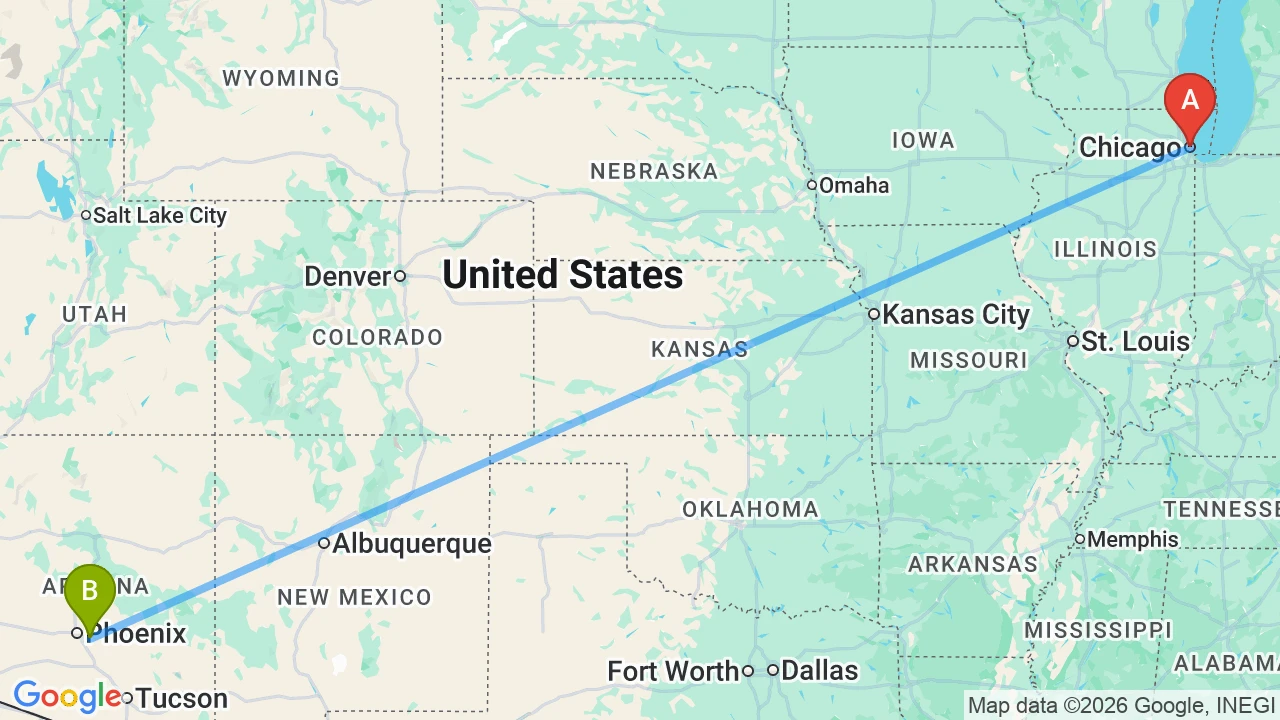
The physical move from Chicago to Gilbert involves roughly 1,700 miles, typically requiring professional movers, multi-day transit, and careful coordination of timing. Households moving in summer face extreme heat on both ends—Chicago’s humidity and Gilbert’s dry, intense heat—which can complicate packing, loading, and unpacking. Winter moves avoid Arizona’s peak heat but may encounter snow and ice in Chicago, adding logistical complexity.
Beyond the move itself, the transition period often surfaces unexpected friction. Driver’s licenses, vehicle registration, and insurance must be updated, and Arizona’s vehicle registration process includes emissions testing in some counties. Utility setup in Gilbert may involve deposits or credit checks, particularly for electricity, which is the dominant household utility. Establishing new routines—finding grocery stores, identifying reliable service providers, mapping out school and activity locations—takes longer in a car-dependent environment where proximity is measured in drive time rather than walking distance.
Households with children often find that school calendars, extracurricular options, and social networks differ significantly. Gilbert’s public schools are generally well-regarded, but the structure and culture may feel different from Chicago’s more varied and neighborhood-specific school landscape. Social integration in Gilbert often happens through planned community events, HOA activities, and organized sports, whereas Chicago’s social fabric is more neighborhood-based and spontaneous.
For renters, lease timing and availability can be tight in Gilbert, particularly during peak moving seasons. For buyers, the higher home prices and competitive market conditions may require faster decision-making and larger financial reserves than expected. Households accustomed to Chicago’s more flexible, varied housing market may find Gilbert’s suburban homogeneity both simpler and more limiting.
Frequently Asked Questions
- Does Gilbert, AZ feel more or less expensive than Chicago, IL?
- Gilbert’s higher housing costs—both for rent and homeownership—create more upfront and ongoing pressure, but the city’s higher median income reflects its role as an affluent suburb. Where costs concentrate depends on your household: car dependence, summer cooling, and HOA fees are more prominent in Gilbert, while Chicago’s transit options and walkable density can reduce transportation and convenience costs for some households. The question isn’t which city is “cheaper,” but where your household feels pressure most.
- How do housing markets differ between Chicago and Gilbert?
- Chicago offers more variety—older housing stock, multi-unit buildings, and neighborhoods at different price points—while Gilbert’s market is dominated by newer single-family homes in master-planned communities. Entry costs are higher in Gilbert, but the housing product is more uniform and suburban. Chicago’s market rewards flexibility and tolerance for density; Gilbert’s rewards capital and preference for space.
- What feels different about daily life after moving from Chicago to Gilbert?
- The biggest shift is car dependence. Chicago’s walkable neighborhoods and rail transit allow many residents to manage daily errands and commutes without driving, while Gilbert’s suburban layout makes a car essential for nearly everything. Climate also inverts: Chicago’s cold winters give way to Gilbert’s extreme summer heat, which reshapes outdoor activity, utility costs, and daily routines. The pace is slower and quieter in Gilbert, but logistics require more planning.
- When does the move from Chicago to Gilbert feel easiest?
- Spring and fall offer the most moderate weather on both ends, avoiding Chicago’s winter ice and Gilbert’s peak summer heat. However, timing also depends on housing availability, school calendars for families, and job start dates. Moves during summer can be logistically harder due to heat, but rental and housing inventory may be higher. There’s no universally “easy” window—just tradeoffs between climate, market conditions, and personal schedules.
- What are the most common adjustment challenges when moving to Gilbert from Chicago?
- Car dependence surprises many movers, particularly those accustomed to walking or taking transit in Chicago. The lack of spontaneous, walkable social spaces and the need to drive for every errand can feel isolating at first. Summer heat intensity—and the corresponding AC costs—also catches people off guard. Finally, the cultural shift from Chicago’s urban density and neighborhood diversity to Gilbert’s suburban uniformity and planned-community structure requires adjustment, especially for households who valued Chicago’s grit and variety.
- Who does this move tend to work best for—and who might struggle?
- The move works well for families seeking space, safety, highly rated schools, and a quieter, car-oriented suburban lifestyle, particularly if they’re relocating with a significant income increase. It also suits households who prefer newer construction, planned amenities, and predictable neighborhood environments. The move is harder for those who rely on walkability, public transit, or urban density for daily convenience, as well as households without the income buffer to absorb Gilbert’s higher housing costs and car-dependent expenses. Singles and young professionals who valued Chicago’s cultural density and spontaneous social fabric may find Gilbert’s suburban structure limiting.
Understanding the Tradeoffs
The relocation from Chicago to Gilbert is not a simple cost-up or cost-down equation. It’s a structural shift in how daily life is organized, where household pressure concentrates, and what kind of infrastructure supports your routines. Gilbert offers space, modern housing, family-friendly amenities, and a slower pace, but it requires higher income, car dependence, and tolerance for suburban homogeneity. Chicago offers density, transit access, walkable neighborhoods, and cultural variety, but it demands tolerance for cold winters, urban intensity, and less residential space.
For households with the income to absorb Gilbert’s housing costs and a preference for suburban predictability, the move can reduce stress and improve quality of life. For those who thrive on urban texture, walkability, and transit flexibility, the shift may feel like a loss of convenience and spontaneity that no amount of square footage can replace.
The best relocation decisions come from understanding not just the numbers, but the daily behaviors, seasonal rhythms, and household logistics that those numbers represent. Use this guide as a starting point, then dig deeper into neighborhood-specific conditions, school quality, commute realities, and the experiential details that matter most to your household.
How this article was built: In addition to public economic data, this article incorporates location-based experiential signals derived from anonymized geographic patterns—such as access density, walkability, and land-use mix—to reflect how day-to-day living actually feels in Chicago, IL and Gilbert, AZ.
For deeper exploration of housing markets, neighborhood comparisons, and cost breakdowns, visit the Chicago, IL and Gilbert, AZ city hubs on IndexYard.