
Huntington Beach’s housing market reflects the tension between coastal California desirability and Orange County’s constrained residential supply. With a median home value of $976,800 and median gross rent of $2,318 per month, the city sits firmly in the high-cost tier of U.S. housing markets—but those figures alone don’t explain how housing costs behave here, or why the choice between renting and owning carries different weight than it does inland or in denser coastal markets.
What shapes Huntington Beach’s housing pressure isn’t just price level—it’s the interaction between low-rise residential form, proximity to both beach amenities and Orange County employment centers, and a governance structure that limits how quickly supply can respond to demand. The result is a market where housing costs dominate household budgets, where ownership builds equity but locks in long-term exposure to California’s property tax and insurance systems, and where [renting vs owning](/huntington-beach-ca/monthly-budget/) involves tradeoffs that play out differently depending on how long you plan to stay and what you value beyond the home itself.
The Housing Market in Huntington Beach Today
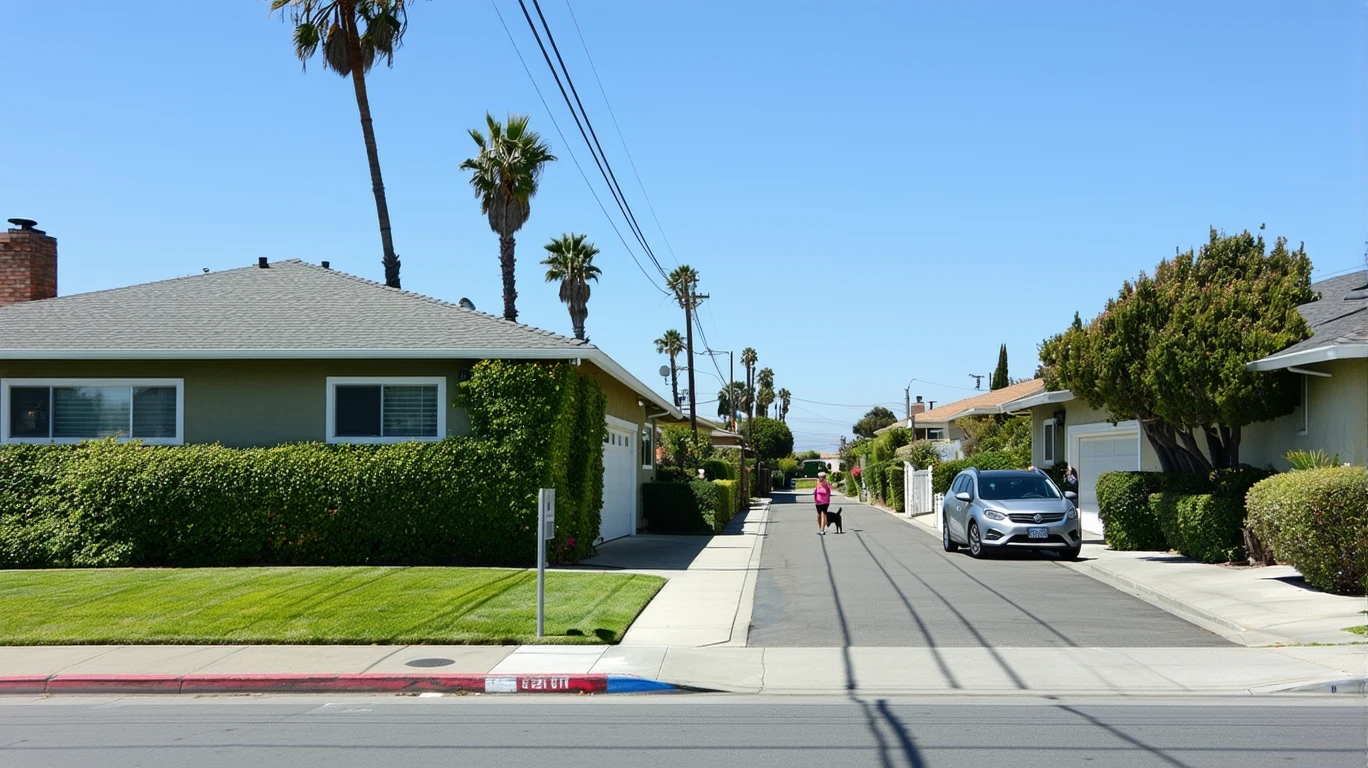
Huntington Beach operates as a coastal bedroom community within Orange County, drawing residents who prioritize beach access, outdoor recreation, and a suburban residential character while remaining within commuting distance of regional employment hubs. The city’s low-rise building profile—average building levels fall below the low threshold for vertical density—means housing supply expands slowly, even as demand remains persistent from both local workers and those willing to commute for coastal living.
The median household income of $114,747 per year reflects a population that skews toward dual-income professionals and established homeowners, but it also highlights the mismatch: even at that income level, the median home value represents more than eight times annual earnings, and median rent consumes roughly 24% of gross income before utilities, transportation, or any other household expense. This isn’t a market where housing fits comfortably into the standard 30% affordability heuristic for most newcomers—it’s a market where housing cost is the primary budget constraint, and other expenses adjust around it.
What newcomers often misunderstand is that Huntington Beach’s housing costs aren’t driven by urban density or transit access—the city has bus service but no rail, and its mixed pedestrian-to-road ratio means most errands and commutes still require a car. Instead, the premium reflects coastal geography, integrated park access (park density exceeds the high threshold), and the scarcity created by low-rise zoning in a region where land is finite. You’re not paying for walkability or transit convenience; you’re paying for proximity to the Pacific, outdoor amenity, and a residential scale that limits how many households can share that access.
Renting in Huntington Beach
At $2,318 per month median gross rent, Huntington Beach sits well above national rental norms, but within the expected range for Orange County coastal communities. Rental pressure here is shaped less by tenant churn and more by the fact that rental housing stock is limited relative to single-family ownership, and what does exist tends to cluster along commercial corridors rather than being evenly distributed across neighborhoods.
Renters in Huntington Beach face a market where location within the city matters significantly. Proximity to the coast, access to parks, and distance from major commute routes all influence rent levels, but so does the structure of the housing itself: older apartment complexes may offer lower base rent but come with higher utility exposure due to less efficient construction and California’s electricity rate of 34.71¢/kWh. Newer units often bundle amenities and pass through higher operating costs, but may offer more predictable utility performance.
The rental experience here is also shaped by the city’s errands accessibility pattern: food and grocery options are corridor-clustered, meaning renters who choose housing based solely on rent level may find themselves adding transportation friction to daily logistics. A lower-rent unit farther from grocery clusters or employment centers can quietly shift costs into fuel, time, and vehicle wear—especially in a city where notable bike infrastructure exists but the overall mobility texture remains mixed, requiring most households to default to car dependency for anything beyond recreational errands.
For renters, the tradeoff is straightforward: you avoid property tax exposure, maintenance liability, and the long-term lock-in of ownership, but you accept that rent can adjust annually and that you have limited control over housing stability in a market where landlords face their own rising costs in insurance, utilities, and property tax reassessment on turnover.
Owning a Home in Huntington Beach
Ownership in Huntington Beach begins with the $976,800 median home value, but the cost structure extends well beyond the purchase price. California’s property tax system, governed by Proposition 13, means that your initial assessed value determines your base tax rate, and increases are capped at 2% annually as long as you remain the owner. This creates a bifurcated market: long-term owners enjoy predictable, relatively low property tax burdens, while new buyers face reassessment at current market value and enter with significantly higher tax exposure.
Property taxes in California are typically around 1% of assessed value plus local voter-approved bonds and assessments, but without the specific rate provided in the data, new buyers should expect their annual property tax bill to reflect the purchase price, not the previous owner’s frozen assessment. This isn’t a minor distinction—it’s the difference between tax stability and a cost that resets with every transaction.
Beyond taxes, ownership in a coastal California city introduces exposure to insurance costs that have risen sharply in recent years due to wildfire risk elsewhere in the state and insurer retreat from the California market. While Huntington Beach itself is not a high wildfire zone, the statewide insurance environment affects availability and pricing, and coastal proximity introduces wind and flood considerations that influence premiums. Homeowners here also face maintenance costs shaped by salt air, which accelerates wear on exterior materials, roofing, and mechanical systems.
Homeowners associations are common in many Huntington Beach neighborhoods, particularly in planned developments and condominium complexes. HOA fees can range widely depending on what services are included—some cover landscaping, exterior maintenance, and community amenities, while others are minimal. The key distinction is that HOA fees are not optional, can increase annually, and represent a cost layer that doesn’t build equity.
The ownership experience in Huntington Beach is defined by control and exposure: you control your housing stability, benefit from equity accumulation in a supply-constrained market, and lock in property tax growth at 2% annually. But you also absorb all maintenance volatility, insurance cost swings, and the risk that California’s governance environment shifts in ways that affect property taxation, insurance availability, or development regulation.
Apartment vs House in Huntington Beach — Cost Behavior Comparison
| Expense Category | Apartment | House |
|---|---|---|
| Cooling costs | Moderate; shared walls reduce exposure, but older buildings with poor insulation face high summer bills at 34.71¢/kWh | Higher; standalone structure with full sun exposure increases cooling load during extended warm season |
| Exterior maintenance | Covered by landlord or HOA; tenant has no direct cost but no control over timing or quality | Owner responsibility; coastal salt air accelerates wear on paint, roofing, and fixtures |
| Water/sewer | Sometimes included in rent; when separate, usage is lower due to smaller unit size and no outdoor irrigation | Always separate; includes irrigation for landscaping, which is significant in a dry climate with aesthetic expectations |
| Parking | May be assigned or limited; street parking restrictions common in denser corridors | Typically includes garage or driveway; no competition for space |
| Property tax exposure | None directly; indirectly reflected in rent adjustments | Direct and ongoing; reassessed at purchase, then capped at 2% annual growth under Prop 13 |
Why these categories differ in Huntington Beach: The city’s low-rise residential form and coastal location create cost distinctions driven by climate (extended cooling season, salt air), infrastructure (separate utility metering, irrigation norms), and governance (Prop 13 tax structure, HOA prevalence). Categories like heating, snow removal, and storm preparation were excluded because they don’t vary meaningfully in this climate. The comparison reflects cost behavior, not absolute amounts, because the latter depends on unit size, age, and location within the city.
Utilities & Upkeep Differences
Utility exposure in Huntington Beach is shaped by California’s high electricity rate of 34.71¢/kWh and the city’s extended cooling season. Coastal proximity moderates temperature extremes compared to inland Orange County, but homes and apartments without ocean breezes or effective ventilation still face significant summer cooling costs. The distinction between apartment and house utility bills is less about total usage and more about control: apartment dwellers may benefit from shared-wall insulation but have no ability to upgrade windows, insulation, or HVAC systems, while homeowners can invest in efficiency but absorb the full cost of doing so.
Natural gas, priced at $23.78/MCF, plays a smaller role in Huntington Beach than in colder climates—heating demand is minimal, and gas is primarily used for water heating and cooking in homes that haven’t converted to electric appliances. This creates a cost structure where electricity dominates utility exposure, and where time-of-use rate plans and solar investment become relevant primarily for homeowners with control over infrastructure.
Maintenance differences between apartments and houses in Huntington Beach are amplified by coastal conditions. Salt air accelerates corrosion on outdoor fixtures, garage doors, and any metal components, meaning houses require more frequent repainting, sealing, and hardware replacement than similar homes inland. Apartment tenants are insulated from these costs, but they also have no control over when or how maintenance is performed, and deferred building upkeep can translate into higher cooling costs or water damage that affects livability before it affects rent.
Landscaping and irrigation represent another divergence: houses in Huntington Beach typically include yards that require ongoing water input in a climate with minimal rainfall, while apartments either include landscaping in HOA fees or eliminate it entirely. The cost isn’t just water—it’s time, equipment, and the expectation that outdoor space will be maintained to neighborhood norms.
Rent vs Buy: Long-Term Exposure in Huntington Beach
The decision between renting and buying in Huntington Beach isn’t primarily about monthly cost equivalence—it’s about which risks you’re willing to accept and which forms of control matter most. Renters face annual rent adjustment risk in a market where landlords experience rising insurance, tax (on turnover), and maintenance costs. There’s no cap on rent increases for most units, and while vacancy risk theoretically moderates rent growth, Huntington Beach’s supply constraints and coastal desirability mean landlords have persistent pricing power.
Buyers, by contrast, lock in predictable property tax growth at 2% annually under Prop 13, but they absorb all volatility in insurance, maintenance, and HOA fees. Insurance costs in California have become less predictable due to statewide insurer behavior, and while Huntington Beach isn’t a high-risk fire zone, the coastal insurance market is influenced by broader state dynamics. Maintenance costs in a coastal environment aren’t optional—they’re recurring and necessary to prevent accelerated deterioration.
The long-term ownership advantage in Huntington Beach is equity accumulation in a supply-constrained market where home values have historically appreciated due to geographic limits on expansion and persistent demand. But that equity is illiquid, and accessing it requires either selling (and losing your Prop 13 tax basis) or borrowing against it. Renters avoid this lock-in and retain flexibility to leave the market if costs or priorities shift, but they build no equity and have no hedge against future rent growth.
Over time, ownership in Huntington Beach rewards those who stay long enough for equity growth to outweigh transaction costs and who value control over housing stability and the ability to modify their living environment. Renting rewards those who prioritize flexibility, who don’t want to absorb maintenance and insurance volatility, or who believe their income or career path will take them elsewhere before ownership’s long-term advantages materialize.
How this article was built: In addition to public economic data, this article incorporates location-based experiential signals derived from anonymized geographic patterns—such as access density, walkability, and land-use mix—to reflect how day-to-day living actually feels in Huntington Beach, CA.
FAQs About Housing Costs in Huntington Beach
Is renting or buying more common in Huntington Beach?
Ownership is more common, reflecting the city’s suburban single-family character and the long-term tax advantages of Prop 13 for established residents. Renters are more concentrated in apartment corridors and newer developments, but rental housing represents a smaller share of total stock compared to ownership.
How does Huntington Beach’s housing cost compare to other Orange County cities?
Huntington Beach sits in the mid-to-upper tier of Orange County coastal housing costs—less expensive than Newport Beach or Laguna Beach, but more expensive than inland communities like Santa Ana or Garden Grove. The premium reflects beach access and residential character, not urban density or transit infrastructure.
What drives utility costs higher in Huntington Beach homes?
California’s electricity rate of 34.71¢/kWh is the dominant factor, combined with extended cooling season demand and the inefficiency of older housing stock. Coastal salt air also increases maintenance frequency for HVAC systems, which affects both performance and operating cost over time.
Does Huntington Beach have rent control?
California’s statewide rent control law (AB 1482) caps annual rent increases at 5% plus inflation for most units built before 2007, but this applies only to tenants in place—new leases can be set at market rate. The law provides some predictability for continuing tenants but doesn’t prevent significant rent resets between occupants.
How does Prop 13 affect property taxes for new buyers in Huntington Beach?
New buyers are reassessed at purchase price, meaning their property tax basis reflects current market value (around $976,800 median). After purchase, annual increases are capped at 2%, creating long-term predictability. But the initial tax burden is significantly higher than what the previous owner paid if they had owned the home for many years.
Making Housing Choices in Huntington Beach
Housing costs in Huntington Beach are shaped by forces that don’t respond quickly to individual budgets: coastal geography, low-rise zoning, California’s tax and insurance systems, and Orange County’s persistent demand from both local workers and lifestyle-driven movers. The result is a market where housing dominates household budgets, where the rent-versus-buy decision hinges on time horizon and risk tolerance rather than monthly equivalence, and where [day-to-day costs](/huntington-beach-ca/cost-overview/) adjust around housing rather than the reverse.
For renters, the tradeoff is flexibility and insulation from maintenance volatility in exchange for no equity accumulation and exposure to annual rent adjustments in a supply-constrained market. For buyers, the tradeoff is long-term tax predictability and equity growth in exchange for absorbing all ownership volatility and losing the ability to leave without transaction costs.
What matters most is understanding that Huntington Beach’s housing costs aren’t an anomaly—they’re the result of deliberate land-use choices, geographic constraints, and a governance structure that prioritizes existing homeowners. The city rewards those who can afford the entry cost and plan to stay long enough for ownership advantages to compound. For those who can’t or won’t make that commitment, renting remains viable, but it requires accepting that housing cost will remain the largest and least flexible line item in the household budget.