
Many people moving to Arvada face the same question: should I rent for a year to learn the city, or buy now before prices climb further? The answer depends less on timing the market and more on understanding how housing pressure works here—and which parts of Arvada align with how you actually live.
Arvada sits in the Denver metro with a median home value of $553,000 and median rent of $1,706 per month. Those figures reflect more than regional demand—they reflect a city with rail access to downtown Denver, walkable commercial corridors in some neighborhoods, and a mixed housing stock that ranges from low-rise single-family blocks to denser, transit-oriented pockets. Where you choose to live within Arvada determines not just your commute, but your daily errands, outdoor access, and long-term cost exposure.
This article explains how housing costs behave in Arvada, what drives the difference between renting and owning, and how to match your household’s priorities to the right part of the city.
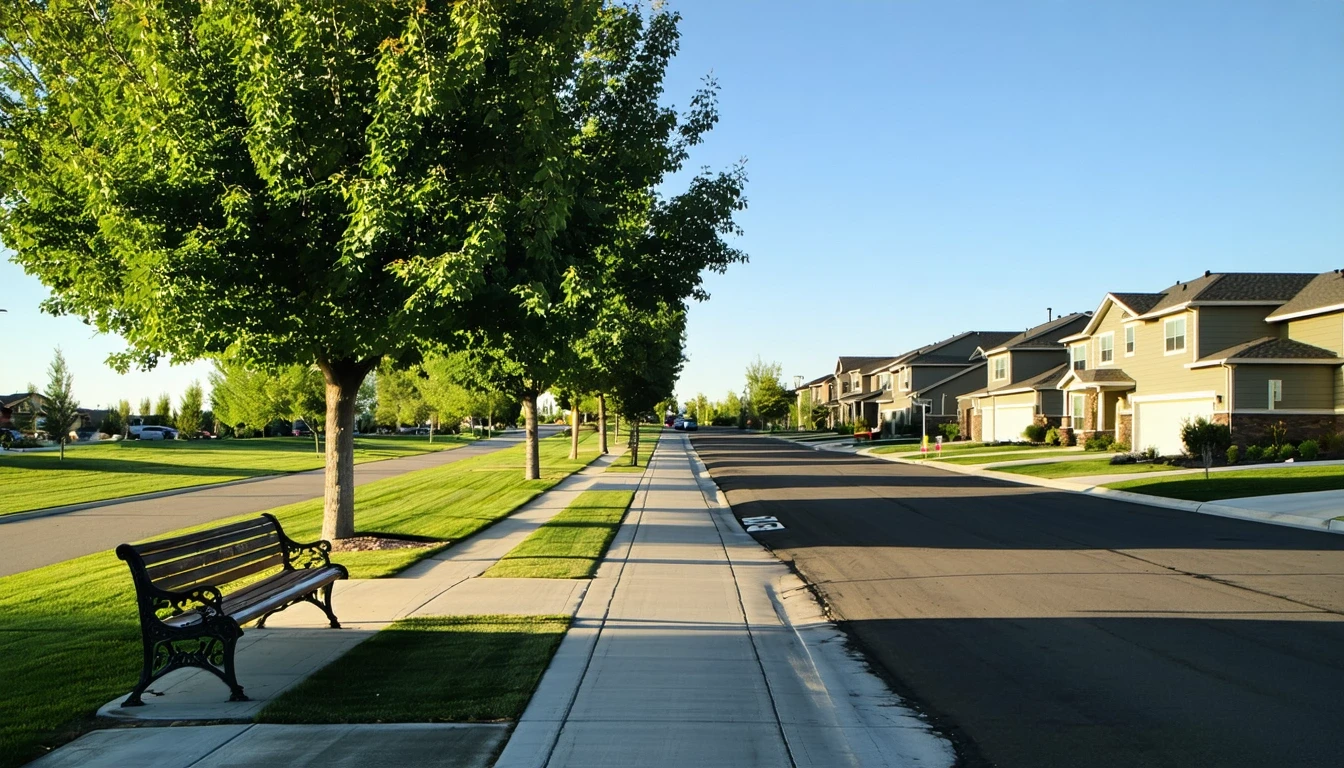
The Housing Market in Arvada Today
Arvada functions as both a Denver bedroom community and an independent commercial hub. That dual identity shapes its housing market. Homes near Olde Town or along the G Line rail corridor command premiums for walkability and transit access, while neighborhoods farther from rail remain car-dependent but offer larger lots and lower density.
The city’s pedestrian infrastructure is unevenly distributed. Some areas have sidewalk networks dense enough to support daily errands on foot; others require a car for every trip. Grocery stores and food establishments are broadly accessible across the city, which reduces the friction of running out for supplies—a hidden cost advantage for homeowners managing maintenance projects or families coordinating schedules.
Park access is integrated throughout Arvada, with density exceeding typical suburban thresholds. This makes outdoor space predictable rather than destination-dependent, which matters for families weighing the value of a private yard against the cost of maintaining one.
What newcomers often misunderstand is that Arvada’s housing market isn’t uniform. A $550,000 home near rail and commercial corridors delivers a fundamentally different cost-of-living experience than the same price point in a car-dependent zone. The former reduces transportation expenses and time costs; the latter requires vehicle ownership and absorbs more household bandwidth for logistics.
Renting in Arvada
At $1,706 per month, median rent in Arvada reflects the same demand pressures driving ownership costs. Renters aren’t escaping the metro’s housing squeeze—they’re paying for flexibility and predictability instead of equity accumulation.
Rental availability varies by neighborhood type. Denser, mixed-use areas near transit offer more apartment inventory, while single-family rental stock dominates car-oriented blocks. The former tends to include younger professionals and households prioritizing walkability; the latter attracts families seeking yard space without the commitment of ownership.
Location within Arvada changes the rental value proposition. A unit near the G Line reduces car dependency, which offsets higher rent through lower transportation costs and shorter errand loops. A rental in a car-dependent neighborhood may cost less per month but requires vehicle ownership, insurance, and fuel—expenses that accumulate invisibly compared to the single line item of rent.
Renters also benefit from Arvada’s errand accessibility. With grocery and food establishments distributed broadly, even car-dependent neighborhoods keep shopping trips short. This reduces the time tax of not owning—a factor that matters more as household size or schedule complexity grows.
The rental experience here isn’t about affordability in absolute terms. It’s about whether the flexibility to leave, the insulation from maintenance costs, and the predictability of a lease term justify paying ownership-equivalent monthly costs without building equity.
Owning a Home in Arvada
Ownership in Arvada starts with a $553,000 median home value. That figure represents the entry point, not the ceiling—and it doesn’t include property taxes, insurance, HOA fees (where applicable), or the maintenance costs that come with Colorado’s dry climate and temperature swings.
Property taxes in Colorado are subject to state-level assessment rules, but the effective burden depends on mill levies set by local districts. Without a specific rate in hand, buyers should expect variability based on school district, fire protection, and municipal services. Taxes aren’t a one-time calculation—they’re an annual exposure that shifts with assessed value and voter-approved measures.
Some Arvada neighborhoods include HOAs, particularly in newer or denser developments. These can cover landscaping, snow removal, or shared amenities, but they also introduce governance risk—special assessments, fee increases, and rule changes that owners can’t avoid. Not all of Arvada is HOA-governed, so buyers have the option to avoid that layer of cost and control.
Maintenance exposure in Arvada is shaped by climate. Heating costs dominate in winter, driven by extended cold seasons and natural gas prices of $12.26 per MCF. Cooling is less intense but still present during summer heat. Exterior maintenance—roof wear, siding, and landscaping—faces stress from dry conditions and temperature cycling. Older homes may also carry deferred maintenance that isn’t visible during a walkthrough but emerges as costly repairs within the first few years.
Ownership also means control. Buyers can renovate, landscape, and modify without landlord approval. They can install energy-efficient systems, add insulation, or plant trees to reduce long-term utility exposure. These decisions require upfront capital but shift cost behavior over time in ways renting never allows.
The value of ownership in Arvada isn’t just financial—it’s about stability. Families with school-age children benefit from predictable housing costs and access to Arvada’s school infrastructure, which meets moderate density thresholds. Park access is integrated, so outdoor recreation doesn’t require driving to trailheads. For households planning to stay five years or more, ownership locks in cost structure and eliminates the risk of lease non-renewal or rent resets.
Apartment vs House in Arvada — Cost Behavior Comparison
The table below isolates cost categories that behave differently in Arvada based on housing type, climate, and infrastructure. Rows are included only where local factors create meaningful distinctions.
| Expense Category | Apartment | House |
|---|---|---|
| Base Housing Cost | $1,706/month median rent | $553,000 median value (ownership costs vary by financing) |
| Heating Exposure | Lower total usage; shared walls reduce heat loss | Higher usage; standalone structure with greater surface area exposed to cold |
| Cooling Exposure | Moderate; upper floors may trap heat | Moderate; larger square footage increases load |
| Maintenance Responsibility | Landlord covers structural, HVAC, and exterior | Owner covers all systems, roof, siding, and landscaping |
| Outdoor Space Control | Limited to balcony or shared grounds | Private yard; requires mowing, irrigation, and seasonal upkeep in dry climate |
Why these rows: Heating exposure differs due to Colorado’s extended cold season and building geometry. Maintenance responsibility is a structural distinction between renting and owning. Outdoor space control matters in Arvada because integrated park access reduces the necessity of a private yard, but ownership still requires managing one if present. Categories like parking, appliances, and pest control were excluded because they don’t vary meaningfully based on Arvada-specific factors.
Utilities & Upkeep Differences
Utility costs in Arvada are driven by climate, not housing type alone. Electricity rates sit at 16.26¢/kWh, which is moderate but accumulates quickly during summer cooling. Natural gas at $12.26/MCF powers heating through long winters, and usage spikes from November through March. Apartments benefit from shared-wall insulation, which reduces heating load. Houses face full exposure on all sides, and older homes with minimal insulation or single-pane windows see the highest bills.
Cooling is less dominant but still noticeable during hot, dry summers. Upper-floor apartments trap heat, while houses with poor attic ventilation or west-facing windows absorb afternoon sun. Owners can mitigate this with insulation upgrades, window treatments, or programmable thermostats—investments renters can’t make.
Maintenance exposure is where housing type diverges sharply. Apartment renters call the landlord when the furnace fails or the roof leaks. Homeowners pay out of pocket, often on short notice. Colorado’s dry climate accelerates wear on exterior paint, roofing materials, and wooden fencing. Temperature swings stress HVAC systems and plumbing. Landscaping requires irrigation, and water costs rise if sprinkler systems aren’t managed carefully.
Houses also carry hidden upkeep: gutter cleaning, driveway sealing, pest prevention, and appliance replacement. These aren’t monthly bills, but they’re recurring and unpredictable. A furnace replacement can cost several thousand dollars; a roof can exceed ten thousand. Renters avoid this volatility entirely, though they pay indirectly through rent that reflects the landlord’s cost of managing these risks.
The upkeep difference isn’t just financial—it’s operational. Homeownership in Arvada requires time, tools, and the ability to coordinate contractors. Renters outsource that complexity, which has value for households with demanding jobs, young children, or limited experience managing property.
Rent vs Buy: Long-Term Exposure in Arvada
The rent-versus-buy decision in Arvada isn’t about which option costs less in year one—it’s about which cost structure aligns with your household’s tolerance for volatility, control, and long-term commitment.
Renters face lease renewal risk. Rent can reset annually based on market conditions, and landlords can choose not to renew. This creates income exposure for households on fixed budgets and planning uncertainty for families with school-age children. The tradeoff is flexibility: renters can leave when a lease ends, avoid maintenance costs, and relocate within Arvada if a job, commute, or neighborhood preference changes.
Owners face different exposure. Property taxes, insurance, and maintenance costs can shift over time, but the largest line item—principal and interest on a fixed-rate mortgage—remains constant. This creates predictability for monthly expenses, but it also locks households into a location and a set of costs that can’t be escaped without selling. Selling involves transaction costs, timing risk, and the possibility that the market has softened since purchase.
Ownership also introduces control. Buyers can reduce utility costs through insulation, weatherization, or energy-efficient systems. They can landscape for lower water use, install solar panels, or replace aging HVAC before it fails. These interventions require capital and time, but they shift cost behavior in ways renting never allows.
Location within Arvada changes the long-term calculus. Households buying near rail and walkable corridors reduce transportation costs and gain access to a lifestyle that doesn’t require two cars. This offsets higher purchase prices through lower ongoing expenses and shorter errand loops. Buyers in car-dependent areas pay less upfront but absorb higher transportation costs and time taxes over the life of ownership.
The decision also depends on how long you plan to stay. Ownership favors households committing to five years or more, allowing time to absorb transaction costs and benefit from cost predictability. Renters who expect to relocate within two to three years avoid the risk of selling into a weak market and the friction of managing a property they no longer occupy.
Neither option is universally better. Renting trades equity accumulation for flexibility and insulation from maintenance risk. Owning trades liquidity and simplicity for control, stability, and long-term cost predictability. The right choice depends on whether your household values optionality or permanence—and whether the part of Arvada you’re considering aligns with how you actually move through daily life.
FAQs About Housing Costs in Arvada
Is rent in Arvada cheaper than owning?
Not necessarily. Median rent of $1,706 per month is comparable to the monthly cost of owning a median-priced home when property taxes, insurance, and maintenance are included. Renting avoids upfront costs like down payments and closing fees, but it doesn’t build equity. The choice depends on whether you value flexibility or long-term cost predictability.
How much do property taxes add to homeownership costs in Arvada?
Property taxes in Arvada depend on assessed value and local mill levies, which vary by school district and municipal services. Buyers should request tax estimates during the purchase process and budget for potential increases due to voter-approved measures or reassessment cycles. Taxes are an annual expense that persists regardless of whether the home is paid off.
Do all Arvada neighborhoods have HOAs?
No. HOA prevalence is higher in newer developments and denser, mixed-use areas. Older single-family neighborhoods typically lack HOAs. Buyers who want to avoid monthly fees, governance rules, and special assessment risk should focus on non-HOA properties, which are widely available in Arvada.
Does living near the G Line rail in Arvada reduce housing costs?
It shifts them. Homes near rail often cost more upfront due to location premiums, but they reduce transportation expenses by enabling car-light living. Households that can walk to errands, parks, and transit save on fuel, insurance, and vehicle maintenance. The net effect depends on how much you drive and whether your household can function with one car instead of two.
What’s the biggest hidden cost of owning a home in Arvada?
Maintenance and repairs. Colorado’s dry climate and temperature swings stress roofs, siding, HVAC systems, and landscaping. Older homes may carry deferred maintenance that emerges as expensive surprises. Buyers should budget for irregular but inevitable costs like furnace replacement, roof repair, and exterior upkeep—expenses renters never see.
Making Housing Choices in Arvada
Housing costs in Arvada reflect the city’s position in the Denver metro, its mixed infrastructure, and the uneven distribution of walkability, transit access, and park availability. A $553,000 home or $1,706 rent isn’t expensive or affordable in isolation—it’s a cost structure that fits some households and strains others, depending on income, priorities, and how long you plan to stay.
Renters gain flexibility and avoid maintenance risk but pay ownership-equivalent costs without building equity. Owners gain stability and control but absorb volatility in taxes, insurance, and upkeep. Neither path is universally better; the right choice depends on whether your household values optionality or permanence.
Location within Arvada matters as much as the decision to rent or buy. Walkable, transit-accessible neighborhoods reduce transportation costs and time taxes, which offsets higher housing prices for some households. Car-dependent areas offer lower entry costs but require vehicle ownership and longer errand loops. Integrated park access throughout the city reduces the necessity of a private yard, though ownership still requires maintaining one if present.
The housing decision in Arvada isn’t about timing the market or finding a deal—it’s about matching your cost tolerance, lifestyle priorities, and planning horizon to the right part of the city. For more on how housing fits into overall living costs and budget planning, explore the related guides on IndexYard.
How this article was built: In addition to public economic data, this article incorporates location-based experiential signals derived from anonymized geographic patterns—such as access density, walkability, and land-use mix—to reflect how day-to-day living actually feels in Arvada, CO.