
Moving from Seattle to Vancouver, WA: How Costs and Daily Life Shift in 2026
The move from Seattle to Vancouver, Washington represents one of the Pacific Northwest’s most common relocation patterns—and one of its most misunderstood. On paper, it looks like a straightforward cost reduction: median costs/”>home values drop from $879,900 in Seattle to $403,400 in Vancouver, and median rent falls from $1,945 to $1,525 per month. But the financial story doesn’t end with housing entry costs. This move fundamentally reshapes where your money goes, how you spend your time, and what daily logistics demand from you.
Vancouver sits just across the Columbia River from Portland, Oregon, creating a unique tax and commute dynamic that defines the city’s role in the region. Many Vancouver residents work in Portland, crossing state lines daily to access Oregon’s job market while maintaining Washington residency—a pattern that eliminates state income tax but introduces cross-river commute complexity. Others work locally or remotely, drawn by the lower housing entry barrier and the slower pace compared to Seattle’s density and vertical growth.
This guide explains how cost pressure, daily rhythms, and household logistics typically shift when you leave Seattle for Vancouver. It does not calculate total savings or declare a financial winner. Instead, it clarifies where costs concentrate, who tends to feel relief or new pressure, and what changes in the texture of daily life. If you’re weighing this move, understanding these shifts matters more than any single number.
Where Cost Pressure Moves
The most visible financial shift is housing entry cost. Seattle’s median home value of $879,900 creates a steep barrier for buyers, particularly those without substantial equity or dual incomes. Vancouver’s $403,400 median represents less than half that figure, opening homeownership to households who would remain renters indefinitely in Seattle. For renters, the gap narrows but remains meaningful: $1,945 per month in Seattle versus $1,525 in Vancouver. That $420 monthly difference compounds over time, but it doesn’t account for neighborhood quality, unit size, or proximity to work—variables that often absorb part of the nominal savings.
What changes more subtly is ongoing cost composition. Seattle’s denser urban form supports walkable errands, integrated green space, and notable cycling infrastructure. Food and grocery density exceeds high thresholds, and rail transit provides an alternative to driving for many trips. Vancouver’s infrastructure signals tell a different story: the city lacks the pedestrian-to-road ratio, transit depth, and mixed-use density that make Seattle’s car-optional lifestyle feasible for a significant share of residents. In Vancouver, most households depend on personal vehicles for daily errands, work commutes, and weekend activities. That dependence doesn’t always show up in upfront budgets, but it shapes fuel costs, insurance premiums, maintenance schedules, and time allocation in ways that Seattle’s transit-accessible neighborhoods do not.
Utility rates remain identical between the two cities—both pay 14.06¢/kWh for electricity and $24.71/MCF for natural gas—but usage patterns differ. Seattle’s more vertical building stock and denser neighborhoods often mean smaller living spaces and shared-wall insulation, which can moderate heating and cooling loads. Vancouver’s housing mix skews toward single-family homes and low-rise structures, where standalone heating systems and larger square footage can increase seasonal utility exposure. Neither city faces extreme temperature swings, but the shift from apartment to house—common in this relocation pattern—often raises utility bills even when rates stay flat.
Grocery costs follow regional price parity differences. Seattle’s RPP index of 113 versus Vancouver’s 107 suggests modestly lower food prices in Vancouver, reflected in derived estimates: bread at $1.96/lb instead of $2.07, ground beef at $7.16/lb versus $7.56, eggs at $2.90/dozen compared to $3.06. (Derived estimate based on national baseline adjusted by regional price parity; not an observed local price.) These differences rarely transform a household budget, but they do reduce the cumulative friction of weekly shopping—especially for families buying in volume.
Housing Markets and Neighborhood Form
Seattle’s housing market reflects decades of constrained supply, tech-driven demand, and vertical infill. The city’s average building levels exceed high thresholds, and mixed residential-commercial land use creates neighborhoods where errands, transit, and housing occupy the same blocks. Ownership in Seattle often means condos or townhomes in denser zones, where HOA fees, parking costs, and shared infrastructure add layers of ongoing obligation. Renters face competitive markets with low vacancy and rapid rent escalation during lease renewals, though the city’s walkability and transit access can offset car ownership costs for some households.
Vancouver’s housing stock skews toward single-family homes and low-rise development. Ownership here more commonly means a standalone house with a yard, garage, and direct street access—attributes that appeal to families and remote workers seeking space and separation. But that form carries its own cost profile: lawn care, exterior maintenance, heating and cooling for larger square footage, and the assumption of car ownership for nearly all trips. Renters in Vancouver encounter less competitive pressure than in Seattle, but they also find fewer high-density apartment buildings with amenities, transit proximity, or walkable commercial corridors.
The neighborhood form difference matters for daily logistics. In Seattle, a household might walk to a grocery store, take light rail to work, and bike to a park—all without starting a car. In Vancouver, those same errands typically require driving, even for short distances. The time cost may feel minimal per trip, but the cumulative effect—fuel, insurance, vehicle depreciation, and the cognitive load of car dependency—reshapes how households allocate resources and plan their days.
Lifestyle and Daily Rhythms
Seattle’s density and infrastructure create a faster, more vertically compressed daily rhythm. Commutes average 27 minutes, but 43.2% of workers face long commutes, reflecting the region’s sprawl and congestion. Still, rail transit, bus networks, and high pedestrian infrastructure density mean that many Seattle residents can choose how they commute, even if the trip takes time. The city’s integrated park access and water features provide green space within walking distance for many neighborhoods, and the urban form supports spontaneous errands without advance planning.
Vancouver’s pace feels slower and more car-dependent. Average commutes run 23 minutes, shorter than Seattle’s, but 30.4% of workers face long commutes—a figure driven largely by cross-river trips to Portland. Only 6.0% of Vancouver workers report working from home, compared to 6.3% in Seattle, suggesting similar remote work adoption. But without Seattle’s transit depth or walkable errands infrastructure, Vancouver households spend more time in cars, even when trip distances stay modest. Grocery runs, school pickups, and weekend activities all assume vehicle access, and the lack of rail transit means that congestion or bridge delays have no easy workaround.
The climate feels similar between the two cities—both experience mild, wet winters and dry summers—but the experience of weather differs by housing type. Seattle renters in multi-family buildings often avoid direct responsibility for exterior maintenance, gutter cleaning, or landscaping. Vancouver homeowners, more commonly in single-family houses, face seasonal yard work, roof maintenance, and the physical exposure that comes with standalone structures. Neither city demands extreme heating or cooling, but the shift from apartment to house often increases both effort and expense.
Income, Employment, and Household Fit
Seattle’s median household income of $116,068 per year reflects the city’s concentration of high-wage tech, healthcare, and professional services jobs. Vancouver’s median of $73,626 per year signals a different economic base: a mix of retail, healthcare, education, and service roles, supplemented by cross-border commuters who earn Portland wages while living in Washington. The income gap matters because it shapes what “affordable” means in each city. A $400,000 home feels reachable for a dual-income household earning $75,000 in Vancouver; that same household would struggle to qualify for Seattle’s $880,000 median without significant savings or external support.
Unemployment rates sit at 4.1% in Seattle and 4.5% in Vancouver—both near regional norms, neither signaling acute labor market distress. But Seattle’s job market offers deeper specialization, higher wage ceilings, and more opportunities for career progression in high-growth sectors. Vancouver’s economy provides stability and accessibility, but fewer paths to rapid income growth. For households prioritizing homeownership and space over career acceleration, that tradeoff often feels worthwhile. For younger professionals or those in specialized fields, the income ceiling in Vancouver can feel limiting over time.
Relocation Logistics and Practical Friction
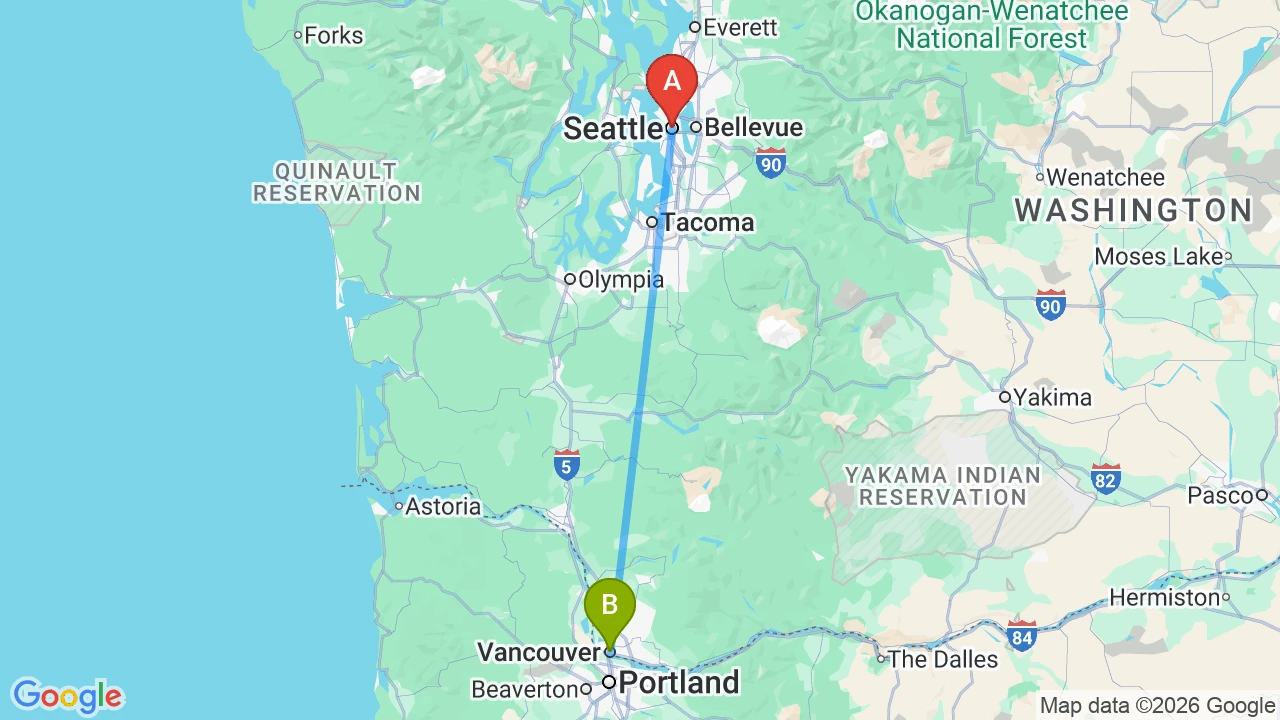
The physical move from Seattle to Vancouver spans roughly 160 miles, a three-hour drive under normal conditions. Most movers handle this as a single-day event, either with a rental truck or a regional moving service. The distance doesn’t demand cross-country logistics, but it does require coordination: lease timing, utility transfers, address changes, and the emotional work of leaving established networks.
What surprises many movers is the shift in daily access. Seattle’s density means that spontaneous plans—meeting a friend for coffee, picking up a forgotten ingredient, dropping off a package—rarely require advance thought. Vancouver’s car-dependent form means those same tasks demand planning: keys, parking, drive time, and the mental load of vehicle dependency. For households with young children, elderly parents, or mobility constraints, that shift can feel more significant than the housing cost savings.
Another common adjustment involves social infrastructure. Seattle’s walkable neighborhoods and transit networks create frequent, low-friction opportunities for casual social contact: running into neighbors at the grocery store, chatting on the bus, or meeting friends at a park without coordinating parking. Vancouver’s suburban form reduces those spontaneous interactions, requiring more intentional effort to maintain social connection. For extroverts or those who rely on ambient community contact, the move can feel isolating even when housing costs drop.
How this article was built: In addition to public economic data, this article incorporates location-based experiential signals derived from anonymized geographic patterns—such as access density, walkability, and land-use mix—to reflect how day-to-day living actually feels in Vancouver, WA.
Frequently Asked Questions
- Does Vancouver, WA feel more or less expensive than Seattle?
- Housing entry costs drop sharply—median home values fall from $879,900 to $403,400, and rent from $1,945 to $1,525 per month—but ongoing expenses shift rather than disappear. Vancouver’s car dependency increases fuel, insurance, and maintenance costs, and the move from apartment to house often raises utilities and upkeep. The question isn’t whether Vancouver feels cheaper overall, but whether the cost pressure moves to categories you can manage more easily.
- How do the housing markets differ between Seattle and Vancouver?
- Seattle’s market emphasizes vertical density, condos, and transit-adjacent apartments, with high entry costs but walkable access to errands and jobs. Vancouver’s market skews toward single-family homes and low-rise neighborhoods, offering more space and lower purchase prices but assuming car ownership and standalone maintenance. Renters in Seattle face tighter competition; renters in Vancouver find more availability but fewer amenity-rich buildings.
- What feels different about daily life after moving from Seattle to Vancouver?
- The most immediate shift is car dependency: errands, commutes, and social plans that once happened on foot or by transit now require driving. The pace slows, neighborhoods feel more residential, and spontaneous plans require more coordination. For households seeking space, quiet, and separation from urban density, that change feels positive. For those who relied on Seattle’s walkability and transit, it can feel restrictive.
- When does this move tend to feel easiest or hardest?
- The move feels smoothest for households with remote work flexibility, established savings for a down payment, and a preference for car-oriented suburban life. It feels hardest for those who depend on Seattle’s transit network, thrive in dense walkable neighborhoods, or work in specialized industries concentrated in Seattle’s urban core. Timing the move around lease cycles, school calendars, or job transitions reduces logistical friction, but the lifestyle adjustment remains the larger variable.
- What challenges do people commonly face when relocating to Vancouver from Seattle?
- The shift from transit-accessible density to car-dependent suburbia catches many movers off guard, especially those who underestimate the cumulative cost and time burden of vehicle dependency. Social isolation can emerge when spontaneous community contact disappears, and the slower pace feels stifling to those accustomed to Seattle’s energy. Cross-river commutes to Portland introduce bridge congestion and weather delays that don’t affect Seattle’s internal transit network.
- Who tends to benefit most from moving to Vancouver, and who might struggle?
- Families seeking homeownership, space, and lower housing entry costs tend to benefit, especially those with remote work or jobs in Vancouver or Portland. Retirees drawn to quieter neighborhoods and lower ongoing housing pressure also find the move advantageous. Young professionals in specialized fields, car-free households, and those who rely on urban density for social connection often struggle with the loss of walkability, transit access, and the faster rhythm that Seattle’s infrastructure supports.
Making the Decision
The move from Seattle to Vancouver trades housing entry barriers for car dependency, urban density for residential space, and transit access for lower rent. It does not eliminate cost pressure—it redirects it. Households who value homeownership, standalone housing, and separation from urban intensity often find the tradeoff worthwhile. Those who depend on walkability, transit networks, or the spontaneous access that density provides may feel the loss more acutely than the housing savings justify.
Neither city offers a universal advantage. Seattle rewards those who can afford its entry costs and thrive in its density. Vancouver rewards those who prioritize space, car-oriented convenience, and lower housing thresholds. The question isn’t which city costs less—it’s which cost structure aligns with how you actually live, work, and move through your days.
For deeper exploration of how costs behave in each city, visit the Seattle and Vancouver city hubs on IndexYard.