
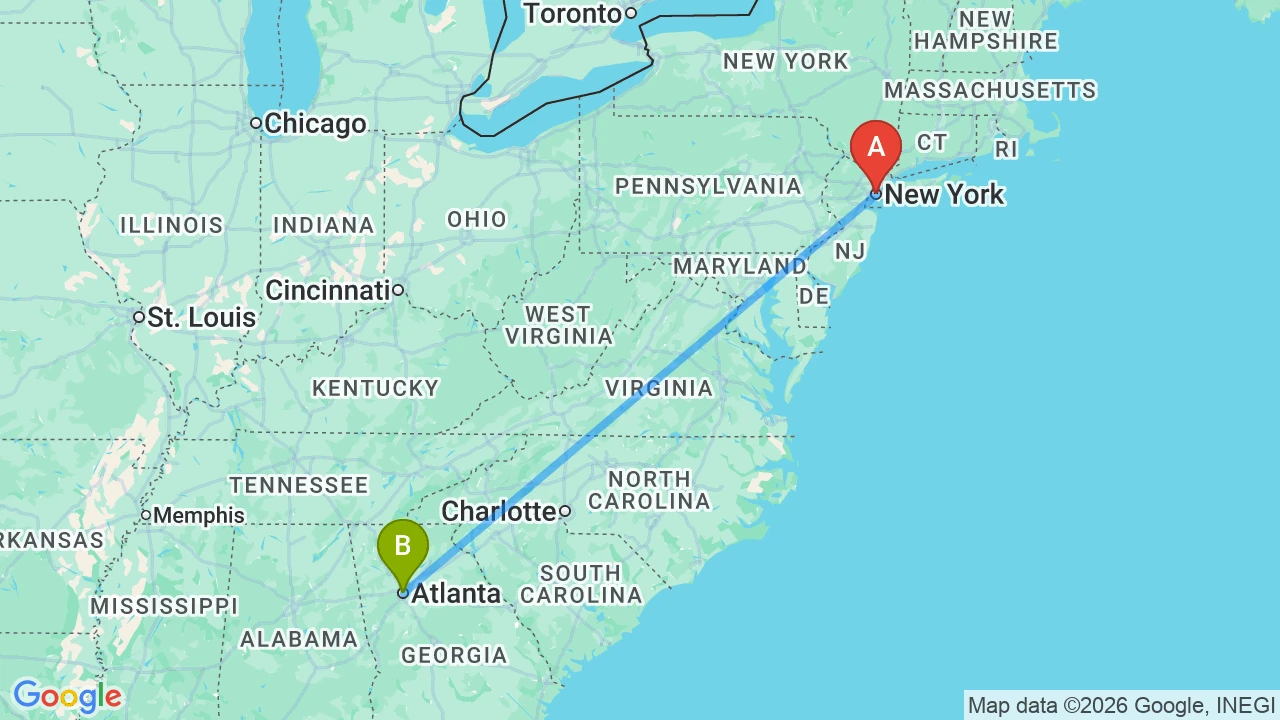
Moving from New York to Atlanta represents one of the most common relocation corridors in the U.S., driven by housing costs, job opportunities, and lifestyle recalibration. But this isn’t a simple “cheaper city” story—it’s a fundamental restructuring of how costs show up, how daily routines work, and where households feel pressure.
This guide explains what typically changes when you make this move: where expenses concentrate differently, how neighborhood form affects logistics, and which household types tend to adapt most easily. It does not predict your total costs or declare whether the move “saves money”—it clarifies where financial and logistical exposure shifts, so you can plan with realistic expectations.
Where Cost Pressure Moves
The most visible shift is housing entry cost. New York’s median home value sits at $732,100, while Atlanta’s is $395,600—a substantially lower barrier to ownership. Renters see a similar pattern: New York’s median gross rent is $1,714 per month compared to Atlanta’s $1,512 per month. The gap is real, but it doesn’t tell the whole story.
What changes more than the sticker price is how housing costs behave. In New York, rent often includes heat or hot water; in Atlanta, tenants typically pay all utilities separately. Ownership in Atlanta frequently involves homeowners association fees, lawn care, and pest control—line items that feel minor individually but accumulate as ongoing obligations. The entry barrier drops, but the operational complexity increases.
Utilities shift in both price and intensity. New York’s electricity rate is 26.95¢/kWh; Atlanta’s is 14.53¢/kWh. But Atlanta’s long, humid cooling season means air conditioning dominates summer bills in a way that New York households—especially apartment dwellers with shared heating systems—rarely experience. Natural gas pricing flips the other direction: New York pays $23.93/MCF, Atlanta $32.21/MCF, though heating demand is lighter in Atlanta overall.
Transportation costs restructure entirely. In New York, rail service is integrated throughout the city, and the average commute is 41 minutes with 69.6% of workers facing long commutes—but many of those commutes happen on foot, subway, or bus. In Atlanta, rail is present but limited in reach, and only 8.6% of workers operate from home compared to New York’s 26.5%. Atlanta’s average commute is shorter at 27 minutes, but 37.6% still face long commutes, and most of those happen by car. Gas is cheaper—$2.65/gal in Atlanta versus $2.98/gal in New York—but the volume of driving increases sharply, along with insurance, maintenance, registration, and parking costs that many New York households never carried.
Grocery costs reflect regional price parity. Items like ground beef, milk, and eggs cost visibly less in Atlanta (e.g., $6.75/lb for ground beef versus $7.49/lb in New York; $4.09 per half-gallon of milk versus $4.53). Derived estimate based on national baseline adjusted by regional price parity; not an observed local price. But access patterns differ: Atlanta’s food and grocery density exceeds high thresholds citywide, yet the car-dependent structure means errands often require deliberate trips rather than spontaneous stops on the way home.
Housing and Neighborhood Patterns
New York’s housing market is defined by vertical density and constrained supply. Atlanta’s is defined by horizontal sprawl and car-oriented access. This isn’t just an aesthetic difference—it changes how you search, what you pay for, and what’s included.
In New York, renters often prioritize proximity to transit and accept smaller square footage in exchange for walkable access to work, food, and services. In Atlanta, space is more abundant, but that space often comes with trade-offs: longer drives to work, grocery stores located along commercial corridors rather than within walking distance, and neighborhoods where sidewalks may be sparse or discontinuous.
Ownership in Atlanta frequently means single-family homes with yards, which introduces maintenance obligations that New York co-op or condo owners handle collectively or not at all. Lawn care, HVAC servicing, pest control, and gutter cleaning become routine rather than exceptional expenses. These aren’t large costs individually, but they add operational friction and recurring line items that many New York households never budgeted for.
Atlanta’s building height profile is more vertical than many Southern metros, and mixed-use development is present in core neighborhoods, but the pedestrian-to-road ratio still reflects a car-first design. Walkable pockets exist—particularly in areas near rail stations—but they represent the exception rather than the norm. If walkability is central to your routine, expect to narrow your neighborhood search significantly and potentially pay a premium for that access.
Lifestyle and Daily Rhythms
Daily life in New York is structured by density, transit, and vertical access. You walk to the subway, pick up groceries on the way home, and run errands in fragments throughout the week. Atlanta’s rhythm is different: errands tend to cluster into deliberate trips, often by car, and the spatial spread of the metro means that “nearby” is measured in drive time rather than blocks.
Atlanta’s experiential structure reflects this. The city shows high pedestrian-to-road ratios in certain areas, rail transit is present, and cycling infrastructure exists in pockets with moderate density. Food and grocery establishments exceed density thresholds citywide, and park access is well-integrated, with water features adding to outdoor amenity availability. Family infrastructure—schools and playgrounds—meets strong density benchmarks, and hospital facilities are present alongside pharmacies. The urban form includes taller buildings in core areas and demonstrates mixed residential and commercial land use.
But these signals describe availability, not default behavior. Most Atlanta households rely on cars for daily logistics, even in neighborhoods with transit access. Commutes are shorter on average, but the lack of remote work prevalence (8.6% versus New York’s 26.5%) means more people are driving more days per week. For households accustomed to walking or taking the subway as a reflex, this shift requires both financial and psychological adjustment.
Climate exposure changes in intensity and season. Atlanta’s summers are long, hot, and humid—conditions that make air conditioning a necessity rather than a luxury. Cooling costs dominate warm-weather utility bills in a way that New York households, particularly those in apartments with shared or minimal cooling systems, may not anticipate. Winters are milder, with rare freezing nights and minimal heating demand, but the extended cooling season more than offsets the reduced heating expense for many households.
Outdoor life is more accessible in Atlanta. Parks are densely distributed, green space is integrated into neighborhoods, and the metro’s layout supports recreational access. But the car-dependent structure means that even outdoor activities often begin with a drive, rather than a walk out the door.
Relocation Logistics and Practical Friction
The logistics of moving from New York to Atlanta are straightforward in theory—major metros, established moving corridors, direct flights—but the adjustment period involves more than packing and unpacking.
Most movers underestimate how much the car dependency shift affects daily routines. In New York, you might not own a car, or you might use it occasionally. In Atlanta, you’ll likely need one immediately, which means shopping for a vehicle, securing insurance (often higher for new residents without local history), registering it, and budgeting for gas, maintenance, and parking. These aren’t one-time costs—they’re new recurring obligations that reframe your monthly expense structure.
Utility setup also surprises many movers. In New York, heat and hot water are often included in rent, and electricity bills tend to be modest due to apartment size and shared building systems. In Atlanta, tenants typically pay for electricity, gas, water, and sometimes trash separately. Summer cooling bills can spike sharply, especially in older homes or units without efficient HVAC systems. Budgeting for utilities requires more attention and seasonal planning than many New York renters are used to.
Neighborhood selection becomes more complex. In New York, proximity to a subway line often defines a neighborhood’s value and accessibility. In Atlanta, transit access exists but doesn’t carry the same universal weight. Instead, you’ll evaluate commute routes by car, highway access, school zones (if relevant), and whether the neighborhood offers walkable errands or requires driving for every task. The criteria shift, and the research process takes longer as a result.
Social and professional networks also take time to rebuild. Atlanta’s job market is strong, with an unemployment rate of 3.6% compared to New York’s 4.8%, but the metro’s sprawl means that professional communities are more geographically dispersed. Networking often requires more deliberate travel, and the lack of dense, spontaneous social infrastructure (corner bars, late-night diners, block-level gathering spots) means that building new routines requires more intentional effort.
Who This Move Tends to Fit
This relocation corridor works best for households prioritizing homeownership entry, space, and a slower daily pace. If you’ve been priced out of New York’s housing market, or if you’re tired of small apartments and long subway commutes, Atlanta offers a clear structural alternative. Families seeking yards, larger homes, and access to schools and parks often find Atlanta’s infrastructure well-suited to their needs, especially given the strong family amenity density.
Remote workers and hybrid professionals also adapt well, particularly if they can minimize commute frequency and take advantage of Atlanta’s lower housing costs without absorbing the full transportation burden. The metro’s job market supports career growth in sectors like logistics, healthcare, film production, and technology, and the lower cost of living can translate into more disposable income—if you manage the car-dependent expense structure carefully.
This move is more challenging for households whose routines depend on walkability, spontaneous access, and transit fluidity. If you don’t drive, or if you prefer not to, Atlanta will feel restrictive. The metro’s transit system exists, but it doesn’t offer the coverage or frequency that New York’s does, and many neighborhoods lack sidewalks or safe pedestrian infrastructure. Renters who value flexibility and minimal maintenance obligations may also feel the shift more acutely, as Atlanta’s rental market often involves more self-service utility management and fewer all-inclusive arrangements.
Households sensitive to heat and humidity should plan carefully. Atlanta’s cooling season is long and intense, and if you’re moving into an older home or a unit with inefficient climate control, summer utility bills can become a significant stressor. The milder winters help, but the seasonal imbalance is real.
Frequently Asked Questions
- Does Atlanta feel more or less expensive than New York?
- Atlanta’s housing entry costs are substantially lower, but the expense structure shifts rather than simply shrinking. You’ll likely spend less on rent or a mortgage, but more on transportation, utilities, and car-related costs. Where you feel pressure depends on your household type: families gaining space and ownership access often feel relief, while individuals accustomed to walkable, transit-rich routines may find the car dependency adds friction and cost they didn’t anticipate.
- How do the housing markets differ between New York and Atlanta?
- New York’s market is constrained, vertical, and expensive, with limited inventory and intense competition. Atlanta’s market is more accessible, with lower entry costs and more space, but it’s also more spread out and car-dependent. Ownership in Atlanta often involves single-family homes with yards and maintenance obligations, while New York leans toward co-ops, condos, and rentals with shared building systems. The operational complexity increases in Atlanta even as the entry barrier drops.
- What feels different about daily life after moving to Atlanta?
- The most immediate change is transportation: you’ll drive more, walk less, and plan errands in clusters rather than handling them spontaneously. The pace is slower, the space is greater, and outdoor access is more integrated, but the car-dependent structure means that even short trips require deliberate effort. Social rhythms also shift—Atlanta’s sprawl makes spontaneous meetups harder, and building new routines takes more intentional planning than in New York’s dense, transit-connected environment.
- When does this move tend to feel easiest or hardest?
- The move feels easiest when you have time to research neighborhoods carefully, secure a vehicle before arrival, and budget for the full transportation and utility cost structure. It feels hardest when you underestimate how much the car dependency affects daily logistics, or when you move in summer without anticipating the intensity of cooling costs. Households with children often find the transition smoother due to Atlanta’s strong family infrastructure, while individuals who rely on walkability may struggle more with the adjustment period.
- What are the most common adjustment pressures?
- Car dependency is the most frequently cited challenge—many movers don’t expect how much driving replaces walking, or how quickly car-related costs accumulate. Utility bills, especially in summer, also surprise renters used to New York’s often-included heat and modest electricity usage. Social isolation can emerge due to the metro’s sprawl and the lack of spontaneous gathering spaces. Finally, the slower pace and quieter neighborhoods feel liberating to some and isolating to others, depending on personality and prior routine.
- Who does this move work best for, and who might struggle?
- This move works best for families seeking space and ownership, remote workers who can minimize commuting, and professionals in Atlanta’s growing job sectors who value a slower pace and lower housing costs. It’s more challenging for individuals who don’t drive, households whose routines depend on walkability and transit, and renters who prefer minimal maintenance obligations. If you thrive on density, spontaneity, and vertical urban life, Atlanta will require significant lifestyle recalibration.
Final Considerations
Moving from New York to Atlanta is not a simple cost reduction—it’s a structural shift in how daily life works, where expenses concentrate, and what logistical friction you’ll encounter. Housing becomes more accessible, but transportation costs rise. Space increases, but so do maintenance obligations. The pace slows, but the car dependency intensifies.
Understanding these tradeoffs before you move allows you to choose neighborhoods strategically, budget for the full expense structure, and set realistic expectations for the adjustment period. Some households thrive in Atlanta’s sprawl and space; others find the car-dependent rhythm exhausting. Neither outcome is universal—it depends on your priorities, routines, and tolerance for logistical change.
For deeper neighborhood-level insights, explore the Atlanta living guide and the New York living guide on IndexYard. Both hubs offer granular breakdowns of housing, transportation, and daily cost behavior to help you plan with precision.
How this article was built: In addition to public economic data, this article incorporates location-based experiential signals derived from anonymized geographic patterns—such as access density, walkability, and land-use mix—to reflect how day-to-day living actually feels in Atlanta, GA.