
Lenexa is considered moderately priced in 2026, with a median home value of $348,600 and median rent of $1,373 per month. The main exposure is housing entry cost rather than day-to-day expenses, particularly for buyers navigating ownership in a suburb with strong walkable pockets and accessible errands infrastructure.
Is the True Cost of Living Higher Than You Think?
When evaluating what it actually costs to live somewhere, the sticker price rarely tells the whole story. In Lenexa, the cost structure is shaped less by inflated grocery bills or utility spikes and more by the upfront commitment required to enter the housing market—and the ongoing transportation decisions that follow. For many households, the question isn’t whether Lenexa is expensive in absolute terms, but whether the tradeoffs between housing entry, commute exposure, and daily convenience align with their financial priorities.
Understanding the true cost means looking past averages and asking: what drives pressure here, where do surprises emerge, and which households face the steepest climbs?
Overall Cost of Living Snapshot
Lenexa’s cost profile is anchored by housing—specifically, the price required to buy in. With a median home value of $348,600, ownership represents the largest single financial commitment most households will face. Renters encounter a different calculus: median gross rent sits at $1,373 per month, positioning Lenexa as accessible relative to many metro-adjacent suburbs, but still requiring disciplined budgeting for households without dual incomes or significant savings.
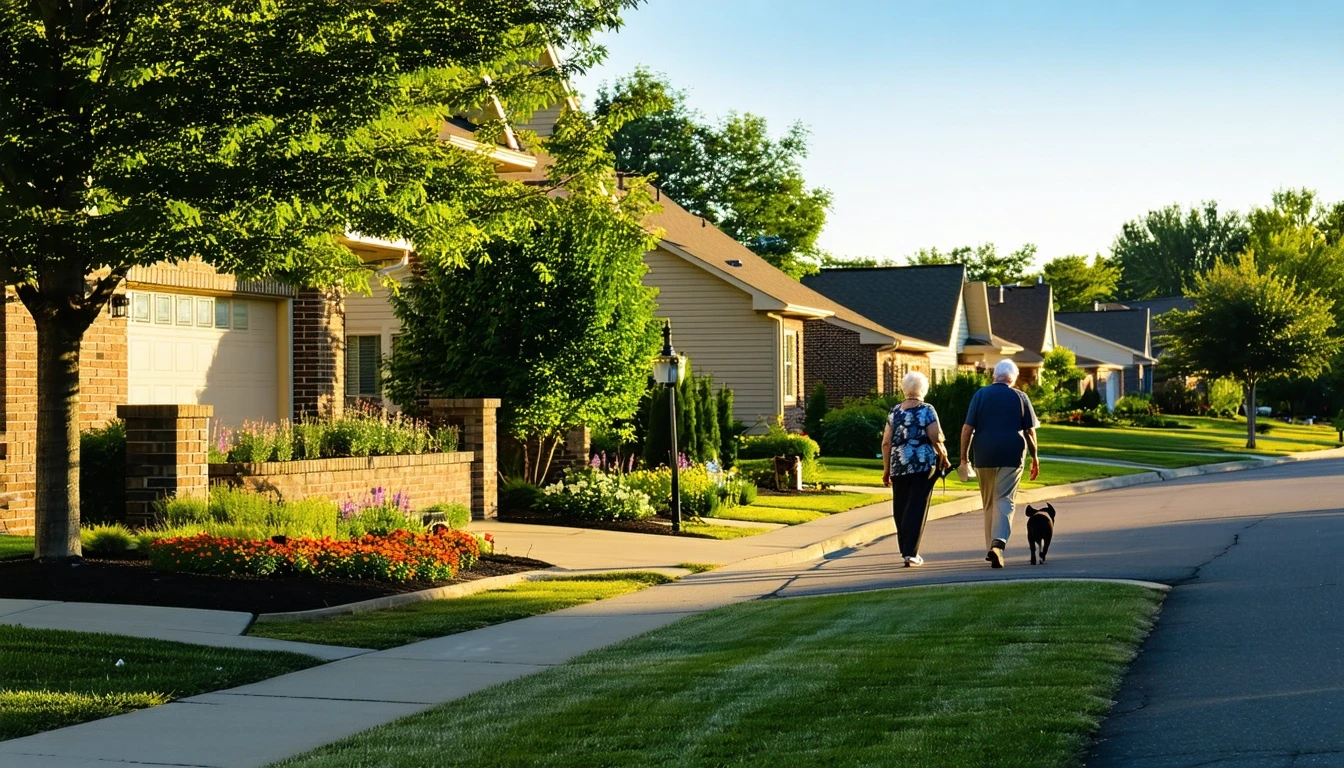
What sets Lenexa apart from the typical suburban cost narrative is the presence of walkable pockets and broadly accessible errands infrastructure. The city exhibits a high pedestrian-to-road ratio and food and grocery density that exceeds typical thresholds, meaning that day-to-day friction—trips to the store, errands, short-distance needs—can often be managed without constant car dependency. This reduces the hidden costs of convenience that plague more sprawling, car-only environments.
Transportation remains a meaningful cost driver, but the structure here is nuanced. The average commute is 19 minutes, and 20% of workers face long commutes, signaling that while many residents enjoy short trips, a meaningful minority are exposed to higher fuel, maintenance, and time costs. Work-from-home adoption is low at 2.3%, meaning most households are commuting regularly.
Utilities present moderate seasonal exposure. Electricity rates stand at 14.29¢/kWh, and natural gas is priced at $12.69/MCF. Neither represents a major cost shock, but households should expect variability tied to heating and cooling cycles rather than stable, predictable bills year-round.
Driver verdict: Housing entry cost dominates the financial landscape. Surprises come not from groceries or utilities, but from underestimating transportation exposure for long commuters and the equity-building pressure of ownership in a moderately priced but not cheap market.
Housing Costs (Primary Driver)
Housing is the fulcrum on which Lenexa’s cost structure balances. For buyers, the $348,600 median home value reflects a market that rewards long-term commitment but demands substantial upfront capital and sustained income stability. This is not a market where entry is casual or speculative—it’s a market where ownership is a deliberate financial strategy, often requiring dual incomes, significant down payments, or both.
Renters face a different set of pressures. At $1,373 per month median rent, Lenexa offers a more flexible entry point, but the cost is still significant enough to require careful income allocation. Renters gain mobility and lower upfront risk, but they forfeit equity accumulation and remain exposed to renewal increases and landlord decisions.
The choice between renting and owning in Lenexa is not simply a matter of preference—it’s a choice between liquidity and leverage. Buyers lock in housing costs (minus taxes, insurance, and maintenance volatility) and build equity over time. Renters preserve cash flow flexibility and avoid maintenance risk, but they remain price-takers in a rental market that can shift with demand.
Conclusion: Lenexa is a buying city for households with stable income and long-term plans. Renters can find access, but the value proposition tilts toward ownership for those who can manage the entry cost.
| Housing Type | Cost Anchor | What That Buys You |
|---|---|---|
| Median Home Value | $348,600 | Equity-building ownership with stable long-term housing cost structure, exposure to maintenance and tax volatility |
| Median Gross Rent | $1,373/month | Flexibility and lower upfront cost, exposure to renewal increases and landlord decisions |
Utilities & Energy Risk
Utility costs in Lenexa are shaped by seasonal extremes rather than baseline rates. Electricity at 14.29¢/kWh is neither a bargain nor a burden—it’s squarely in the range where usage patterns matter more than the rate itself. Summers bring extended cooling demand, and households with poor insulation, older HVAC systems, or large square footage will see bills climb noticeably during peak heat months.
Natural gas, priced at $12.69/MCF, becomes relevant during heating season. For context, 1 MCF approximates 100 therms, meaning that winter months will drive gas consumption and costs upward for homes relying on gas furnaces. The volatility here is not in the rate—it’s in the duration and intensity of heating demand, which varies year to year based on weather severity.
The key insight: utilities in Lenexa are not a primary cost driver, but they are a source of variability. Households that plan for seasonal swings and invest in efficiency measures (programmable thermostats, insulation upgrades, HVAC maintenance) can reduce exposure. Those who ignore usage patterns or live in energy-inefficient homes will face sharper seasonal spikes.
Risk classification: Moderate. Utilities are manageable with planning, but they introduce enough variability to affect month-to-month cash flow, particularly for renters who lack control over infrastructure quality.
Groceries & Daily Costs
Grocery costs in Lenexa reflect a regional price environment that is slightly below national averages, as indicated by the city’s regional price parity index of 87. This means that food and household essentials generally cost less here than in higher-cost metros, though the difference is modest rather than transformative.
What matters more than individual item prices is the accessibility of grocery options. Lenexa exhibits high grocery density, meaning that households have multiple options within reasonable proximity. This reduces the hidden costs of food shopping—time, fuel, and the convenience tax of limited choice. When grocery stores are broadly accessible, households can shop strategically, compare prices, and avoid the markup that comes with captive-market retailers.
The pressure point for groceries is not the price per pound—it’s the household composition and dietary habits. Larger families, households with dietary restrictions, or those prioritizing organic and specialty items will feel more pressure than smaller households eating simply. But the baseline cost environment is favorable, and the infrastructure supports efficient shopping without requiring long drives or settling for limited selection.
Transportation Reality
Transportation in Lenexa operates on a split model. The city has walkable pockets with substantial pedestrian infrastructure, meaning that for households living in these areas, daily errands—groceries, coffee, short trips—can often be managed on foot. This is not a universal experience, but it’s a meaningful one for those who prioritize location within the city.
For most households, however, a car is essential. The average commute is 19 minutes, which is manageable, but 20% of workers face long commutes, signaling that a significant minority are driving substantial distances regularly. With work-from-home adoption at just 2.3%, nearly everyone is commuting, and that means fuel, maintenance, insurance, and depreciation are recurring exposures.
Gas prices sit at $3.48 per gallon, which is neither extreme nor negligible. The cost of transportation in Lenexa is less about the per-gallon price and more about the cumulative effect of commute length, vehicle count, and household logistics. A household with two long commuters and two vehicles faces a fundamentally different [cost structure](https://indexyard.com/best-moving-companies-guide/) than a single-car household with a short commute and access to walkable errands.
Public transit exists in the form of bus service, but it is limited. For households that can structure their lives around walkable access and short commutes, transportation costs remain contained. For those who cannot, transportation becomes a significant and ongoing financial commitment.
Cost Exposure Profiles
Cost exposure in Lenexa is not uniform—it’s shaped by housing choice, commute structure, and household logistics. Understanding where pressure concentrates helps clarify who thrives here and who struggles.
Low-exposure profile: A renter living in one of Lenexa’s walkable pockets, with a short commute and access to broadly accessible grocery and errands infrastructure, faces minimal day-to-day cost friction. Rent is the primary fixed cost, utilities are moderate, and transportation costs remain low due to reduced driving. This household benefits from Lenexa’s infrastructure advantages without bearing the full weight of ownership or long-distance commuting.
High-exposure profile: A buyer stretching to afford the $348,600 median home value, managing a long commute, and operating multiple vehicles faces compounding pressure. Ownership brings equity but also locks in property taxes, insurance, and maintenance volatility. Long commutes amplify fuel, time, and vehicle depreciation costs. This household is exposed on multiple fronts, and any income disruption or unexpected expense creates cascading strain.
The difference between these profiles is not income alone—it’s the alignment between housing choice, commute structure, and daily logistics. Lenexa rewards households that can leverage its walkable pockets and accessible errands infrastructure while managing housing entry cost strategically. It penalizes those who overextend on housing while simultaneously bearing high transportation exposure.
Frequently Asked Questions
Is Lenexa more affordable than Overland Park in 2026? Lenexa generally offers lower housing entry costs than Overland Park, though both are moderately priced suburbs. The value proposition depends on whether you prioritize walkable pockets and accessible errands infrastructure, where Lenexa performs well, versus other amenities where Overland Park may offer more options.
What does a typical cost profile look like in Lenexa? Housing dominates, with median home values at $348,600 and median rent at $1,373 per month. Transportation is the second-largest exposure, particularly for households with long commutes or multiple vehicles. Utilities and groceries are moderate and manageable with planning.
Do utilities cost more in Lenexa than in nearby areas? Utility rates in Lenexa are comparable to regional averages. Electricity at 14.29¢/kWh and natural gas at $12.69/MCF are neither bargains nor burdens—seasonal usage patterns matter more than the rates themselves.
What costs tend to surprise newcomers in Lenexa? Many newcomers underestimate transportation exposure, particularly if they assume all suburbs are equally car-dependent. Lenexa has walkable pockets that reduce daily driving, but long commuters still face significant fuel and vehicle costs. Property taxes and homeowners insurance can also surprise buyers who focus only on purchase price.
Are property taxes higher in Lenexa than in Olathe? Property tax rates vary by jurisdiction and assessment practices, but both cities are in Johnson County, which generally has higher property taxes than many Kansas counties. Buyers should verify current mill levies and assessment trends rather than assume parity.
Is Lenexa a good value for renters? Renters benefit from accessible errands infrastructure and walkable pockets, which reduce transportation friction. At $1,373 median rent, Lenexa is moderately priced but not cheap—value depends on income stability and whether the location aligns with commute and lifestyle needs.
How does Lenexa’s cost of living compare to Kansas City overall? Lenexa tends to have higher housing costs than many Kansas City neighborhoods but offers suburban amenities, lower crime, and better-maintained infrastructure. The tradeoff is between urban density and suburban structure, with cost differences reflecting that divide.
How this article was built: In addition to public economic data, this article incorporates location-based experiential signals derived from anonymized geographic patterns—such as access density, walkability, and land-use mix—to reflect how day-to-day living actually feels in Lenexa, KS.