
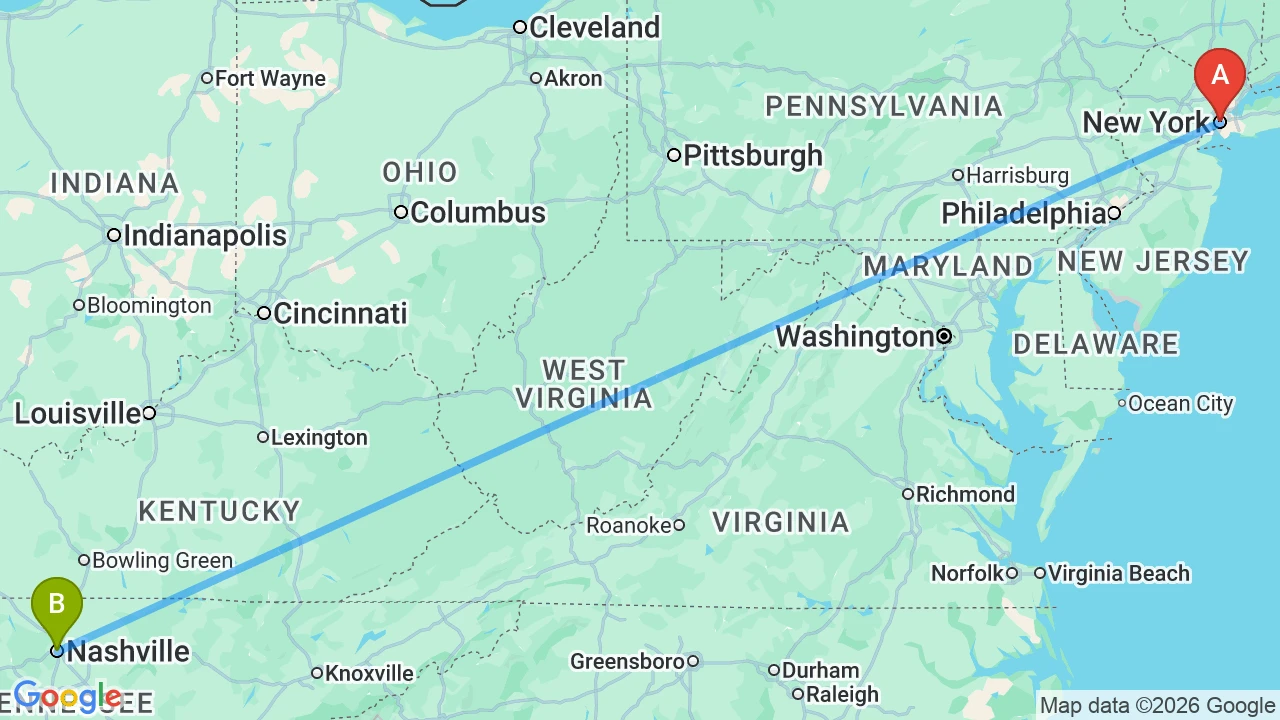
Moving from New York to Nashville represents one of the more dramatic urban-to-Southern relocations Americans consider, and the shift touches nearly every aspect of daily life. This isn’t simply a question of whether Nashville is “cheaper”—it’s about understanding where cost pressure concentrates differently, how daily rhythms change, and which household types tend to thrive or struggle after the move.
New York operates at a scale and intensity few American cities match. Median home values reach $732,100, median rent sits at $1,714 per month, and the regional price level runs 12% above the national baseline. The average commute stretches to 41 minutes, though 26.5% of workers avoid it entirely by working from home. Nearly 70% of commuters face what’s classified as a long commute. Unemployment stands at 4.8%. The city’s density, transit infrastructure, and walkable neighborhoods create a particular cost-benefit equation: high entry costs, but reduced need for car ownership and access to services within walking distance.
Nashville’s cost structure reflects a different regional reality. The overall price level runs 3% below the national baseline. Unemployment is notably lower at 2.9%, suggesting a tight labor market. While comprehensive housing data isn’t available in the current dataset, Nashville’s growth trajectory and regional character point toward a market under pressure from sustained in-migration, particularly from higher-cost metros like New York.
This guide explains how cost exposure, daily logistics, and lifestyle patterns shift between these two cities. It does not calculate total budgets, declare a financial winner, or predict whether you’ll save money. Instead, it clarifies where pressure moves, what changes in your daily routine, and who tends to feel the transition most acutely.
Cost Pressure Shifts: Where Expenses Concentrate Differently
The most immediate financial shift involves housing entry barriers and ongoing transportation exposure. New York’s $732,100 median home value and $1,714 median rent create formidable upfront costs, but the city’s transit density and walkable infrastructure mean many households can function without a car. Nashville’s lower regional price level suggests reduced housing entry costs in relative terms, but the city’s car-dependent structure introduces a different kind of ongoing expense.
In New York, location-based experiential signals derived from anonymized geographic patterns show strong transit viability and walkable errands access in many neighborhoods. Households can often reach daily needs—groceries, pharmacies, services—on foot or via short transit trips. This reduces the need for vehicle ownership, insurance, maintenance, and parking costs that can easily exceed several hundred dollars monthly.
Nashville’s urban form operates differently. The city’s layout and lower density mean most households rely on personal vehicles for daily errands, commuting, and accessing services. This introduces steady costs: car payments or maintenance, insurance, fuel, and parking. Gas prices currently sit at $2.48 per gallon in Nashville compared to $2.98 in New York, but the volume of driving required typically outweighs the per-gallon savings. Households accustomed to New York’s transit-oriented lifestyle often underestimate how much driving Nashville requires and what that costs over time.
Utility exposure shifts as well, though in ways that vary by season and housing type. New York’s electricity rate runs 26.95¢/kWh, while Nashville’s sits at 13.06¢/kWh—a substantial difference that affects monthly bills. Natural gas pricing shows a smaller gap: $23.93/MCF in New York versus $20.33/MCF in Nashville. Nashville’s climate brings hot, humid summers that drive air conditioning demand for extended periods, while winters are milder than New York’s, reducing heating intensity. The net effect depends on housing size, insulation quality, and thermostat habits, but many movers find that lower per-unit energy costs don’t always translate to lower total bills if they’re cooling a larger space for more months of the year.
Grocery costs follow the regional price pattern. Items like bread ($2.05/lb in New York vs $1.78/lb in Nashville), eggs ($3.04/dozen vs $2.63/dozen), and milk ($4.53/half-gallon vs $3.93/half-gallon) reflect Nashville’s lower cost index. These are derived estimates based on national baselines adjusted by regional price parity; not observed local prices. The directional pattern is clear: routine grocery spending tends to run lower in Nashville, though the magnitude of the difference depends on household size, dietary preferences, and where you shop.
Housing and Neighborhood Patterns
New York’s housing market is defined by scarcity, vertical density, and fierce competition. The $732,100 median home value and $1,714 median rent reflect decades of constrained supply meeting sustained demand. Renters face frequent lease renewals with unpredictable increases, while buyers confront high entry costs, co-op board processes, and limited inventory. Neighborhoods vary widely in character, but the common thread is that proximity to transit, services, and employment centers commands a premium.
Nashville’s housing market has experienced rapid appreciation driven by in-migration and economic growth. While current median values aren’t available in this dataset, the city’s regional price index and growth trajectory suggest a market where entry costs are lower than New York’s in absolute terms, but where competition remains intense and inventory moves quickly. Renters may find more space per dollar, but lease terms and renewal behavior can still create pressure. Homebuyers often discover that Nashville’s market, while more accessible than New York’s, still requires speed and flexibility.
Neighborhood form matters as much as price. New York’s density and mixed-use development mean that even in outer boroughs, residents often live within walking distance of groceries, schools, and services. Nashville’s neighborhoods tend toward lower density and single-use zoning, which translates to more driving for routine errands. Families moving from New York sometimes underestimate how much time they’ll spend coordinating pickups, dropoffs, and errands that previously happened on foot or via a single subway trip.
Lifestyle and Daily Rhythms
Daily life in New York revolves around density, transit schedules, and vertical living. The 41-minute average commute reflects a mix of subway, bus, and walking trips, often involving transfers and crowding. Errands happen in small increments—grabbing groceries on the way home, picking up prescriptions between meetings—because stores and services are embedded in residential neighborhoods. Social life, dining, and entertainment are accessible without a car, and many households treat vehicle ownership as an expensive inconvenience rather than a necessity.
Nashville operates at a different tempo. Commutes happen by car, often on highways or arterial roads that experience peak-hour congestion. Errands require planning and consolidation because destinations are spread out. Grocery runs, doctor’s appointments, and school pickups each demand a separate car trip, and households with multiple members often need multiple vehicles. The rhythm is less spontaneous, more scheduled, and more dependent on coordination and driving time.
Location-based experiential signals show that Nashville’s urban form and errands accessibility create a car-dependent daily pattern for most households. Unlike New York, where transit viability and walkable access reduce the need for vehicle ownership, Nashville’s layout means that running a household without a car is difficult outside a few central neighborhoods. This affects not just transportation costs, but time, flexibility, and the mental load of logistics.
Climate exposure also shifts. New York experiences cold winters with occasional snow, requiring heating and winter clothing, but summers are warm rather than extreme. Nashville’s summers bring extended heat and humidity, driving air conditioning use for months at a time, while winters are mild with rare freezing nights. Households accustomed to New York’s seasonal rhythm may find Nashville’s long cooling season more taxing, both in energy costs and in outdoor comfort during peak summer months.
Relocation Logistics and Practical Friction
The physical move from New York to Nashville covers roughly 900 miles, typically requiring professional movers or a multi-day drive. Timing matters: summer months see higher moving costs and tighter inventory in Nashville, while winter offers more flexibility but less favorable weather for the drive itself. Movers leaving New York often face building restrictions, elevator reservations, and tight loading windows that add logistical complexity.
Once in Nashville, new residents encounter adjustment friction that goes beyond cost. Establishing a new routine requires finding grocery stores, healthcare providers, and service providers—all of which now require driving. Families with school-age children face different school systems, extracurricular structures, and social networks. The loss of New York’s transit infrastructure means that teenagers and non-drivers lose independence, and households must rethink how they manage daily logistics.
Social and professional networks also require rebuilding. New York’s density and industry concentration mean that professional communities are often geographically compact and accessible via transit. Nashville’s economy is growing and diversifying, but industry networks are more dispersed, and professional socializing often requires driving to specific districts or suburbs. The unemployment rate of 2.9% suggests a healthy job market, but the texture of professional life feels different.
What surprises movers most is often the cumulative effect of small changes. Individually, driving to the grocery store or needing a second car seems manageable. Collectively, these shifts add time, coordination, and ongoing costs that weren’t part of the New York equation. The tradeoff is more space, lower housing entry costs, and a different pace of life—but it’s a tradeoff that requires intentional adjustment, not just financial calculation.
Frequently Asked Questions
- Does Nashville feel more or less expensive than New York?
- Nashville’s lower regional price level and reduced housing entry costs make it feel more accessible upfront, but the shift in where costs concentrate matters as much as the total. New York’s high rent and home prices dominate the budget, but transit access reduces transportation costs. Nashville spreads expenses differently: lower housing costs but higher transportation exposure due to car dependence, plus extended air conditioning seasons that affect utilities. Who feels the financial relief depends on household size, commute patterns, and whether you’re renting or buying.
- How do housing markets differ between New York and Nashville?
- New York’s market is defined by scarcity, high entry costs, and intense competition, with a median home value of $732,100 and median rent of $1,714. Nashville’s market reflects rapid growth and in-migration pressure, with lower absolute costs but still competitive conditions. New York offers more walkable, transit-accessible neighborhoods; Nashville’s neighborhoods are more car-dependent and spread out. Renters in both cities face renewal pressure, but Nashville offers more space per dollar, while New York offers more access per dollar.
- What feels different about daily life after moving from New York to Nashville?
- The most immediate change is the shift from transit-oriented to car-dependent living. Errands that happened on foot or via subway in New York now require driving, and households often need multiple vehicles. The pace feels slower and less dense, with more space but more time spent coordinating logistics. Social and professional networks require rebuilding, and the loss of spontaneous access to dining, culture, and services takes adjustment. Climate exposure shifts from cold winters to long, humid summers.
- When does the move from New York to Nashville tend to feel easiest?
- Timing depends more on household circumstances than season. Families with school-age children often prefer summer to avoid mid-year transitions, though Nashville’s housing market and moving costs peak then. Workers with flexible start dates may find late fall or early spring easier for logistics and inventory. The adjustment period feels smoothest for households who research neighborhoods carefully, budget for transportation costs upfront, and expect a slower, more car-dependent rhythm rather than assuming a direct cost-of-living trade.
- What are the most common adjustment pressures after this move?
- Transportation dependence surprises many movers—needing a car for every errand, managing multiple vehicles, and spending more time driving. The loss of walkable access and transit independence affects daily routines and household logistics. Climate adjustment, particularly Nashville’s long, humid summers, takes time. Rebuilding professional and social networks requires intentional effort, and the slower pace can feel isolating for households accustomed to New York’s density and spontaneity. Financially, the shift from high rent to car ownership costs requires budget rebalancing.
- Who does this move work best for, and who might struggle?
- This move tends to work well for households seeking lower housing entry costs, more space, and a slower pace, especially those who don’t mind car dependence and prefer milder winters. Families with young children often appreciate more room and outdoor space, and remote workers can take advantage of Nashville’s lower cost structure without needing to commute. The move is harder for households who rely on transit, value walkability and spontaneous access, or whose professional networks are tightly tied to New York’s industry concentration. Singles and non-drivers lose independence, and those who underestimate transportation costs may find the financial relief smaller than expected.
Understanding the Tradeoff
Moving from New York to Nashville is not a simple cost arbitrage. It’s a shift in how daily life is structured, where expenses concentrate, and what kind of friction you encounter in routine tasks. New York’s high housing costs come with transit access, walkability, and density that reduce other expenses and increase spontaneity. Nashville’s lower entry costs come with car dependence, longer cooling seasons, and a rhythm that requires more planning and driving.
The households who thrive after this move are those who understand the tradeoff clearly: they’re willing to exchange access and density for space and lower housing pressure, and they budget not just for rent or mortgage differences, but for the transportation, time, and logistical shifts that come with Nashville’s urban form. The households who struggle are often those who assume the financial difference will be straightforward, or who underestimate how much they relied on New York’s infrastructure and spontaneity.
If you’re considering this move, spend time understanding Nashville’s neighborhood patterns, transportation realities, and climate exposure. Visit during summer to experience the heat and humidity. Map out daily errands from potential neighborhoods to see what driving actually looks like. And recognize that the adjustment period involves more than finding a new apartment—it involves rebuilding routines, networks, and expectations around what daily life feels like.
For deeper neighborhood comparisons, cost breakdowns, and local context, explore IndexYard’s Nashville and New York city hubs.
How this article was built: In addition to public economic data, this article incorporates location-based experiential signals derived from anonymized geographic patterns—such as access density, walkability, and land-use mix—to reflect how day-to-day living actually feels in Nashville, TN.