
Introduction: Why This Move Matters
The move from New York, NY to Raleigh, NC represents one of the most dramatic relocations in the American urban landscape—not just in distance, but in how daily life is structured, where money goes, and what households gain or give up in the process. People consider this move for many reasons: lower housing entry barriers, job opportunities in Raleigh’s growing tech and research sectors, a desire to escape the relentless pace and density of New York, or simply the appeal of a place where a salary stretches differently.
What changes isn’t just the price tags—it’s where cost pressure concentrates, how much control you have over expenses, and what trade-offs you accept in exchange for relief in other areas. New York’s cost structure is dominated by housing scarcity, transit dependence, and the premium paid for density and access. Raleigh’s structure shifts that pressure toward car ownership, utility exposure, and a different kind of space management. This article explains how those shifts play out in practice, who tends to benefit, and where surprises tend to emerge.
This is not a savings calculator or affordability verdict. It’s a guide to understanding where pressure moves when you trade one urban system for another—and how to think clearly about whether that trade makes sense for your household.
Cost Pressure Shifts: Where Money Goes Differently
In New York, cost pressure is front-loaded and visible: median gross rent sits at $1,714 per month, and median home values reach $732,100. These figures reflect not just space, but access—proximity to transit, jobs, culture, and the infrastructure that makes car-free living possible. The regional price parity index of 112 confirms that nearly everything costs more, but housing is where the gap feels most acute. Median household income in New York is $76,607 per year, which means housing alone can consume a significant share of take-home pay, leaving less room for discretionary spending or savings.
Raleigh’s cost structure is fundamentally different. Median gross rent is $1,371 per month, and median home values are $347,000—both substantially lower than New York. The regional price parity index of 98 suggests that overall costs run slightly below the national baseline. Median household income in Raleigh is $78,631 per year, which is modestly higher than New York’s, creating a different relationship between earnings and expenses. On paper, this looks like straightforward relief. In practice, the shift is more nuanced.
The cost pressure doesn’t disappear—it relocates. In Raleigh, you’ll likely spend less on rent or a mortgage, but you’ll spend more on transportation, utilities, and the infrastructure required to live in a place where daily errands and commutes are car-dependent. Electricity rates in Raleigh are 15.05¢/kWh, compared to New York’s 26.95¢/kWh, which sounds favorable—but Raleigh’s hot, humid summers drive extended cooling seasons, and homes are typically larger, meaning total usage can climb quickly. Natural gas prices are slightly higher in Raleigh at $25.54/MCF versus New York’s $23.93/MCF, though heating demands are lighter in North Carolina’s milder winters.
Gasoline in Raleigh averages $2.67/gallon, compared to $2.98/gallon in New York—but the real shift is in how much you’ll drive. In New York, 26.5% of workers work from home, and the average commute is 41 minutes, with 69.6% of commuters facing long commutes—but many of those commutes happen on trains and buses, not in personal vehicles. Raleigh’s infrastructure is built around car ownership. Rail transit is present, and the city shows a high pedestrian-to-road ratio in certain areas, but the overall mobility texture is one of walkable pockets within a car-oriented region. Grocery density is high, and food establishment density is moderate, meaning errands are corridor-clustered rather than broadly accessible. You’ll need a car, you’ll drive it often, and that shifts both your monthly budget and your daily rhythm.
The unemployment rate in Raleigh is 3.1%, compared to 4.8% in New York, reflecting a tighter labor market and strong job growth in sectors like technology, healthcare, and education. This can mean more negotiating power for workers, but it also means competition for housing in desirable neighborhoods near employment hubs.
Housing & Neighborhood Patterns: Entry vs. Ongoing Obligations
The housing market shift from New York to Raleigh is one of the most tangible changes movers experience. In New York, the barrier to entry is extreme—whether you’re renting or buying, securing housing requires significant upfront capital, proof of income well above the rent threshold, and often a willingness to compromise on space, location, or condition. The median home value of $732,100 puts ownership out of reach for many households, and even those who can afford it face intense competition, co-op board approvals, and maintenance fees that can rival a second rent payment.
Raleigh’s median home value of $347,000 represents a dramatic reduction in entry cost, making homeownership accessible to households who would have been locked into renting indefinitely in New York. For renters, the median gross rent of $1,371 per month is lower than New York’s, but it’s not cheap—it’s just less punishing. The key difference is that in Raleigh, you’re more likely to get space, parking, and amenities for that rent, whereas in New York, you’re paying for density, access, and the ability to live without a car.
Neighborhood form in Raleigh is mixed: average building levels fall in the medium range, and both residential and commercial land use are present, creating pockets of walkability and mixed-use development. However, the overall urban form is lower-density and more spread out than New York’s. This means that while you may find neighborhoods with good access to parks (park density exceeds the high threshold, and water features are present), schools and playgrounds are less densely distributed, which can matter for families trying to minimize driving.
Ongoing housing obligations shift in character. In New York, renters face rent increases that can be steep and unpredictable, especially in unregulated units. Owners face high property taxes, co-op or condo fees, and the cost of maintaining aging infrastructure. In Raleigh, property taxes and homeowners association fees vary widely by neighborhood, and insurance costs can be influenced by weather exposure and construction type. Utilities, as mentioned, can be a larger share of the monthly budget due to cooling demands and larger square footage.
The trade-off is clear: Raleigh offers lower entry barriers and more space, but it requires you to manage a different set of ongoing costs—car ownership, fuel, maintenance, insurance, and utilities that scale with square footage. New York offers access and density, but at a price that can feel suffocating for households without high or stable incomes.
Lifestyle & Daily Rhythms: Pace, Access, and Car Dependence
Daily life in New York is shaped by density, transit, and the friction of proximity. The average commute is 41 minutes, but much of that time is spent on subways, buses, or commuter rail—time that can be used for reading, working, or simply decompressing. Errands are often walkable or a short subway ride away. The city’s infrastructure supports a lifestyle where car ownership is optional, and for many, impractical. The trade-off is noise, crowding, and the constant negotiation of shared space.
Raleigh’s daily rhythm is fundamentally different. Rail transit is present, and certain areas show substantial pedestrian infrastructure, but the overall mobility texture is one of walkable pockets within a car-dependent framework. Grocery stores and food establishments are corridor-clustered, meaning you’ll drive to most errands. Commute data for Raleigh is not available in the feed, but the presence of rail and moderate bike infrastructure suggests that some residents can reduce car dependence—but most cannot eliminate it. You’ll spend less time in transit, but more time behind the wheel, and your daily routine will be shaped by parking availability, traffic patterns, and the logistics of managing a vehicle.
Climate exposure shifts dramatically. New York’s winters are cold, with current temperatures around 17°F (feels like 10°F), and heating costs can be significant, though many rental buildings include heat. Summers are hot and humid, but air conditioning is often included in rent or managed by building systems. Raleigh’s current temperature is 25°F (feels like 17°F), but the city’s climate is defined more by its long, hot, humid summers than its mild winters. Extended cooling seasons mean that air conditioning is not optional, and electricity usage can spike from May through September. Homes are typically larger and less thermally efficient than New York apartments, which amplifies exposure.
Park density in Raleigh is high, and water features are present, offering strong access to outdoor spaces—something that can feel like a luxury after years of competing for a patch of grass in a New York park. However, family infrastructure is limited: school density and playground density both fall below thresholds, which can mean more driving for families with children. Healthcare access is strong, with hospital facilities and pharmacies present, offering routine and emergency care without the overwhelming scale of New York’s medical infrastructure.
The lifestyle shift is not just about cost—it’s about control, predictability, and the trade-off between access and autonomy. Raleigh offers more space, quieter streets, and a slower pace, but it requires you to manage more logistics, own more things, and accept that convenience often means driving.
Relocation Logistics & Practical Friction
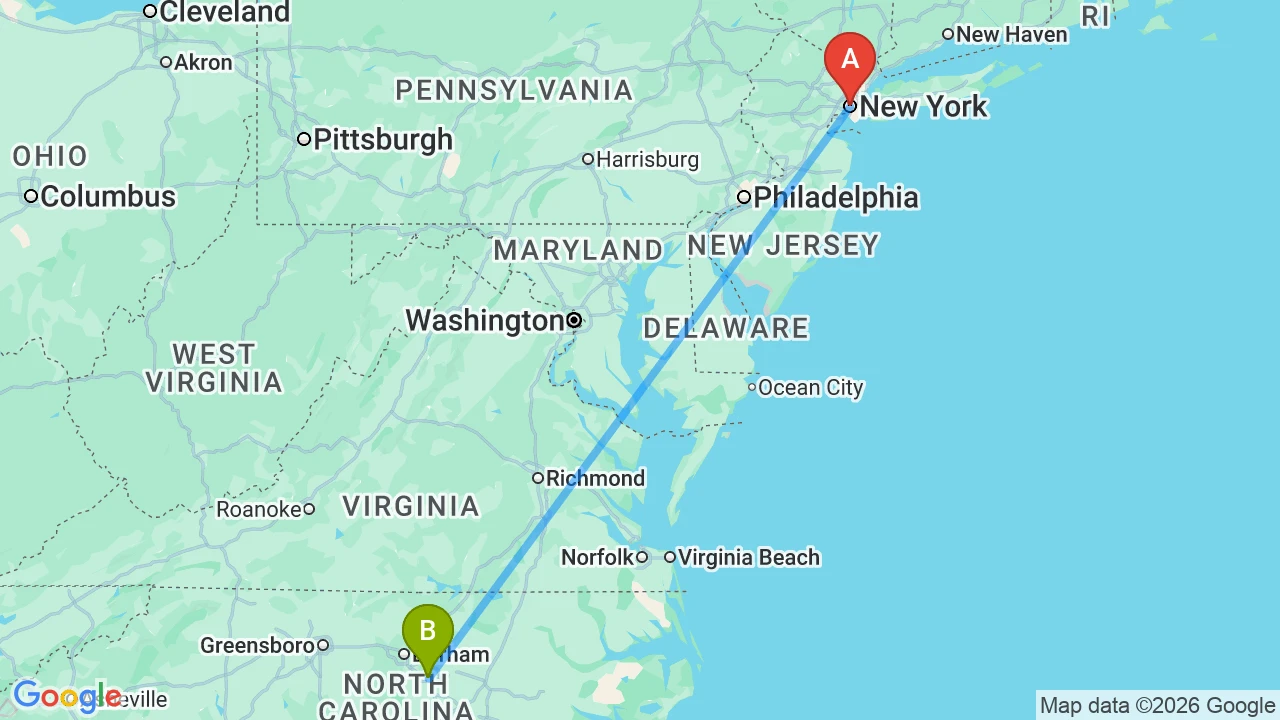
The physical act of moving from New York to Raleigh is straightforward in distance—roughly 500 miles—but the logistical and psychological friction is significant. Most movers underestimate how much the shift in infrastructure affects daily routines. In New York, you may not own a car, or if you do, you rarely use it. In Raleigh, you’ll need one almost immediately, which means budgeting for a down payment, insurance, registration, and the ongoing costs of fuel and maintenance. If you’re moving without a vehicle, that’s a major upfront expense that can strain a relocation budget.
Housing searches in Raleigh are less intense than in New York—there’s more inventory, less competition, and landlords are generally more flexible—but the geography is more spread out, so understanding neighborhood trade-offs requires more research and often multiple site visits. Proximity to work, schools, grocery stores, and parks matters more in Raleigh because you can’t easily substitute transit for distance.
Utility setup in Raleigh is typically straightforward, but new residents are often surprised by how much electricity costs during the summer months, even with lower per-kWh rates than New York. Budgeting for cooling is essential, and understanding how insulation, window quality, and thermostat management affect bills can take a full seasonal cycle to learn.
Social adjustment is another layer. New York’s density creates a kind of ambient social life—you’re always around people, even if you’re not interacting with them. Raleigh’s lower density and car-dependent structure mean that social connections require more intentionality. You’ll need to seek out community, whether through work, neighborhood groups, or recreational activities, rather than encountering it passively.
The most common surprise for movers is how much the shift in mobility affects time and autonomy. In New York, you’re constrained by transit schedules and crowding, but you’re also free from the responsibility of maintaining a vehicle. In Raleigh, you have more control over your schedule, but you’re also responsible for every trip, every errand, and every mile. That trade-off feels liberating to some and isolating to others.
Frequently Asked Questions
- Does Raleigh, NC feel more or less expensive than New York, NY?
- Raleigh feels less expensive in the most visible ways—housing, rent, and the overall cost of securing a place to live—but the cost structure is different, not simply lower. In New York, housing dominates your budget, but many other costs (car ownership, utilities, space management) are reduced or eliminated. In Raleigh, housing pressure eases, but transportation, cooling costs, and the logistics of car-dependent living shift the burden elsewhere. Households who value space and lower rent will feel immediate relief; those who relied on New York’s transit and density may find the new costs harder to predict.
- How do housing markets differ between New York and Raleigh?
- New York’s housing market is defined by scarcity, competition, and high entry barriers—whether renting or buying, you’re paying a premium for access and density. Raleigh’s market is more accessible, with lower home values and rents, but it’s also more car-dependent and spread out. You’ll get more space in Raleigh, but you’ll also need to manage utilities, parking, and the logistics of a larger footprint. Ownership is more attainable in Raleigh, but ongoing costs (insurance, property taxes, maintenance) require careful budgeting.
- What feels different about daily life after moving from New York to Raleigh?
- The pace slows, the space expands, and the logistics shift. In New York, daily life is compressed—errands, commutes, and social life happen in close proximity, often on foot or by transit. In Raleigh, daily life is more spread out and car-dependent, which means more control over your schedule but also more responsibility for managing transportation. The ambient social life of New York’s density is replaced by quieter streets and the need to seek out community intentionally. Climate exposure also changes—summers are hotter and longer, and cooling costs become a larger part of the budget.
- When does the move from New York to Raleigh tend to feel easiest or hardest?
- The move tends to feel easiest for households who are ready to trade density for space, who have stable income, and who are comfortable with car ownership. It feels hardest during the first summer, when cooling costs and humidity can be jarring, and during the adjustment period when the absence of transit and walkable density requires new routines. Families with children may find the transition smoother if they secure housing near schools and parks early, reducing the need for constant driving.
- What are the most common challenges when relocating from New York to Raleigh?
- The most common challenges are adjusting to car dependence, managing higher utility costs during the summer, and recalibrating social routines in a lower-density environment. Many movers underestimate how much they relied on New York’s transit and walkability, and the shift to driving everywhere can feel isolating at first. Budgeting for a vehicle, insurance, and fuel is another hurdle, especially for households who didn’t own a car in New York. The slower pace and quieter streets can also feel disorienting after years of constant stimulation.
- Who does this move work best for, and who might struggle?
- This move works best for households seeking lower housing costs, more space, and a slower pace—especially those with stable income, remote work flexibility, or jobs in Raleigh’s growing sectors. Families who want yards, parks, and quieter neighborhoods often thrive. The move is harder for households who rely on transit, who value density and walkability, or who are unprepared for the upfront and ongoing costs of car ownership. Singles and young professionals who thrived on New York’s social density may find Raleigh’s car-dependent structure isolating, while those exhausted by New York’s intensity may find it liberating.
How this article was built: In addition to public economic data, this article incorporates location-based experiential signals derived from anonymized geographic patterns—such as access density, walkability, and land-use mix—to reflect how day-to-day living actually feels in Raleigh, NC.
Conclusion: Understanding the Trade-Off
The move from New York to Raleigh is not a simple cost reduction—it’s a fundamental shift in how daily life is structured, where money goes, and what trade-offs you accept in exchange for relief in other areas. Raleigh offers lower housing costs, more space, and a slower pace, but it requires car ownership, higher utility exposure, and a different kind of logistical management. New York offers density, access, and the ability to live without a car, but at a cost that can feel overwhelming for many households.
The households who benefit most from this move are those who are ready to trade density for space, who have stable income and the flexibility to manage new costs, and who value autonomy over access. The households who struggle are those who underestimate the shift in mobility, who rely on transit and walkability, or who are unprepared for the upfront costs of car ownership and the ongoing exposure of utilities and maintenance.
If you’re considering this move, the key is to understand not just the numbers, but the systems—how housing, transportation, utilities, and daily routines interact, and where your household’s priorities align with the trade-offs each city demands. For deeper exploration of Raleigh’s cost structure, neighborhood patterns, and practical living details, visit the Raleigh hub on IndexYard. For New York-specific context, explore the New York hub.