
How much is enough to feel at ease? In New Albany, that question doesn’t yield a clean number—it surfaces a tension between the income you earn and the structure you’re stepping into. The median household income here is $224,824 per year, and the median home value is $634,600. Those figures don’t describe a budget; they describe a threshold. Below it, every decision about housing, errands, schools, and time becomes a negotiation. Above it, the place starts to work the way it was designed to.
This article explains how income pressure and comfort actually work in New Albany—not through affordability math, but through the lived experience of households at different income levels navigating a place where costs are structural, not incidental.
What “Living Comfortably” Means in New Albany
Comfort in New Albany is not about luxury—it’s about margin. It’s the difference between a household that absorbs a $2,013 monthly rent without rearranging other spending and one that treats that figure as a ceiling that dictates everything else. It’s whether a $634,600 home purchase feels like a stable foundation or a financial stretch that leaves no room for property tax increases, insurance adjustments, or deferred maintenance.
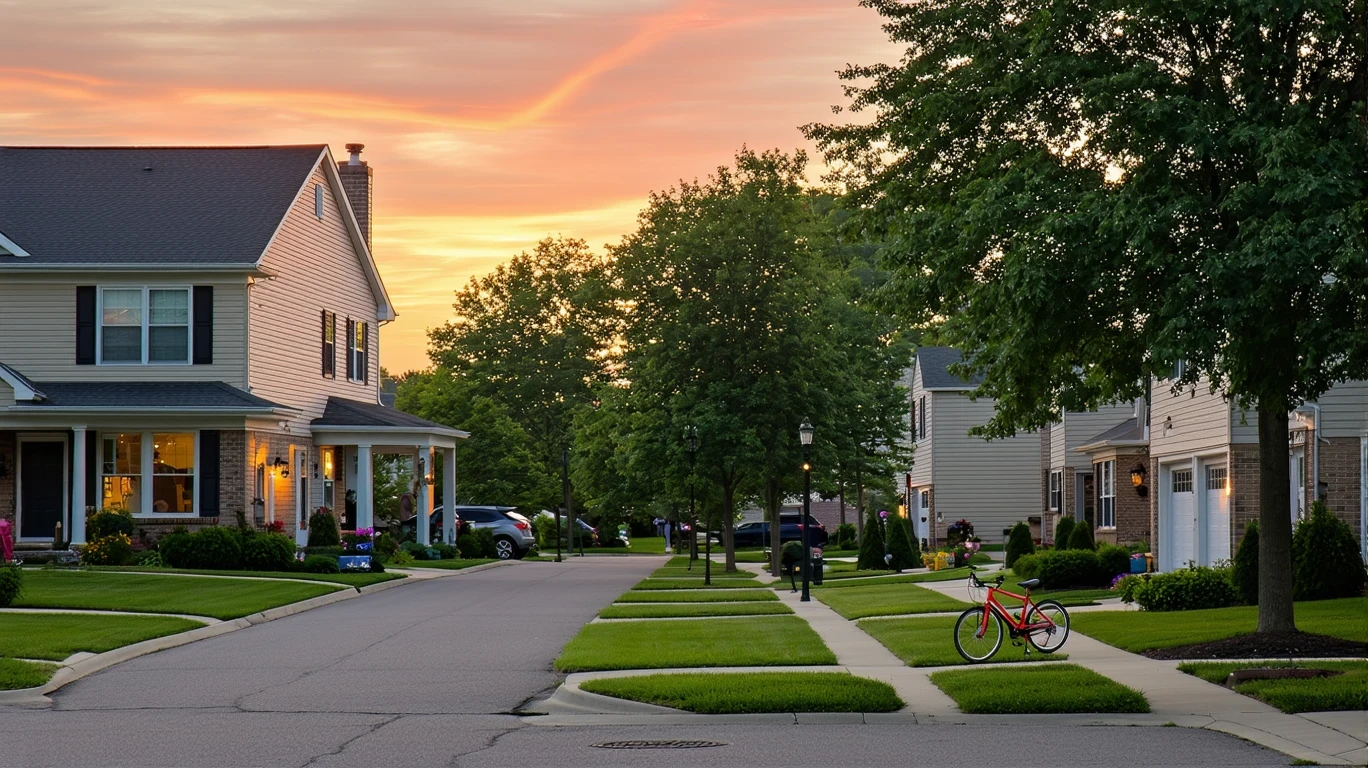
Comfort here also means navigating the place itself without friction. New Albany has walkable pockets—areas where the pedestrian-to-road ratio is high and sidewalks connect neighborhoods to parks and some daily destinations. Bike infrastructure is notably present, offering car-alternative mobility for those who can use it. But errands are corridor-clustered: grocery stores and food establishments are concentrated along certain routes, not evenly distributed. That means some households walk to daily needs easily, while others plan every trip. The structure rewards flexibility but punishes rigidity.
For families, comfort includes solving the school access puzzle. School density here is low, which surprises many newcomers given the affluent profile. Families either pay for private options, accept longer commutes to preferred public schools, or adjust expectations. Park density is high—among the highest detected—and water features are present, so outdoor recreation is integrated into daily life. But the mismatch between green space abundance and school infrastructure creates a tension that income alone doesn’t resolve.
Comfort in New Albany is contextual. It’s not a universal standard—it’s the point where the place stops requiring constant adjustment.
Where Income Pressure Shows Up First
Housing dominates. The $634,600 median home value is not just a purchase price—it’s an ongoing exposure to property taxes on high-value assets, insurance premiums that reflect replacement cost, and maintenance on homes that are larger and more complex than state norms. For renters, the $2,013 median gross rent sets a floor that leaves little room for error if income is modest or single-source.
Utility costs add seasonal volatility. Electricity rates are 17.31¢/kWh, and natural gas is priced at $11.25/MCF. Winters here are cold, summers warm. Heating and cooling aren’t optional—they’re baseline. Households in larger homes or older construction face higher usage, and those swings show up every few months. Comfort means absorbing those bills without adjusting thermostats or delaying other spending.
Transportation pressure is structural, not just financial. Gas prices are $3.41/gal, but the real cost is time and planning. Corridor-clustered errands mean some trips are walkable or bikeable, but many aren’t. Families managing school drop-offs, grocery runs, and healthcare appointments face a logistics burden that income doesn’t eliminate—it just makes it easier to outsource or absorb.
For families, the pressure point is mismatch. Low school density in a high-income area forces decisions that feel incongruent: pay for private school, drive farther for public options, or accept that the neighborhood’s infrastructure doesn’t match its income profile. That gap doesn’t show up in cost calculators, but it shows up in daily life.
How the Same Income Feels Different by Household
Households at similar income levels often experience very different pressure depending on size, structure, and expectations.
Single adults face the full weight of housing cost on one income. A $2,013 rent or a mortgage on a $634,600 home is a significant share of earnings, even at above-median income. But single adults also benefit most from New Albany’s walkable pockets and notable bike infrastructure. A household of one can often live car-light or car-free in certain neighborhoods, reducing transportation cost and time. Errands require planning, but the burden is lower. Hospital presence means healthcare access is local. The income threshold for comfort is high, but the lifestyle is more flexible.
Couples without children can split housing costs, but they still absorb the same structural pressures. A $634,600 home or $2,013 rent is more manageable on two incomes, but it still leaves less margin than comparable housing in nearby suburbs. The advantage: couples can take fuller advantage of integrated green space, mixed-height urban form, and walkable pockets for recreation and errands. The trade-off: they’re paying for a place designed around family wealth, even if they don’t have children. Comfort comes sooner than for single adults, but it still requires dual income well above regional norms.
Families with children face compounded pressure. Housing cost is the same, but the structural gaps are wider. Low school density means families must solve access through private tuition, longer commutes, or compromise. Corridor-clustered errands become a logistics challenge when managing multiple schedules. Walkable pockets don’t offset car dependency for a household juggling school, activities, and grocery runs. Park density is high—an advantage—but it doesn’t compensate for the school infrastructure mismatch. Comfort for families requires income well above the already-high median, plus the capacity to navigate gaps that wealthier households solve with paid services or time.
The Comfort Threshold (Qualitative)
The comfort threshold in New Albany is not a salary—it’s a condition. It’s the point where housing cost no longer forces tradeoffs in other categories. Where seasonal utility swings don’t require behavioral adjustment. Where the gap between corridor-accessible errands and walkable-from-home errands doesn’t create time stress. Where school access, if relevant, is solved without financial strain or logistical burden.
For some households, that threshold is reached at incomes near the $224,824 median. For others—particularly single-income families or households expecting walkable-from-home daily errands—it’s higher. The threshold isn’t about covering costs. It’s about absorbing the structure of the place without constant negotiation.
Households below the threshold feel every mismatch: between income and housing cost, between errands location and daily routine, between school expectations and infrastructure reality. Households above it experience New Albany as it was designed: a place where high income buys space, access, and optionality.
Why Online Cost Calculators Get New Albany Wrong
Cost calculators sum housing, utilities, food, and transport into a single total and compare it to income. But New Albany’s pressure is structural, not arithmetic.
The $634,600 median home value isn’t just a monthly payment—it’s property tax volatility, insurance on high-value assets, and maintenance on larger homes. Calculators treat it as a line item. Residents experience it as ongoing exposure.
Corridor-clustered errands mean some households walk easily while others drive every trip. Calculators assume one behavior. Reality depends on where you live within the city and how your household moves.
The $224,824 median income signals that “typical” here is already far above state norms. Calculators apply generic affordability rules—30% for housing, 10% for transport—but those heuristics assume a different income distribution. In New Albany, the baseline is already elevated. What feels “affordable” here would feel expensive elsewhere, and what feels tight here might not register as hardship in a calculator.
Low school density in a high-income area creates a cost that doesn’t appear in any database: the need to solve access through private tuition, driving time, or compromise. Calculators can’t capture that.
People feel surprised after moving because the structure of the place—how errands work, how schools are accessed, how housing cost behaves over time—doesn’t match the affordability total they were given. What shapes the cost of living in New Albany is not the sum of expenses; it’s the interaction between income, infrastructure, and expectations.
How to Judge Whether Your Income Fits New Albany
Instead of asking “Is my income enough?”, ask these questions:
- Can you absorb a $634,600 home purchase (or compete in that market as a renter) without monthly payment stress? If the answer is no, every other decision will be shaped by housing cost.
- Does your household adapt easily to corridor-based errands, or do you need walkable-from-home grocery access? New Albany offers both, but not uniformly. If you expect to walk out your door to daily needs, location within the city matters more than income.
- If you have children, can you navigate limited school density? This might mean private school tuition, longer commutes, or accepting a mismatch between neighborhood wealth and school infrastructure. Income helps, but it doesn’t eliminate the logistics.
- Can you handle seasonal utility swings in a climate with cold winters and warm summers without budget disruption? Heating and cooling are not optional. Larger homes amplify the exposure.
- Does your income leave margin after housing, or does housing cost dictate all other decisions? Comfort begins when housing is absorbed, not when it’s barely covered.
These questions don’t produce a number. They produce clarity about whether your income and the structure of New Albany are compatible.
FAQs About Living Comfortably in New Albany
What income level feels comfortable in New Albany?
Comfort isn’t a single income level—it’s the point where housing cost no longer forces tradeoffs, where errands and school access are solved without friction, and where seasonal utility swings don’t require behavioral change. For many households, that threshold is near or above the $224,824 median household income. For single-income families or those expecting walkable-from-home errands, it’s higher. Comfort depends on household size, structure, and expectations, not just earnings.
Is New Albany affordable for families?
New Albany is structurally challenging for families unless income is well above regional norms. The $634,600 median home value and $2,013 median rent create high baseline housing costs. Low school density means families must solve access through private options, longer commutes, or compromise—a cost that doesn’t show up in affordability calculators. High park density and integrated green space are advantages, but they don’t offset the school infrastructure gap. Families feel comfortable here when income absorbs both housing and the logistical costs of navigating structural mismatches.
Can you live in New Albany without a car?
It depends on where you live within the city and what your daily routine requires. New Albany has walkable pockets with high pedestrian-to-road ratios and notable bike infrastructure, making car-light or car-free living possible for some households—particularly single adults or couples without children. But errands are corridor-clustered, meaning grocery stores and food establishments are concentrated along certain routes, not evenly distributed. Families managing school drop-offs and multiple errands face a higher car-dependency burden. Bus service is present, but it’s the only transit option. Living without a car is feasible in specific neighborhoods for specific household types, but it’s not the default experience.
How does New Albany compare to other Columbus suburbs?
New Albany sits at the high end of the Columbus metro area in both income and housing cost. The $224,824 median household income and $634,600 median home value are well above most nearby suburbs. The trade-off: integrated green space, hospital presence, and walkable pockets in certain areas. The downside: low school density despite affluent demographics, and corridor-clustered errands that require planning. Other suburbs may offer lower housing costs and more even school access, but fewer offer the same combination of park density, mixed urban form, and bike infrastructure. New Albany works well for high-income households that value green space and can navigate structural gaps. It works less well for families expecting uniform walkability or school access that matches neighborhood wealth.
What surprises people about the cost of living here?
Three things surprise newcomers most. First, the gap between the affluent profile and limited school density—families expect more school infrastructure given the income level. Second, the unevenness of errands access: some neighborhoods are highly walkable, others require driving for every trip, and that distinction doesn’t show up in city-wide averages. Third, the ongoing cost of housing beyond the purchase price—property taxes, insurance, and maintenance on high-value homes create volatility that modest-income households struggle to absorb, even if they qualify for a mortgage. People expect what a budget has to handle in New Albany to be high, but they underestimate how much of that pressure is structural rather than discretionary.
How this article was built: In addition to public economic data, this article incorporates location-based experiential signals derived from anonymized geographic patterns—such as access density, walkability, and land-use mix—to reflect how day-to-day living actually feels in New Albany, OH.
New Albany can work well for some households—but only if expectations match reality. Comfort here is not about earning enough to cover a list of expenses. It’s about earning enough to absorb a structure: high housing costs, corridor-clustered errands, limited school density, and seasonal utility swings. The threshold is different for every household, but the principle is the same. Income buys margin, and margin buys comfort. Without it, the place requires constant adjustment.