
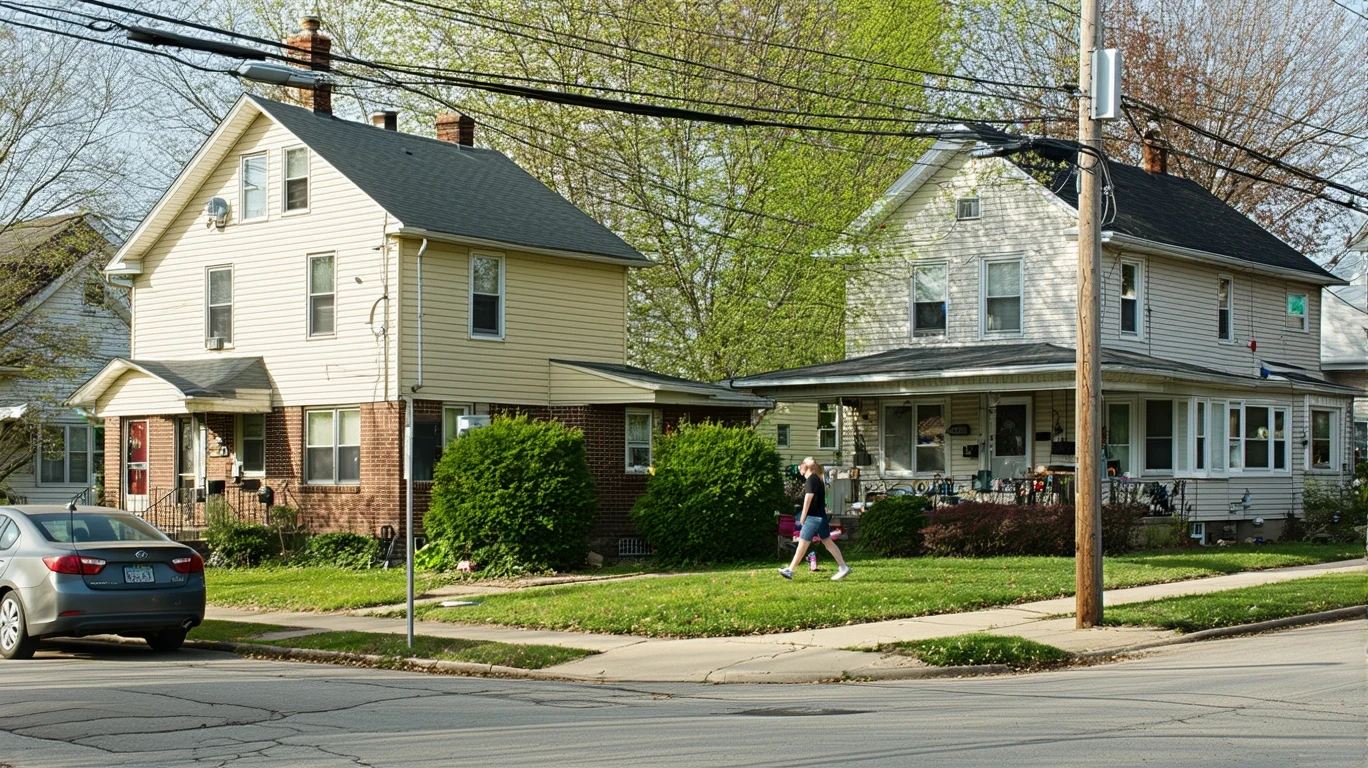
Apartment vs House in Reynoldsburg — Monthly Cost Comparison
| Expense Category | Apartment | House |
|---|---|---|
| Base Housing Cost | $1,172/month (median rent) | ~$1,100–1,300/month (illustrative mortgage on $217,200 median home, before taxes/insurance) |
| Heating & Cooling Exposure | Lower; shared walls reduce surface area exposed to Ohio winters and summer heat | Higher; detached low-rise homes face full seasonal swings, especially heating months |
| Utility Responsibility | Often partially included or metered separately; less control but lower volatility | Full responsibility; electricity at 17.59¢/kWh and natural gas at $11.25/MCF mean seasonal bills fluctuate with weather |
| Maintenance & Upkeep | Landlord handles; predictable monthly outlay | Owner handles; roof, HVAC, and yard work add irregular but significant costs over time |
| Grocery & Errands Access | High food and grocery density reduces trip frequency and planning burden | Same access; low-rise form with mixed-use presence means errands remain broadly accessible regardless of housing type |
Why these differences matter in Reynoldsburg: The city’s low-rise suburban form and mixed mobility texture mean both renters and owners rely primarily on cars, but the high density of food and grocery establishments reduces the friction of daily errands. Heating exposure dominates in detached homes due to Ohio’s cold winters, while apartments benefit from shared-wall insulation. The table omits categories like HOA fees and property tax specifics because those figures are not available in local data, but ownership in Reynoldsburg still carries the typical long-term exposures of maintenance, tax adjustments, and utility volatility that renters avoid.
The Housing Market in Reynoldsburg Today
Reynoldsburg sits in the Columbus metro area with a median home value of $217,200 and median gross rent of $1,172 per month. What shapes this market is its position as a low-rise suburban community with a regional price parity index of 95—meaning overall costs run about 5% below the national baseline. That below-average price environment extends to housing, where moderate home values and rent levels reflect the city’s role as a commuter suburb rather than a high-demand urban core.
Newcomers often misunderstand how Reynoldsburg’s mixed mobility texture and broadly accessible errands interact with its car-oriented infrastructure. Despite the city’s pedestrian-to-road ratio sitting in the medium band and bus service being present, the practical reality is that most households depend on cars for commuting and longer trips. Yet the high density of food and grocery establishments—exceeding density thresholds—means daily errands don’t require the same level of advance planning or long drives typical of more isolated suburbs. This combination creates a housing market where location within the city matters less for grocery access and more for commute direction and school proximity.
The unemployment rate of 4.0% and median household income of $68,778 per year suggest a stable, working- and middle-class base. Housing here isn’t shaped by rapid gentrification or tech-driven demand; it’s driven by families and individuals seeking moderate costs within reach of Columbus employment centers. The low-rise building character—average building levels fall below the low threshold—reinforces the suburban single-family and small multifamily pattern, with limited high-density or vertical development.
Renting in Reynoldsburg
At $1,172 per month, median gross rent in Reynoldsburg reflects the city’s below-national price parity and suburban housing stock. Rental pressure here is moderate rather than extreme; the market doesn’t face the same supply constraints or rapid rent escalation seen in denser metro cores. Renters benefit from the city’s broadly accessible grocery and food infrastructure, which reduces the time and fuel cost of stocking a household even without walkable access from every address.
Location within Reynoldsburg affects rental experience primarily through commute access and school assignment rather than errands or healthcare. The city’s limited healthcare access—no hospital or clinics detected within city boundaries, though pharmacies are present—means renters planning for medical needs should expect to travel to nearby communities. The mixed pedestrian infrastructure and bus-only transit mean that renters without cars face meaningful limitations, particularly for work commutes and non-grocery errands.
Rental volatility in Reynoldsburg follows the broader Columbus metro pattern: renewals tend to adjust with regional demand rather than hyperlocal factors. Because the city’s housing stock is predominantly low-rise and suburban, rental increases are more closely tied to metro-wide employment growth and migration than to neighborhood-specific development. Renters should expect moderate, steady pressure rather than sharp year-over-year swings, but they should also recognize that lease renewals offer less predictability than fixed-rate ownership over multi-year horizons.
Owning a Home in Reynoldsburg
The median home value of $217,200 positions Reynoldsburg as an accessible entry point for first-time buyers and families seeking space without the premium costs of closer-in Columbus neighborhoods. Ownership here means taking on the full exposure of a detached, low-rise home in a climate with cold winters and warm summers. Heating costs dominate the colder months, and natural gas prices at $11.25/MCF translate to noticeable seasonal bills when temperatures drop. Electricity at 17.59¢/kWh drives cooling costs in summer, though the cooling season is shorter and less intense than heating exposure.
Property taxes, insurance, and maintenance are the three long-term variables that distinguish ownership from renting in Reynoldsburg. While specific tax rates aren’t available in local data, Ohio’s property tax structure means that assessed values and millage rates vary by school district and county, and owners should expect periodic reassessments that adjust their tax burden over time. Maintenance costs are driven by the age and condition of the housing stock; many homes in Reynoldsburg are older single-family structures where HVAC, roofing, and plumbing systems require replacement on 15- to 25-year cycles.
Ownership also brings control over housing stability and the ability to lock in a portion of monthly costs through a fixed-rate mortgage. In a market where rent adjustments follow metro trends, owning removes the risk of lease-end surprises and allows households to plan around a predictable principal and interest payment. However, the tradeoff is assuming responsibility for all irregular costs—storm damage, appliance failure, and system upgrades—that landlords absorb in rental arrangements.
Utilities & Upkeep Differences
Utility exposure in Reynoldsburg is shaped by Ohio’s seasonal extremes and the city’s low-rise housing form. Detached homes face higher heating and cooling costs than apartments because they lack shared walls and have greater exterior surface area exposed to weather. In winter, natural gas heating dominates expenses, and in summer, air conditioning drives electricity usage. For illustrative context, a typical household using around 1,000 kWh per month would face a bill near $176 for electricity alone, and heating months might add roughly $11 per MCF of natural gas usage—but actual costs vary widely based on home size, insulation, and thermostat habits.
Apartment renters in Reynoldsburg often see lower utility bills due to shared-wall insulation and smaller square footage, and in some cases landlords include water, trash, or even heat in the rent. Homeowners, by contrast, pay for every utility separately and absorb the full cost of inefficiency or extreme weather. The city’s climate—cold winters with occasional heavy snow and warm, humid summers—means that utility costs aren’t evenly distributed across the year. Owners should expect higher bills from roughly November through March and moderate cooling costs from June through August.
Maintenance and upkeep differences are less about Reynoldsburg specifically and more about the housing type. Single-family homes require yard work, exterior painting, roof replacement, and driveway or sidewalk repair—all costs that apartment renters never see. In a low-rise suburban market like Reynoldsburg, where most homes sit on individual lots with grass and trees, these tasks are regular rather than occasional. The city’s water features and moderate park density suggest a greener environment that supports pleasant outdoor space but also means gutters, drainage, and landscaping require attention.
Rent vs Buy: Long-Term Exposure in Reynoldsburg
The decision between renting and buying in Reynoldsburg isn’t primarily about monthly payment comparison—it’s about which set of risks and responsibilities fits a household’s timeline and tolerance for variability. Renters face the risk of lease renewals that adjust with metro-wide demand, but they avoid the risk of major repair costs, tax increases, and market value shifts. Owners face the risk of irregular maintenance expenses and property tax adjustments, but they lock in a portion of their housing cost and gain control over their living situation.
Over time, ownership in Reynoldsburg shifts more of the cost burden onto the owner. Roofs need replacement, HVAC systems fail, and property taxes adjust as assessed values and school funding needs change. These costs don’t appear on a monthly schedule, but they accumulate and require either cash reserves or financing. Renters avoid these entirely, though they pay for that avoidance through rent levels that reflect landlords’ need to cover these same expenses plus profit margin.
Ownership also creates exposure to Reynoldsburg’s housing market performance. If the Columbus metro area grows and demand for suburban housing increases, owners benefit from appreciation. If the region stagnates or if remote work reduces commuter demand, owners bear the downside. Renters remain insulated from market value risk but also miss any upside. In a city where the regional price parity sits below the national average and the economy is stable rather than booming, ownership is less about speculative gain and more about long-term cost control and stability.
The choice depends on how long a household plans to stay and how much variability they can manage. Buyers who expect to remain in Reynoldsburg for seven or more years and who can handle irregular repair costs will likely find ownership more predictable than renting over that horizon. Renters who value flexibility, who expect to move within a few years, or who prefer to avoid maintenance responsibility will find the moderate rent levels in Reynoldsburg a reasonable tradeoff for reduced risk.
FAQs About Housing Costs in Reynoldsburg
Is $1,172 per month typical for rent in Reynoldsburg, OH?
$1,172 per month is the median gross rent, meaning half of rental units cost more and half cost less. Actual rent depends on unit size, age, and location within the city, but this figure reflects the middle of the market for Reynoldsburg’s suburban rental stock.
How does the $217,200 median home value in Reynoldsburg compare to the Columbus metro?
Reynoldsburg’s median home value sits below many closer-in Columbus suburbs, reflecting its role as a commuter community rather than a high-demand urban neighborhood. The regional price parity of 95 suggests overall costs—including housing—run slightly below the national baseline, which extends to home prices.
What drives heating and cooling costs for homeowners in Reynoldsburg?
Ohio’s cold winters and warm summers create seasonal utility swings, with heating costs dominating from November through March and cooling costs rising in summer. Detached homes face higher exposure than apartments due to greater exterior surface area, and electricity at 17.59¢/kWh and natural gas at $11.25/MCF set the baseline rates before usage and weather intensity are factored in.
Does Reynoldsburg’s grocery and errands access reduce housing costs?
Not directly, but the city’s high food and grocery density—exceeding density thresholds—reduces the time, fuel, and planning burden of stocking a household. This lowers the indirect cost of living in a car-dependent suburb by making daily errands more efficient, even though housing prices themselves aren’t shaped by grocery access.
Should renters or buyers expect healthcare costs to affect housing decisions in Reynoldsburg?
Reynoldsburg has limited healthcare access, with no hospital or clinics detected within city boundaries, though pharmacies are present. Households with regular medical needs should expect to travel to nearby communities, which adds commute time and fuel costs but doesn’t directly change rent or home prices. This affects quality of life and convenience rather than housing affordability.
Making Housing Choices in Reynoldsburg
Housing costs in Reynoldsburg reflect a suburban market with moderate prices, below-national price parity, and a low-rise built environment. At $1,172 per month for rent and $217,200 for a median home, the city offers accessible entry points for renters and buyers alike, particularly those seeking space and stability within the Columbus metro area. The choice between renting and owning depends less on monthly payment math and more on how households weigh predictability against flexibility, and how much irregular cost variability they can manage.
Renters benefit from avoiding maintenance and tax exposure, and the city’s broadly accessible grocery and food infrastructure reduces the friction of car-dependent errands. Owners gain long-term cost control and stability but take on the full seasonal utility swings, maintenance cycles, and property tax adjustments that come with a detached home in a climate with cold winters and warm summers. Both paths work in Reynoldsburg, but the fit depends on timeline, risk tolerance, and whether a household values control over costs or freedom from repair responsibility.
For readers weighing how housing fits into their broader financial picture, Your Monthly Budget in Reynoldsburg: Where It Breaks explores how rent or ownership interacts with other recurring expenses. And for those comparing Reynoldsburg’s overall cost environment to other options, Cost of Living in Reynoldsburg: The Tradeoffs Behind the Total provides the full context. If a move is ahead, Best Moving Companies Guide covers logistics and planning.
How this article was built: In addition to public economic data, this article incorporates location-based experiential signals derived from anonymized geographic patterns—such as access density, walkability, and land-use mix—to reflect how day-to-day living actually feels in Reynoldsburg, OH.