
“It’s close enough to Indy that you can get there fast, but far enough out that you actually have a yard and don’t hear sirens at 2 a.m.”
That tension—between proximity and separation, convenience and quiet—shapes much of what people feel about living in Plainfield. This isn’t a city trying to be something it’s not. It’s a suburban community west of Indianapolis that offers space, relative affordability, and a family-friendly rhythm. But it’s also a place where you’ll drive to most things, where spontaneity requires planning, and where the texture of daily life leans heavily on car ownership and corridor-based errands.
Understanding whether Plainfield feels like a good fit means understanding what you’re trading in and what you’re getting back. For some households, that tradeoff is exactly right. For others, it’s a source of ongoing friction.
What Plainfield Feels Like Day to Day
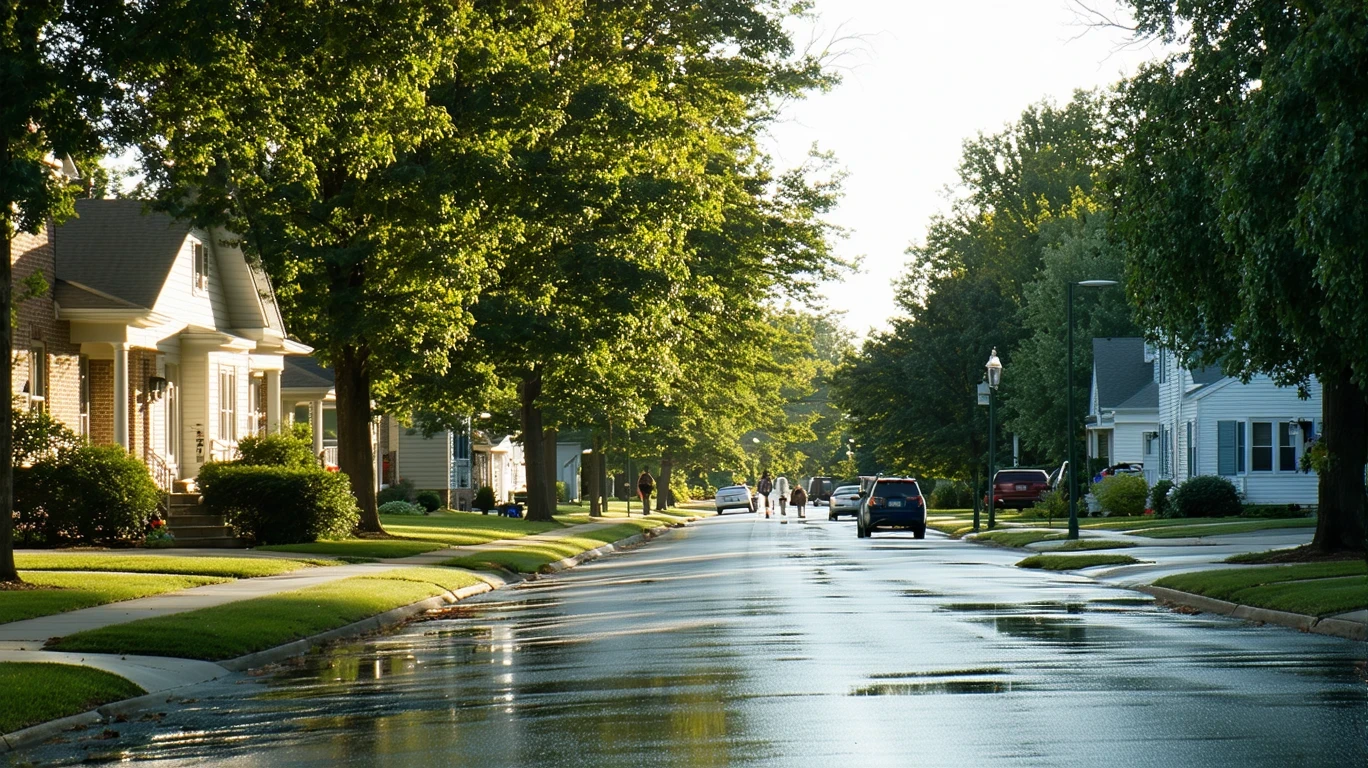
Plainfield’s emotional tone is shaped by its infrastructure. The town has moderate pedestrian pathways along certain corridors, and bus service does exist, but the overall layout assumes you’re driving. Grocery stores, restaurants, and services cluster along commercial strips rather than being woven into neighborhoods. That means errands are accessible—but not spontaneous. You plan your stops, you drive to them, and you move through your day in a car-dependent rhythm.
For families with kids, retirees seeking predictability, or commuters to Indianapolis who want lower housing pressure, this structure works. Homes tend to be single-family, low-rise, and set back from the road. There’s green space—parks are present, water features add visual relief—but outdoor access still requires intentionality. You don’t stumble into a café or a trail on your way home from work. You go there on purpose.
People who thrive here tend to value control, routine, and space over density, walkability, and serendipity. People who struggle here often describe feeling isolated, car-trapped, or bored. The infrastructure doesn’t support a lifestyle built on foot traffic, transit flexibility, or layered urban texture. It supports a lifestyle built on driving, planning, and home-centered living.
Social Media Buzz in Plainfield
On platforms like Facebook and Reddit, Plainfield discussions tend to center on a few recurring themes: growth, traffic, chain retail expansion, and the tension between “small-town feel” and “suburban sprawl.” There’s pride in the town’s schools and parks, but also frustration with the sameness of commercial development and the lack of walkable, independent businesses.
“It’s clean, it’s safe, it’s boring. If you have kids and a car, you’re fine. If you want to walk to a coffee shop or take a bus downtown, you’re going to be frustrated.”
“I moved here from Indy for the space and the quiet, and I got exactly that. But I didn’t realize how much I’d miss being able to just walk somewhere on a whim.”
“Plainfield is what it is—a suburb. If you expect anything else, you’re setting yourself up for disappointment.”
The tone is pragmatic, not defensive. People here tend to know what the town offers and what it doesn’t. The friction comes when expectations don’t align with infrastructure.
Local News Tone
Local coverage in and around Plainfield tends to frame the town through the lens of growth management, school performance, and commercial development. Headlines reflect ongoing conversations about identity and change:
- “New Retail Centers Bring Convenience, Raise Questions About Character”
- “Families Weigh School Access Against Commute Tradeoffs”
- “Town Balances Suburban Comfort with Calls for More Walkability”
- “Residents Debate What ‘Small-Town Feel’ Means in a Growing Suburb”
The framing is rarely alarmist, but it does reflect a community in transition—one that’s adding population and infrastructure faster than it’s adding texture or variety. The emotional undertone is cautious optimism mixed with protectiveness: people want growth, but they don’t want to lose what drew them here in the first place.
Review-Based Public Perception
On Google, Yelp, and neighborhood platforms, Plainfield earns steady praise for cleanliness, safety, and family-friendliness. Parks, chain restaurants, and big-box retail get positive mentions. But there’s also a recurring note of disappointment from people who expected more local character, more walkable neighborhoods, or more dining variety.
“Great place to raise kids. Quiet, good schools, lots of space. Just don’t expect much nightlife or culture.”
“Everything you need is here, but it all looks the same. Strip malls, chain stores, wide roads. Functional, but not charming.”
“If you’re okay driving everywhere, it’s fine. If you want to walk to things or take transit, this isn’t the place.”
Neighborhood variation exists—newer planned developments tend to feel more uniform, while older pockets closer to the town center offer slightly more texture—but the overall pattern holds. Plainfield rewards people who want suburban predictability and penalizes people who want urban spontaneity.
Comparison to Nearby Cities
| Aspect | Plainfield | Avon | Brownsburg |
|---|---|---|---|
| Overall Vibe | Quiet, car-dependent, family-oriented | Similar suburban feel, slightly more retail density | More small-town character, less commercial sprawl |
| Walkability | Limited to certain corridors | Also car-dependent, some trail access | Slightly more compact downtown area |
| Transit Access | Bus service present | Minimal transit options | Minimal transit options |
| Dining & Retail | Chain-heavy, corridor-clustered | Similar chain presence, newer developments | Mix of chains and local spots |
| Commute to Indy | Direct access via I-70 | Direct access via I-70 | Slightly farther northwest |
All three towns serve similar functions: they’re suburban bedroom communities for Indianapolis commuters who want space, affordability, and family infrastructure. Plainfield and Avon feel nearly interchangeable in terms of layout and amenities, though Avon skews slightly newer. Brownsburg retains a bit more small-town identity, with a more defined downtown and slightly less reliance on strip-mall retail. If you prioritize convenience and direct highway access, Plainfield and Avon are strong matches. If you want a bit more character and don’t mind a slightly longer commute, Brownsburg may feel more grounded.
What Locals Are Saying
“We moved here from a condo in Broad Ripple, and it was a huge adjustment. We have a yard now, and the schools are good, but I miss being able to walk to a bar or a bookstore. Everything here requires a car.”
— Young parent, moved from Indianapolis
“Plainfield is exactly what we wanted. Quiet streets, good parks, close enough to Indy for work but far enough that it doesn’t feel crowded. We’re not looking for nightlife—we’re looking for stability.”
— Family with school-age children
“It’s fine if you have a car and a routine. But if your car breaks down or you lose your license, you’re kind of stuck. There’s a bus, but it doesn’t go everywhere, and it’s slow.”
— Retiree on fixed income
“I work remotely, so I don’t commute, but I do feel like I’m driving all the time just to get groceries or meet a friend. Nothing is close. Everything is spread out.”
— Remote worker, renting
“Honestly, I like it here. It’s not exciting, but it’s predictable. I know what I’m getting. No surprises, no drama, just a quiet place to live.”
— Long-time resident
“I thought I’d save money by moving out here, and I did on rent. But now I’m spending more on gas and car maintenance because I have to drive everywhere. It’s a tradeoff.”
— Young professional, new to area
“If you’re raising a family and you want space, this is a good spot. If you’re single and you want things to do, you’re probably going to feel restless.”
— Parent, lived here five years
Does Plainfield Feel Like a Good Fit?
Plainfield works for people who want suburban infrastructure, who value space and quiet over density and spontaneity, and who are comfortable with car dependency. It works for families seeking good schools and parks, for commuters to Indianapolis who want lower housing costs, and for retirees who prioritize predictability and safety.
It tends to frustrate people who want walkability, who rely on transit, who crave dining variety or cultural texture, or who feel trapped without spontaneous access to third places. The town’s layout rewards planning and car ownership. It penalizes improvisation and foot traffic.
If you’re deciding whether Plainfield aligns with your needs, consider how you actually move through your day. Do you plan your errands in batches, or do you like to wander? Do you see your car as a tool, or as a burden? Do you value routine, or do you crave surprise?
For more on where money goes in Plainfield, or how quality of life factors shape daily experience, explore the related guides. And if you’re weighing Plainfield against other options, understanding the housing tradeoffs can help clarify what you’re gaining—and what you’re giving up.
How this article was built: In addition to public economic data, this article incorporates location-based experiential signals derived from anonymized geographic patterns—such as access density, walkability, and land-use mix—to reflect how day-to-day living actually feels in Plainfield, IN.
The perspectives shown reflect commonly expressed local sentiment and recurring themes in public discussion, rather than individual accounts.