
| Transit Type | Coverage in Oldsmar | Typical Commute Duration |
|---|---|---|
| Bus Service | Present, corridor-focused | 25 minutes (average all modes) |
| Rail Transit | Not available | — |
| Bike Infrastructure | Notable presence | — |
| Pedestrian Paths | High ratio in pockets | — |
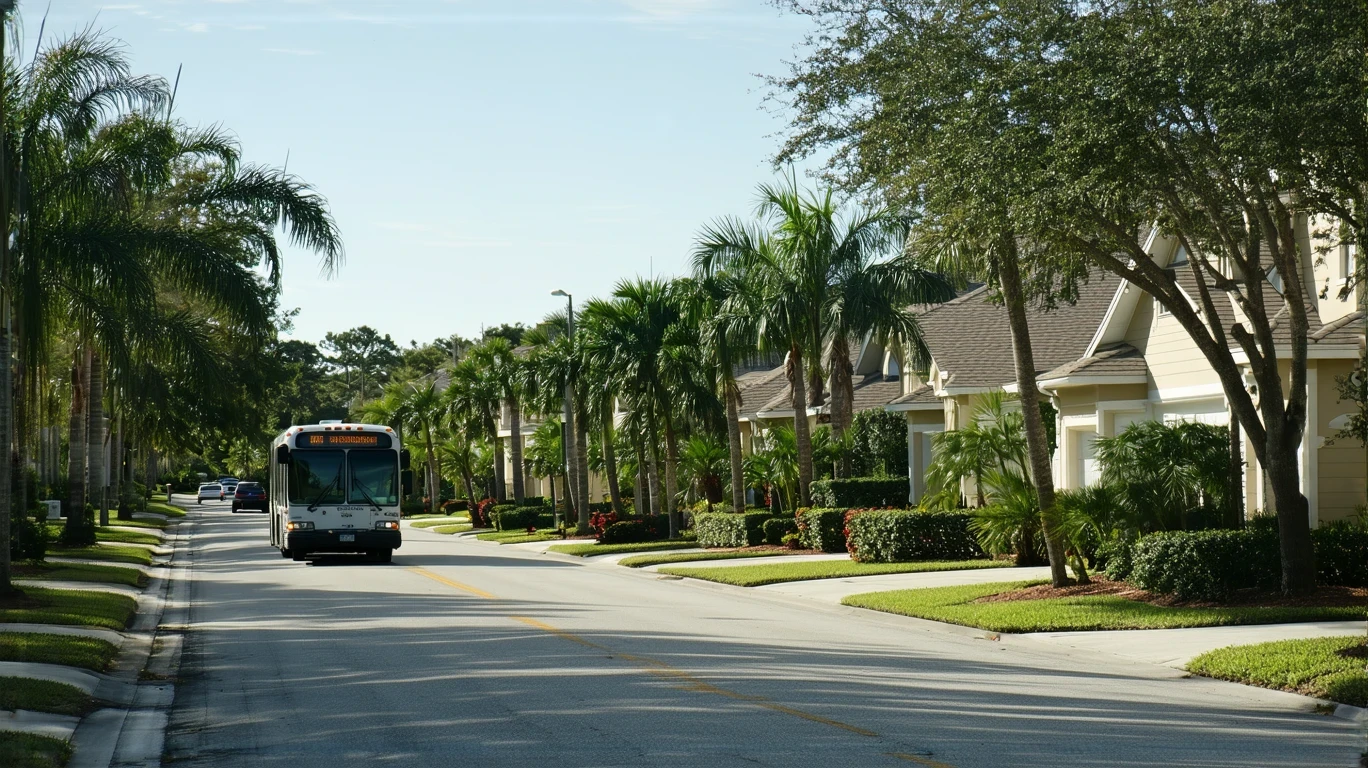
How People Get Around Oldsmar
Transportation options in Oldsmar reflect a city built primarily around driving, but with meaningful pockets of walkable infrastructure and bus service that work well for specific corridors and household types. Newcomers often assume that because sidewalks and bike paths exist in parts of the city, they can live car-free or car-light. In practice, most residents still rely on a personal vehicle for daily errands, school runs, and commuting—even in neighborhoods where walking feels pleasant and safe.
Oldsmar’s layout mixes residential subdivisions with commercial corridors, and while some areas show a high pedestrian-to-road ratio and notable cycling infrastructure, these features support recreation and short trips more than full mobility independence. The city sits within the Tampa metro region, where job centers, healthcare facilities, and major retail are distributed across a wide area. That geography means even households living in walkable pockets typically keep at least one car to manage the logistics of work, family, and errands that fall outside their immediate neighborhood.
Only 3.3% of workers in Oldsmar work from home, which is notably low and signals that most residents commute regularly. The average commute is 25 minutes, and 41.4% of workers face longer commutes—a reflection of the regional job market’s reach rather than poor local access. Understanding how mobility works here means recognizing that infrastructure exists to support walking and biking in specific zones, but the broader structure of daily life still assumes car access.
Public Transit Availability in Oldsmar
Public transit in Oldsmar centers around bus service, which is present and serves key corridors but does not blanket the city. Residents may encounter systems such as Pinellas Suncoast Transit Authority (PSTA), though coverage varies by area and service is concentrated along main roads rather than extending deep into residential subdivisions. For someone living near a well-served route and working along a compatible corridor, the bus can function as a practical commute option. For most households, though, transit plays a supplemental role rather than replacing the need for a car.
Bus service tends to work best for individuals with predictable schedules, single-destination commutes, and proximity to stops. It falls short for families managing multi-stop errands, parents coordinating school pickups, or workers whose job sites sit outside the primary transit corridors. There is no rail service in Oldsmar, which limits high-frequency, high-capacity options and means that anyone relying on public transit is working within the constraints of bus schedules and coverage gaps.
The presence of transit does not automatically translate to transit viability for every household. Location within the city matters significantly—renters in corridor-clustered zones near grocery stores, pharmacies, and bus stops experience a different level of access than homeowners in peripheral neighborhoods where services are sparse and stops are farther apart. Transit availability is real, but it’s geographically uneven and functionally limited for many daily tasks.
Driving & Car Dependence Reality
Driving remains the dominant mode of transportation in Oldsmar, not because residents prefer it in principle, but because the city’s layout and the regional job market make car ownership the most practical choice for most households. Parking is generally abundant and free, which removes one of the friction points that discourages driving in denser cities. Roads are designed to move vehicles efficiently, and most commercial development includes dedicated parking lots, reinforcing the expectation that customers and employees will arrive by car.
Car dependence in Oldsmar is tied to sprawl and the separation of land uses. Even in neighborhoods with mixed residential and commercial presence, the distances between home, work, school, and services often exceed what’s practical to cover on foot or by bike—especially when managing time constraints, weather exposure, or carrying groceries and supplies. Families with children face additional complexity: school bus service may not align with work schedules, extracurriculars require pickups and drop-offs, and errands often involve multiple stops across different parts of the city or metro area.
For single adults or couples without children, car dependence can feel less burdensome, particularly if they live near their workplace or have flexible schedules. But for most households, the question isn’t whether to own a car—it’s whether one vehicle is enough or if a second (or third) becomes necessary to manage competing demands. The tradeoff isn’t between driving and not driving; it’s between accepting the cost and control that come with car ownership versus absorbing the time penalties and logistical friction of trying to get by without one.
Commuting Patterns & Daily Mobility
Commuting in Oldsmar typically involves driving to job sites in Tampa, Clearwater, or other parts of the metro region. The 25-minute average commute reflects a mix of short local trips and longer regional drives, and the fact that 41.4% of workers face longer commutes indicates that many residents are reaching beyond Oldsmar for employment. This isn’t a sign of poor local job availability—it’s a feature of living in a metro area where opportunities are distributed across multiple cities and employment centers.
Daily mobility patterns in Oldsmar are shaped by the need to chain trips together. A typical day might involve dropping kids at school, commuting to work, stopping for groceries on the way home, and picking up children from an after-school activity. Public transit and biking can handle point-to-point trips, but they struggle with the multi-stop, time-sensitive sequences that define many households’ routines. This is where car dependence becomes less about preference and more about the structure of daily life.
People who benefit most from proximity are those whose work, errands, and social life align with the corridors where services cluster. Renters in apartments near grocery stores and bus stops can reduce their reliance on driving for some tasks, though they still typically need a car for less frequent trips. Homeowners in subdivisions farther from commercial zones absorb more commute friction and have fewer alternatives to driving, which makes vehicle reliability and fuel costs more central to their household budgets.
Who Transit Works For — and Who It Doesn’t
Public transit in Oldsmar works best for single adults or couples without children who live near bus routes, work along compatible corridors, and have schedules that align with service hours. These households can use transit for commuting while keeping a car for errands, or in some cases, rely on a combination of biking, walking, and occasional rideshares to reduce car dependence. The key is that their daily logistics are simple enough that transit’s limitations—fixed routes, limited frequency, coverage gaps—don’t create unmanageable friction.
Transit doesn’t work well for families managing school schedules, multi-stop errands, or jobs that require arriving early, staying late, or traveling to sites outside the main corridors. Parents coordinating pickups and drop-offs face timing constraints that bus schedules can’t accommodate, and households with multiple working adults often need separate vehicles to avoid bottlenecks. Older adults who no longer drive may find transit useful for specific trips, but the lack of comprehensive coverage means they still depend on family, friends, or rideshare services for many needs.
The distinction isn’t about income or preference—it’s about household complexity and geographic luck. A renter living in a corridor-clustered zone near a grocery store and a bus stop has structural advantages that a homeowner in a peripheral subdivision simply doesn’t. Transit viability in Oldsmar is real for a subset of residents, but it’s not a citywide condition, and it doesn’t eliminate the need for car access for most people.
Transportation Tradeoffs in Oldsmar
Choosing between transit and driving in Oldsmar isn’t a binary decision—it’s a question of how much flexibility, predictability, and control matter to your household. Driving offers the most flexibility: you can leave when you want, stop where you need to, and adjust your route in real time. It also comes with costs—vehicle payments, insurance, fuel, maintenance—and the responsibility of managing breakdowns, parking, and traffic. For most households, these tradeoffs are worth it because driving solves problems that transit can’t.
Transit offers lower direct costs and removes the burden of vehicle ownership, but it requires living in the right location, working along a compatible route, and accepting less control over timing and convenience. For someone whose life fits within transit’s constraints, it can work well and reduce what a budget has to handle in Oldsmar. For everyone else, transit becomes a supplement rather than a replacement, useful for specific trips but not sufficient for daily logistics.
Biking and walking add another layer of flexibility, particularly in neighborhoods with notable cycling infrastructure and high pedestrian-to-road ratios. These modes work well for short trips, recreation, and errands within walkable pockets, but they don’t replace the need for a car when distances grow, weather turns harsh, or you’re carrying more than a backpack. The tradeoff is between time and exposure: biking saves money and offers exercise, but it also means arriving sweaty in Florida heat and losing time on longer trips.
The real tradeoff in Oldsmar is between accepting car dependence and the costs that come with it, or trying to minimize driving and absorbing the logistical friction that creates. Most households choose the former because the latter simply doesn’t work for their daily reality.
FAQs About Transportation in Oldsmar (2026)
Is public transit usable for daily commuting in Oldsmar?
Public transit is usable for daily commuting if you live near a bus route, work along a compatible corridor, and have a schedule that aligns with service hours. For single adults or couples without children, transit can function as a primary commute mode, though most households still keep a car for errands and trips outside the transit network. For families managing school schedules or multi-stop logistics, transit typically serves as a supplement rather than a full replacement for driving.
Do most people in Oldsmar rely on a car?
Yes. Most people in Oldsmar rely on a car for daily transportation, even in neighborhoods with walkable infrastructure and bus service. The city’s layout, the regional distribution of jobs and services, and the complexity of household logistics make car ownership the most practical choice for the majority of residents. Only 3.3% of workers work from home, and 41.4% face longer commutes, which reinforces the need for personal vehicle access.
Which areas of Oldsmar are easiest to live in without a car?
Areas with corridor-clustered food and grocery options, proximity to bus stops, and walkable infrastructure offer the best chance of reducing car dependence. Renters in apartments near commercial corridors can manage some errands on foot or by bike and use transit for commuting, though most still find a car necessary for trips outside their immediate neighborhood. Peripheral subdivisions and areas farther from services require car access for nearly all daily tasks.
How does commuting in Oldsmar compare to nearby cities?
Commuting in Oldsmar reflects the broader Tampa metro pattern: most workers drive, commutes average around 25 minutes, and a significant share of residents travel to job sites in other cities. Oldsmar’s position within the metro region means commuting here is similar to other suburban cities in the area—car-dependent, regionally oriented, and shaped by the distribution of employment centers across multiple municipalities.
Does Oldsmar have bike lanes or paths?
Yes. Oldsmar has notable cycling infrastructure, with a bike-to-road ratio that exceeds typical thresholds. Bike lanes and paths support recreation and short trips within certain neighborhoods, but they don’t replace the need for a car for most daily logistics. Biking works well for exercise and errands within walkable pockets, but longer distances, weather exposure, and the need to carry supplies limit its role as a primary transportation mode for most households.
How Transportation Fits Into the Cost of Living in Oldsmar
Transportation in Oldsmar isn’t just about getting around—it’s a structural factor that shapes where you can live, how much time you spend commuting, and how much flexibility you have in managing daily life. Car dependence means that vehicle costs—payments, insurance, fuel at $3.93 per gallon, and maintenance—become recurring budget pressures that most households can’t avoid. For families with multiple working adults or children in activities, a second vehicle often becomes necessary, doubling the fixed costs and adding complexity to household finances.
Transit availability offers an alternative for some households, but it doesn’t eliminate transportation costs—it shifts them. Renters who can rely on bus service and biking still face tradeoffs in time, convenience, and access to opportunities outside the transit network. Homeowners in peripheral areas have fewer options and absorb more of the cost and friction that come with car dependence. The choice isn’t between cheap and expensive transportation; it’s between paying for control and flexibility versus accepting the limitations of a more constrained mobility system.
Understanding how transportation works in Oldsmar helps clarify which neighborhoods offer the best fit for your household’s logistics, which costs are fixed versus variable, and where you have room to make tradeoffs. If you’re evaluating whether Oldsmar works for your situation, start by mapping your daily routine—work, school, errands, social life—and see how much of it falls within walking, biking, or transit range. For most households, the answer will point back to car ownership, but knowing that upfront lets you plan for it rather than be surprised by it.
How this article was built: In addition to public economic data, this article incorporates location-based experiential signals derived from anonymized geographic patterns—such as access density, walkability, and land-use mix—to reflect how day-to-day living actually feels in Oldsmar, FL.