
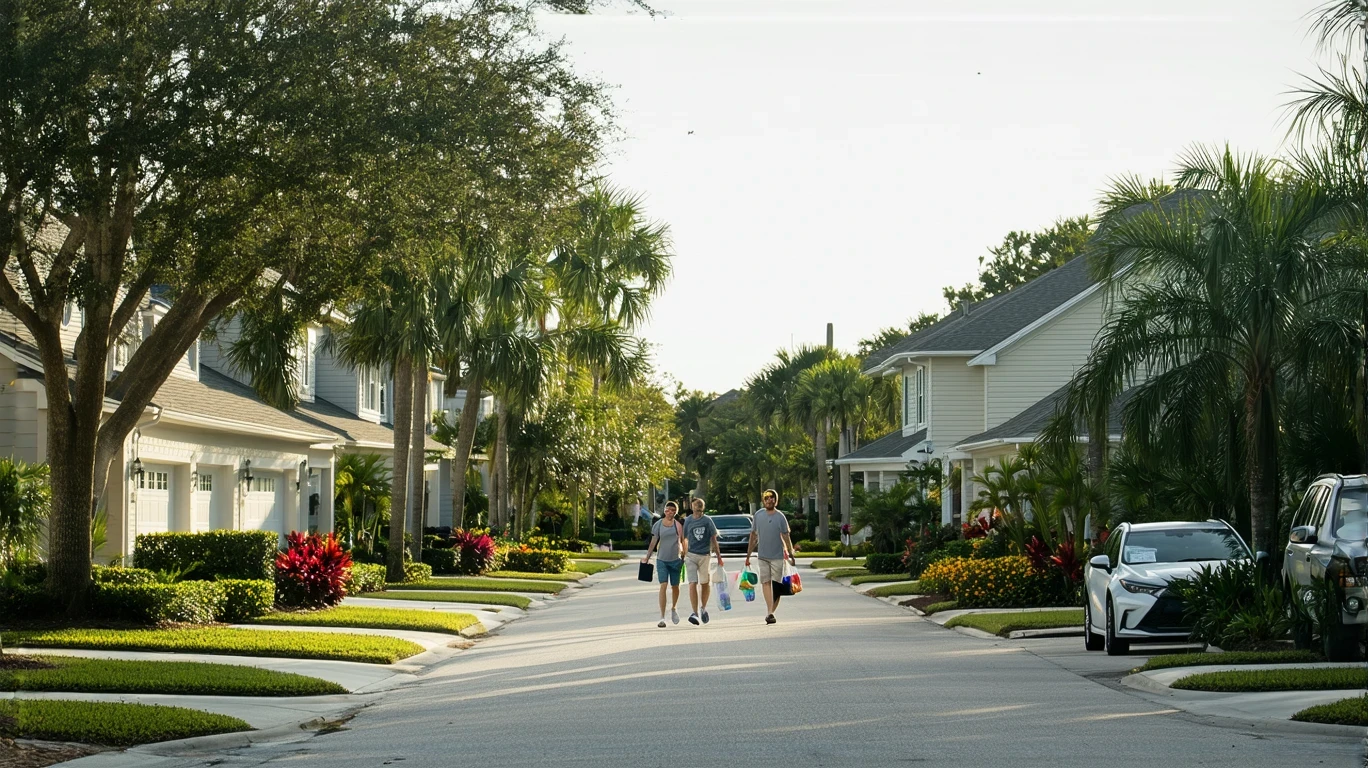
How Grocery Costs Feel in Oldsmar
Grocery prices in Oldsmar sit slightly above the national baseline, reflecting a regional price parity index of 103—meaning the cost of staple items here runs about 3% higher than the U.S. average. For most households, that difference doesn’t announce itself on any single shopping trip, but it accumulates over weeks and months, especially for families buying in volume or retirees managing fixed budgets. The pressure isn’t dramatic, but it’s present, and it shows up most clearly when comparing per-pound prices on proteins, dairy, and fresh produce. Singles and young professionals notice grocery costs in a different way: their absolute spending is lower, but they’re more exposed to convenience markups and premium store pricing, since smaller households often shop more frequently and in smaller quantities.
With a median household income of $73,984 per year, Oldsmar households generally have room to absorb moderate grocery inflation without restructuring their budgets entirely. But “room to absorb” doesn’t mean indifference. Families with children feel the volume effect—every incremental price increase on milk, eggs, or chicken gets multiplied across gallons, dozens, and pounds each week. Retirees on fixed incomes face a different calculus: their spending is predictable, but so is their revenue, and even small, sustained price creases reduce purchasing power over time. The key insight here is that grocery cost pressure in Oldsmar is less about sticker shock and more about cumulative exposure, household size, and the friction involved in switching between store tiers to capture savings.
One structural reality shapes how groceries feel here: food and grocery options are concentrated along corridors rather than evenly distributed across neighborhoods. That clustering means store choice isn’t just about preference—it’s about travel time, trip planning, and whether your daily routine naturally passes a discount grocer or only mid-tier chains. For households with flexible transportation and time, that’s manageable. For those relying on fixed schedules, limited vehicle access, or tight errand windows, the corridor layout adds friction to cost management. It’s not that options don’t exist; it’s that accessing them requires intentional routing, and that shapes which households can easily trade convenience for savings.
Grocery Price Signals (Illustrative)
The table below shows illustrative prices for common staple items in Oldsmar, derived from national baselines adjusted for regional cost patterns. These figures are not store-specific or week-specific; they’re anchors that reflect how staple prices tend to compare locally. This is not a shopping list, and it’s not a cart total—it’s a snapshot of relative price positioning for decision context.
| Item | Price |
|---|---|
| Bread (per pound) | $1.91/lb |
| Cheese (per pound) | $4.82/lb |
| Chicken (per pound) | $2.11/lb |
| Eggs (per dozen) | $2.58/dozen |
| Ground beef (per pound) | $6.94/lb |
| Milk (per half-gallon) | $4.15/half-gallon |
| Rice (per pound) | $1.11/lb |
Derived estimate based on national baseline adjusted by regional price parity; not an observed local price.
What stands out is the spread between low-cost staples like rice and bread versus proteins like ground beef and cheese. A household buying heavily in the protein and dairy categories will feel price pressure more acutely than one relying on grains, beans, and seasonal produce. The per-pound price on chicken is relatively moderate, but ground beef at nearly $7 per pound becomes a budget consideration for families cooking multiple dinners per week. Eggs and milk, both high-frequency purchases, sit in a middle band—not cheap, but not prohibitive. The takeaway isn’t that any single item is unaffordable; it’s that the composition of your cart and the store tier you’re shopping determine whether these prices feel manageable or tight.
Store Choice & Price Sensitivity
Grocery cost pressure in Oldsmar varies more by store tier than by any single “average” price level. Discount grocers—regional chains and no-frills formats—offer the lowest per-item prices, often 15–25% below mid-tier competitors on staples like milk, eggs, bread, and canned goods. These stores strip out service layers, limit selection, and rely on high volume to keep margins thin. For budget-conscious households, especially families buying in quantity, discount grocers are the primary lever for controlling food costs. The tradeoff is reduced variety, fewer prepared or specialty items, and sometimes less convenient locations given the corridor clustering mentioned earlier.
Mid-tier grocers—the familiar supermarket chains that anchor most suburban shopping centers—offer broader selection, better produce quality, and more predictable inventory. Prices here sit closer to the regional baseline reflected in the table above. For households prioritizing convenience, one-stop shopping, and consistent stock, mid-tier stores are the default. They’re not the cheapest, but they’re rarely the most expensive, and they’re usually the easiest to access along daily commute or errand routes. The cost premium over discount stores is real but not extreme, and many households absorb it in exchange for time savings and reduced trip complexity.
Premium grocers—organic-focused chains, specialty markets, and upscale formats—can run 30–50% higher than discount stores on comparable items, and even higher on organic, prepared, or imported goods. These stores serve households willing to pay for quality signals, dietary preferences, or experiential shopping. For singles and small households, premium grocers can quietly inflate grocery spending, since the per-trip cost difference feels small but compounds over months. Families shopping premium formats for everything face significant cost pressure unless income comfortably supports it. The key insight: premium pricing isn’t inherently wasteful, but it requires intentional budgeting and clarity about which categories justify the markup.
Because food and grocery options in Oldsmar are concentrated along corridors, switching between store tiers isn’t always frictionless. A household living near a mid-tier chain might need to add 10–15 minutes of drive time to reach a discount grocer, and that travel cost—both in time and fuel—offsets some of the per-item savings. Conversely, a household with a discount store on their commute route captures savings with no added friction. This geographic clustering means that store choice isn’t purely a price decision; it’s also a logistics decision, and that affects which households can easily optimize their grocery spending.
What Drives Grocery Pressure Here
Income is the first filter. At a median household income of $73,984, most Oldsmar households can cover a moderate grocery bill without financial strain, but “moderate” is doing heavy lifting in that sentence. A two-person household spending $600–$700 per month on groceries (a realistic range for mid-tier shopping) is allocating roughly 10–11% of gross income to food at home. That’s manageable. A family of four spending $1,000–$1,200 per month is closer to 16–19% of gross income, and that starts to compete with housing, utilities, and transportation for budget share. Lower-income households, or those with more than four members, feel grocery costs as a binding constraint, not a background expense.
Household size amplifies everything. A single-person household might spend $250–$350 per month and barely notice week-to-week price swings. A family of four buying milk by the gallon, eggs by the flat, and chicken by the multi-pack sees every $0.20 price increase multiply across volume. The same 5% inflation rate that’s invisible to a single person can add $50–$60 per month to a family’s grocery bill. That’s why store tier choice and bulk buying matter more for larger households: the percentage savings on per-unit prices scale with volume, and the effort required to capture those savings pays off faster.
Seasonal variability plays a quieter role. Florida’s climate allows for year-round produce availability, which moderates some of the price swings seen in colder states where fresh vegetables and fruits become scarce or expensive in winter. That said, national supply chains and commodity price shocks (fuel costs, weather events elsewhere, export demand) still ripple through local grocery prices. Shoppers in Oldsmar won’t see dramatic seasonal price spikes on staples, but they will notice gradual drift in categories like beef, dairy, and processed foods, which track broader inflation trends more than local growing seasons.
The corridor clustering of grocery options also drives pressure indirectly. Households with easy access to multiple store tiers can shop strategically—buying staples at discount grocers and filling gaps at mid-tier stores. Households with limited access, whether due to transportation constraints or time pressure, default to the nearest option, which may or may not be the most cost-effective. That geographic friction doesn’t show up in price indices, but it shapes real-world grocery spending just as much as per-item costs do.
Practical Ways People Manage Grocery Costs
The most effective strategy is intentional store tier selection. Households that route even half their staple purchases—milk, eggs, bread, rice, canned goods—through a discount grocer can reduce their monthly grocery spending noticeably without sacrificing quality or nutrition. The key is separating “where I buy volume staples” from “where I fill gaps or buy specialty items.” Many households in Oldsmar do this implicitly, stopping at a discount store for pantry stock and a mid-tier chain for produce, meat, or last-minute needs. Making that split explicit and routine turns it into a cost-control lever rather than an occasional tactic.
Bulk buying works when storage and usage align. Families cooking daily meals can buy proteins, grains, and frozen vegetables in larger packs and capture per-unit savings without waste. Singles or couples risk spoilage unless they’re comfortable with freezer rotation or repetitive meals. The math is simple: buying a 5-pound bag of rice instead of a 1-pound bag cuts per-pound cost significantly, but only if you’ll use it before it goes stale. The same logic applies to meat, cheese, and bread—larger formats save money when turnover is high and waste is low.
Seasonal and sale-based shopping reduces cost volatility. Proteins, canned goods, and frozen items cycle through promotional pricing, and households that can shift purchase timing—buying chicken when it’s on sale and freezing it, stocking up on canned tomatoes during a promotion—smooth out their monthly spending and avoid paying peak prices. This requires some planning and flexibility, but it doesn’t require couponing or extreme effort. Just tracking which staples you use regularly and buying ahead when prices dip creates meaningful savings over months.
Private-label and store-brand products offer another margin of control. Most mid-tier and discount grocers carry house brands that match or closely approximate name-brand quality at 20–30% lower prices. Categories like pasta, canned vegetables, dairy, and baking staples are particularly strong candidates for private-label substitution. Premium grocers also carry store brands, though the price gap there is often smaller. The point isn’t to eliminate name brands entirely; it’s to default to store brands for commoditized categories and reserve name-brand spending for items where quality or preference differences are meaningful.
Finally, cooking from scratch rather than buying prepared or convenience foods reduces per-meal costs and gives households more control over ingredients and portion sizes. A rotisserie chicken or pre-cut vegetables save time but carry a convenience markup. A household willing to spend 20–30 minutes on meal prep can buy raw ingredients at lower per-pound prices and stretch their grocery budget further. This isn’t a universal solution—time is a real constraint, especially for working parents—but for households with flexibility, it’s one of the highest-leverage cost management tools available.
Groceries vs Eating Out (Directional)
Cooking at home in Oldsmar remains significantly cheaper per meal than eating out, even when accounting for the time and effort involved. A home-cooked dinner for two using mid-tier grocery staples—chicken, rice, vegetables—might cost $8–$12 in ingredients. The same meal at a casual restaurant runs $30–$45 after entrees, drinks, tax, and tip. The cost gap is wide enough that even households with tight schedules and limited cooking skills can capture savings by preparing just a few more meals per week at home.
The tradeoff isn’t purely financial. Eating out saves time, eliminates cleanup, and offers variety and social experience that home cooking doesn’t replicate. For busy professionals, families with young children, or anyone managing competing demands, restaurant meals and takeout aren’t indulgences—they’re time-buying decisions. The question isn’t whether eating out costs more (it does), but whether the time and convenience it buys justify the expense within a given household’s budget and priorities.
One useful framing: treating restaurant meals as planned expenses rather than default options. A household that budgets for two or three dinners out per week and cooks the rest can enjoy the convenience and experience of eating out without letting it quietly inflate their monthly food costs. The inverse—defaulting to takeout and cooking occasionally—makes it much harder to control spending, since restaurant meals compound quickly and grocery staples go unused or spoil.
FAQs About Grocery Costs in Oldsmar (2026)
Is it cheaper to shop in bulk in Oldsmar? Bulk buying reduces per-unit costs on staples like rice, pasta, canned goods, and proteins, but only if your household uses the volume before spoilage. Families and larger households capture the most benefit; singles and couples need to be more selective to avoid waste.
Which stores in Oldsmar are best for low prices? Discount-tier grocers offer the lowest per-item prices, often 15–25% below mid-tier chains on staples. Mid-tier supermarkets provide broader selection and convenience at moderate pricing, while premium grocers charge significantly more for organic, specialty, and prepared items.
How much more do organic items cost in Oldsmar? Organic products typically run 30–60% higher than conventional equivalents, with the largest premiums on produce, dairy, and meat. The gap narrows slightly at premium grocers that emphasize organic selection, but it remains substantial across all store tiers.
How do grocery costs for two adults in Oldsmar tend to compare to nearby cities? Oldsmar’s regional price parity of 103 places it slightly above the national average, and close to other Tampa-area suburbs. Differences within the metro are usually smaller than differences between store tiers, so where you shop often matters more than which nearby city you’re in.
How do households in Oldsmar think about grocery spending when cooking at home? Most households treat groceries as a controllable expense, using store tier choice, bulk buying, and sale timing to manage costs. Families focus on volume efficiency, while singles and retirees prioritize predictable staples and minimal waste. The corridor clustering of grocery options means access and trip planning also shape spending patterns.
How Groceries Fit Into the Cost of Living in Oldsmar
Groceries sit in the middle of the household expense stack—less dominant than housing, more controllable than transportation, and more variable than utilities. For most Oldsmar households, food costs are manageable within a broader budget, but they’re also one of the few categories where behavior and store choice create immediate, measurable savings. That makes groceries a useful pressure-release valve when other costs (rent, insurance, fuel) rise or when income tightens temporarily.
The regional price parity of 103 means grocery prices here track slightly above the national baseline, but the spread between discount and premium store tiers is wider than that 3% index suggests. A household shopping strategically across tiers can experience grocery costs closer to the national average or even below it, while a household defaulting to premium formats will feel prices well above. That range—and the control households have over where they land within it—is what makes grocery spending both a cost-of-living factor and a cost-management opportunity.
For a full picture of how groceries interact with housing, utilities, transportation, and other monthly expenses, see the complete budget breakdown for Oldsmar. That article walks through how all the pieces fit together, what a realistic monthly budget looks like for different household types, and where the biggest financial pressures and tradeoffs emerge. Groceries are one line item, but understanding how they compete with rent, commuting costs, and savings goals requires seeing the whole structure.
How this article was built: In addition to public economic data, this article incorporates location-based experiential signals derived from anonymized geographic patterns—such as access density, walkability, and land-use mix—to reflect how day-to-day living actually feels in Oldsmar, FL.