
“I moved here for the trails and the bike lanes, and honestly, that part delivers. But the cost-to-income ratio is wild, and you feel it every month. If you’re not making serious money or already own, it’s a grind. Still, I can’t imagine leaving — the access to the outdoors is unmatched.”
That tension — between Boulder’s undeniable lifestyle appeal and its relentless cost pressure — shows up in nearly every conversation about living here. This isn’t a city where people feel neutral. You either align deeply with what Boulder offers, or you find yourself constantly weighing whether the tradeoffs are worth it.
Understanding Boulder’s vibe means understanding that duality: pride in outdoor access, bike culture, and community character on one side; frustration with housing costs, growth debates, and affordability barriers on the other. The city attracts outdoor enthusiasts, active families, and remote workers who prioritize lifestyle over commute. But it also filters out cost-sensitive households, people expecting uniform walkability citywide, and those who need urban density or hospital proximity.
This article translates the emotional tone of living in Boulder — not through surveys or sentiment scores, but through the recurring themes, tradeoffs, and alignment patterns that shape how people experience day-to-day life here.
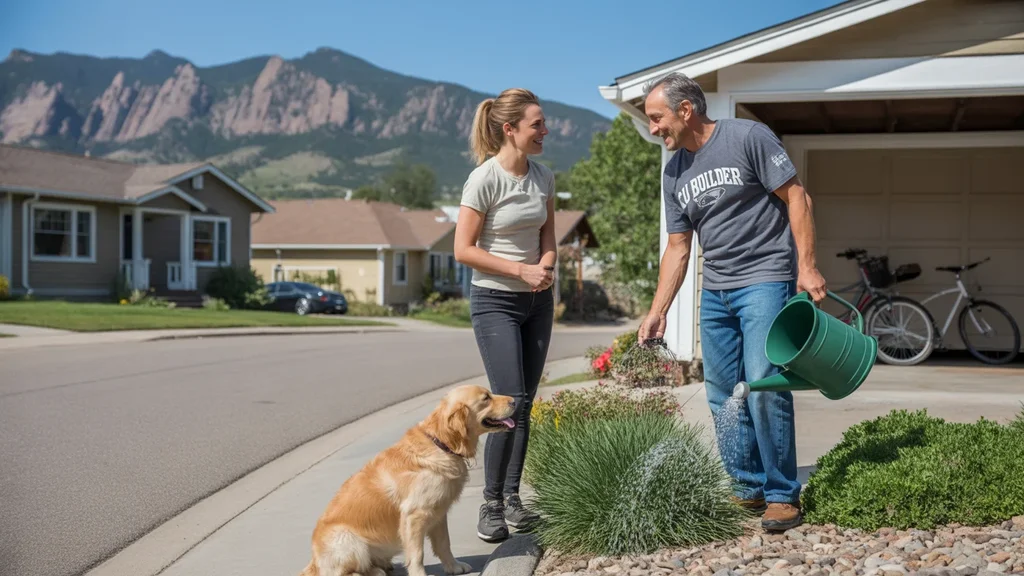
The Emotional Landscape of Boulder
Boulder’s vibe is shaped by a few core realities that residents return to again and again: exceptional outdoor access, strong bike and pedestrian infrastructure in pockets, broadly accessible errands and grocery options, and a mixed building character that creates varied neighborhood texture. The city integrates parks and green space at a high density, with water features woven throughout, and playground and school access ranks strong for families.
But Boulder also carries the weight of being one of Colorado’s most expensive small cities. The median home value sits at $919,700, and median gross rent runs $1,853 per month, while median household income is $80,243 per year. That gap creates a recurring emotional theme: people love the lifestyle, but the cost structure forces constant evaluation of whether it’s sustainable.
The city’s dual identity as both a college town (home to CU Boulder) and a retirement destination adds another layer. You get student energy, seasonal flux, and a younger demographic mixed with active retirees who’ve chosen Boulder for its outdoor life and amenities. That combination creates vibrancy, but it also means housing demand stays high and competition for walkable, amenity-rich neighborhoods is intense.
Outdoor access is Boulder’s primary alignment factor. The city’s park density exceeds high thresholds, and residents consistently describe trail access, open space, and proximity to the Flatirons as the reason they stay despite cost pressure. For households who prioritize recreation over square footage, Boulder delivers in ways few other cities can match.
Bike culture is another defining feature. The bike-to-road ratio exceeds high thresholds, and cycling infrastructure is present throughout parts of the city. Residents who bike commute or use bikes for errands find Boulder’s infrastructure supportive, though the experience varies by neighborhood. Walkability is concentrated in pockets rather than spread evenly, which means some areas support car-free living while others require vehicle dependency for daily tasks.
Healthcare access is routine and local — clinics and pharmacies are present — but there’s no hospital within city limits. For households managing chronic conditions or those who want emergency care proximity, that absence becomes a friction point. It’s not a dealbreaker for most, but it’s a tradeoff that surfaces in discussions about long-term fit.
Social Media Buzz in Boulder
On platforms like Reddit, Facebook groups, and X (formerly Twitter), Boulder’s online conversation tends to cluster around a few recurring themes: outdoor life and recreation, housing affordability and cost pressure, bike and pedestrian infrastructure, growth and development debates, and community character preservation.
The tone is often protective. Long-time residents express pride in what makes Boulder distinct — its open space system, its commitment to trails and parks, its bike-friendly design — but they also voice concern about growth pressure and whether new development will erode the qualities that drew people here in the first place.
“Boulder’s outdoor access is legitimately world-class. You can bike to work, hit a trail at lunch, and still make it home for dinner. But the cost of entry is brutal, and it’s getting worse every year.”
“I love the bike lanes and the fact that I can run errands without a car in my neighborhood. But let’s be real — if you’re not in one of the walkable pockets, you’re driving everywhere just like any other suburb.”
“The college town energy keeps things interesting, but it also means rent spikes every fall and the housing market never cools off. If you’re not already locked in, good luck.”
There’s also a recurring thread of frustration aimed at newcomers who move to Boulder expecting urban amenities or big-city convenience. The city offers a lot, but it’s not dense, it doesn’t have rail transit, and outside the core walkable areas, it functions more like a car-dependent suburb. People who arrive expecting something different often feel friction early.
Local News Tone
Local coverage in Boulder tends to frame the city through a few timeless lenses: growth and development debates, outdoor recreation and open space preservation, transportation and bike infrastructure, housing affordability and cost pressure, and community identity and character evolution.
Headlines and story angles often reflect the tension between Boulder’s appeal and its challenges:
- “Community Debates What Growth Should Look Like”
- “New Bike Lanes Expand, But Gaps Remain in Coverage”
- “Outdoor Access Remains a Draw as Housing Costs Climb”
- “Residents Weigh Affordability Against Lifestyle Quality”
- “College Town Energy Meets Retiree Appeal in Shifting Demographics”
The tone is rarely celebratory or alarmist. Instead, it’s evaluative — acknowledging what works (outdoor access, bike culture, errands accessibility) while surfacing what creates friction (cost pressure, hospital absence, uneven walkability). The framing reflects a community that’s constantly negotiating tradeoffs rather than declaring victory or defeat.
Review-Based Public Perception
On platforms like Google Reviews, Yelp, and Nextdoor-style community boards, Boulder’s public perception splits along predictable lines: people who prioritize outdoor life and active recreation tend to express high satisfaction, while those focused on affordability, urban convenience, or healthcare proximity voice more mixed or critical views.
Positive themes tend to emphasize:
- Exceptional trail and park access integrated throughout the city
- Strong bike infrastructure and pedestrian-friendly pockets
- Broadly accessible grocery and food options without long drives
- Family-friendly amenities, especially playgrounds and schools
- Natural beauty and proximity to the Flatirons
“If you’re into hiking, biking, or just being outside, Boulder is hard to beat. The access is unreal, and you don’t have to drive an hour to find a trail.”
“We moved here with young kids, and the playground density is honestly impressive. There’s always a park nearby, and the schools feel accessible.”
Critical or mixed themes tend to focus on:
- High housing pressure relative to income, especially for renters
- Walkability concentrated in select neighborhoods, not citywide
- No hospital within city limits (routine care only)
- Transit limited to bus service, no rail options
- Cost of living creates barriers for middle-income households
“Boulder’s great if you’re already financially comfortable, but if you’re trying to build savings or buy a home on a normal income, it’s a tough place to make it work long-term.”
“I thought it would be more walkable everywhere, but unless you’re in one of the core neighborhoods, you’re still driving to most things. It’s not as car-free as people make it sound.”
Neighborhood variation matters here. Newer planned areas and older pockets offer different textures — some with mixed-use walkability and bike access, others more car-dependent with single-family layouts. Expectations about what “Boulder living” means often clash with the reality of where someone can afford to live.
Comparison to Nearby Cities
| Dimension | Boulder | Denver | Fort Collins |
|---|---|---|---|
| Outdoor Access | Exceptional trail and park integration | Strong metro parks, less immediate access | Very strong, similar outdoor culture |
| Walkability | Concentrated in pockets, not citywide | Urban core walkable, suburbs car-dependent | Moderate, bike culture present |
| Transit Options | Bus only, no rail | Light rail and bus network | Bus only, similar to Boulder |
| Cost Pressure | Very high relative to income | High, but more income diversity | High, but slightly more accessible |
| Community Vibe | Protective, outdoor-focused, college town energy | Urban, diverse, faster-paced | Laid-back, college town, outdoor-oriented |
Boulder, Denver, and Fort Collins each attract outdoor-oriented households, but the experience of living in each city differs in meaningful ways.
If you prioritize immediate trail access, integrated green space, and a smaller-city feel, Boulder delivers more consistently than Denver. But Denver offers rail transit, urban walkability in core neighborhoods, and more income diversity, which can ease cost pressure for some households. Denver also has hospital access and specialist care within city limits, which Boulder lacks.
Fort Collins shares Boulder’s outdoor culture and college town energy (home to Colorado State University), but it tends to feel slightly more accessible financially and less intensely protective of its character. The bike culture is strong in Fort Collins, though not quite as developed as Boulder’s. If you want a similar vibe with less cost pressure, Fort Collins often surfaces as an alternative.
Boulder’s edge is its outdoor integration and the density of its park and trail network. If that’s your primary alignment factor, Boulder justifies the cost. If you need urban density, rail transit, or more affordable entry points, Denver or Fort Collins may fit better.
What Locals Are Saying
“I’m a remote worker, and Boulder’s lifestyle-to-commute tradeoff is perfect for me. I bike to coffee shops, hit trails at lunch, and never sit in traffic. The cost is high, but I’m paying for time and access, not square footage.”
“We moved here with two young kids, and the playground and school access has been great. But the housing market is brutal. We’re renting, and every lease renewal feels like a negotiation we’re losing.”
“I love the bike infrastructure, but it’s not as universal as people think. If you’re not in one of the walkable pockets, you’re still driving to the grocery store and dealing with parking like anywhere else.”
“Boulder’s outdoor access is legitimately unmatched. I can trail run before work, bike commute, and still have time for evening hikes. That’s worth the cost for me, but I get why it doesn’t work for everyone.”
“The college town energy keeps things interesting, but it also means the housing market never cools off. Every fall, rent spikes, and competition for anything decent gets intense.”
“I’m retired, and Boulder checks a lot of boxes — outdoor life, walkable errands in my neighborhood, good local clinics. But I wish there was a hospital closer. For routine stuff, it’s fine, but I worry about emergencies.”
“I’ve been here ten years, and the cost pressure is real. If you’re not making well above the median income or you don’t already own, it’s hard to build savings. The lifestyle is great, but the financial stress is constant.”
Does Boulder Feel Like a Good Fit?
Boulder doesn’t work for everyone, and that’s not a flaw — it’s a function of what the city prioritizes. If you’re an outdoor enthusiast who values trail access, integrated green space, and bike culture, Boulder delivers at a level few other cities can match. If you’re a family seeking strong playground and school infrastructure, or a remote worker who wants to trade commute time for lifestyle quality, Boulder’s structure supports that alignment.
But if you’re cost-sensitive, expecting uniform walkability citywide, or need hospital proximity for health reasons, Boulder creates friction. The city’s affordability barrier is real, and it filters out middle-income households who can’t absorb the gap between cost structure and income. Transit is limited to bus service, which works for some but not for car-free households outside walkable pockets.
The emotional profile of Boulder is one of tradeoff clarity: people who stay tend to accept the cost pressure in exchange for outdoor access and lifestyle quality. People who leave often cite affordability as the breaking point, even when they love the city’s character.
If you’re considering Boulder, the question isn’t whether it’s “happy” or “good” in the abstract. The question is whether its specific strengths align with your priorities, and whether its specific friction points are tolerable given what you gain. For the right household, Boulder justifies the cost. For others, the tradeoff doesn’t pencil out, and that’s worth knowing before you commit.
How this article was built: In addition to public economic data, this article incorporates location-based experiential signals derived from anonymized geographic patterns—such as access density, walkability, and land-use mix—to reflect how day-to-day living actually feels in Boulder, CO.
The perspectives shown reflect commonly expressed local sentiment and recurring themes in public discussion, rather than individual accounts.