
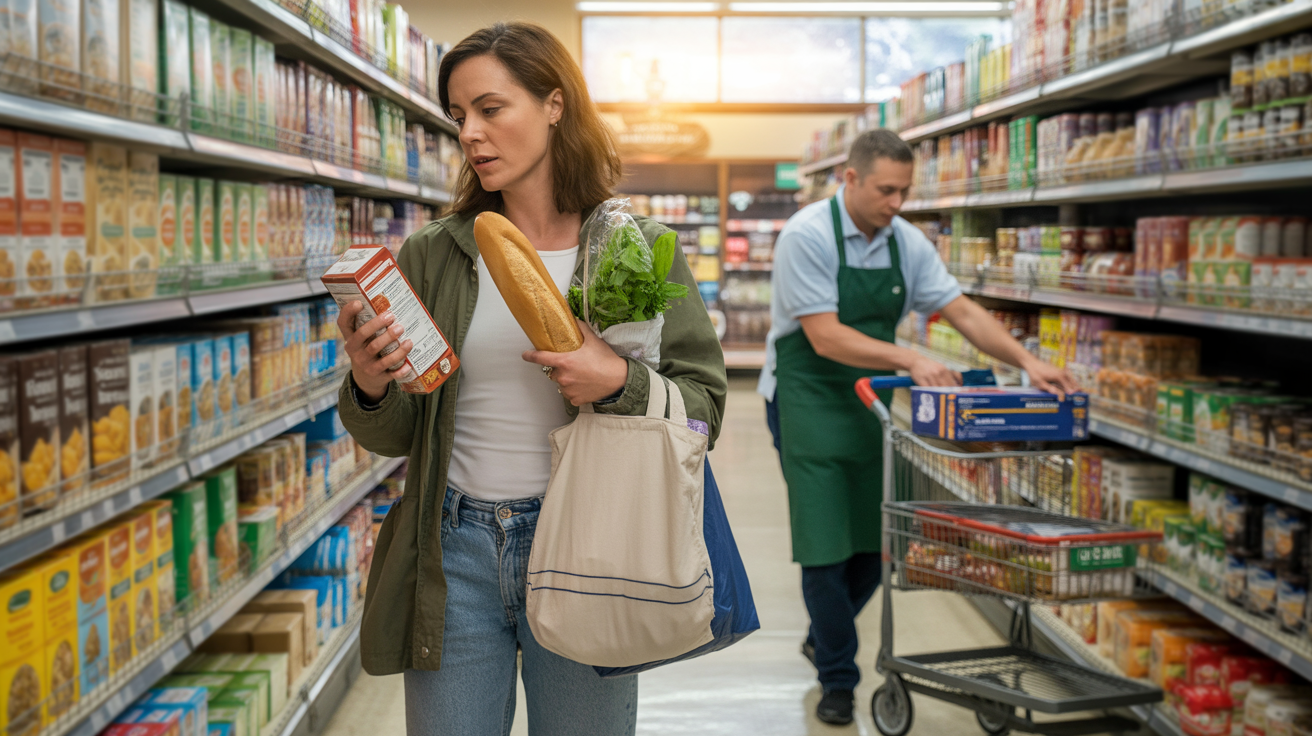
How Grocery Costs Feel in Okolona
When you’re planning meals for the week in Okolona, the grocery run feels different than it might in downtown Louisville or out in the smaller towns farther east. You’re working within a car-oriented suburb where food shopping happens along commercial corridors rather than within walking distance of most homes. The prices you encounter reflect Kentucky’s below-average regional cost structure—the RPP index sits at 94, meaning the same dollar stretches a bit further here than in many parts of the country—but that advantage shows up unevenly across the grocery aisle. Staples like bread, rice, and chicken tend to track close to or slightly below national averages, while items subject to tighter supply chains or premium branding can narrow that gap quickly.
Grocery costs in Okolona don’t typically dominate household budgets the way housing or transportation do, but they create steady, recurring pressure that singles and families feel in different ways. A single adult buying for one can keep weekly trips modest and adjust easily when a favorite item jumps in price. Families with kids face less flexibility: school lunches, snacks, and the sheer volume required each week mean that even small per-unit price shifts compound quickly. The difference between a $1.74 loaf of bread and a $2.50 bakery loaf, or between $1.93-per-pound chicken thighs and $4.40-per-pound cheese, becomes meaningful when you’re filling a cart for four or five people multiple times a month.
Understanding grocery pressure here requires looking beyond the receipt total. It’s about recognizing which households have room to substitute, which staples anchor the budget, and how store choice and shopping habits influence whether Okolona feels affordable or tight when it comes to feeding a household. The experience isn’t uniform—it’s shaped by income, household size, and the daily decisions people make about where to shop and what trade-offs they’re willing to accept.
Grocery Price Signals (Illustrative)
Item-level prices offer a way to understand how Okolona compares on everyday staples, not as a complete shopping list but as illustrative anchors that show relative positioning. These figures reflect modeled estimates adjusted for regional price parity and should be understood as directional signals rather than store-specific guarantees. Derived estimate based on national baseline adjusted by regional price parity; not an observed local price.
| Item | Price |
|---|---|
| Bread (per pound) | $1.74/lb |
| Rice (per pound) | $1.01/lb |
| Chicken (per pound) | $1.93/lb |
| Ground beef (per pound) | $6.33/lb |
| Cheese (per pound) | $4.40/lb |
| Eggs (per dozen) | $2.35/dozen |
| Milk (per half-gallon) | $3.78/half-gallon |
These prices illustrate how staple items tend to compare locally—not a full shopping list. Bread, rice, and chicken sit comfortably in the lower-cost tier, making them reliable anchors for budget-conscious meal planning. Ground beef and cheese, by contrast, carry noticeably higher per-pound costs, which matters when recipes call for larger quantities or when households rely on these proteins regularly. Eggs and milk fall somewhere in between: everyday essentials that don’t spike the budget but add up quickly in larger households where a dozen eggs might last two days and a half-gallon of milk disappears even faster.
What these numbers reveal is texture, not totals. A household that builds meals around chicken, rice, and seasonal vegetables will experience Okolona’s grocery costs very differently than one that leans heavily on beef, cheese, and convenience items. The price spread between low-cost staples and higher-ticket ingredients creates natural decision points every time someone plans a week’s worth of dinners or decides whether to stretch ground beef with beans or buy another pound.
Store Choice & Price Sensitivity
Grocery price pressure in Okolona varies significantly by store tier, and understanding that variation is essential to making sense of how food costs actually feel here. The discount tier—stores that emphasize private-label products, no-frills layouts, and high-volume turnover—delivers the tightest pricing on staples. Shoppers willing to accept limited selection, bring their own bags, and skip the bakery counter can keep per-item costs low and stretch each grocery dollar further. For households operating on fixed incomes, managing tight margins, or feeding multiple people, the discount tier often becomes the default, not out of preference but out of necessity.
The mid-tier represents the middle ground: recognizable supermarket chains with broader selection, occasional sales, and loyalty programs that reward frequency. Prices on basics like bread, eggs, and chicken stay competitive, but convenience items, prepared foods, and name-brand products carry noticeable markups. Families who value one-stop shopping, prefer certain brands, or need the flexibility of longer hours and more locations often settle into this tier, accepting moderately higher costs in exchange for reduced friction. The premium tier—specialty grocers, organic-focused markets, and stores emphasizing local sourcing—caters to households with more discretionary income and specific priorities around quality, sustainability, or dietary preferences. Prices here can run significantly higher across the board, and the premium tier’s appeal depends entirely on whether those differences align with a household’s values and budget capacity.
In Okolona, store access follows the car-oriented commercial corridor pattern typical of suburban Louisville. Most residents drive to shop, and the choice of store becomes a deliberate trade-off: time, distance, and fuel cost against per-item savings and selection. A household that drives an extra few miles to reach a discount grocer might save enough on a week’s worth of staples to justify the trip, while another might prioritize convenience and proximity, absorbing slightly higher costs to avoid the logistical burden. These decisions aren’t static—they shift with gas prices, work schedules, and household cash flow, making store choice a dynamic part of how grocery pressure is managed rather than a one-time preference.
What Drives Grocery Pressure Here
Income plays the most direct role in determining how grocery costs feel in Okolona. Households earning well above the median can absorb price fluctuations, experiment with premium products, and treat grocery shopping as a low-stress routine. Those closer to or below median income face a different reality: every price increase on a staple item forces a substitution, and the cumulative effect of those adjustments—switching from beef to chicken, from name brands to store brands, from fresh to frozen—adds up to a fundamentally different grocery experience. The same store, the same aisle, the same products, but entirely different levels of pressure depending on what percentage of take-home pay is committed before the cart is even filled.
Household size amplifies that pressure in predictable ways. A single adult can keep grocery spending modest, adjust portions easily, and absorb waste without major consequences. Add a partner, and volume doubles but efficiency improves—buying in bulk makes sense, and meal planning becomes more worthwhile. Add children, especially school-aged kids with high caloric needs and strong preferences, and grocery costs shift from manageable to relentless. The difference between feeding two adults and feeding two adults plus three kids isn’t linear—it’s exponential in terms of volume, frequency, and the loss of flexibility to skip meals, stretch leftovers, or delay a shopping trip.
Regional distribution and access patterns also shape grocery pressure in Okolona, though less visibly. Because the area relies on car-based shopping along commercial corridors, households without reliable transportation face compounded difficulty. Limited transit options mean that grocery access becomes a logistical challenge, not just a pricing question. Smaller convenience stores and corner markets, where they exist, carry higher per-unit prices and narrower selection, effectively penalizing the households least able to absorb those costs. Seasonal variability introduces another layer: produce prices fluctuate with growing cycles and supply chain conditions, and while Okolona’s moderate climate doesn’t impose the extreme heating or cooling costs seen elsewhere, it doesn’t eliminate the reality that fresh fruits and vegetables cost more in winter and early spring when local growing seasons are dormant.
Practical Ways People Manage Grocery Costs
Managing grocery costs in Okolona comes down to behavioral strategies that reduce waste, increase control, and align spending with actual consumption rather than aspirational meal plans. Meal planning stands out as the most effective lever: deciding in advance what gets cooked each night, building a shopping list around those meals, and buying only what’s needed eliminates impulse purchases and ensures that perishables get used before they spoil. The discipline required is real, but the payoff is immediate—fewer half-used vegetables rotting in the crisper, fewer forgotten leftovers pushed to the back of the fridge, and a clearer sense of whether the week’s grocery spending actually fed the household or just filled the cart.
Shopping store sales and using loyalty programs introduces another layer of control, though it requires attention and timing. Many mid-tier grocers rotate discounts on staples, and households that track those cycles can stock up when prices dip and avoid paying full price on frequently used items. Loyalty programs, digital coupons, and app-based discounts reward frequency and volume, but they also require engagement—downloading apps, checking offers, and sometimes adjusting shopping patterns to match what’s on sale rather than what was originally planned. For some households, that trade-off makes sense; for others, the cognitive load outweighs the savings.
Buying in bulk works well for non-perishables and household staples—rice, beans, canned goods, pasta—but only if storage space and upfront cash flow allow it. A twenty-pound bag of rice delivers better per-unit value than a two-pound bag, but it also requires the ability to spend more in a single trip and the space to store it at home. Households living paycheck to paycheck or in smaller rental units often can’t access those efficiencies, even when they understand the math. Reducing food waste, meanwhile, comes down to honest consumption habits: buying less of what sounds good and more of what actually gets eaten, using leftovers intentionally rather than optimistically, and recognizing that a deal on something the household won’t use isn’t a deal at all.
Groceries vs Eating Out (Directional)
The trade-off between cooking at home and eating out shapes grocery pressure in ways that aren’t always obvious. Cooking at home almost always costs less per meal than restaurant dining or takeout, but it demands time, energy, and planning that not every household can consistently provide. A family that cooks dinner six nights a week will see lower grocery bills than one that eats out half the time, but the comparison isn’t purely financial—it’s also about bandwidth, schedules, and whether anyone in the household has the capacity to shop, prep, and clean up after a full day of work or caregiving.
In Okolona, where car dependency defines daily logistics and food access is corridor-clustered rather than walkable, the decision to cook or eat out often hinges on proximity and convenience as much as cost. A household that passes multiple fast-food options on the commute home faces a different set of temptations than one that has to drive out of the way to pick up takeout. The friction of stopping, ordering, and waiting can discourage frequent restaurant meals, but so can the friction of an empty fridge, no meal plan, and the prospect of starting dinner from scratch at 7 p.m. Groceries and dining aren’t opposites—they’re part of a continuous spectrum of food spending, and where a household lands on that spectrum depends on income, time, and the daily realities of managing a household in a car-oriented suburb.
FAQs About Grocery Costs in Okolona (2026)
Is it cheaper to shop in bulk in Okolona? Buying in bulk reduces per-unit costs on non-perishables like rice, beans, and canned goods, but only if you have the upfront cash flow and storage space to make it practical. Households operating on tight weekly budgets or living in smaller rental units may not be able to access those efficiencies, even when the math makes sense.
Which stores in Okolona are best for low prices? Discount-tier grocers that emphasize private-label products and high-volume turnover tend to deliver the tightest pricing on staples. Mid-tier supermarkets offer broader selection and convenience, while premium grocers cater to households prioritizing organic, local, or specialty items at noticeably higher price points.
How much more do organic items cost in Okolona? Organic and specialty products typically carry significant premiums over conventional equivalents, though exact markups vary by store tier and product category. Households prioritizing organic options should expect to allocate a larger share of grocery spending to those choices, particularly for produce, dairy, and meat.
How do grocery costs for two adults in Okolona tend to compare to nearby cities? Okolona benefits from Kentucky’s below-average regional price parity, meaning grocery staples generally cost somewhat less here than in higher-cost metros. However, the advantage is modest and varies by item, store tier, and shopping habits rather than delivering uniform savings across the board.
How do households in Okolona think about grocery spending when cooking at home? Cooking at home almost always costs less per meal than eating out, but it requires time, planning, and energy that not every household can consistently provide. The trade-off between groceries and dining out depends on income, schedules, and whether the household has the bandwidth to shop, prep, and cook regularly.
How Groceries Fit Into the Cost of Living in Okolona
Groceries occupy a middle position in Okolona’s cost structure—less dominant than housing or transportation, but more persistent and less flexible than discretionary spending. Unlike rent, which stays fixed month to month, or utilities, which spike seasonally, grocery costs fluctuate with household size, income, and behavior. That variability makes groceries a pressure point for some households and a manageable line item for others, depending on how much room exists in what a budget has to handle in Okolona after fixed costs are covered.
For households earning above the median, groceries rarely create financial stress. There’s enough margin to absorb price increases, choose preferred brands, and shop at mid-tier or premium stores without forcing trade-offs elsewhere. For households closer to or below median income, groceries become a recurring negotiation: which staples to prioritize, which substitutions to accept, and how much time and fuel to invest in chasing lower prices. The same grocery environment produces fundamentally different experiences depending on where a household sits relative to the income distribution and how much discretionary capacity remains after housing, transportation, and utilities claim their share.
Understanding grocery costs in Okolona means recognizing that the numbers on the shelf are only part of the story. The rest comes down to store access, household composition, income stability, and the daily decisions that determine whether food spending feels manageable or relentless. For a complete picture of how groceries interact with housing, transportation, and other recurring expenses, the Monthly Budget article provides the full breakdown. Here, the focus stays on what drives grocery pressure, who feels it most, and how behavior and store choice shape the experience of feeding a household in a car-oriented suburb where access, selection, and price vary significantly depending on where you’re willing to drive and how much flexibility your budget allows.
How this article was built: In addition to public economic data, this article incorporates location-based experiential signals derived from anonymized geographic patterns—such as access density, walkability, and land-use mix—to reflect how day-to-day living actually feels in Okolona, KY.