
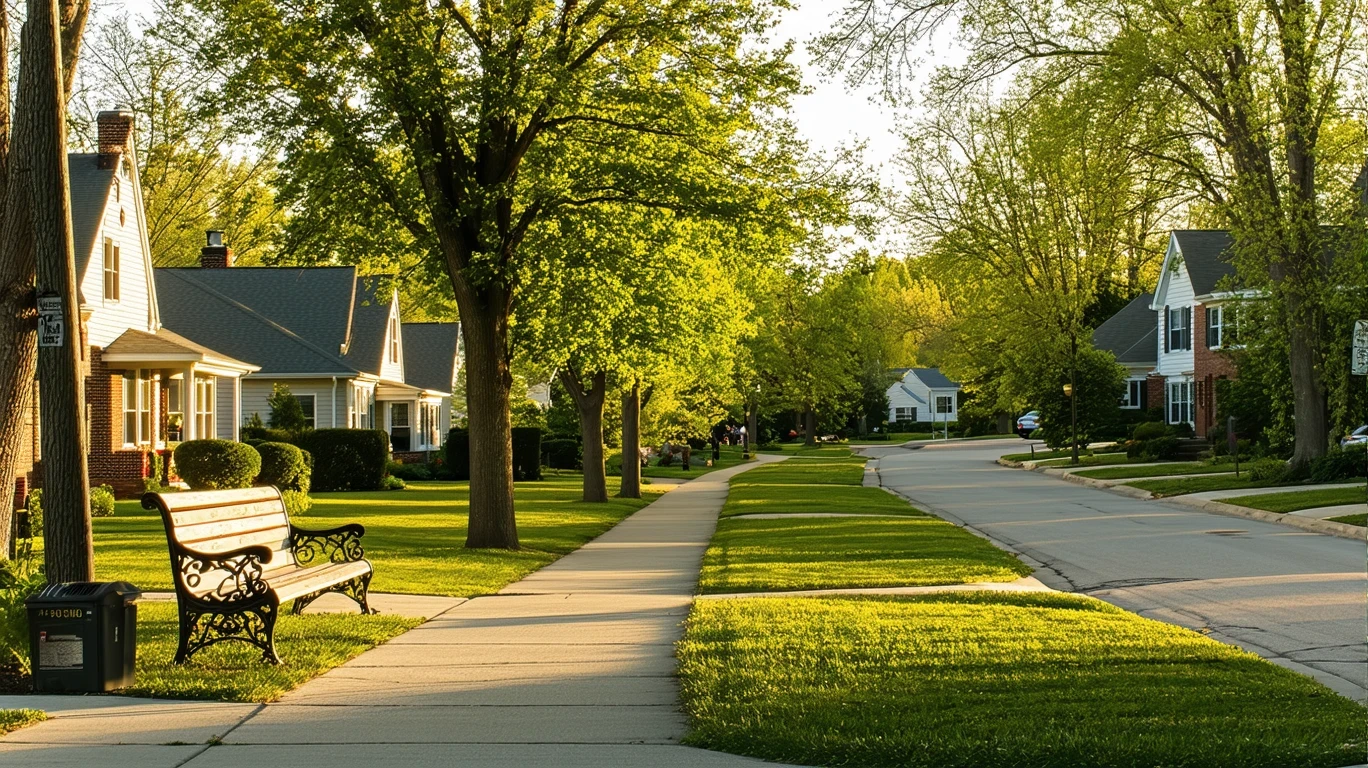
Noblesville and Carmel sit just miles apart in the Indianapolis metro, share the same regional price environment, and draw from overlapping job markets—but the cost pressures households face in each city diverge sharply in 2026. Noblesville offers a median home value of $295,700 and median gross rent of $1,202 per month, while Carmel’s housing market sits at $425,900 for homes and $1,499 per month for rent. Both cities attract families, commuters, and professionals, but the decision between them hinges less on total affordability and more on which costs dominate your household’s budget and how much control you have over them.
The tradeoffs are structural, not just financial. Noblesville’s lower housing entry costs come with sparse food and grocery infrastructure and higher commute friction—46.5% of workers face long commutes, and only 5.7% work from home. Carmel’s higher housing costs pair with integrated park access, hospital presence, and corridor-clustered errands, but utility rates run higher—electricity costs 17.34¢/kWh compared to Noblesville’s 15.91¢/kWh, and natural gas is priced at $14.78/MCF versus $10.25/MCF. The better choice depends on whether your household is more exposed to upfront housing barriers, ongoing utility volatility, or daily logistics friction.
This comparison explains where cost pressure concentrates in each city, how different household types experience that pressure, and which mechanisms—entry barriers, predictability, time costs, or ongoing obligations—matter most when deciding between Noblesville and Carmel in 2026.
Housing Costs
Housing costs in Noblesville and Carmel reflect two distinct market structures. Noblesville’s median home value of $295,700 positions it as a lower-barrier entry point for buyers, while Carmel’s $425,900 median represents a significantly higher upfront commitment. For renters, the gap is narrower but still meaningful: Noblesville’s median gross rent of $1,202 per month compared to Carmel’s $1,499 per month translates to different ongoing obligations and flexibility thresholds. These differences matter most for households deciding whether to prioritize lower entry costs or accept higher housing expenses in exchange for other structural advantages.
The housing stock in each city shapes more than just price—it determines exposure to maintenance, utilities, and long-term predictability. Noblesville’s lower home values often correspond to older or more varied housing types, which can introduce higher heating and cooling exposure depending on insulation and system age. Carmel’s higher-priced homes tend to reflect newer construction and more uniform development patterns, which may offer better energy efficiency but come with higher property tax bases and sometimes HOA fees that bundle services like landscaping or trash removal. Renters in Noblesville face fewer corridor-clustered grocery options, which can increase reliance on car trips for errands, while Carmel’s mixed land use and integrated parks offer more walkable pockets that reduce daily friction.
For first-time buyers, Noblesville’s lower entry barrier makes ownership more accessible, but the tradeoff includes longer commutes and sparser daily infrastructure. Families prioritizing space and lower upfront costs may find Noblesville’s housing market easier to enter, especially if they can absorb commute time and plan grocery trips in advance. Carmel’s higher housing costs appeal to households that value proximity to hospital facilities, integrated green space, and corridor-clustered errands—benefits that reduce daily logistics friction but require absorbing higher monthly obligations. Renters sensitive to ongoing costs may prefer Noblesville’s lower rent, while those prioritizing walkable pockets and family infrastructure may find Carmel’s higher rent justified by reduced car dependency and better access to schools and playgrounds.
Housing takeaway: Noblesville fits households prioritizing lower entry barriers and willing to manage sparse errands infrastructure and longer commutes. Carmel fits households that can absorb higher housing costs in exchange for integrated parks, hospital access, and corridor-clustered daily errands. The primary difference is not total affordability but whether upfront housing barriers or ongoing logistics friction dominate your household’s cost experience.
Utilities and Energy Costs

Utility costs in Noblesville and Carmel diverge in both rates and seasonal exposure. Noblesville’s electricity rate of 15.91¢/kWh and natural gas price of $10.25/MCF create lower baseline exposure for heating and cooling, while Carmel’s 17.34¢/kWh electricity rate and $14.78/MCF natural gas price introduce higher ongoing obligations for the same usage patterns. Both cities experience cold winters and warm summers typical of central Indiana, but the cost of managing that climate differs depending on housing stock, home size, and system efficiency. Households in older Noblesville homes may face higher heating exposure despite lower rates if insulation and HVAC systems are less efficient, while Carmel’s newer construction often reduces usage intensity even as rates run higher.
Seasonal volatility affects both cities, but the mechanisms differ. Noblesville’s lower natural gas price reduces winter heating pressure, especially for single-family homes with older furnaces or larger square footage. Carmel’s higher natural gas price increases exposure during extended heating months, though newer homes with better insulation and programmable thermostats can offset some of that pressure. Cooling costs in summer depend more on home age and orientation than city-level differences—older homes in Noblesville with less efficient AC systems may see higher summer bills despite lower electricity rates, while Carmel’s newer homes with better sealing and modern HVAC systems may use less electricity overall even at higher per-kWh costs.
Household size and housing type determine how much these rate differences matter. Single adults or couples in apartments face lower absolute utility costs in both cities, but Noblesville’s lower rates provide more predictability for those managing tight budgets. Families in single-family homes experience higher baseline usage, and Carmel’s higher rates amplify that exposure—especially in larger homes with multiple zones or older systems. Renters in Noblesville may benefit from lower electricity and gas rates if utilities aren’t bundled into rent, while Carmel renters in newer complexes may see utilities included or offset by better building efficiency. Homeowners in Carmel face higher ongoing utility obligations but may gain long-term control through efficiency upgrades, while Noblesville homeowners enjoy lower rates but may need to invest in insulation or system improvements to avoid higher usage.
Utility takeaway: Noblesville offers lower electricity and natural gas rates, reducing baseline exposure for households in older homes or managing larger square footage. Carmel’s higher rates introduce more ongoing pressure, but newer housing stock and better efficiency can offset usage intensity. Households sensitive to seasonal volatility and managing older homes may prefer Noblesville’s lower rates, while those in newer construction may find Carmel’s higher rates manageable through reduced consumption.
Groceries and Daily Expenses
Grocery and daily spending pressure in Noblesville and Carmel is shaped more by infrastructure and access than by price differences. Both cities share the same regional price parity index of 95, meaning grocery staples cost roughly the same at the shelf level. The difference lies in how households access those staples and how daily errands infrastructure affects convenience spending. Noblesville’s sparse food and grocery density means fewer nearby options, which can push households toward less frequent, larger shopping trips and greater reliance on big-box stores. Carmel’s corridor-clustered food and grocery options provide more flexibility for smaller, more frequent trips, which can reduce bulk buying but also introduce more opportunities for convenience spending on prepared foods, coffee, and takeout.
The structural difference matters most for households managing time constraints or varying grocery volumes. Single adults and couples in Noblesville may find sparse grocery access manageable if they can plan weekly trips and tolerate longer drives to reach discount or specialty stores. Families managing larger grocery volumes face more friction in Noblesville—fewer nearby options mean less price flexibility and more reliance on whatever stores are accessible within a reasonable drive. Carmel’s corridor-clustered grocery infrastructure offers more choice and shorter trips, which can reduce time costs but also increase exposure to convenience spending creep if households lean on prepared foods or frequent dining out to save time.
Dining out and convenience spending follow similar patterns. Noblesville’s sparser food density limits casual dining and takeout options, which can reduce spontaneous spending but also increase reliance on home cooking and meal planning. Carmel’s higher food establishment density makes dining out and coffee runs more accessible, which can add flexibility for busy households but also introduces more temptation to spend on convenience. Households sensitive to grocery price volatility may find both cities comparable at the staples level, but those managing tight schedules or prioritizing walkable errands may experience Carmel’s infrastructure as more forgiving despite the risk of higher convenience spending.
Grocery takeaway: Noblesville’s sparse grocery infrastructure requires more planning and longer trips, which can reduce convenience spending but increase time costs and reliance on big-box stores. Carmel’s corridor-clustered options offer more flexibility and shorter trips, which can reduce logistics friction but increase exposure to convenience spending creep. Families managing larger grocery volumes and tight schedules may prefer Carmel’s access, while households prioritizing lower convenience spending and willing to plan ahead may find Noblesville’s structure more predictable.
Taxes and Fees
Taxes and local fees in Noblesville and Carmel introduce ongoing obligations that vary by housing type, ownership status, and length of residence. Both cities sit within the same county and state tax framework, so sales taxes and income taxes remain consistent. The primary differences emerge in property taxes, HOA fees, and city-specific service charges. Noblesville’s lower median home value of $295,700 typically results in lower absolute property tax bills compared to Carmel’s $425,900 median, though effective tax rates depend on local levies, school district funding, and special assessments that can shift year to year.
HOA fees and service charges introduce another layer of variability. Carmel’s newer developments often include HOA fees that bundle landscaping, trash removal, and shared amenities like pools or parks, which can add predictability but also increase monthly obligations. Noblesville’s housing stock includes more varied neighborhoods, some with minimal HOA structures and others with fees that cover only basic maintenance. Households in Noblesville may face lower HOA fees overall but need to budget separately for services like trash, water, and yard care. Renters in both cities typically see these costs embedded in rent or billed separately depending on lease terms, but homeowners experience them as direct, recurring obligations that affect long-term affordability.
The structure of these costs matters more than the totals. Noblesville’s lower property tax base and fewer bundled fees create more flexibility for homeowners managing variable income or planning short-term stays, but they also require more active management of individual service bills. Carmel’s higher property taxes and more common HOA structures introduce higher ongoing obligations but can simplify budgeting by consolidating services into predictable monthly payments. Long-term residents in Carmel may find the higher tax burden offset by stable services and integrated infrastructure, while recent movers to Noblesville may appreciate lower entry-level tax exposure even if it means managing more separate bills.
Taxes and fees takeaway: Noblesville’s lower property tax base and fewer bundled HOA fees reduce ongoing obligations for homeowners prioritizing flexibility and lower baseline costs. Carmel’s higher property taxes and more common HOA structures increase monthly obligations but offer more predictable, consolidated service billing. Homeowners planning to stay several years may prefer Carmel’s stability, while those managing variable income or shorter timelines may find Noblesville’s lower tax exposure more forgiving.
Transportation & Commute Reality
Transportation costs and commute patterns in Noblesville and Carmel reflect different levels of car dependence and time friction. Noblesville’s average commute time of 27 minutes and long commute percentage of 46.5% signal significant time costs for workers traveling to Indianapolis or other regional job centers. Only 5.7% of Noblesville workers work from home, meaning the vast majority rely on cars for daily commutes. Gas prices in Noblesville sit at $3.47/gal, which affects ongoing fuel costs for households making frequent or long-distance trips. Carmel’s commute data is less granular, but its walkable pockets and corridor-clustered errands infrastructure suggest lower daily car dependence for households living near mixed-use areas, though regional commutes to Indianapolis remain common.
The structural difference lies in how much time and fuel households spend on daily logistics. Noblesville’s sparse errands infrastructure and higher long commute percentage mean more trips require a car, more time spent driving, and more exposure to fuel price volatility. Households managing multiple errands—groceries, school drop-offs, medical appointments—face longer cumulative drive times and less flexibility to consolidate trips. Carmel’s notable bike infrastructure and walkable pockets offer more options for short trips within the city, which can reduce fuel costs and time friction for households living near corridors with grocery, dining, and service access. Regional commutes to Indianapolis remain car-dependent in both cities, but Carmel’s integrated parks and hospital presence reduce the need for additional trips outside the city for family or healthcare needs.
Households sensitive to commute time may find Noblesville’s 27-minute average manageable if they work locally or tolerate longer drives in exchange for lower housing costs. Families managing school schedules, after-school activities, and errands face more friction in Noblesville due to sparse infrastructure and higher car reliance. Carmel’s higher housing costs come with reduced daily logistics friction for households that can absorb the upfront expense, while Noblesville’s lower housing entry barrier appeals to those willing to trade time for lower monthly obligations. Gas price differences—$3.47/gal in Noblesville versus $2.83/gal in Carmel—affect ongoing fuel costs, but the total impact depends more on commute distance and trip frequency than the per-gallon rate alone.
Cost Structure Comparison
Housing pressure dominates the cost experience in both Noblesville and Carmel, but the mechanisms differ. Noblesville’s lower median home value of $295,700 and median gross rent of $1,202 per month create lower entry barriers for buyers and renters, making ownership and rental access easier for households managing tighter budgets or prioritizing lower upfront costs. Carmel’s median home value of $425,900 and median gross rent of $1,499 per month introduce higher ongoing obligations that require absorbing more housing expense in exchange for integrated infrastructure, hospital access, and corridor-clustered errands. Households sensitive to housing entry costs will feel Noblesville’s structure as more forgiving, while those prioritizing reduced daily logistics friction may find Carmel’s higher housing costs justified by better access and walkability.
Utilities introduce more volatility in Carmel due to higher electricity and natural gas rates. Carmel’s 17.34¢/kWh electricity rate and $14.78/MCF natural gas price amplify seasonal exposure for households in larger homes or managing older HVAC systems, while Noblesville’s 15.91¢/kWh and $10.25/MCF rates reduce baseline utility pressure. Newer housing stock in Carmel can offset some of that rate difference through better insulation and efficiency, but households managing variable income or tight budgets may find Noblesville’s lower utility rates more predictable. The difference is less about total utility spending and more about whether rate exposure or usage intensity drives monthly bills.
Transportation patterns matter more in Noblesville, where 46.5% of workers face long commutes and sparse errands infrastructure requires more car trips for daily logistics. Carmel’s walkable pockets and corridor-clustered grocery and food options reduce daily car dependence for households living near mixed-use areas, which can lower fuel costs and time friction even if regional commutes to Indianapolis remain common. Households managing multiple errands, school schedules, or medical appointments will feel Noblesville’s sparse infrastructure as more time-consuming and car-dependent, while Carmel’s integrated parks and hospital presence reduce the need for additional trips outside the city.
The better choice depends on which costs dominate your household. Households sensitive to housing entry barriers and utility predictability may prefer Noblesville’s lower baseline costs, even if it means managing longer commutes and sparser errands infrastructure. Households prioritizing reduced daily logistics friction, integrated parks, and hospital access may find Carmel’s higher housing and utility costs justified by better infrastructure and walkability. For families managing tight schedules and multiple errands, the difference is less about price and more about predictability—Noblesville requires more planning and car dependence, while Carmel offers more flexibility and shorter trips at the cost of higher ongoing obligations.
How the Same Income Feels in Noblesville vs Carmel
Single Adult
Housing becomes the first non-negotiable cost, and Noblesville’s lower rent offers more breathing room for single adults managing entry-level or mid-tier incomes. Flexibility exists in grocery and convenience spending, but Noblesville’s sparse errands infrastructure requires more planning and longer drives, which can reduce spontaneous spending but increase time costs. Carmel’s higher rent tightens the budget earlier, but corridor-clustered errands and walkable pockets reduce car dependence and offer more flexibility for short trips. The role of commute friction depends on job location—Noblesville’s longer average commute and higher long commute percentage introduce more time and fuel exposure, while Carmel’s walkable pockets and integrated infrastructure reduce daily logistics friction for those working locally or managing flexible schedules.
Dual-Income Couple
Housing costs remain the largest fixed expense, but dual incomes make Carmel’s higher rent or mortgage more manageable if both partners prioritize walkability and reduced car dependence. Noblesville’s lower housing costs free up more budget for discretionary spending or savings, but the tradeoff includes longer commutes and sparser errands infrastructure that can increase time costs and fuel exposure. Flexibility exists in dining out and convenience spending, and Carmel’s higher food establishment density makes those options more accessible, which can add convenience but also increase spending creep. The role of commute friction becomes more complex with two work schedules—Noblesville’s higher long commute percentage affects both partners if jobs are located in Indianapolis or other regional centers, while Carmel’s walkable pockets and corridor-clustered infrastructure reduce daily trip frequency for couples managing errands together.
Family with Kids
Housing and childcare become non-negotiable first, and Noblesville’s lower home prices make ownership more accessible for families prioritizing space and lower entry barriers. Flexibility disappears quickly in Noblesville due to sparse school and playground infrastructure, longer commutes, and higher car dependence for errands, school drop-offs, and medical appointments. Carmel’s higher housing costs introduce more upfront pressure, but integrated parks, hospital presence, and corridor-clustered errands reduce daily logistics friction and offer more walkable access to family infrastructure. The role of commute friction and car dependence becomes critical—Noblesville requires more planning, longer drives, and higher fuel exposure for families managing multiple schedules, while Carmel’s walkable pockets and mixed land use offer more flexibility and shorter trips at the cost of higher ongoing housing and utility obligations.
Decision Matrix: Which City Fits Which Household?
| Decision factor | If you’re sensitive to this… | Noblesville tends to fit when… | Carmel tends to fit when… |
|---|---|---|---|
| Housing entry + space needs | You prioritize lower upfront costs and easier ownership access | You can absorb longer commutes and sparser errands infrastructure in exchange for lower home prices and rent | You can absorb higher housing costs in exchange for integrated parks, hospital access, and walkable pockets |
| Transportation dependence + commute friction | You manage multiple errands, school schedules, or long regional commutes | You tolerate higher car dependence and longer average commute times in exchange for lower housing entry barriers | You prioritize walkable pockets and corridor-clustered errands that reduce daily car trips and time friction |
| Utility variability + home size exposure | You manage seasonal heating and cooling costs in larger or older homes | You benefit from lower electricity and natural gas rates that reduce baseline exposure despite older housing stock | You accept higher utility rates in exchange for newer construction and better energy efficiency that offset usage intensity |
| Grocery strategy + convenience spending creep | You manage tight budgets or prefer planning larger, less frequent shopping trips | You tolerate sparse grocery infrastructure and longer drives to big-box stores in exchange for lower convenience spending temptation | You prioritize corridor-clustered grocery options and shorter trips that reduce logistics friction despite higher convenience spending risk |
| Fees + friction costs (HOA, services, upkeep) | You prioritize lower ongoing obligations and more control over individual service bills | You prefer lower property taxes and fewer bundled HOA fees that offer more flexibility for variable income or shorter timelines | You accept higher property taxes and more common HOA structures that consolidate services into predictable monthly payments |
| Time budget (schedule flexibility, errands, logistics) | You manage tight schedules, multiple errands, or family logistics | You tolerate longer drives and more planning in exchange for lower housing and utility baseline costs | You prioritize integrated infrastructure and walkable pockets that reduce daily trip frequency and time friction |
Lifestyle Fit
Noblesville and Carmel offer distinct lifestyle experiences shaped by infrastructure, access, and daily logistics. Noblesville’s walkable pockets and notable bike infrastructure provide some pedestrian-friendly areas, but sparse food and grocery density means most errands require a car. The city’s average commute time of 27 minutes and long commute percentage of 46.5% reflect significant time costs for workers traveling to Indianapolis or other regional job centers. Outdoor access is present, with moderate park density and water features that offer recreational options, but family infrastructure remains limited—school and playground density fall below thresholds, which can increase friction for families managing childcare and after-school activities. Healthcare access is routine and local, with clinics present but no hospital, meaning more serious medical needs require travel to nearby cities.
Carmel’s lifestyle infrastructure is more integrated and family-oriented. The city’s walkable pockets and notable bike infrastructure support pedestrian and cycling activity in mixed-use areas, while corridor-clustered food and grocery options reduce daily car dependence for households living near those corridors. Park density exceeds high thresholds, and water features are present, creating more accessible outdoor space for recreation and family activities. Family infrastructure is stronger, with school density in the medium band, and healthcare access includes a hospital, which reduces the need for trips outside the city for medical care. The mixed building height character and mixed land use presence create a more varied urban form that supports both residential and commercial activity in closer proximity.
Lifestyle factors indirectly affect costs in both cities. Noblesville’s sparser errands infrastructure and longer commutes increase fuel exposure and time costs, while Carmel’s walkable pockets and corridor-clustered infrastructure reduce daily car trips and logistics friction. Newer housing stock in Carmel can lower utility bills through better insulation and efficiency, while Noblesville’s older homes may require more heating and cooling despite lower utility rates. Families managing tight schedules and multiple errands will find Carmel’s integrated parks, hospital presence, and walkable infrastructure more forgiving, while households prioritizing lower housing entry costs and willing to manage longer drives may prefer Noblesville’s structure.
Noblesville quick facts: Average commute time is 27 minutes, with 46.5% of workers facing long commutes and only 5.7% working from home.
Carmel quick facts: Park density exceeds high thresholds, hospital is present, and corridor-clustered food and grocery options reduce daily car dependence for households near mixed-use areas.
Frequently Asked Questions
Is Noblesville or Carmel cheaper for renters in 2026?
Noblesville’s median gross rent of $1,202 per month creates lower ongoing obligations for renters compared to Carmel’s $1,499 per month, but the difference is less about total affordability and more about where cost pressure shows up. Noblesville’s lower rent comes with sparse errands infrastructure and longer commutes, which increase car dependence and time costs. Carmel’s higher rent pairs with corridor-clustered grocery options, walkable pockets, and integrated parks that reduce daily logistics friction. Renters sensitive to baseline housing costs may prefer Noblesville, while those prioritizing walkability and reduced car dependence may find Carmel’s higher rent justified by better infrastructure.
How do utility costs compare between Noblesville and Carmel in 2026?
Noblesville’s electricity rate of 15.91¢/kWh and natural gas price of $10.25/MCF create lower baseline exposure for heating and cooling compared to Carmel’s 17.34¢/kWh and $14.78/MCF. The difference matters most for households in larger homes or managing older HVAC systems, where higher usage amplifies rate differences. Carmel’s newer housing stock can offset some of that rate exposure through better insulation and efficiency, while Noblesville’s lower rates provide more predictability for households managing variable income or tight budgets. The primary difference is whether rate exposure or usage intensity drives monthly utility bills.
Which city is better for families managing tight schedules in 2026?
Carmel’s integrated parks, hospital presence, and corridor-clustered errands infrastructure reduce daily logistics friction for families managing school schedules, medical appointments, and grocery trips. Noblesville’s sparse errands infrastructure and longer commutes require more planning and car dependence, which increases time costs and fuel exposure for families managing multiple schedules. Families prioritizing walkability and reduced trip frequency may find Carmel’s higher housing costs justified by better access, while those willing to manage longer drives and sparser infrastructure may prefer Noblesville’s lower housing entry barriers.
How do commute patterns differ between Noblesville and Carmel in 2026?
Noblesville’s average commute time of 27 minutes and long commute percentage of 46.5% signal significant time costs for workers traveling to Indianapolis or other regional job centers, with only 5.7% working from home. Carmel’s commute data is less granular, but its walkable pockets and corridor-clustered infrastructure suggest lower daily car dependence for households living near mixed-use areas. Regional commutes to Indianapolis remain common in both cities, but Carmel’s integrated infrastructure reduces the need for additional trips outside the city for errands, healthcare, or family activities. Households managing long regional commutes may find Noblesville’s lower housing costs more forgiving, while those prioritizing reduced daily trip frequency may prefer Carmel’s structure.
Do grocery costs differ between Noblesville and Carmel in 2026?
Both cities share the same regional price parity index of 95, meaning grocery staples cost roughly the same at the shelf level. The difference lies in access and infrastructure—Noblesville’s sparse food and grocery density requires longer drives and more reliance on big-box stores, which can reduce convenience spending but increase time costs and planning burden. Carmel’s corridor-clustered grocery options offer more flexibility for shorter, more frequent trips, which can reduce logistics friction but increase exposure to convenience spending creep on prepared foods and dining out. Families managing larger grocery volumes and tight schedules may prefer Carmel’s access, while households prioritizing lower convenience spending and willing to plan ahead may find Noblesville’s structure more predict