
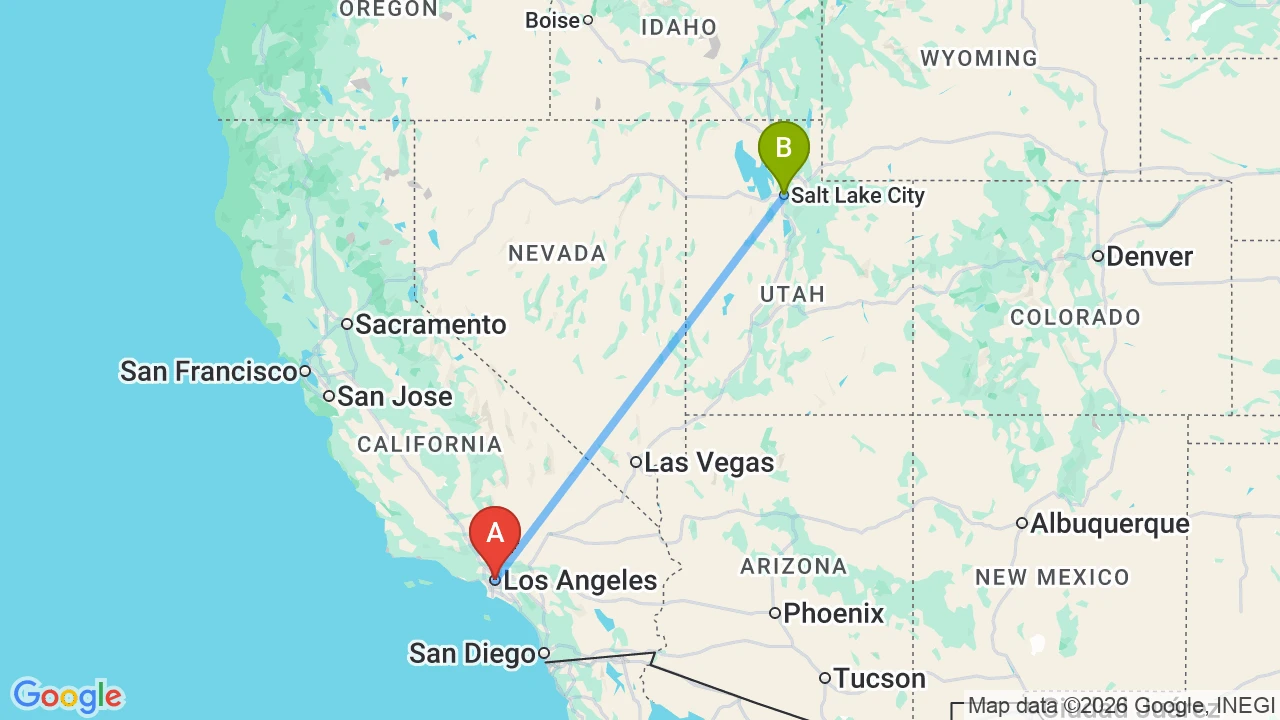
Moving from Los Angeles to Salt Lake City in 2026 means trading one of the country’s most expensive coastal metros for a mountain-region hub with a very different cost structure and daily rhythm. This isn’t a simple “cheaper vs. more expensive” story—it’s about where pressure concentrates, how daily logistics change, and which household types tend to feel relief versus new friction.
Los Angeles combines high housing costs, long commutes, and elevated prices across most categories. Salt Lake City offers lower entry barriers for housing and significantly reduced transportation costs, but brings its own texture: a car-dependent layout, distinct seasonal utility exposure, and a tighter, faster-growing market that behaves differently than LA’s sprawling rental ecosystem.
This guide explains how cost behavior, lifestyle pace, and household logistics shift between these two cities. It does not predict total budgets or declare a financial winner—it clarifies what changes, for whom, and why.
Cost Pressure Shifts: Where Money Shows Up Differently
The most immediate financial shift is housing entry cost. Los Angeles’ median home value sits at $822,600, while Salt Lake City’s is $458,600—a substantial reduction in down payment requirements and mortgage principal. Renters see a similar pattern: LA’s median gross rent is $1,791 per month, compared to $1,254 in Salt Lake City.
But lower headline housing costs don’t mean uniform relief. Salt Lake City’s housing market has tightened considerably in recent years, and inventory constraints can create competitive pressure, especially for single-family homes in desirable neighborhoods. Renters may find fewer large-scale apartment complexes compared to LA’s dense inventory, and lease renewal behavior can feel less predictable in a smaller, faster-moving market.
Transportation costs shift dramatically. Gas prices drop from $4.64 per gallon in Los Angeles to $2.79 in Salt Lake City, and the average commute shortens from 31 minutes to 19 minutes. In LA, 52.1% of workers face long commutes; in Salt Lake City, that figure is 19.4%. For households that rely on daily driving, this translates to lower fuel spending and less time lost to traffic—but it also reflects a reality where car dependence is nearly universal. Salt Lake City’s work-from-home rate is just 3.5%, compared to 13.1% in LA, signaling a more traditional commute culture.
Utilities present a mixed picture. Electricity rates are much lower in Salt Lake City—12.99¢ per kWh versus 34.71¢ in LA—which can significantly reduce baseline power bills. Natural gas is also cheaper: $10.21 per MCF compared to $21.89 in Los Angeles. However, Salt Lake City’s cold winters mean heating becomes a larger seasonal expense, whereas LA’s mild climate keeps year-round utility usage relatively flat. Households moving from coastal California may be surprised by the intensity of winter heating demand and the need to budget for seasonal spikes.
Grocery costs show modest regional differences. For example, ground beef averages $6.75 per pound in LA and $6.48 in Salt Lake City; a half-gallon of milk is $4.10 in LA versus $3.94 in Salt Lake City.* These are derived estimates and reflect regional price parity adjustments rather than observed local prices, but they suggest that day-to-day grocery spending will feel slightly lower—though not transformatively so.
*Derived estimate based on national baseline adjusted by regional price parity; not an observed local price.
Housing & Neighborhood Patterns
Los Angeles’ housing market is defined by scarcity, density, and long-term rent control in some areas. Renters often face annual increases, but the sheer size of the rental market means options exist across a wide price spectrum. Homebuyers confront high entry costs but benefit from a mature, liquid resale market.
Salt Lake City’s housing market is smaller, tighter, and more volatile. The metro has grown rapidly, and housing supply has struggled to keep pace. This creates competitive pressure for both renters and buyers, especially in neighborhoods close to downtown or near the University of Utah. Renters may find that lease renewals come with steeper increases than expected, and buyers may face bidding pressure even in a market with lower absolute prices.
Neighborhood form also differs. Los Angeles sprawls across a vast basin with pockets of walkable density (Santa Monica, Pasadena, parts of the Westside) but mostly car-dependent suburbs. Salt Lake City is more compact geographically, but its grid layout and low-density residential zones mean that most daily errands require driving. Walkable urban living is concentrated in a few downtown blocks and select neighborhoods like Sugar House; elsewhere, car ownership is effectively mandatory.
For families, this shift can feel liberating—shorter commutes, easier parking, less traffic stress—but it also means fewer transit alternatives and less flexibility for households trying to minimize car expenses.
Lifestyle & Daily Rhythms
Los Angeles operates at a sprawling, high-friction pace. Traffic is a constant factor, and even short trips can require significant time. The city’s size and density create access to a wide range of amenities, but that access comes with logistical overhead. Public transit exists but is limited in reach and speed; most Angelenos drive, and those who don’t often face long, multi-transfer commutes.
Salt Lake City feels faster in execution but narrower in scope. Errands that might take an hour in LA—due to distance and traffic—often take 20 minutes in Salt Lake City. The metro is smaller, roads are less congested, and parking is rarely a problem. But this efficiency comes with trade-offs: fewer late-night options, less neighborhood-level retail diversity, and a stronger reliance on driving for nearly every task.
The experiential texture of mobility shifts significantly. In Los Angeles, many residents cobble together a mix of driving, ride-sharing, and occasional transit use, depending on the day and destination. In Salt Lake City, the car is the default—and often the only practical option—for nearly all trips. This reduces daily friction but increases household exposure to vehicle costs, maintenance, and the need for multiple cars in multi-adult households.
Climate also reshapes daily life. Los Angeles offers year-round mild weather with minimal seasonal variation—outdoor activities are accessible in every month, and heating or cooling demands remain modest. Salt Lake City brings hot, dry summers and cold, snowy winters. Residents gain access to world-class skiing and mountain recreation, but they also face seasonal preparation: winter tires, snow removal, heating system upkeep, and the need to plan around weather in ways that rarely occur in coastal California.
How this article was built: In addition to public economic data, this article incorporates location-based experiential signals derived from anonymized geographic patterns—such as access density, walkability, and land-use mix—to reflect how day-to-day living actually feels in Salt Lake City, UT.
Relocation Logistics & Practical Friction
The physical move from Los Angeles to Salt Lake City is straightforward by interstate standards—roughly 700 miles, typically completed in one long day of driving or a single moving truck run. But the adjustment period involves more than logistics.
Households accustomed to LA’s density and transit options may find Salt Lake City’s car dependence isolating at first, especially if they’ve relied on ride-sharing or occasional Metro use. The lack of walkable neighborhood retail means that even small errands—picking up a prescription, grabbing coffee—require getting in the car. For families with young children, this can simplify some routines (easier parking, faster trips) but complicate others (no quick walk to a park or corner store).
Seasonal preparation is another adjustment. Los Angeles residents rarely think about winter weather; Salt Lake City residents must. This includes budgeting for snow tires, understanding how heating systems work, and planning for days when roads are icy or air quality is poor due to winter inversions.
Professionally, Salt Lake City’s unemployment rate of 3.2% is lower than Los Angeles’ 5.8%, signaling a tighter labor market with strong demand in tech, finance, and healthcare. However, the job market is smaller in absolute terms, and specialized roles—especially in entertainment, media, or niche creative fields—are far less common than in LA. Remote workers gain the most flexibility, as they can access Salt Lake City’s lower costs without depending on the local job market.
Socially, the shift can feel significant. Los Angeles is vast, diverse, and fragmented; social networks are often spread across long distances. Salt Lake City is smaller and more cohesive, with a strong sense of place but less demographic and cultural diversity. For some, this feels welcoming and easier to navigate. For others—especially those who value LA’s cosmopolitan mix—it can feel limiting.
Frequently Asked Questions
- Does Salt Lake City feel more or less expensive than Los Angeles?
- Salt Lake City typically reduces housing entry costs, transportation spending, and utility rates, but the overall expense picture depends on household type and priorities. Families who drive frequently and value homeownership often feel significant relief. Renters in competitive neighborhoods may find that local market tightness offsets some of the headline savings, and those accustomed to LA’s transit options may face higher car-related costs than expected.
- How do housing markets differ between Los Angeles and Salt Lake City?
- Los Angeles offers a larger, more liquid housing market with high absolute costs but broad inventory and established rent control in some areas. Salt Lake City has lower median prices but tighter supply, faster appreciation in recent years, and more competitive bidding pressure. Renters may find fewer large apartment complexes and less predictable lease renewal behavior. Buyers gain lower entry costs but may face faster-moving markets and fewer resale comparables.
- What does daily life feel different after moving from LA to Salt Lake City?
- Daily life in Salt Lake City is faster in execution but more car-dependent in structure. Commutes shorten dramatically, errands take less time, and parking is rarely a challenge. However, walkable neighborhoods are limited, public transit is minimal, and seasonal weather requires more planning. Households gain logistical efficiency but lose some of the spontaneity and transit flexibility that parts of LA offer.
- When does the move from Los Angeles to Salt Lake City tend to feel easiest?
- The move tends to feel smoothest for households arriving in late spring or early fall, when weather is mild and housing inventory is more active. Winter moves require navigating snow and ice, which can complicate logistics for those unfamiliar with cold-weather driving. Summer moves avoid weather challenges but may coincide with peak housing competition, especially for families coordinating school-year transitions.
- What are the most common adjustment pressures after this move?
- The most common surprises include the intensity of car dependence, the seasonal swing in utility costs, and the tighter housing market dynamics. Households used to LA’s transit options or walkable pockets may feel isolated without a car. Those accustomed to year-round mild weather may underestimate winter heating costs or the need for seasonal home preparation. Renters may also find that Salt Lake City’s smaller market offers fewer mid-lease flexibility options than LA’s large rental inventory.
- Who does this move tend to work best for—and who may struggle?
- This move tends to work well for families seeking homeownership, professionals with remote flexibility, and households prioritizing shorter commutes and lower baseline costs. It’s especially appealing to those who value outdoor recreation and don’t mind seasonal weather. The move can be harder for renters in competitive neighborhoods, households that rely on transit or walkability, and those whose careers depend on LA’s specialized job markets (entertainment, media, fashion). Singles or couples without cars may also find Salt Lake City’s layout more limiting than LA’s density.
Conclusion
Moving from Los Angeles to Salt Lake City in 2026 is not a simple cost-cutting exercise—it’s a structural shift in how daily life is organized, where money concentrates, and what trade-offs households accept. Housing entry costs drop significantly, commutes shorten, and transportation expenses fall. But car dependence increases, seasonal utility costs rise, and the housing market’s tightness can create unexpected pressure.
This move tends to work best for families seeking homeownership, remote workers who can decouple income from local job markets, and households that value efficiency and outdoor access over urban density. It can be more challenging for renters in competitive neighborhoods, those who rely on transit or walkability, and professionals whose careers depend on LA’s specialized industries.
For deeper exploration of Salt Lake City’s cost structure, neighborhood patterns, and household fit, visit the Salt Lake City cost of living hub on IndexYard. For metro-wide comparisons and suburb breakdowns, see the Salt Lake City metro overview.