
Introduction: Why Los Angeles to Phoenix?
The move from Los Angeles to Phoenix represents one of the most traveled relocation corridors in the Southwest, driven primarily by housing accessibility and a desire to escape California’s coastal cost pressure. For many households, Phoenix offers a path to homeownership or larger living spaces that feel out of reach in LA’s competitive market. But this isn’t simply a story of “cheaper everything”—it’s a story of where costs concentrate, how daily rhythms change, and which household expenses shift from recurring pressure to upfront decisions.
Los Angeles median home values sit at $822,600, while Phoenix homes are priced at $340,200—a dramatic difference in entry barriers. Renters see a similar gap: LA’s median gross rent is $1,791 per month compared to Phoenix’s $1,322 per month. But housing is only one piece of the puzzle. This guide explains how transportation patterns, utility exposure, commute behavior, and lifestyle infrastructure shift when you trade LA’s sprawling coastal metro for Phoenix’s desert expanse.
This article focuses on cost behavior—where expenses show up, how they fluctuate, and who feels them most—not on calculating total budgets or declaring one city “better” than the other. The goal is to help you understand what changes, not whether the move pencils out financially.
Cost Pressure Shifts: Where Money Moves
The most immediate financial shift is the dramatic reduction in housing entry barriers. Whether you’re buying or renting, Phoenix removes a significant layer of upfront cost pressure that defines life in Los Angeles. For buyers, the difference in median home values translates to lower down payments, smaller mortgages, and reduced monthly obligations. For renters, the monthly savings create breathing room that many LA households haven’t experienced in years.
But lower housing costs don’t mean lower total costs—they mean costs redistribute. In Phoenix, you’ll likely spend more on cooling your home during the extended summer season, when triple-digit heat dominates daily life. Electricity rates in Phoenix are 15.66¢/kWh, roughly half of LA’s 31.91¢/kWh, but the intensity and duration of air conditioning use can push summer utility bills higher than many LA transplants expect. Conversely, Phoenix’s mild winters mean minimal heating expenses, a reversal from LA’s occasional cool-season gas use.
Transportation costs also shift in character. Gas prices in Phoenix average $2.98/gal compared to LA’s $4.34/gal, offering meaningful relief at the pump. However, Phoenix’s car-dependent infrastructure means you’ll likely drive more frequently and over longer distances for errands, social activities, and daily logistics. The average commute in Phoenix is 25 minutes, shorter than LA’s 31 minutes, but only 6.1% of Phoenix workers telecommute compared to 13.1% in LA. The result: lower per-gallon costs but higher overall driving frequency.
Grocery costs in Phoenix tend to run slightly higher due to regional price parity differences, though the gap is modest. (Derived estimate based on national baseline adjusted by regional price parity; not an observed local price.) For example, ground beef averages around $7.09/lb in Phoenix versus $6.69/lb in LA, while eggs come in at $2.87/dozen compared to $2.71/dozen. These differences rarely define a household budget, but they do accumulate over time, especially for larger families.
Housing & Neighborhood Patterns
The housing market shift is the defining feature of this move. Los Angeles operates as one of the nation’s most supply-constrained markets, where competition, bidding wars, and long searches are standard. Phoenix, while growing rapidly, still offers more inventory, faster transactions, and neighborhoods where homeownership feels attainable for middle-income households.
For renters, the difference isn’t just the monthly payment—it’s the flexibility. Phoenix’s rental market tends to offer more space per dollar, more pet-friendly options, and less competition for desirable units. Lease renewals in Phoenix can still bring increases, but the baseline pressure is lower, and the threat of displacement feels less acute than in LA’s hyper-competitive landscape.
Homebuyers face a different set of tradeoffs. Phoenix’s lower entry costs make ownership accessible, but the market has seen rapid appreciation in recent years, and inventory can tighten quickly in desirable suburban pockets. Property taxes in Arizona are structured differently than California’s Prop 13 system, meaning your tax bill can rise more predictably with assessed value rather than being capped at purchase price plus small annual increases. This doesn’t make Phoenix more expensive overall, but it does mean ongoing costs behave differently over time.
Neighborhood form also shifts. Phoenix’s metro area is characterized by sprawling suburban development, master-planned communities, and car-oriented design. Walkable, mixed-use neighborhoods exist but are the exception rather than the rule. If you’re accustomed to LA’s pockets of pedestrian-friendly density—whether in Santa Monica, Pasadena, or parts of the Westside—you’ll need to actively seek out similar environments in Phoenix, often in areas like downtown Phoenix, Tempe, or older central neighborhoods.
Lifestyle & Daily Rhythms
Daily life in Phoenix operates on a different cadence than Los Angeles. The most obvious shift is climate: Phoenix’s desert heat dominates summer planning, with outdoor activities concentrated in early mornings and evenings. From June through September, midday heat makes errands, exercise, and even short walks uncomfortable without planning. This isn’t occasional—it’s structural, shaping when you leave the house, how you schedule your day, and how much you rely on air-conditioned spaces.
Commute patterns also change in character. While Phoenix’s average commute is shorter than LA’s, the metro area’s sprawl means many households still face long drives, especially if they live in outer suburbs like Surprise, Goodyear, or Queen Creek and work in central Phoenix or Scottsdale. Unlike LA, where traffic congestion is constant and predictable, Phoenix traffic tends to be lighter but more spread out, with fewer viable shortcuts or alternative routes. Only 37.6% of Phoenix workers have long commutes (over 45 minutes) compared to 52.1% in LA, but the car remains non-negotiable for most households.
Phoenix’s infrastructure reflects its car-dependent design. Running errands typically means driving to multiple locations rather than clustering stops within a walkable district. Grocery stores, pharmacies, and retail centers are accessible, but they’re rarely within walking distance unless you live in select urban pockets. This pattern increases convenience in some ways—parking is abundant, stores are spacious—but it also means every outing requires a vehicle, adding incremental costs and time.
Social and recreational rhythms shift as well. Phoenix offers extensive outdoor access, from desert hiking trails to sprawling parks, but the summer heat compresses the usable season. Winter becomes the prime time for outdoor activity, a reversal from LA’s year-round temperate climate. If you’re accustomed to spontaneous beach trips, coastal walks, or mild evenings, Phoenix’s intensity requires adjustment.
The metro area’s structure also influences how households experience access and convenience. In Los Angeles, density and proximity mean you’re rarely far from a wide variety of dining, entertainment, and cultural options, even if traffic makes reaching them frustrating. In Phoenix, options are plentiful but more dispersed, requiring longer drives and more intentional planning. Families with children often find Phoenix’s suburban infrastructure well-suited to school access and youth activities, but households seeking walkable urban amenities need to prioritize location carefully.
Relocation Logistics & Practical Friction
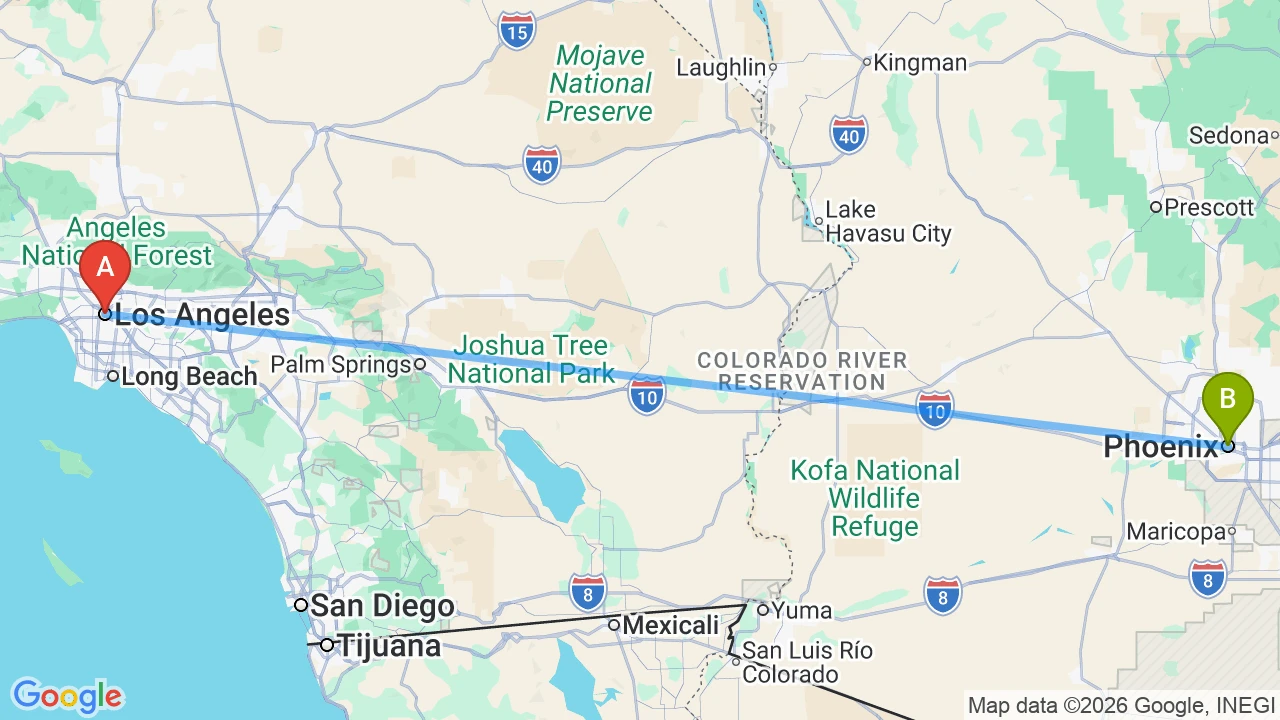
The physical move from Los Angeles to Phoenix is relatively straightforward compared to longer-distance relocations. The drive is roughly 370 miles and takes about six hours under normal conditions, making it feasible for households to move themselves or coordinate closely with movers. However, summer moves can be punishing due to heat exposure, both during loading and unloading and while driving through desert stretches. Spring and fall offer the most comfortable conditions, while winter is mild but can bring occasional rain.
One of the most common surprises for LA transplants is the adjustment to Phoenix’s summer intensity. Even if you’ve visited Phoenix in July or August, living through a full summer—managing utility bills, planning around heat, and adapting daily routines—feels different than vacationing. Households that underestimate cooling costs or fail to budget for higher summer electricity use often face sticker shock in their first few months.
Another adjustment is the shift in access patterns. In LA, despite traffic, you’re embedded in a region with deep infrastructure, diverse neighborhoods, and proximity to coastal and mountain recreation. Phoenix offers its own recreational landscape, but the trade is real: fewer spontaneous options, more driving, and a different relationship with outdoor space. For some households, this feels liberating—less congestion, more room to breathe. For others, especially those who thrived on LA’s density and variety, it can feel isolating.
Employment transitions also vary by industry. Phoenix has a growing job market, with strengths in healthcare, education, technology, and logistics, but it lacks the entertainment, media, and creative industry depth that defines LA’s economy. Remote workers and retirees often find the transition seamless, while professionals in niche fields may need to adjust expectations or maintain remote arrangements with California-based employers. The unemployment rate in Phoenix is 3.1%, notably lower than LA’s 5.8%, reflecting a tighter labor market and stronger job growth.
Frequently Asked Questions
- Does Phoenix feel more or less expensive than Los Angeles?
- Phoenix removes the intense housing cost pressure that dominates LA life, but it redistributes expenses rather than eliminating them. You’ll spend less on rent or mortgage payments, but more on cooling during summer months and likely more on driving due to Phoenix’s car-dependent layout. The shift feels most dramatic for renters and first-time buyers, who gain access to housing options that would be out of reach in LA. However, households that rely on walkability, public transit, or coastal amenities may find Phoenix’s lifestyle costs—measured in time, convenience, and adaptation—higher than expected.
- How do housing markets differ between Los Angeles and Phoenix?
- Los Angeles operates as a supply-constrained, high-competition market where homeownership requires significant capital and patience. Phoenix offers lower entry barriers, faster transactions, and more inventory, making it accessible to middle-income buyers. However, Phoenix’s rapid growth means desirable neighborhoods can tighten quickly, and property taxes behave differently than California’s Prop 13 system, rising more predictably with assessed value. Renters in Phoenix enjoy more space per dollar and less competition, but the market has seen significant rent increases in recent years, especially in suburban areas popular with transplants.
- What feels different about daily life after moving to Phoenix?
- Daily rhythms shift around Phoenix’s desert climate and car-dependent infrastructure. Summer heat dominates planning from June through September, concentrating outdoor activities in early mornings and evenings. Errands, socializing, and recreation require more driving and intentional planning compared to LA’s denser, more spontaneous access patterns. Commutes are often shorter in duration but still car-reliant, and walkable neighborhoods are the exception rather than the rule. Families often appreciate Phoenix’s suburban infrastructure and school access, while urban-oriented households may feel the loss of LA’s density and variety.
- When does the move from LA to Phoenix feel easiest or hardest?
- Spring and fall offer the most comfortable moving conditions, with mild weather and manageable heat. Summer moves are logistically challenging due to extreme temperatures, both during the physical move and the immediate adjustment period when you’re setting up utilities and learning cooling strategies. Winter is mild and pleasant but can bring occasional rain. Timing also matters for housing inventory—spring tends to see more listings, while summer and winter can be quieter. Remote workers and retirees have the most flexibility, while families with school-age children often prioritize summer to avoid mid-year transitions.
- What are the most common adjustment pressures after moving?
- The most frequent challenge is adapting to Phoenix’s summer heat intensity, which affects daily routines, utility bills, and outdoor activity planning. Many LA transplants also underestimate the shift to car dependence, finding that even short errands require driving and that walkable, mixed-use neighborhoods are harder to find. Social adjustment varies—some households appreciate Phoenix’s slower pace and suburban space, while others miss LA’s density, cultural variety, and coastal access. Employment transitions can be smooth for remote workers and in-demand professionals, but niche industries may require creative solutions or continued ties to California employers.
- Who does this move work best for—and who might struggle?
- This move tends to benefit renters and first-time buyers priced out of LA’s housing market, remote workers seeking lower fixed costs, and families prioritizing space, school access, and suburban infrastructure. Retirees often find Phoenix’s mild winters and lower housing costs appealing, though summer heat requires adjustment. The move can be harder for households that rely on walkability, public transit, or LA’s deep cultural and entertainment infrastructure. Professionals in entertainment, media, and creative industries may face limited local opportunities, and anyone who thrives on coastal proximity or spontaneous urban access may feel the trade acutely.
Conclusion: Tradeoffs, Not Totals
Moving from Los Angeles to Phoenix is fundamentally about trading one set of cost pressures for another. You’ll gain housing affordability, shorter commutes, and relief from California’s relentless cost escalation. But you’ll also take on Phoenix’s summer heat intensity, car-dependent logistics, and a different relationship with space, access, and daily rhythm.
This move works best for households that prioritize homeownership, space, and lower fixed costs over walkability, density, and coastal amenities. It’s well-suited to families, remote workers, and retirees who can adapt to Phoenix’s suburban infrastructure and seasonal intensity. It’s harder for urban-oriented households, professionals tied to LA’s niche industries, and anyone who relies on spontaneous access to diverse neighborhoods and cultural options.
The key is understanding that Phoenix doesn’t replicate LA at a lower price point—it offers a fundamentally different lifestyle with its own costs, conveniences, and compromises. Explore Phoenix’s neighborhoods, employment landscape, and seasonal realities in depth before committing, and use IndexYard’s city-specific guides to dig into the details that matter most for your household.
How this article was built: In addition to public economic data, this article incorporates location-based experiential signals derived from anonymized geographic patterns—such as access density, walkability, and land-use mix—to reflect how day-to-day living actually feels in Phoenix, AZ.