
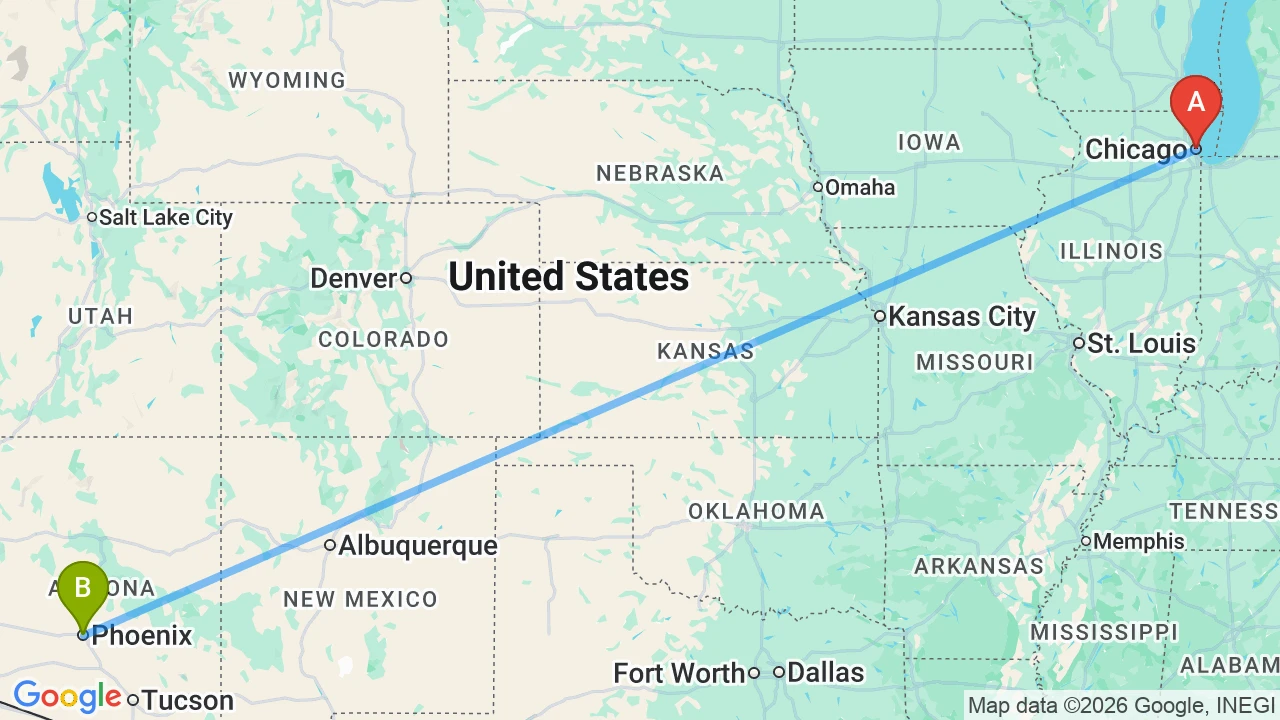
Why People Consider Moving from Chicago to Phoenix
The Chicago-to-Phoenix corridor attracts a wide range of movers: remote workers seeking lower housing entry costs, retirees drawn to warmer winters, and professionals chasing Phoenix’s expanding job market. What unites them is a willingness to trade Chicago’s dense urban infrastructure and four-season climate for Phoenix’s sprawling, car-oriented layout and desert heat.
This move fundamentally reshapes where your money goes and how you spend your time. Housing entry barriers shift, utility exposure flips from heating to cooling, and daily errands that once happened on foot or via transit now require a car. The goal of this guide is not to declare Phoenix “cheaper” or “better,” but to explain where cost pressure moves and which household types feel it most.
We focus on cost behavior—how expenses concentrate, when they spike, and what tradeoffs emerge—not on total budgets or affordability thresholds. If you’re weighing this move, understanding these shifts will help you plan more realistically.
Cost Pressure Shifts: Where Money Moves
The most immediate financial shift is in housing entry costs. Phoenix’s median home value of $340,200 sits above Chicago’s $304,500, meaning homebuyers face a higher upfront barrier despite Phoenix’s reputation as a Sun Belt bargain. Renters experience near-parity: Chicago’s median gross rent is $1,314 per month, while Phoenix comes in at $1,322 per month. The difference is negligible on paper, but the structure of rental markets differs. Chicago’s rental stock includes more mid-rise and high-rise buildings with bundled amenities; Phoenix leans toward single-family rentals and low-rise complexes where utilities, landscaping, and pest control are often billed separately.
Transportation costs shift in both direction and predictability. Chicago’s average commute is 34 minutes, with 59.7% of workers enduring long commutes—but 14.6% work from home, and many rely on the CTA’s extensive rail and bus network. Phoenix’s average commute is shorter at 25 minutes, and only 37.6% face long commutes, but just 6.1% work from home. More importantly, Phoenix is built for cars. Errands that once required a single transit pass now demand fuel, insurance, and parking. Gas prices are nearly identical ($2.93/gallon in Chicago vs. $3.00/gallon in Phoenix), but Phoenix households drive more miles per week, and the lack of viable transit alternatives makes car ownership non-negotiable for most.
Utility exposure flips entirely. Chicago’s electricity rate of 18.74¢/kWh exceeds Phoenix’s 15.55¢/kWh, but Chicago’s utility burden peaks in winter, driven by heating. Phoenix’s burden peaks in summer, when air conditioning runs continuously for months. Natural gas is cheaper in Chicago ($15.48/MCF vs. $23.77/MCF in Phoenix), but Phoenix households use far less of it. The result: Chicago movers accustomed to high winter heating bills will face high summer cooling bills instead—often larger, longer, and less predictable due to Phoenix’s extreme heat.
Income and employment conditions favor Phoenix slightly. The median household income in Phoenix is $72,092 per year, compared to $71,673 in Chicago—a modest difference. But Phoenix’s unemployment rate of 3.1% is significantly lower than Chicago’s 5.4%, signaling a tighter labor market with more job security and upward mobility potential for those in growing sectors like healthcare, logistics, and tech.
Housing and Neighborhood Patterns
Chicago’s housing market offers more variety in urban form. You can rent a studio in a walkable neighborhood with transit access, or buy a single-family home in a car-dependent suburb. Phoenix’s housing stock is overwhelmingly suburban in character, even within city limits. Neighborhoods are organized around arterial roads, shopping centers anchor commercial districts, and residential streets prioritize privacy over connectivity. This affects not just commute patterns, but daily errands: grocery runs, pharmacy stops, and school pickups all require driving.
Homeownership in Phoenix often comes with hidden ongoing costs. Many neighborhoods are governed by homeowners associations (HOAs) that charge monthly or annual fees for landscaping, community pools, and exterior maintenance. These fees are common in both cities, but Phoenix’s desert climate adds unique expenses: xeriscaping, pool maintenance, and pest control (scorpions, roof rats) are routine. Chicago homeowners face their own climate-driven costs—snow removal, foundation waterproofing, and heating system upkeep—but the seasonal rhythm differs.
Renters in Phoenix should expect to pay separately for utilities that were sometimes included in Chicago leases. Water, trash, and sewer are often billed directly to tenants, and summer electricity bills can exceed $200/month for a modest apartment. Chicago renters in larger buildings often benefit from heat included in rent or shared utility arrangements; Phoenix renters rarely do.
Lifestyle and Daily Rhythms
Daily life in Phoenix revolves around the car and the calendar. Errands that once clustered into a single walk or train ride now require multiple car trips. Grocery stores, gyms, and medical offices are rarely within walking distance, even in newer mixed-use developments. This isn’t a flaw—it’s the design logic of the region—but it increases both transportation costs and time spent in transit.
The climate shift is profound. Chicago’s winters are long, cold, and snowy; Phoenix’s are mild and sunny. But Phoenix’s summers are extreme, with triple-digit heat lasting from May through September. Outdoor activities shift to early morning or evening, and midday errands feel punishing. Households with children, pets, or outdoor hobbies must adapt routines around heat exposure. Utility bills spike accordingly: air conditioning is not optional, and cooling costs dominate household budgets during the extended summer season.
Commute behavior changes in texture, not just duration. Chicago commuters often trade time for cost, choosing longer transit rides to avoid parking fees or traffic. Phoenix commuters trade cost for convenience, driving alone in air-conditioned cars on wide, fast-moving freeways. Rush hour congestion exists, but it’s less dense than Chicago’s gridlock. The tradeoff: lower stress per trip, but higher cumulative cost and less flexibility if your car breaks down.
How this article was built: In addition to public economic data, this article incorporates location-based experiential signals derived from anonymized geographic patterns—such as access density, walkability, and land-use mix—to reflect how day-to-day living actually feels in Phoenix, AZ.
Relocation Logistics and Practical Friction
The move itself is straightforward: Phoenix is a major destination city with competitive moving services and ample rental truck availability. But the adjustment period involves more friction than many expect. If you’re moving without a car, you’ll need to buy one quickly—Phoenix’s transit system exists, but it doesn’t serve most residential neighborhoods effectively. If you’re moving with a car, you’ll need to register it in Arizona, update insurance, and possibly retrofit it for extreme heat (battery, coolant, tire pressure monitoring).
Timing matters. Summer moves are cheaper (lower demand for movers and rentals), but physically brutal. Spring and fall offer the best balance of weather and availability. Winter moves are rare but pleasant, as Phoenix’s mild winters make unpacking and exploring easy.
Newcomers are often surprised by how much they drive. Errands that once took 20 minutes on foot now require 20 minutes in the car. Social plans require more coordination, as friends and family are spread across a metro area that spans over 500 square miles. The pace feels slower in some ways—less pedestrian hustle, more space—but faster in others, as freeways and wide roads encourage higher speeds and longer trips.
Frequently Asked Questions
- Does Phoenix feel more or less expensive than Chicago?
- Phoenix doesn’t feel uniformly cheaper or more expensive—it redistributes where costs concentrate. Housing entry costs are slightly higher, but renters face near-parity. The bigger shift is in transportation (you’ll drive more) and utilities (summer cooling replaces winter heating). Households that relied on Chicago’s transit and walkable neighborhoods will feel the increase in car-related expenses most acutely. Those who already drove everywhere in Chicago may find Phoenix’s shorter commutes and lower congestion a relief.
- How do the housing markets differ between Chicago and Phoenix?
- Chicago offers more variety in housing form—high-rise apartments, vintage walk-ups, suburban single-family homes—while Phoenix is overwhelmingly suburban and car-oriented, even in central neighborhoods. Phoenix’s median home value is higher, but its rental market is comparable. Ongoing costs differ: Phoenix homeowners face HOA fees, desert landscaping, and pool upkeep, while Chicago homeowners contend with heating system maintenance, snow removal, and older housing stock repairs.
- What feels different about daily life after moving to Phoenix?
- Daily routines become more car-dependent and climate-driven. Errands require driving, outdoor activities shift to early morning or evening during summer, and social plans involve longer distances. The pace feels less dense and hurried than Chicago, but the trade-off is reduced spontaneity—you can’t easily walk to a café or catch a train on impulse. Households with children or pets must plan around extreme summer heat.
- When does this move tend to feel easiest or hardest?
- Spring and fall moves offer the best balance of manageable weather and housing availability. Summer moves are cheaper but physically challenging due to extreme heat. Winter moves are rare but comfortable, as Phoenix’s mild winters make settling in easy. The adjustment period feels hardest for those who underestimate how much they’ll drive or how intense summer heat becomes.
- What are the most common adjustment pressures?
- New movers struggle most with car dependence, summer utility bills, and the sprawling geography. Errands take longer in aggregate, even if individual trips are faster. Social isolation can creep in if you’re used to spontaneous, walkable urban life. Households that thrived on Chicago’s dense infrastructure and transit access face the steepest learning curve.
- Who does this move work best for—and who might struggle?
- This move works well for remote workers seeking lower-density living, retirees drawn to mild winters, and professionals in Phoenix’s growing job sectors. Families with school-age children benefit from newer schools and larger homes, though they’ll drive more. The move is harder for car-free households, those who rely on public transit for work, and anyone who thrives on walkable urban density. If your budget is already tight, the shift from transit passes to car ownership can strain finances quickly.
Conclusion: Tradeoffs, Not Totals
Moving from Chicago to Phoenix is not a simple cost swap—it’s a structural shift in how you live, move, and spend. Housing entry costs are slightly higher in Phoenix, but renters face near-parity. Transportation costs rise for most households due to increased driving, while utility costs flip from winter heating to summer cooling. The job market is stronger in Phoenix, but the lifestyle requires more planning, more driving, and more adaptation to extreme heat.
This move works best for households that value space, sunshine, and car-oriented convenience over walkability and transit access. It’s harder for those who rely on dense urban infrastructure or tight budgets that can’t absorb the shift to car ownership. If you’re considering this move, focus less on whether Phoenix is “cheaper” and more on whether its cost structure and lifestyle rhythm align with how you actually want to live.
For deeper exploration of Phoenix’s neighborhoods, cost breakdowns, and local resources, visit the Phoenix hub on IndexYard. If you’re still weighing your options, the Chicago hub offers side-by-side comparisons and detailed cost guides to help you decide.