

Moore’s median rent runs $1,208 per month compared to Midwest City’s $996—a structural difference that shapes household budgets before utilities, groceries, or transportation enter the picture. Both cities sit in the Oklahoma City metro, share identical regional price environments, and offer similar family infrastructure, but the way cost pressure concentrates differs sharply depending on whether housing entry barriers or ongoing flexibility matter more to your household in 2026.
The decision between these two cities isn’t about finding the “cheaper” option—it’s about understanding where your money goes first, which costs stay predictable, and which household types feel financial pressure differently. Midwest City offers lower housing entry points and documented transit options, while Moore’s higher housing costs align with a higher median household income baseline that suggests a different economic profile among residents.
This comparison explains how housing, utilities, transportation, and daily expenses behave differently in each city, and which households find stability versus strain depending on where cost pressure shows up first.
Housing Costs
Housing forms the foundation of cost structure differences between Midwest City and Moore. Midwest City’s median home value sits at $147,700, while Moore’s reaches $170,300—a gap that translates directly into down payment requirements, mortgage obligations, and property tax exposure for buyers. For renters, Midwest City’s median gross rent of $996 per month creates a lower ongoing obligation compared to Moore’s $1,208, affecting how much flexibility remains after housing costs claim their share of monthly income.
These differences matter most at the entry point. First-time buyers in Midwest City face lower down payment hurdles and smaller monthly mortgage obligations, which can mean the difference between qualifying for financing or waiting another year. Moore’s higher home values demand more upfront capital and larger monthly payments, but the city’s median household income of $73,285 per year—compared to Midwest City’s $56,811—suggests that many Moore residents operate with more income cushion to absorb those costs. The trade isn’t about one city being universally more affordable; it’s about whether your household income and savings align with the entry barrier each city presents.
For renters, the $212 monthly difference between median rents compounds over time into thousands of dollars annually, but it also reflects differences in housing stock, unit size, and neighborhood access. Moore’s higher rents often correspond to newer construction, larger floor plans, and neighborhoods with different amenity profiles. Midwest City’s lower rents provide more breathing room for households managing student loans, childcare, or irregular income, while Moore’s rent levels assume steadier, higher earnings. Families prioritizing space and newer builds may find Moore’s rent premium worthwhile; single adults or couples prioritizing financial flexibility may prefer Midwest City’s lower baseline obligation.
| Housing Type | Midwest City | Moore |
|---|---|---|
| Median Home Value | $147,700 | $170,300 |
| Median Gross Rent | $996 per month | $1,208 per month |
The housing takeaway depends entirely on household income stability and savings position. Households with variable income, single earners, or those building emergency funds face less strain in Midwest City, where lower housing costs leave more room for other obligations. Households with dual incomes, established savings, or prioritizing newer housing stock may find Moore’s higher costs manageable given the income context typical of residents there. The primary pressure isn’t magnitude—it’s whether housing costs dominate your budget or leave flexibility for everything else.
Utilities and Energy Costs
Electricity and natural gas rates run virtually identical between Midwest City and Moore—13.34¢/kWh for electricity and roughly $37/MCF for natural gas—which means utility cost differences come down to usage patterns, housing stock age, and household behavior rather than rate structure. Both cities experience Oklahoma’s hot summers and cool winters, creating dual-season utility exposure where air conditioning dominates warm months and heating drives bills during cold stretches. The question isn’t which city has cheaper utilities; it’s how housing type and household size amplify or dampen that exposure.
Older single-family homes in either city tend to show higher heating and cooling costs due to insulation gaps, older HVAC systems, and larger conditioned square footage. Newer apartments or townhomes—more common in certain Moore neighborhoods—often feature better insulation, shared walls that reduce heating loss, and smaller floor plans that cost less to condition year-round. A family in a 1,800-square-foot older home in Midwest City may experience higher summer cooling bills than a couple in a 1,200-square-foot newer apartment in Moore, even though the rates are identical. Housing form matters as much as household size when predicting utility volatility.
Households managing tight budgets feel utility seasonality more acutely when housing costs already consume a large share of income. In Midwest City, where housing entry barriers sit lower, families may have more monthly cushion to absorb a high summer electric bill without cutting other expenses. In Moore, where housing costs run higher, the same utility spike may force tradeoffs elsewhere—fewer restaurant meals, delayed car maintenance, or skipped discretionary purchases. Predictability becomes the key variable: households in newer, better-insulated housing face less volatility, while those in older stock must plan for wider seasonal swings.
The utility takeaway centers on housing stock interaction. Households in newer construction—regardless of city—experience more predictable utility costs and lower seasonal peaks. Households in older homes, larger floor plans, or single-family detached housing face higher baseline usage and sharper seasonal swings. Midwest City’s lower housing costs may offset higher utility exposure for families in older homes, while Moore’s higher housing costs may feel more manageable in newer, more efficient units. The decision depends on whether you prioritize lower upfront housing obligations or lower ongoing utility volatility.
Groceries and Daily Expenses
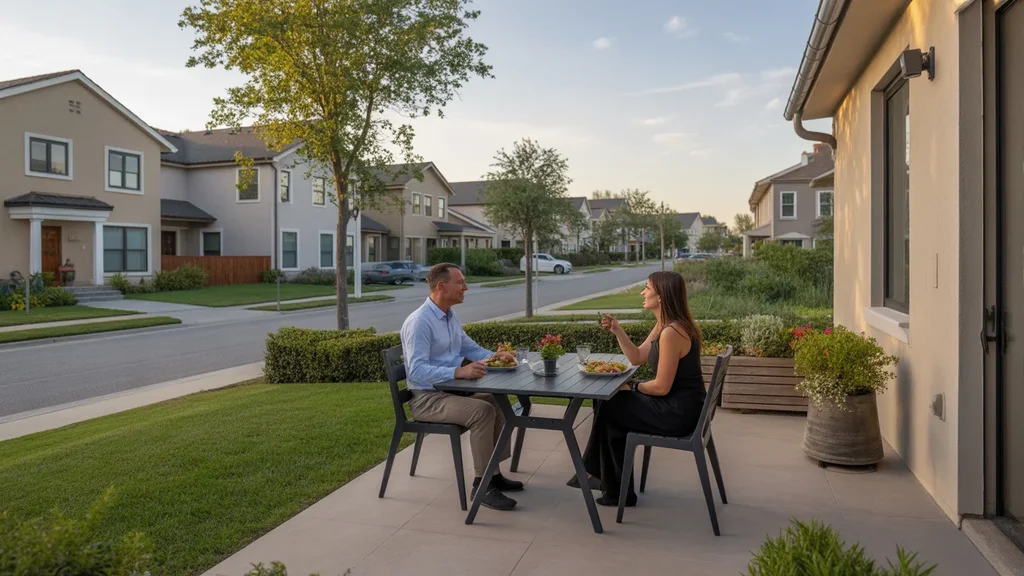
Both Midwest City and Moore share the same regional price environment—reflected in their identical RPP index of 91—which means grocery staples, household goods, and everyday purchases cost roughly the same across both cities. The difference isn’t in the price of milk, bread, or chicken; it’s in how households navigate access, convenience, and spending habits shaped by each city’s layout and retail concentration. Food and grocery options in both cities cluster along commercial corridors rather than spreading evenly, which means some neighborhoods require more driving, more planning, or more reliance on convenience stores that charge premium prices.
Households sensitive to grocery costs benefit from planning around big-box stores, discount grocers, and bulk purchasing—all of which require car access and time flexibility in both cities. Single adults and couples with unpredictable schedules may lean more heavily on convenience options—grabbing takeout, shopping at smaller neighborhood stores, or ordering delivery—which adds cost creep that doesn’t show up in grocery price comparisons but absolutely affects monthly spending. Families managing larger grocery volumes feel the impact of access friction more sharply: an extra 15 minutes of driving per shopping trip, or reliance on a less competitive store, compounds into real time and money costs over a month.
Dining out and convenience spending also vary by household type and income cushion. Moore’s higher median household income suggests residents may absorb restaurant meals, coffee runs, and prepared food purchases more easily without budget strain. Midwest City’s lower income baseline means households may need to plan more carefully around discretionary food spending, cooking at home more frequently, and limiting takeout to avoid budget overruns. The prices at restaurants don’t differ dramatically between cities, but the frequency and casualness of dining out does—and that behavioral difference drives real cost variation.
The grocery and daily expenses takeaway is about friction and habits, not prices. Households with time flexibility, car access, and willingness to plan around discount stores face similar costs in both cities. Households relying on convenience, proximity, or delivery face higher costs regardless of location. Moore’s higher income context may make convenience spending feel less painful, while Midwest City’s lower housing costs may leave more room for grocery flexibility even at lower income levels. The decision depends on whether your household prioritizes time savings or cost discipline in daily routines.
Taxes and Fees
Property taxes, sales taxes, and local fees form a layer of cost exposure that varies by housing type, ownership status, and length of residence. Property taxes in both cities depend on assessed home values, which means Moore homeowners face higher annual property tax bills due to higher median home values, even if tax rates remain similar. A home valued at $170,300 generates a larger annual property tax obligation than one valued at $147,700, and that difference recurs every year, compounding over time for long-term residents.
Renters don’t pay property taxes directly, but landlords pass those costs through in rent pricing, which partially explains Moore’s higher median rent. The property tax burden doesn’t disappear for renters—it simply gets embedded in the monthly rent figure rather than appearing as a separate bill. Homeowners feel property tax exposure more directly and must plan for annual or semi-annual payments that can strain cash flow if not budgeted carefully. Midwest City’s lower home values translate into lower property tax obligations for owners, leaving more flexibility for maintenance, repairs, or savings.
Sales taxes apply uniformly across everyday purchases in both cities, but households with higher spending volumes—larger families, those dining out frequently, or those making regular retail purchases—feel sales tax exposure more acutely. Local fees for trash collection, water, sewer, and stormwater vary by provider and housing type, with single-family homeowners typically facing separate bills while apartment renters often see these costs bundled into rent. HOA fees, where applicable, add another layer of predictable monthly cost that varies widely by neighborhood and housing type in both cities.
The taxes and fees takeaway depends on ownership status and time horizon. Homeowners in Moore face higher property tax obligations due to higher home values, which compounds over years of ownership. Homeowners in Midwest City benefit from lower property tax exposure, leaving more room for other financial priorities. Renters in both cities see taxes and fees embedded in rent, but Moore’s higher rents reflect higher underlying property costs. Households planning to stay long-term should weigh property tax exposure carefully; those renting short-term may care more about rent predictability than embedded tax costs.
Transportation & Commute Reality
Midwest City’s average commute runs 22 minutes, providing a concrete reference point for how residents experience daily travel time and transportation costs. Moore lacks comparable commute data, but its position in the Oklahoma City metro and similar suburban form suggest commute patterns likely fall in a similar range. Both cities rely heavily on car ownership for daily mobility, with gas prices sitting nearly identical—$2.35 per gallon in Midwest City and $2.38 in Moore—meaning fuel costs don’t drive meaningful differences between the two.
What does differ is transit infrastructure and car-independence options. Midwest City shows bus service presence, offering at least some households the option to reduce car dependency for certain trips, even if most residents still drive for most errands. Moore’s experiential signals don’t indicate comparable transit infrastructure, suggesting households there face more complete car reliance. For single adults or couples managing one vehicle, Midwest City’s bus service—however limited—provides a backup option for commuting or errands when the car isn’t available. In Moore, lacking that option means every trip requires a car, which increases pressure to maintain reliable transportation at all times.
Commute time matters less for its fuel cost and more for its time cost. A 22-minute commute means roughly 45 minutes of daily travel time for full-time workers, which compounds into hours per week that can’t be spent on errands, childcare, meal prep, or rest. Households with two working adults face doubled commute time exposure, which affects schedule flexibility, childcare logistics, and overall time budget. Midwest City’s documented commute time provides clarity for planning; Moore’s lack of data doesn’t mean commutes are longer or shorter, just that households must verify typical travel times for their specific work locations before committing.
The transportation takeaway centers on car dependence and time friction. Both cities require car ownership for most households, with fuel costs running nearly identical. Midwest City’s bus service provides limited car-independence options that may matter for specific households, while Moore’s lack of documented transit suggests more complete car reliance. Commute time affects household logistics more than fuel budgets, and households with two working adults or complex schedules should prioritize verifying actual commute patterns over assuming regional averages apply.
Cost Structure Comparison
Housing dominates the cost experience in both cities, but the nature of that pressure differs. Midwest City’s lower median home value and rent create less strain at the entry point, making it easier for households to qualify for housing, build savings, or manage variable income. Moore’s higher housing costs demand more upfront capital and higher ongoing obligations, but align with a higher median household income that suggests many residents operate with more financial cushion. The difference isn’t about one city being universally cheaper—it’s about whether your household income and savings align with the entry barrier and ongoing obligation each city presents.
Utilities introduce similar seasonal volatility in both cities due to identical rates and shared climate exposure, but housing stock age and type determine how sharply those swings hit individual households. Families in older, larger homes face higher baseline usage and wider seasonal peaks regardless of city, while households in newer, smaller units experience more predictable costs. Midwest City’s lower housing costs may leave more room to absorb utility spikes, while Moore’s higher housing costs may feel more manageable in newer, more efficient construction. The decision depends on whether you prioritize lower housing entry barriers or lower utility volatility.
Daily expenses—groceries, dining, convenience spending—cost roughly the same in both cities due to shared regional pricing, but household income context shapes how much flexibility exists for discretionary spending. Moore’s higher median income suggests residents may absorb restaurant meals and convenience purchases more easily, while Midwest City’s lower income baseline means households may need to plan more carefully around discretionary food spending. The prices don’t differ; the frequency and casualness of spending does, and that behavioral difference drives real cost variation.
Transportation patterns matter more for time budget than fuel costs, with both cities requiring car ownership for most households. Midwest City’s bus service provides limited car-independence options that may matter for specific households, while Moore’s lack of documented transit suggests more complete car reliance. Commute time affects household logistics, childcare coordination, and overall schedule flexibility more than fuel budgets, and households with two working adults or complex schedules should prioritize verifying actual commute patterns over assuming regional averages apply.
The decision between Midwest City and Moore depends entirely on which costs dominate your household budget and which tradeoffs you’re willing to accept. Households sensitive to housing entry barriers, variable income, or single-earner periods may prefer Midwest City’s lower baseline obligations. Households with dual incomes, established savings, or prioritizing newer housing stock may find Moore’s higher costs manageable given the income context typical of residents there. Neither city is universally cheaper—each concentrates cost pressure differently depending on household type, income stability, and financial priorities.
How the Same Income Feels in Midwest City vs Moore
Single Adult
Housing becomes the first non-negotiable cost, and Midwest City’s lower rent leaves more room for student loan payments, car maintenance, or building an emergency fund. Moore’s higher rent demands more income stability and leaves less cushion for irregular expenses or income gaps. Flexibility exists in dining out and entertainment in Midwest City, while Moore requires more careful planning around discretionary spending. Midwest City’s bus service provides a backup option if car expenses spike unexpectedly, while Moore demands reliable car access at all times. Time cost matters less for single adults without childcare logistics, but commute friction still affects how much energy remains after work for errands, cooking, or rest.
Dual-Income Couple
Housing costs feel more manageable with two incomes, but Moore’s higher rent or mortgage still claims a larger share of combined earnings upfront. Midwest City offers more breathing room if one partner faces a job transition, income reduction, or temporary unemployment. Flexibility disappears faster in Moore if one income drops, forcing quicker adjustments to spending or savings drawdowns. Both cities require two cars for most dual-income couples, doubling transportation exposure and maintenance obligations. Commute friction compounds when both partners work full-time, leaving less time for meal prep, errands, or household tasks, which can drive convenience spending higher in either city.
Family with Kids
Housing space needs become non-negotiable, and Moore’s higher home values or rents buy access to newer construction and larger floor plans that may justify the cost. Midwest City’s lower housing costs leave more room for childcare, extracurriculars, or medical expenses that families can’t defer. Flexibility exists in grocery strategy—families with time to plan around discount stores face similar costs in both cities, while those relying on convenience pay more regardless of location. Transportation becomes a logistics puzzle with school drop-offs, activity shuttles, and errand chains, and car dependence in both cities means every trip requires planning and fuel. Time cost dominates financial cost for families, and commute friction affects how much energy remains for parenting, homework help, and household management after work hours end.
Decision Matrix: Which City Fits Which Household?
| Decision Factor | If You’re Sensitive to This… | Midwest City Tends to Fit When… | Moore Tends to Fit When… |
|---|---|---|---|
| Housing entry + space needs | Down payment size, monthly obligation, qualifying for financing | You need lower entry barriers or more flexibility for variable income | You have dual incomes and prioritize newer construction or larger floor plans |
| Transportation dependence + commute friction | Car reliability, backup options, daily travel time | You value having bus service as a backup option for some trips | You accept complete car dependence and prioritize verifying your specific commute |
| Utility variability + home size exposure | Seasonal bill swings, older vs newer housing stock | You can absorb utility spikes more easily due to lower housing costs | You prioritize newer, more efficient housing that reduces seasonal volatility |
| Grocery strategy + convenience spending creep | Time for meal planning, reliance on takeout, access to discount stores | You need more cushion for discretionary spending or irregular food costs | You can absorb convenience spending without budget strain due to higher income context |
| Fees + friction costs (HOA, services, upkeep) | Property taxes, embedded costs in rent, long-term ownership exposure | You benefit from lower property tax obligations and more predictable fees | You accept higher embedded costs in exchange for newer housing and amenities |
| Time budget (schedule flexibility, errands, logistics) | Commute time, errand chains, childcare coordination | You need more financial flexibility to manage time constraints and logistics | You can trade higher housing costs for housing form that reduces some logistics friction |
Lifestyle Fit
Both Midwest City and Moore offer suburban living with similar family infrastructure, park access, and mixed building heights that create neighborhoods with both single-family homes and smaller multi-unit housing. Midwest City shows substantial pedestrian infrastructure in parts of the city, with walkable pockets where sidewalks, crosswalks, and pedestrian paths make short trips feasible without a car. Moore shows similar walkable infrastructure in certain areas, though the extent and connectivity may vary by neighborhood. Both cities feature food and grocery options concentrated along commercial corridors rather than distributed evenly, which means some neighborhoods require more driving for daily errands while others offer closer access to shopping and dining.
Outdoor access feels similar in both cities, with moderate park density and water features providing recreational options for families, runners, and dog owners. Schools and playgrounds meet moderate density thresholds in both cities, supporting family life without requiring long drives to reach parks or school zones. Healthcare access in both cities centers on clinics and pharmacies rather than hospital facilities, meaning routine medical needs can be handled locally while more serious care requires travel to larger facilities in the Oklahoma City metro. Both cities show mixed land use with residential and commercial areas coexisting, which supports some walkable errands in certain neighborhoods while still requiring cars for most daily travel.
Lifestyle differences between the cities come down to income context and housing form rather than amenities or access. Moore’s higher median household income suggests a different resident profile—more dual-income households, more established professionals, more families prioritizing newer construction. Midwest City’s lower housing costs attract more first-time buyers, single-income families, and households building savings or managing variable income. Both cities support family life, outdoor recreation, and suburban routines, but the financial cushion and housing priorities differ, which shapes how residents experience daily life even when amenities look similar on paper.
Midwest City’s 22-minute average commute provides a concrete reference point for daily travel time. Both cities show bus stops or limited transit options, though car ownership remains essential for most households.
Frequently Asked Questions
Is Midwest City or Moore cheaper for renters in 2026?
Midwest City’s median gross rent of $996 per month creates a lower ongoing housing obligation compared to Moore’s $1,208, which leaves more room for other expenses, savings, or managing irregular income. Moore’s higher rent often corresponds to newer construction and larger units, but the cost difference matters most for households with variable income or those building emergency funds. The decision depends on whether you prioritize lower baseline rent or newer housing stock.
How do housing costs in Midwest City compare to Moore for first-time buyers in 2026?
Midwest City’s median home value of $147,700 creates a lower down payment hurdle and smaller monthly mortgage obligation compared to Moore’s $170,300, which can mean the difference between qualifying for financing now or waiting another year. Moore’s higher home values demand more upfront capital but align with a higher median household income that suggests many residents operate with more financial cushion. The difference isn’t about one city being universally more affordable—it’s about whether your savings and income align with the entry barrier each city presents.
Do utilities cost more in Midwest City or Moore in 2026?
Electricity and natural gas rates run virtually identical between the two cities—13.34¢/kWh for electricity and roughly $37/MCF for natural gas—which means utility cost differences come down to housing stock age, unit size, and household behavior rather than rate structure. Older, larger homes in either city show higher heating and cooling costs, while newer, smaller units experience more predictable bills. The decision depends on whether you prioritize lower housing costs that leave room to absorb utility spikes, or newer construction that reduces seasonal volatility.
Which city requires more car dependence, Midwest City or Moore, in 2026?
Both cities require car ownership for most households, with gas prices running nearly identical at $2.35 per gallon in Midwest City and $2.38 in Moore. Midwest City shows bus service presence, offering at least some households the option to reduce car dependency for certain trips, while Moore’s lack of documented transit suggests more complete car reliance. The difference matters most for single adults or couples managing one vehicle, where Midwest City’s bus service provides a backup option when the car isn’t available.
How does the same household income feel different in Midwest City versus Moore in 2026?
The same gross income stretches differently depending on where housing pressure shows up first. Midwest City’s lower housing costs leave more room for savings, irregular expenses, or managing single-income periods, while Moore’s higher housing costs assume steadier, higher earnings and leave less cushion for income disruptions. Moore’s higher median household income of $73,285 compared to Midwest City’s $56,811 suggests residents there typically operate with more financial cushion to absorb higher housing obligations, but households with variable income or building emergency funds may feel more strain in Moore even at similar income levels.
Conclusion
Midwest City and Moore offer different cost structures that fit different household types depending on where financial pressure concentrates first. Midwest City’s lower housing entry barriers—$147,700 median home value and $996 median rent—create more flexibility for households managing variable income, single-earner periods, or building savings, while Moore’s higher costs—$170,300 median home value and $1,208 median rent—align with a higher median household income that suggests residents there typically operate with more financial cushion. Utilities, groceries, and transportation costs run similar in both cities due to identical rates and shared regional pricing, which means the decision comes down to housing obligations and how much flexibility remains after rent or mortgage claims its share.
Neither city is universally cheaper—each concentrates cost pressure differently depending on household income stability, savings position, and financial priorities. Households sensitive to housing entry barriers, variable income, or single-earner periods may find Midwest City’s lower baseline obligations easier to manage, while households with dual incomes, established savings, or prioritizing newer housing stock may find Moore’s higher costs manageable given the income context typical of residents there. The decision depends entirely on which costs dominate your household budget, which tradeoffs you’re willing to accept, and whether you prioritize lower upfront obligations or housing form that reduces other friction. Both cities support suburban family life, outdoor recreation, and car-dependent routines—the difference is where your money goes first and how much flexibility remains for everything else.
How this article was built: In addition to public economic data, this article incorporates location-based experiential signals derived from anonymized geographic patterns—such as access density, walkability, and land-use mix—to reflect how day-to-day living actually feels in Midwest City, OK.