
How Grocery Costs Feel in Matthews
Grocery prices in Matthews sit just below the national baseline, with a regional price parity index of 98 suggesting a modest cost advantage compared to higher-cost metros. For most households, this translates to predictable pricing on staples without the sticker shock common in coastal markets or rapidly inflating Sun Belt cities. The median household income of $103,405 provides meaningful cushion for typical families, but that doesn’t mean grocery costs go unnoticed. Singles and young couples often feel the pinch more acutely—buying for one or two means fewer opportunities to leverage bulk pricing, and convenience-driven shopping at nearby stores can quietly inflate weekly spending.
What makes grocery costs in Matthews distinct isn’t just the price level—it’s how access patterns shape the shopping experience. Grocery density here exceeds high thresholds, meaning there are plenty of stores to choose from, but they tend to cluster along commercial corridors rather than distribute evenly across neighborhoods. That corridor-clustered accessibility pattern means grocery shopping often requires a dedicated trip rather than a spontaneous stop on the way home. For families managing multiple errands, this adds a layer of planning: choosing between the closest option for speed or driving a bit farther to a discount-tier store for better per-unit pricing becomes a recurring tradeoff, not a one-time decision.
The result is a grocery landscape where price pressure is moderate but unevenly distributed. Households with flexible schedules and reliable transportation can optimize around store tier and timing. Those with tighter constraints—whether time, mobility, or budget—may find themselves paying a convenience premium more often than they’d prefer. Understanding how store choice and trip planning interact with local access patterns is essential to managing food costs here without feeling squeezed.
Grocery Price Signals (Illustrative)
These prices illustrate how staple items tend to compare locally—not a full shopping list. They’re derived estimates based on national baseline pricing adjusted by regional price parity, useful for understanding relative positioning but not precise enough to predict your actual checkout total. Prices vary by store tier, brand choice, and weekly promotions, so treat these as directional anchors rather than guarantees.
| Item | Illustrative Price |
|---|---|
| Bread (per pound) | $1.81/lb |
| Cheese (per pound) | $4.59/lb |
| Chicken (per pound) | $2.01/lb |
| Eggs (per dozen) | $2.45/dozen |
| Ground Beef (per pound) | $6.60/lb |
| Milk (per half-gallon) | $3.95/half-gallon |
| Rice (per pound) | $1.05/lb |
Derived estimate based on national baseline adjusted by regional price parity; not an observed local price.
Protein costs—chicken at around $2.01 per pound and ground beef at $6.60—reflect typical regional pricing for the Southeast, where poultry remains affordable but red meat carries a noticeable premium. Eggs at $2.45 per dozen and milk near $3.95 per half-gallon sit comfortably in the moderate range, neither bargain-bin cheap nor premium-priced. Cheese at $4.59 per pound can add up quickly for families who cook frequently, while rice at $1.05 per pound remains one of the most cost-efficient staples available. The key takeaway isn’t any single item’s price—it’s the cumulative effect of these mid-range figures across a full cart, week after week.
Store Choice & Price Sensitivity
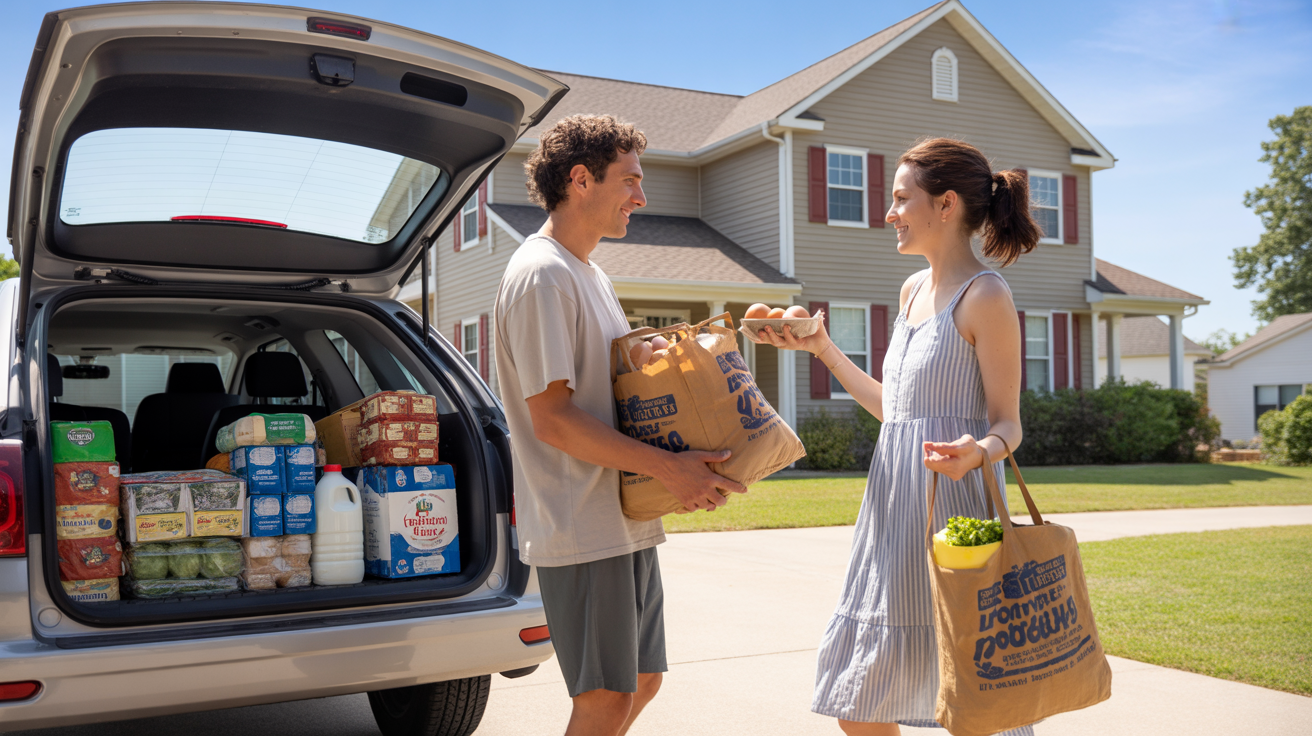
Grocery price pressure in Matthews varies significantly by store tier, and understanding that variation is more useful than focusing on a single “average” experience. Discount-tier stores—no-frills chains with limited selection and house brands—offer the lowest per-unit pricing, especially on shelf-stable staples, dairy, and frozen goods. Households willing to plan trips around these locations and accept less variety can reduce grocery spending meaningfully without sacrificing nutritional quality. The tradeoff is time and convenience: discount stores may not be the closest option, and the shopping experience prioritizes efficiency over ambiance.
Mid-tier stores—regional and national chains with broader selection, weekly sales, and loyalty programs—occupy the middle ground. Pricing here is competitive on promoted items but higher on non-sale goods, meaning savvy shoppers who track circulars and stock up during promotions can approximate discount-tier costs with more convenience. For families managing busy schedules, mid-tier stores often represent the best balance between accessibility, selection, and cost. These are the stores most households default to, and where the corridor-clustered access pattern in Matthews becomes most relevant: choosing which mid-tier location to visit often depends on proximity to other errands, not just price.
Premium-tier stores—specialty grocers, organic-focused chains, and upscale markets—charge noticeably more across nearly every category, with premiums most visible in produce, meat, and prepared foods. For households prioritizing organic certification, specialty diets, or ready-to-eat convenience, these stores deliver value through selection and quality rather than price. But for budget-conscious shoppers, even occasional premium-tier trips can distort weekly spending. The key insight is that store tier isn’t just about brand preference—it’s a structural cost lever that interacts directly with how grocery access is distributed across Matthews.
What Drives Grocery Pressure Here
Income plays a moderating role in how grocery costs feel. With a median household income above $103,000, most families in Matthews can absorb typical grocery bills without acute financial stress. But income doesn’t eliminate sensitivity—it shifts the threshold at which price increases become noticeable. Higher-earning households may not flinch at $6.60 per pound for ground beef, but they still notice when that figure climbs to $8 or when weekly totals creep upward without obvious changes in consumption. For households earning below the median—service workers, single-income families, or early-career professionals—the same price environment creates tighter margins and less room for convenience-driven choices.
Household size amplifies grocery cost pressure in predictable ways. Singles face the highest per-person costs due to packaging inefficiencies and limited bulk-buying opportunities. Couples without children can optimize more easily, splitting costs and leveraging sales without the volume demands of a larger household. Families with children—especially school-age kids—experience the steepest absolute spending and the greatest sensitivity to per-unit price variation. A family of four buying chicken, eggs, and milk weekly will feel a 10% price swing much more acutely than a single person buying the same items in smaller quantities. This size-driven sensitivity makes store tier choice and trip planning especially consequential for larger households.
Regional distribution and access patterns also shape grocery pressure in ways that aren’t immediately visible in price tags. Because grocery stores cluster along corridors rather than embedding uniformly across neighborhoods, some households face longer drives to reach their preferred store tier. That distance cost—measured in time, fuel, and trip frequency—can quietly offset per-unit savings. A household that saves $15 per trip by driving to a discount-tier store but makes that trip twice as often as they would to a closer mid-tier option may not come out ahead once fuel and time are factored in. This isn’t a universal outcome, but it’s a real tradeoff that varies by residential location within Matthews.
Seasonal variability in grocery costs tends to be modest in the Southeast, where year-round growing seasons keep produce prices relatively stable compared to colder climates. That said, certain categories—berries, leafy greens, and specialty vegetables—still fluctuate with national supply patterns, and holiday periods (Thanksgiving, Christmas, summer grilling season) bring predictable spikes in demand-driven items like turkey, brisket, and shellfish. These seasonal shifts don’t reshape the overall cost structure, but they do create windows where meal planning and substitution strategies matter more.
Practical Ways People Manage Grocery Costs
Store tier rotation is one of the most effective behavioral levers households use to control grocery spending. Rather than committing exclusively to one store, many families split their shopping: bulk staples and pantry items from discount-tier stores, fresh produce and proteins from mid-tier stores during sales, and occasional specialty items from premium-tier stores only when necessary. This approach requires more planning and multiple stops, but it allows households to capture per-unit savings on high-volume items without sacrificing quality or variety on the goods where freshness and selection matter most.
Tracking weekly circulars and timing purchases around promotions is another common strategy, especially for families who cook frequently. Mid-tier stores cycle discounts on meat, dairy, and frozen goods predictably, and households who stock up during those windows can approximate discount-tier pricing without the extra drive. The key is freezer space and meal planning discipline—buying chicken at $1.50 per pound only saves money if you use it before freezer burn sets in. For households without the storage capacity or cooking routine to leverage bulk promotions, this strategy delivers less value.
Substitution and flexibility in meal planning help reduce exposure to price volatility. When ground beef spikes, switching to chicken thighs or pork shoulder keeps protein costs manageable. When berries are expensive, shifting to apples or bananas maintains fruit intake without the premium. This kind of adaptability doesn’t require extreme couponing or deprivation—it’s simply a willingness to let price signals influence the menu rather than treating every ingredient as non-negotiable. Households with dietary restrictions or strong preferences have less room to maneuver here, but for most families, modest substitution can smooth out cost fluctuations without compromising nutrition.
House brands and generic equivalents offer another straightforward cost reduction, especially on shelf-stable goods like pasta, rice, canned tomatoes, and frozen vegetables. Quality differences between name brands and store brands have narrowed considerably in recent years, and for many categories, the savings are immediate and consistent. The psychological barrier—brand loyalty or perceived quality gaps—is often the only real obstacle. Households willing to experiment with generics on low-risk items (cereal, snacks, baking staples) can reduce grocery spending incrementally without noticeable lifestyle impact.
Groceries vs Eating Out (Directional)
The tradeoff between cooking at home and eating out in Matthews isn’t purely financial—it’s a question of time, energy, and household logistics. Cooking at home consistently delivers lower per-meal costs, especially for families where economies of scale apply. A home-cooked dinner for four might cost $12 to $18 in ingredients, while the same meal at a casual restaurant could easily run $50 to $70 before tip. But that comparison assumes time and labor are free, which they aren’t. For dual-income households managing long commutes and after-school activities, the convenience of takeout or dining out occasionally isn’t a splurge—it’s a time-management decision.
The corridor-clustered access pattern that shapes grocery shopping in Matthews also affects dining options. Restaurants, like grocery stores, tend to concentrate along commercial corridors, meaning a quick dinner out often involves the same kind of dedicated trip as a grocery run. That reduces the convenience advantage of eating out for some households, especially those in more residential pockets where neither groceries nor restaurants are within easy walking distance. The result is that both cooking and dining out require planning, and the cost-versus-convenience calculus shifts depending on how a household’s daily routine intersects with Matthews’ commercial geography.
For singles and couples, the cost gap between cooking and eating out narrows somewhat. Cooking for one or two often means leftovers, food waste, or repetitive meals, and the time investment per serving is higher than for larger households. A $12 takeout lunch or $20 dinner for one doesn’t feel extravagant when compared to buying ingredients that may spoil before they’re used. Families, by contrast, face steeper absolute costs when eating out and gain more from home cooking, making the grocery-versus-restaurant tradeoff more financially consequential. Neither approach is universally “better”—the right balance depends on household size, income, schedule flexibility, and how much value a household places on cooking as an activity versus a chore.
FAQs About Grocery Costs in Matthews (2026)
Is it cheaper to shop in bulk in Matthews? Shopping in bulk can reduce per-unit costs, especially at discount-tier stores or warehouse clubs, but it requires upfront spending, storage space, and the discipline to use perishable items before they spoil. For families with consistent consumption patterns and freezer capacity, bulk buying on proteins, grains, and shelf-stable goods often pays off. Singles or couples may find that bulk quantities lead to waste unless they’re strategic about freezing portions or splitting purchases.
Which stores in Matthews are best for low prices? Discount-tier stores generally offer the lowest per-unit pricing on staples, dairy, and frozen goods, while mid-tier stores become competitive during weekly sales and promotions. Premium-tier stores charge more across most categories but deliver broader selection and specialty items. The “best” store depends on whether you prioritize absolute lowest cost, convenience and variety, or specific product quality—and whether you’re willing to make multiple stops to optimize across those dimensions.
How much more do organic items cost in Matthews? Organic products typically carry a noticeable premium over conventional equivalents, with the gap widest on produce, dairy, and meat. The exact difference varies by store tier and item, but households prioritizing organic certification should expect meaningfully higher grocery bills. For budget-conscious shoppers, selectively buying organic on high-priority items (often called the “Dirty Dozen” for produce) while choosing conventional options elsewhere can balance cost and preference.
How do grocery costs for two adults in Matthews tend to compare to nearby cities? Matthews’ regional price parity index of 98 suggests grocery costs run slightly below the national average, and likely comparable to or modestly lower than higher-cost metros in North Carolina or the broader Southeast. Households moving from expensive coastal markets may notice savings, while those relocating from lower-cost rural areas might find prices slightly elevated. The difference is usually incremental rather than dramatic, and store tier choice often matters more than city-to-city variation within the region.
How do households in Matthews think about grocery spending when cooking at home? Most households view grocery spending as a controllable cost category where planning, store choice, and meal flexibility can meaningfully influence outcomes. Families with higher incomes may prioritize convenience and quality over absolute lowest cost, while budget-conscious households focus on per-unit pricing, promotions, and substitution strategies. The corridor-clustered access pattern means grocery shopping often requires intentional trip planning rather than spontaneous stops, which reinforces the importance of list-making and store tier decisions in managing weekly spending.
Do grocery costs in Matthews fluctuate seasonally? Seasonal variation in grocery costs here is generally modest compared to colder climates, thanks to year-round growing seasons in the Southeast. Certain categories—berries, leafy greens, and specialty produce—still fluctuate with national supply patterns, and holiday periods bring predictable demand-driven price increases on items like turkey, brisket, and shellfish. These shifts don’t reshape the overall cost structure, but they create windows where meal planning and substitution strategies can help smooth out spending.
Can you stay under $100 per week on groceries in Matthews? Staying under $100 per week is achievable for singles or couples who shop strategically at discount-tier stores, plan meals around sales, and minimize convenience purchases. For families with children, that threshold becomes much harder to maintain without significant restrictions on variety, protein quality, or fresh produce. The feasibility depends heavily on household size, dietary preferences, and willingness to invest time in planning and multi-store shopping. For most families, $100 per week is a floor rather than a comfortable target.
How Groceries Fit Into the Cost of Living in Matthews
Grocery costs in Matthews occupy a middle position in the household budget hierarchy—less dominant than housing or transportation, but more variable and controllable than utilities. For most households, groceries represent steady, recurring spending that responds to intentional choices: store tier, meal planning, and willingness to substitute or wait for sales. That controllability makes groceries a natural place to look when household budgets tighten, but it also means grocery spending can quietly inflate when convenience takes priority over cost discipline. The corridor-clustered access pattern reinforces this dynamic: choosing the closest store over the cheapest one is a small decision in isolation, but repeated weekly, it compounds into meaningful cost differences.
Housing costs—whether rent or mortgage—still dominate the financial landscape in Matthews, with a median home value of $360,000 and median gross rent of $1,495 per month setting the baseline for shelter expenses. Groceries don’t rival that scale, but they interact with it indirectly: households stretched thin by housing costs have less margin to absorb grocery price increases or convenience premiums. Similarly, transportation costs—shaped by a 26-minute average commute and gas prices near $3.93 per gallon—create time constraints that influence grocery shopping behavior. A household facing a long commute may value proximity and speed over per-unit savings, even when they know a discount-tier store would cost less.
For a complete picture of how grocery spending fits into your overall monthly expenses in Matthews—including housing, utilities, transportation, and discretionary costs—see the detailed breakdown in Monthly Spending in Matthews: The Real Pressure Points. That article provides the budget totals and category-level context this piece defers, helping you understand not just what groceries cost, but how they fit into the broader financial structure of living here. Grocery costs are manageable in Matthews for most households, but managing them well requires understanding both the price environment and the access patterns that shape how, where, and when you shop.
How this article was built: In addition to public economic data, this article incorporates location-based experiential signals derived from anonymized geographic patterns—such as access density, walkability, and land-use mix—to reflect how day-to-day living actually feels in Matthews, NC.