
| Transportation Mode | Coverage Pattern | Practical Role |
|---|---|---|
| Bus Service | Corridor-based | Supplemental for aligned schedules |
| Personal Vehicle | Citywide | Primary for most households |
| Pedestrian Infrastructure | Pockets with high ratios | Supports local errands in select areas |
| Cycling Infrastructure | Limited corridors | Recreational and short trips |
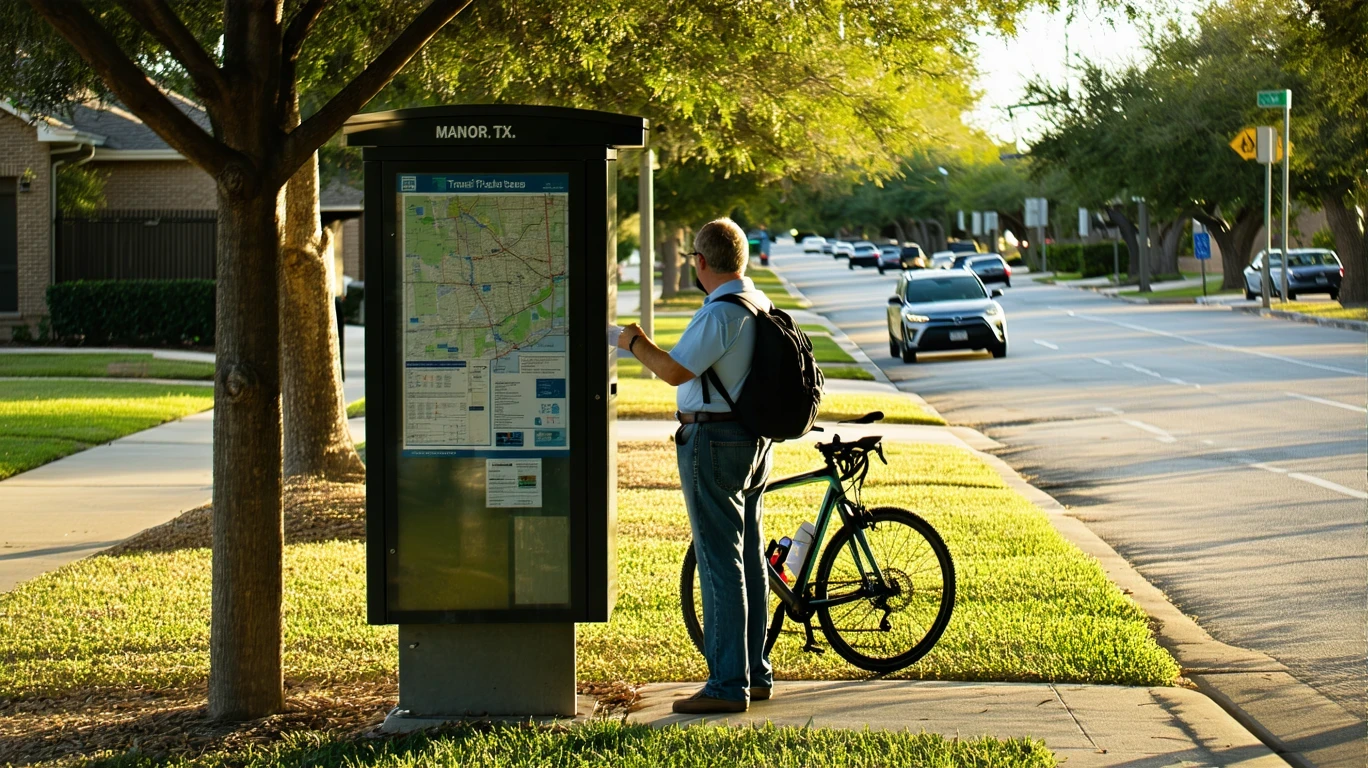
How People Get Around Manor
Transportation options in Manor revolve around personal vehicles, with bus service playing a supplemental role for households whose schedules and destinations align with existing routes. The city’s low-rise development pattern and corridor-clustered layout for food and grocery access mean that even neighborhoods with strong pedestrian-to-road ratios still require driving for most weekly errands. Newcomers often expect either full suburban car dependency or urban-style transit coverage; Manor sits between those extremes, offering limited public transit infrastructure within a fundamentally car-oriented geography.
The pedestrian infrastructure that does exist tends to concentrate in specific pockets rather than blanketing the city, which means walkability varies sharply by neighborhood. Bus stops are present, but service follows corridors rather than filling in residential zones comprehensively. This structure works well for households with predictable, linear commutes to destinations the bus serves directly, but it creates friction for anyone managing multi-stop trips, irregular schedules, or jobs outside the coverage area. Manor’s proximity to Austin amplifies this dynamic—many residents commute outward for work, and transit options thin quickly once you leave the city’s core corridors.
Public Transit Availability in Manor
Public transit in Manor centers around bus service, which operates along select corridors rather than offering citywide coverage. The system functions best for residents living near major routes with destinations that align with the service pattern—typically straightforward commutes to employment centers or educational institutions. For those households, transit provides a viable alternative to driving, particularly during peak hours when traffic congestion increases travel time variability for car commuters.
Where transit falls short is in coverage of peripheral neighborhoods, late-evening service, and flexibility for errands that don’t follow a linear path. The corridor-based model means that households even a few blocks off a main route face longer walk times to access service, and the low-rise development pattern spreads destinations widely enough that multi-stop trips become impractical without a car. Transit works as a supplement for specific use cases, not as a replacement for vehicle ownership in most Manor households.
Driving & Car Dependence Reality
Driving remains the primary mode of transportation for daily life in Manor, shaped by the city’s geographic spread and the way commercial and residential areas are distributed. Even in neighborhoods with walkable pockets, the corridor-clustered pattern of grocery stores and other essential services means that weekly shopping, school drop-offs, and medical appointments typically require a car. Parking is generally abundant and free, which removes one of the friction points that makes driving costly or inconvenient in denser urban areas.
Car dependence here is less about personal preference and more about infrastructure reality. The low-rise building character and the distance between home, work, and errands create a structural need for personal vehicles. Households without reliable access to a car face significant logistical challenges, particularly for anything beyond the narrow set of trips that bus service covers. This isn’t a city where you can easily “go car-light” unless your specific address, job location, and daily routine happen to align with the limited transit corridors.
Commuting Patterns & Daily Mobility
Commuting in Manor often means traveling outward toward Austin or other regional employment centers, and the structure of those trips varies widely by household. Single-job commuters with predictable schedules and destinations near bus routes can sometimes rely on transit, but most residents build their routines around driving. Multi-stop commutes—dropping kids at school, running an errand before work, picking up groceries on the way home—are common, and transit doesn’t accommodate that complexity well.
The benefit of driving in Manor is flexibility and control over timing, which matters when job hours shift, daycare pickup windows are tight, or weekend errands pile up. The tradeoff is exposure to fuel price fluctuations and the need to maintain a vehicle. Proximity to Austin creates opportunity for employment but also embeds commute dependency into household logistics for many families. Those who work locally or from home experience Manor very differently than those who drive 30 or 40 minutes each way daily.
Who Transit Works For — and Who It Doesn’t
Transit in Manor works best for renters or owners living within walking distance of bus corridors, with jobs or schools located along those same routes, and schedules that align with service hours. Students commuting to nearby educational institutions, single adults with linear work commutes, and households willing to structure their routines around transit timing can make it functional. The key is alignment—if your home, destination, and schedule all fit the existing service pattern, bus transit becomes a practical tool.
Transit doesn’t work well for households in peripheral neighborhoods, families managing complex daily logistics, or anyone whose job or errands fall outside the corridor coverage. Parents coordinating school pickups, shift workers with non-standard hours, and residents who need to make multiple stops in a single trip will find transit limiting. Car ownership remains the default for most Manor households not because transit is absent, but because it covers only a narrow slice of the trips people actually need to make.
Transportation Tradeoffs in Manor
Choosing between transit and driving in Manor is less about cost optimization and more about control, predictability, and daily friction. Transit offers lower direct expense and removes the need to maintain a vehicle, but it constrains where you can live, where you can work, and how you structure errands. Driving provides flexibility and eliminates the time cost of waiting for buses or walking to stops, but it ties household finances to fuel prices and vehicle upkeep.
The tradeoff becomes sharper when you consider how transportation shapes housing choice. Living near a bus corridor might reduce driving necessity, but it doesn’t eliminate it for most households, and those locations don’t always align with other priorities like school quality or housing size. Driving allows you to live anywhere in Manor and access the full city, but it also means every trip—work, groceries, social plans—starts with getting in the car. Neither option is clearly better; the right fit depends on whether your household values routine predictability or schedule flexibility more.
FAQs About Transportation in Manor (2026)
Is public transit usable for daily commuting in Manor?
Public transit is usable for daily commuting if your home and workplace both sit near existing bus corridors and your schedule aligns with service hours. For households outside those corridors or with non-linear commutes, transit becomes impractical, and driving remains necessary.
Do most people in Manor rely on a car?
Yes, most people in Manor rely on a car for daily transportation. The city’s low-rise development pattern and corridor-clustered layout for essential services make driving the primary mode for groceries, errands, school runs, and commuting, even in neighborhoods with some pedestrian infrastructure.
Which areas of Manor are easiest to live in without a car?
Areas near bus corridors with walkable access to stops and proximity to grocery or retail clusters are easiest to navigate without a car, but even those locations typically require occasional driving or ride services for errands that fall outside transit coverage.
How does commuting in Manor compare to nearby cities?
Commuting in Manor involves more car dependence than in denser parts of Austin, where transit coverage is broader, but less congestion and parking difficulty than in the urban core. Manor functions as a suburban commuter city, with many residents driving to jobs elsewhere in the metro area.
Can you get by without a car if you work from home in Manor?
Working from home reduces commute dependency significantly, but most Manor households still need a car for groceries, medical appointments, and errands. The corridor-clustered pattern of services and limited transit coverage mean that even remote workers face logistical friction without a vehicle.
How Transportation Fits Into the Cost of Living in Manor
Transportation in Manor functions as a structural factor that shapes where you can live, how you spend time, and what flexibility you retain in daily life. It’s not just a line item in a budget—it’s a set of tradeoffs that interact with housing choice, job access, and household logistics. Households that can align their routines with bus service gain some insulation from fuel price swings, but they trade schedule flexibility and geographic freedom. Those who drive gain control and convenience but absorb the cost and maintenance burden of vehicle ownership.
The way people move around Manor affects how they experience the city’s cost structure more broadly. Living near a bus corridor might reduce transportation expense, but it doesn’t eliminate the need for a car in most cases, and it may limit housing options. Driving everywhere opens up the full city but ties your household to fuel markets and vehicle reliability. For a fuller picture of how transportation costs interact with housing, utilities, and day-to-day expenses, the Monthly Budget article provides numeric context and category-level breakdowns.
Understanding how you’ll actually get around—and what that movement costs in time, money, and flexibility—is one of the clearest ways to reduce uncertainty when evaluating whether Manor fits your household. Transit exists, but it’s narrow in scope. Driving is dominant, but it’s not universally burdensome. The key is knowing which pattern your life will follow and planning accordingly.
How this article was built: In addition to public economic data, this article incorporates location-based experiential signals derived from anonymized geographic patterns—such as access density, walkability, and land-use mix—to reflect how day-to-day living actually feels in Manor, TX.