
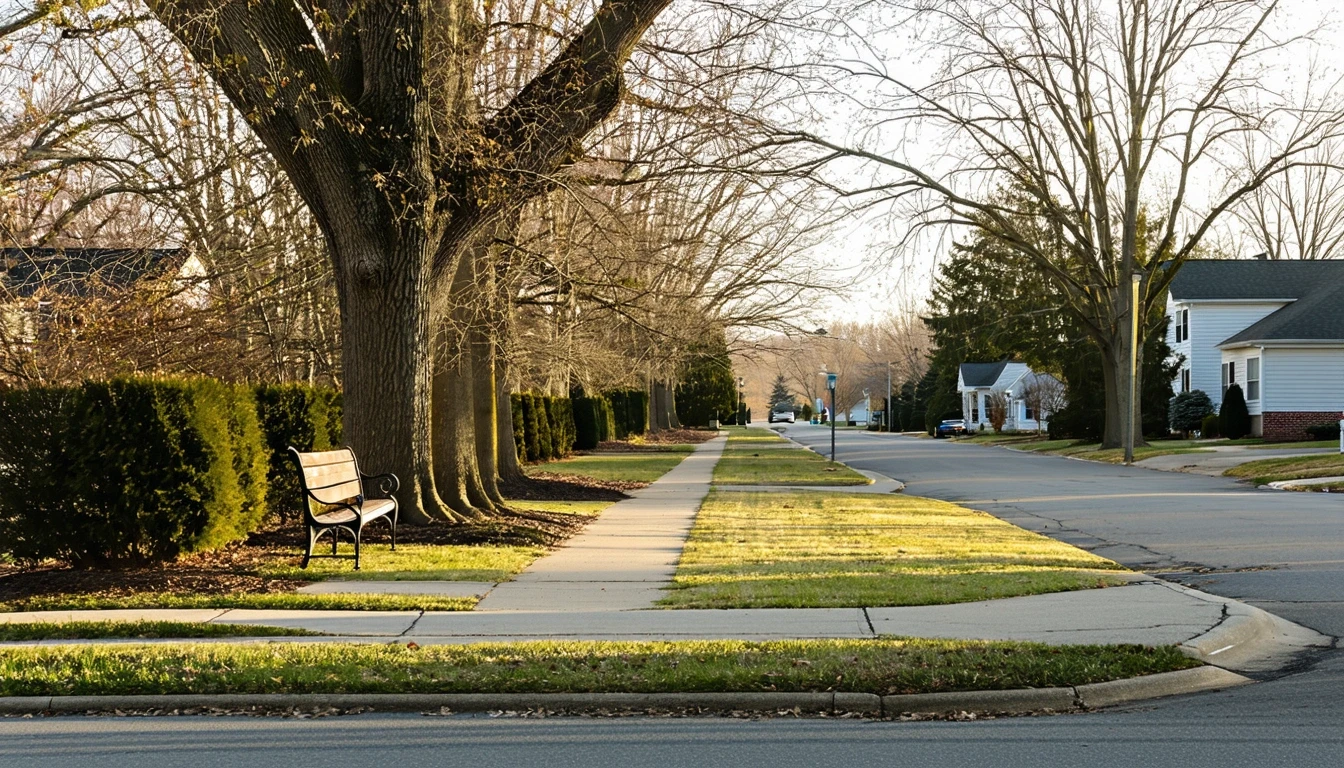
Housing in Lyndon operates within Louisville’s eastern suburban corridor, where car-oriented infrastructure and corridor-clustered retail shape how ownership and rental costs translate into day-to-day living. The median home value sits at $252,400, while median rent reaches $1,159 per month—figures that reflect a market priced below national parity but structured around vehicle dependency and errand planning. Understanding Lyndon’s housing costs means recognizing how place structure amplifies or dampens the financial exposure that comes with renting versus owning.
The Housing Market in Lyndon Today
Lyndon’s housing market reflects its role as a Louisville metro suburb where residential neighborhoods mix with commercial corridors. The regional price parity index of 94 indicates costs run below the national baseline, but that discount doesn’t eliminate the structural realities of how people live here. Pedestrian infrastructure sits below density thresholds, and food and grocery options concentrate along corridors rather than distributing evenly across neighborhoods. This means housing decisions in Lyndon aren’t just about monthly payments—they’re about whether your home location supports the vehicle-dependent errands and commuting patterns the street network demands.
Newcomers often underestimate how car-oriented infrastructure changes the effective cost of housing. A rental or purchase that looks affordable on paper can carry hidden friction if it’s positioned away from the corridors where services cluster. The mixed building stock and moderate green space access suggest a suburb that’s neither uniformly low-rise nor densely vertical, creating variation in maintenance exposure and utility predictability that buyers and renters need to evaluate block by block.
Renting in Lyndon
Median gross rent of $1,159 per month positions Lyndon’s rental market in a range that demands stable income but doesn’t require top-tier earnings. With median household income at $63,806 per year, renters face a cost structure where housing claims a meaningful but not overwhelming share of monthly budgets. The rental experience here hinges on location within the city’s corridor-clustered layout. Renters positioned near the commercial corridors where food and grocery density peaks gain convenience; those in quieter residential pockets trade errand accessibility for lower traffic exposure but accept longer drives for routine tasks.
Rental housing in Lyndon doesn’t insulate tenants from the realities of car dependency. Bus service exists, but the car-oriented street texture means most renters will need a vehicle to manage daily errands efficiently. Parking availability, garage access, and proximity to the corridors that concentrate retail become decision factors that shape the true cost of renting here. Lease renewals carry the usual exposure to rent increases, but the deeper volatility comes from changes in commute patterns or household logistics that force a move to a different part of the city.
Owning a Home in Lyndon
At $252,400, the median home value in Lyndon reflects a market where ownership is accessible to households with moderate savings and stable income, but the structure of ownership costs extends well beyond the purchase price. Property taxes, insurance, and maintenance create ongoing exposure that varies with the age and type of housing stock. The mixed building character—neither uniformly single-family nor densely multifamily—means ownership experiences differ widely depending on whether you’re buying into an older neighborhood with mature trees and aging systems or a newer development with lower immediate maintenance needs but potential HOA governance.
Ownership in Lyndon locks in housing cost predictability for the mortgage portion but leaves owners exposed to the volatility of utilities, maintenance, and local governance decisions. Winter heating exposure becomes a tangible cost factor; current conditions show temperatures at 29°F with a feels-like of 20°F, and extended cold seasons mean natural gas or electric heating systems cycle frequently. Electricity rates of 13.70¢/kWh and natural gas prices of $14.02/MCF provide the rate structure, but actual bills depend on home insulation quality, system efficiency, and how much square footage you’re conditioning. Owners also absorb the full cost of lawn care, snow removal, and exterior upkeep—tasks that renters typically avoid.
Apartment vs House in Lyndon — Cost Behavior Comparison
| Expense Category | Apartment | House |
|---|---|---|
| Heating/Cooling Exposure | Lower square footage and shared walls reduce conditioning load; winter heating less intensive | Greater square footage and detached structure increase heating exposure during cold seasons; insulation quality varies widely |
| Maintenance Responsibility | Landlord typically covers exterior, HVAC, and structural repairs; tenant handles interior only | Owner absorbs all maintenance, including roof, siding, HVAC replacement, and seasonal yard work |
| Vehicle Dependency | Corridor-clustered apartments may reduce drive frequency for errands; parking often included but limited | Houses in residential pockets require vehicle for nearly all errands; garage and driveway parking standard |
| Green Space Access | Moderate park density provides nearby options; private outdoor space limited or absent | Private yards common; park access still present but less critical for daily outdoor use |
Methodology note: The table above includes only categories where Lyndon’s car-oriented infrastructure, corridor retail clustering, winter heating exposure, and mixed building stock create meaningful differences in cost behavior. Generic distinctions that apply uniformly across all markets were excluded to focus on what actually varies here.
Utilities & Upkeep Differences
Utility exposure in Lyndon is shaped by the extended heating season and the mixed building stock that determines how efficiently homes retain conditioned air. Apartments, with their smaller footprints and shared walls, face lower heating loads during winter months when temperatures drop and stay cold for extended periods. Houses, especially older detached single-family homes, carry higher heating exposure because they condition more square footage and lose heat through exterior walls, attics, and basements. The electricity rate of 13.70¢/kWh and natural gas price of $14.02/MCF set the cost per unit, but the intensity of usage—driven by insulation quality, system age, and thermostat behavior—determines whether utility bills remain predictable or spike during peak heating months.
Maintenance differences between apartments and houses in Lyndon aren’t just about cost magnitude—they’re about control and timing. Apartment renters offload HVAC repairs, roof leaks, and exterior painting to landlords, which smooths out volatility but removes control over service quality and timing. Homeowners in Lyndon face the full spectrum of upkeep: HVAC systems that age out after 15–20 years, roofs that need replacement, and yard maintenance that varies with lot size and tree cover. The moderate green space access and presence of water features in some neighborhoods mean properties near parks or retention ponds may face additional drainage or landscaping considerations that aren’t immediately visible during a walkthrough.
Rent vs Buy: Long-Term Exposure in Lyndon
The structural difference between renting and owning in Lyndon isn’t about which option costs less in year five—it’s about which exposure profile fits your household’s tolerance for volatility and need for control. Renters face lease renewal risk, where rent adjustments can force budget recalibrations or relocation decisions, but they avoid the capital risk of major system failures and the long-term exposure to property tax or insurance changes. Owners lock in their mortgage payment, which provides predictability for the largest single housing cost component, but they absorb the full volatility of maintenance, utilities, and local governance decisions that can shift the effective cost of ownership over time.
In Lyndon’s car-oriented, corridor-clustered environment, ownership also means committing to a specific location within the city’s infrastructure network. If your home sits away from the retail corridors, you’re locking in a vehicle-dependent errand pattern for as long as you own the property. Renters retain the flexibility to relocate closer to the corridors or adjust to changes in employment location without the transaction costs of selling. Over time, ownership in Lyndon rewards households that value stability, can manage maintenance exposure, and have aligned their home location with their long-term commute and errand patterns. Renting fits households that prioritize flexibility, want to avoid capital risk, or haven’t yet committed to Lyndon’s specific infrastructure tradeoffs.
FAQs About Housing Costs in Lyndon
What does the $252,400 median home value in Lyndon actually buy?
At that price point, you’re typically looking at single-family homes in mixed-age neighborhoods, with variation in lot size, building condition, and proximity to the commercial corridors where errands cluster. The value reflects Lyndon’s position as a Louisville suburb with below-national price parity, but the structure of the home—age, insulation, HVAC condition—will determine your ongoing utility and maintenance exposure more than the purchase price alone.
How does car dependency in Lyndon affect housing costs?
Car-oriented infrastructure means nearly every household needs at least one vehicle to manage daily errands efficiently, which adds insurance, fuel, and maintenance costs to the effective cost of housing. Homes or apartments positioned near the corridors where grocery and food options concentrate reduce drive frequency slightly, but the street network doesn’t support car-free living for most households. This makes parking availability, garage access, and vehicle storage part of the housing cost equation.
Is renting in Lyndon cheaper than owning over time?
That framing misses the structural difference. Renting at $1,159 per month avoids capital risk and maintenance volatility but leaves you exposed to lease renewal increases and offers no equity accumulation. Owning at $252,400 locks in mortgage predictability but transfers all maintenance, utility, and governance risk to you. The question isn’t which is cheaper—it’s which risk profile fits your household’s income stability, timeline, and tolerance for cost volatility.
How do utilities behave differently in Lyndon apartments versus houses?
Apartments face lower heating exposure during Lyndon’s cold seasons because smaller square footage and shared walls reduce conditioning loads. Houses, especially detached single-family homes, condition more space and lose heat through exterior surfaces, which increases winter utility bills. The electricity rate of 13.70¢/kWh and natural gas price of $14.02/MCF set the per-unit cost, but the intensity of heating demand—driven by insulation, system efficiency, and home size—determines whether bills stay manageable or spike during extended cold periods.
What housing tradeoffs matter most in Lyndon?
Location within the corridor-clustered layout, vehicle dependency, and heating exposure dominate the tradeoff space. Homes closer to the retail corridors reduce errand drive time but may face higher traffic exposure. Older homes in established neighborhoods offer mature landscaping and larger lots but carry higher maintenance and heating costs. Newer construction or apartments reduce maintenance volatility but may come with HOA governance or limited outdoor space. The tradeoff that matters most depends on whether you prioritize convenience, cost predictability, or control over your living environment.
Making Housing Choices in Lyndon
Housing costs in Lyndon don’t operate in isolation—they interact with the city’s car-oriented infrastructure, corridor-clustered retail, and winter heating exposure to create a cost structure that rewards households who align their housing choice with their mobility needs and maintenance tolerance. The $252,400 median home value and $1,159 median rent provide the baseline figures, but the true cost of housing here depends on where you land within the city’s layout, how much vehicle dependency you’re willing to accept, and whether you’re prepared to manage the volatility of utilities and upkeep that come with ownership.
Renters gain flexibility and avoid capital risk but remain exposed to lease renewal pressure and the limitations of landlord-controlled maintenance timelines. Owners lock in mortgage predictability and gain control over their property but absorb the full spectrum of maintenance, utility, and governance exposure that comes with detached housing in a mixed building stock. For households considering Lyndon, the decision isn’t just about affordability—it’s about whether the housing structure fits your household’s logistics, income stability, and long-term plans within Louisville’s eastern suburban corridor.
For a broader view of how housing costs interact with other expenses, see The Real Cost Pressures in Lyndon. If you’re evaluating Monthly Spending in Lyndon: The Real Pressure Points, understanding housing exposure helps clarify where your budget faces the most volatility. And if you’re planning a move, Pods vs trucks: which move is best for you? can help you navigate the logistics of getting here.
How this article was built: In addition to public economic data, this article incorporates location-based experiential signals derived from anonymized geographic patterns—such as access density, walkability, and land-use mix—to reflect how day-to-day living actually feels in Lyndon, KY.