
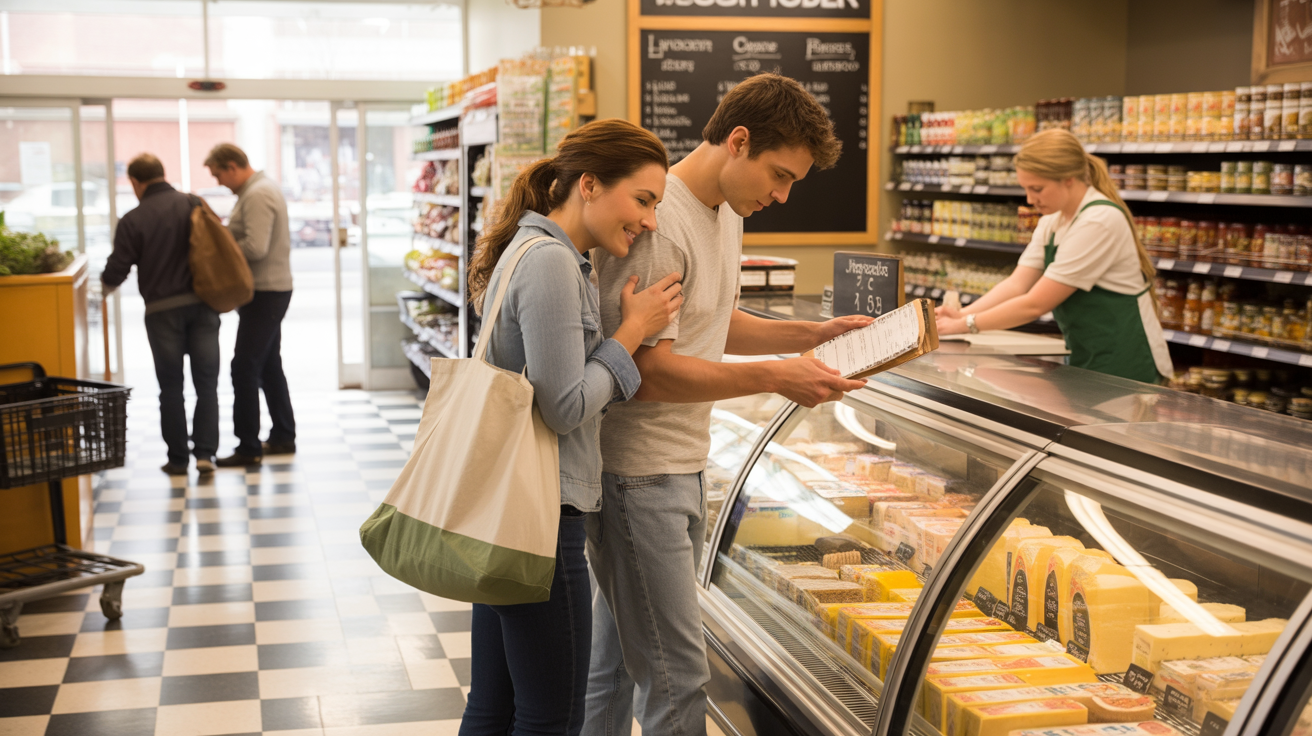
How Grocery Costs Feel in Lyndon
Grocery prices in Lyndon, Kentucky sit slightly below the national baseline, reflecting the city’s regional price parity index of 94—but that modest advantage doesn’t mean food costs disappear into the background. For households earning around the median income of $63,806 per year, grocery spending remains one of the most visible and frequent financial decisions, and the pressure varies sharply depending on household size and where you choose to shop. Singles and couples often find staple items manageable with some attention to store choice, while families with children feel the cumulative weight of feeding multiple people week after week. Unlike fixed costs such as rent or insurance, grocery spending responds directly to behavior: which store you drive to, what’s on sale, and whether you’re willing to plan around bulk purchases all shape the experience more than any single price point.
What makes grocery costs in Lyndon distinct is not dramatic price swings but the structural reality of where money goes in a car-oriented, corridor-clustered environment. Because pedestrian infrastructure is limited and food retailers concentrate along commercial corridors, grocery shopping here is a planned, car-based activity rather than a spontaneous errand. That means households tend to consolidate trips, favor larger formats, and weigh drive time against per-item savings more carefully than residents of denser, more walkable cities might. The result is a grocery landscape where store tier choice—discount, mid-tier, or premium—becomes the primary lever for managing food costs, and where the friction of access subtly reinforces bulk buying and trip efficiency over frequent, small purchases.
For families, grocery pressure compounds quickly. A household of four faces not just higher volume but also the challenge of balancing nutrition, preference, and budget across breakfast staples, school lunches, and dinner planning. Even modest per-pound price differences add up when you’re buying chicken, ground beef, and fresh produce multiple times a month. Singles, by contrast, often find that grocery costs feel more controllable—but they also lose the per-unit advantage of bulk packaging, and waste becomes a bigger concern when perishables spoil before they’re used. Couples occupy a middle ground, with enough volume to justify larger packages but enough flexibility to shift between store tiers depending on the week’s priorities.
Grocery Price Signals (Illustrative)
These prices illustrate how staple items tend to compare locally—not a full shopping list or a snapshot of any single store’s shelf. They’re derived from regional price adjustments and reflect the cost texture of everyday grocery decisions in Lyndon, offering a sense of where baseline pricing sits for common household staples. Actual prices vary by retailer, format, brand, and weekly promotions, but these figures provide useful reference points for understanding relative cost pressure.
| Item | Illustrative Price |
|---|---|
| Bread (per pound) | $1.73/lb |
| Cheese (per pound) | $4.55/lb |
| Chicken (per pound) | $1.92/lb |
| Eggs (per dozen) | $2.42/dozen |
| Ground beef (per pound) | $6.35/lb |
| Milk (per half-gallon) | $3.85/half-gallon |
| Rice (per pound) | $1.00/lb |
Ground beef stands out as the most expensive item per pound, reflecting broader protein cost pressures that affect households nationwide. Chicken offers a more budget-friendly alternative for families trying to stretch dinner spending, while eggs and milk remain foundational staples that most households purchase weekly regardless of income. Rice and bread anchor the lower end of the price spectrum, providing filling, shelf-stable options that help households manage volume without escalating costs. Cheese sits in the middle—a frequent purchase for many families but one where brand, format, and store tier create wide price variation.
What these prices reveal is not a uniform grocery experience but a landscape where small differences compound. A family buying chicken twice a week, eggs every few days, and ground beef for weekend meals will feel pricing pressure differently than a single person buying the same items in smaller quantities and less frequently. The gap between discount and premium store pricing on these same items can easily reach 20–30%, meaning that where you shop in Lyndon’s corridor-clustered retail environment often matters more than what you buy.
Store Choice & Price Sensitivity
Grocery price pressure in Lyndon varies more by store tier than by any single average price. Discount grocers—regional chains and no-frills formats—offer the lowest per-item pricing, often undercutting mid-tier stores by a meaningful margin on staples like milk, eggs, bread, and canned goods. These stores thrive on volume, limited selection, and minimal service, and they attract households for whom grocery spending is a top-three budget concern. Mid-tier grocers occupy the largest footprint in Lyndon’s commercial corridors, offering broader selection, name-brand options, and a more conventional shopping experience at moderate pricing. Premium grocers, where present, cater to households prioritizing organic options, specialty items, and prepared foods, with pricing that reflects those preferences.
Because Lyndon’s food accessibility is corridor-clustered and car-dependent, store choice is not a convenience decision—it’s a planning decision. Households must weigh drive time, fuel cost, and trip consolidation against per-item savings. A family willing to drive an extra few minutes to a discount grocer and buy in bulk can reduce per-pound costs significantly, but that strategy requires storage space, upfront cash flow, and the ability to plan meals around what’s available rather than what’s preferred. Singles and couples, by contrast, often find that mid-tier stores offer a better balance: close enough to minimize drive time, broad enough to avoid multiple stops, and flexible enough to accommodate smaller basket sizes without forcing bulk purchases that lead to waste.
Store tier choice also interacts with income sensitivity. For households earning near or below the median income of $63,806, discount grocers become essential rather than optional, and weekly shopping trips are often tightly budgeted around sale cycles and loss leaders. Higher-income households gain the flexibility to prioritize convenience, variety, or quality over price, but even they feel the cumulative impact of grocery inflation when feeding a family of four. The corridor-clustered layout means that switching between store tiers requires intentional routing—there’s no walkable grid where you can easily compare prices across three stores in a single trip. That friction reinforces loyalty and habit, making the initial choice of primary grocer more consequential than in denser, more competitive retail environments.
What Drives Grocery Pressure Here
Grocery pressure in Lyndon is shaped by the interaction of household size, income, and the structural realities of car-dependent, corridor-based shopping. Families feel the most acute pressure because volume amplifies every price difference: buying chicken, milk, eggs, and produce for four people rather than one or two turns modest per-item costs into significant weekly totals. Singles face a different challenge—they avoid the volume problem but lose the per-unit advantage of bulk packaging, and perishables become a waste risk when purchased in quantities designed for larger households. Couples occupy the middle, with enough volume to justify some bulk purchases but enough flexibility to shift between store tiers and adjust meal planning around sales without feeling locked into a single strategy.
Income sensitivity plays a central role. Households earning near the median income of $63,806 often find that grocery spending competes directly with other variable costs—utilities, fuel, and discretionary spending—and that even modest grocery inflation creates noticeable monthly pressure. Higher-income households gain breathing room, but they’re not insulated: feeding a family of four still requires consistent spending, and the cumulative cost of preferring organic, name-brand, or specialty items adds up quickly. Lower-income households, by contrast, must treat grocery shopping as a tightly managed budget category, often relying on discount stores, sale cycles, and careful meal planning to avoid running short before the next paycheck.
Regional distribution and access patterns also matter. Because Lyndon’s food retailers cluster along corridors rather than dispersing evenly across neighborhoods, some households face longer drive times to reach their preferred store tier, while others live closer to mid-tier options but farther from discount alternatives. That geography creates uneven access to the lowest prices, and it means that transportation costs—fuel, time, and vehicle wear—become part of the grocery cost equation. Seasonal variability, while not extreme in this region, still influences produce pricing and availability, with summer offering broader selection and lower prices on fresh fruits and vegetables, while winter shifts households toward frozen, canned, and shelf-stable options that may carry different cost profiles.
Practical Ways People Manage Grocery Costs
Households in Lyndon manage grocery costs primarily through store choice, trip planning, and meal flexibility rather than extreme couponing or deprivation. Shopping at discount grocers for staples—milk, eggs, bread, rice, canned goods—while reserving mid-tier or premium stores for specialty items or perishables allows families to capture the largest per-item savings without sacrificing variety entirely. Buying in bulk when storage and cash flow permit reduces per-unit costs on non-perishables and proteins, though it requires upfront spending and the discipline to avoid waste. Planning meals around what’s on sale each week, rather than building a shopping list around fixed preferences, helps households adapt to price fluctuations without feeling deprived.
Reducing food waste is another high-impact lever. Perishables like produce, dairy, and meat spoil quickly when over-purchased, and singles or couples often find that buying smaller quantities more frequently—despite the per-unit cost penalty—saves money compared to discarding unused food. Batch cooking and freezing meals extends the usable life of bulk purchases, particularly for proteins and prepared dishes, and it reduces the temptation to order takeout when time is short. Substituting lower-cost proteins—chicken for ground beef, eggs for meat—lowers per-meal costs without eliminating nutrition, and it’s a strategy that families with children often adopt to manage volume without escalating spending.
Store loyalty programs, digital coupons, and sale-cycle awareness all help, but they require time and attention. Households that track weekly ads, load digital offers, and time their shopping trips to coincide with markdowns gain incremental savings, but the effort involved is not trivial. For some, the time cost outweighs the financial benefit; for others, particularly those managing tight budgets, it’s a necessary part of the routine. The key insight is that grocery cost management in Lyndon is less about finding secret hacks and more about aligning store choice, trip frequency, and meal planning with household priorities—whether that’s minimizing cost, maximizing convenience, or balancing both.
Groceries vs Eating Out (Directional)
The tradeoff between cooking at home and eating out is not purely financial—it’s about time, energy, and convenience as much as cost. Cooking at home in Lyndon consistently costs less per meal than dining out, particularly for families, but it requires planning, shopping, preparation, and cleanup. A home-cooked dinner for four built around chicken, rice, and vegetables might cost a fraction of what the same household would spend at a casual restaurant, but it also demands an hour or more of active time. For dual-income households, that time cost is real, and the temptation to order takeout or pick up fast food increases when schedules are tight and energy is low.
Eating out offers immediate convenience and eliminates decision fatigue, but it compounds quickly. A single takeout meal for a family of four can easily exceed what that household might spend on groceries for two or three home-cooked dinners, and frequent restaurant meals—even at mid-tier or fast-casual spots—can rival or exceed monthly grocery spending. Singles and couples face a different calculus: cooking for one or two often feels inefficient, and the per-meal cost advantage of home cooking shrinks when perishables spoil or when the effort of cooking a full meal outweighs the savings. For them, a mix of home cooking for some meals and eating out for others often feels more sustainable than committing fully to either extreme.
The directional lesson is that grocery spending and dining-out spending exist in tension, not isolation. Households that cook most meals at home gain the largest cost advantage, but they also bear the time and effort burden. Those who eat out frequently gain convenience but sacrifice significant budget flexibility. Most households in Lyndon find themselves somewhere in the middle, cooking at home most nights but relying on takeout or restaurants when time, energy, or occasion demands it. The key is recognizing that the tradeoff is not binary—it’s a spectrum, and where you land on it depends on income, household size, schedule, and priorities as much as on food prices themselves.
FAQs About Grocery Costs in Lyndon (2026)
Is it cheaper to shop in bulk in Lyndon? Buying in bulk reduces per-unit costs on non-perishables and proteins, but it requires upfront cash flow, storage space, and the discipline to avoid waste. For families, bulk shopping at discount stores often delivers meaningful savings; for singles or couples, smaller quantities purchased more frequently may prevent spoilage and feel more manageable.
Which stores in Lyndon are best for low prices? Discount-tier grocers consistently offer the lowest per-item pricing on staples like milk, eggs, bread, and canned goods, often undercutting mid-tier stores by a noticeable margin. Mid-tier stores provide broader selection and convenience at moderate pricing, while premium grocers cater to households prioritizing organic or specialty items. Because food retailers cluster along corridors, store choice often involves weighing drive time and trip consolidation against per-item savings.
How much more do organic items cost in Lyndon? Organic items typically carry a premium over conventional equivalents, with the gap widening on produce, dairy, and proteins. The exact difference varies by store tier and item, but households prioritizing organic options should expect to allocate a larger share of their grocery budget to those purchases, particularly when feeding a family.
How do grocery costs for two adults in Lyndon tend to compare to nearby cities? Lyndon’s regional price parity index of 94 suggests grocery costs sit slightly below the national baseline, meaning staple items generally cost a bit less here than in higher-cost metros. However, the car-dependent, corridor-clustered layout means that access to the lowest prices requires intentional planning and drive time, which can offset some of the per-item savings depending on household location and store choice.
How do households in Lyndon think about grocery spending when cooking at home? Most households view grocery spending as a controllable but persistent cost that responds to store choice, meal planning, and waste management. Families with children feel the most pressure due to volume, while singles and couples gain more flexibility but face different challenges around bulk purchasing and perishability. Cooking at home consistently costs less than eating out, but it requires time, energy, and planning—making the tradeoff between groceries and dining out as much about convenience and schedule as about price.
How Groceries Fit Into the Cost of Living in Lyndon
Grocery costs in Lyndon occupy a middle position in the household budget—less dominant than housing or transportation, but more frequent and more controllable than either. Unlike rent or mortgage payments, which remain fixed month to month, grocery spending responds directly to behavior: where you shop, what you buy, and how much you waste all shape the outcome. That responsiveness makes groceries one of the few cost categories where households can exercise meaningful control without relocating or changing jobs, but it also means that grocery spending requires ongoing attention and discipline rather than a one-time decision.
For a complete picture of monthly expenses in Lyndon—including housing, utilities, transportation, and discretionary spending—refer to the Monthly Budget article, which integrates grocery costs into the broader household financial structure. Groceries interact with other variable costs, particularly utilities and fuel, and understanding how they fit together helps households allocate resources more effectively. A family that reduces grocery spending by shopping at discount stores may find that the savings free up budget room for higher utility bills in summer or winter, while a household that prioritizes convenience and eats out frequently may face tighter constraints elsewhere.
The key to managing grocery costs in Lyndon is recognizing that the experience varies by household type, income, and store choice, and that the car-dependent, corridor-clustered layout makes trip planning and store tier selection more consequential than in denser, more competitive retail environments. Families feel the most pressure and benefit the most from bulk buying and discount stores; singles and couples gain more flexibility but face different tradeoffs around waste and per-unit pricing. Regardless of household size, the households that manage grocery costs most effectively are those that align store choice, meal planning, and shopping frequency with their priorities—whether that’s minimizing cost, maximizing convenience, or finding a sustainable balance between the two.
How this article was built: In addition to public economic data, this article incorporates location-based experiential signals derived from anonymized geographic patterns—such as access density, walkability, and land-use mix—to reflect how day-to-day living actually feels in Lyndon, KY.