
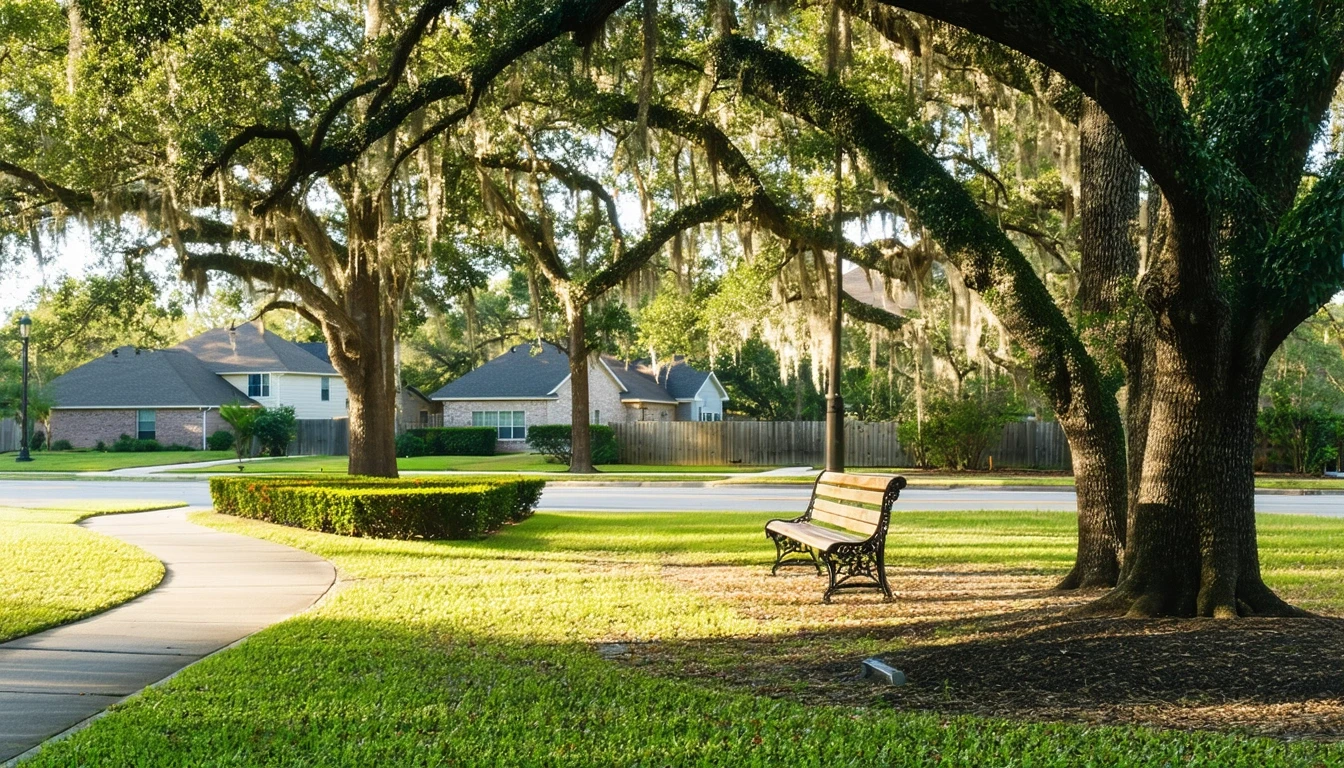
Apartment vs House: Monthly Cost Snapshot in League City
Before diving into the details, here’s how typical monthly housing costs compare between renting an apartment and owning a house in League City. These figures reflect base housing expenses before utilities, commuting, and lifestyle costs.
| Expense Category | Apartment | House |
|---|---|---|
| Base Housing Payment | $1,598/month (median rent) | Mortgage on $312,500 median home (varies by down payment and rate) |
| Property Tax | Included in rent | Paid directly; Texas has no state income tax but relies on property taxes |
| Maintenance Responsibility | Landlord handles | Owner handles; Gulf Coast humidity and heat accelerate wear |
| Cooling Costs | Lower square footage reduces load | Larger space and extended cooling season increase exposure |
| Governance | Lease terms set by landlord | May include HOA dues and rules depending on neighborhood |
Methodology note: This table includes only categories where cost behavior differs meaningfully in League City due to climate (extended cooling season), tax structure (Texas property tax reliance), housing stock (mix of single-family and apartment communities), and maintenance exposure (Gulf Coast humidity). Generic categories like insurance were omitted because the difference is not driven by local conditions.
The Housing Market in League City Today
League City sits in the Houston metro area, close enough to benefit from regional job growth but far enough to maintain a distinct suburban character. The median home value of $312,500 reflects a market shaped by proximity to NASA’s Johnson Space Center, the Port of Houston, and the Texas Medical Center—employers that draw dual-income households and professionals willing to commute for space and schools.
What newcomers often misunderstand is that League City is not a uniform suburb. The city has walkable pockets with mixed residential and commercial land use, alongside car-oriented neighborhoods where errands require planning. Food and grocery options cluster along corridors rather than spreading evenly, which means your daily routine depends heavily on which part of the city you choose. Families prioritize League City for its strong school and playground infrastructure, both of which meet density thresholds that many comparable suburbs don’t.
The housing market here rewards buyers who understand tradeoffs. You’re not paying for downtown walkability or rail transit—League City has bus service but no rail. You’re paying for family infrastructure, hospital access, and a housing stock that balances single-family homes with apartment communities. The regional price parity index of 100 means costs align closely with the national baseline, but the experience of living here is shaped by what you can’t see in aggregate numbers: where you live within the city determines how much you drive, how easily you run errands, and what drives expenses beyond the mortgage or rent check.
Renting in League City
Median gross rent in League City is $1,598 per month, a figure that reflects both the city’s proximity to Houston employment centers and the quality of local family amenities. Renters here are paying for access to strong schools, playgrounds, and healthcare—League City has a hospital and pharmacies present—without the long-term commitment of ownership in a market where home values exceed $300,000.
Rental pressure in League City comes from two directions. First, the city’s role as a commuter suburb means renters often compete with buyers who are priced out of closer-in Houston neighborhoods but still need reasonable access to work. Second, the corridor-clustered pattern of grocery and food options means not all rental locations offer the same convenience. If you rent in a part of the city with lower errands accessibility, you’ll spend more time driving for basics, which shifts your real cost of living even if the lease price looks identical.
Renters should expect variation in how walkable their immediate surroundings feel. League City has walkable pockets where pedestrian infrastructure is strong, but these are not citywide. If your daily routine depends on being able to walk to a grocery store or pharmacy, you’ll need to prioritize location within the city, not just the city itself. The presence of bus service provides some flexibility, but without rail transit, most renters still rely on a car for commuting and errands.
The extended cooling season in League City—driven by Gulf Coast heat and humidity—also affects renters, though typically less than homeowners. Apartments have lower square footage, which reduces cooling loads, but electricity at 15.69¢/kWh still means summer utility bills add noticeable expense on top of rent. Renters in older buildings or units with poor insulation will feel this more acutely.
Owning a Home in League City
The median home value of $312,500 positions League City as a market where ownership requires substantial income or savings. Using the standard 30% affordability heuristic, a household would need an annual income around $117,000 to comfortably carry a mortgage on a median-priced home—a threshold that aligns closely with the city’s median household income of $117,316 per year. This suggests the market is calibrated for dual-income households or single earners with above-median wages.
Ownership in League City exposes you to costs that renters avoid. Texas has no state income tax, which means property taxes carry more weight in funding schools, infrastructure, and services. While the specific rate isn’t provided here, buyers should expect property taxes to be a significant annual expense, paid directly rather than folded into a monthly rent check. This creates predictability in one sense—your tax bill is based on assessed value, not landlord discretion—but it also means you’re directly exposed to any changes in local tax policy or assessment practices.
Maintenance responsibility shifts entirely to the owner, and in League City, that responsibility is shaped by climate. The extended cooling season and Gulf Coast humidity accelerate wear on HVAC systems, roofing, and exterior paint. Homes here work harder to stay cool, and that effort shows up in both utility bills and the frequency of repairs. Owners also face the possibility of HOA dues and rules depending on the neighborhood, which can add another layer of monthly cost and governance.
What ownership offers in return is control and stability. Your monthly housing payment doesn’t reset at a landlord’s discretion. You can make efficiency upgrades, adjust landscaping to reduce water use, or install programmable thermostats to manage cooling costs. You’re also building equity in a market supported by regional job growth, though that equity comes with the risk of maintenance surprises and the reality that selling a home in a suburban market takes longer than breaking a lease.
Utilities & Upkeep Differences
Utility and maintenance exposure in League City is driven by climate, housing type, and infrastructure. The extended cooling season—shaped by Gulf Coast heat and humidity—dominates household energy use. Electricity at 15.69¢/kWh is the primary cost lever, and the difference between an apartment and a house is substantial.
For illustrative context, a typical apartment using around 800 kWh per month during peak summer might see electric bills around $125, while a house using 1,200–1,500 kWh could approach $190–$235. These are not guarantees—they depend on insulation, thermostat habits, and occupancy—but they reflect the reality that larger homes in a hot, humid climate require more energy to stay comfortable. Natural gas at $19.31/MCF plays a smaller role here; heating demand is minimal compared to cooling, so gas is more relevant for water heating and cooking than for climate control.
Maintenance differences between apartments and houses in League City are less about generic “houses cost more” and more about what the climate does to materials. Humidity accelerates mold, mildew, and wood rot. Heat stresses roofing and siding. HVAC systems run longer and harder, which shortens their lifespan. Apartment dwellers are insulated from these costs—landlords handle repairs—but homeowners face them directly and repeatedly.
Water and sewer costs are typically billed separately in both rentals and owned homes, and outdoor watering during dry stretches can add noticeable expense for homeowners with larger lots. Renters in smaller units with no yard responsibility avoid this entirely.
Rent vs Buy: Long-Term Exposure in League City
The decision between renting and buying in League City is not a savings calculation—it’s a risk profile choice. Renters face volatility in the form of lease renewals, where rent can reset based on market conditions, landlord strategy, or property turnover. Owners face volatility in the form of maintenance surprises, tax assessment changes, and the ongoing cost of keeping a home functional in a climate that accelerates wear.
Renters in League City maintain flexibility. If your job changes, your commute needs shift, or you discover that your neighborhood’s errands accessibility doesn’t match your expectations, you can move when the lease ends. You’re not locked into a mortgage on a $312,500 asset that may take months to sell. But that flexibility comes with less control. You can’t upgrade insulation to lower cooling costs. You can’t install solar panels or replace an inefficient HVAC system. You’re subject to the landlord’s timeline for repairs and improvements.
Owners gain control and predictability in their base housing payment, but they absorb all the exposure that renters avoid. The extended cooling season means higher utility bills year after year. Humidity and heat mean more frequent repairs. Property taxes are paid directly, and while they’re more predictable than rent resets, they’re also unavoidable. Ownership in League City works best for households with stable income, emergency savings to cover maintenance, and a long enough timeline to justify the upfront and ongoing costs.
The presence of strong family infrastructure—schools and playgrounds that meet density thresholds—makes ownership particularly appealing to families planning to stay for years. The investment in housing doubles as an investment in access to those amenities. But for single-income households, renters without cars, or anyone whose job requires flexibility, the long-term exposure of ownership may outweigh the benefits.
FAQs About Housing Costs in League City
Is League City affordable for renters on a single income?
Median rent of $1,598 per month creates pressure for single-income renters, especially those earning below the city’s median household income of $117,316 per year. Affordability depends heavily on income level, whether you have roommates, and how much you spend on transportation and utilities. Renters in less walkable parts of the city will spend more on gas and car maintenance, which compounds housing costs.
How much does cooling a home in League City typically cost?
Cooling costs depend on home size, insulation, and thermostat settings, but the extended cooling season driven by Gulf Coast heat and humidity makes electricity the dominant utility expense. At 15.69¢/kWh, a house using 1,200 kWh per month during summer would see electric bills around $188 before fees, while a smaller, well-insulated apartment might stay closer to $125. These are illustrative figures, not guarantees.
Does League City require a car, or can you rely on transit and walking?
League City has walkable pockets and bus service, but the city is not uniformly walkable, and there is no rail transit. Most residents rely on cars for commuting and errands. If you live in a part of the city with strong pedestrian infrastructure and corridor-clustered grocery access, you can reduce car dependence for some daily tasks, but you’ll still need a vehicle for work and less frequent trips.
What makes League City appealing to families compared to other Houston suburbs?
League City has strong family infrastructure, with both school density and playground density meeting thresholds that many comparable suburbs don’t. The city also has a hospital present, which reduces travel time for medical needs. These factors make it particularly attractive to families with children who plan to stay long-term and value access to schools, parks, and healthcare over walkability or transit options.
How does homeownership in League City compare to renting over five years?
Ownership and renting in League City represent different risk profiles, not different savings outcomes. Renters face lease renewal volatility but avoid maintenance costs, property taxes, and the long-term commitment of a mortgage. Owners gain control and stability in their base payment but absorb all repair costs, tax exposure, and the reality that selling a home in a suburban market takes time. The right choice depends on income stability, savings, timeline, and whether you value flexibility or control.
Making Housing Choices in League City
Housing costs in League City reflect the city’s role as a family-oriented suburb within the Houston metro, where proximity to major employers, strong schools, and healthcare access justify home values above $300,000 and rents approaching $1,600 per month. The market rewards dual-income households and families planning to stay long enough to absorb the upfront and ongoing costs of ownership, while renters gain flexibility at the cost of control and exposure to lease renewal volatility.
What makes League City distinct is not any single cost figure but the interaction between housing type, location within the city, and climate. The extended cooling season and Gulf Coast humidity create ongoing utility and maintenance exposure that affects homeowners more than renters. The corridor-clustered pattern of grocery and food access means your daily errands experience depends on where you live, not just whether you rent or own. The presence of walkable pockets and mixed land use offers some households the ability to reduce car dependence, but the city as a whole still requires a vehicle for most residents.
Families with children will find League City’s infrastructure—schools, playgrounds, hospital access—well-suited to their needs, especially if they have the income to manage a median home price of $312,500 or median rent of $1,598. Single-income households and renters without cars will face more friction, both in affording housing and in managing day-to-day costs that extend beyond the lease or mortgage payment. Understanding how housing costs behave here means recognizing that the decision isn’t just rent versus buy—it’s about which risks you’re willing to carry and which tradeoffs align with your household’s income, timeline, and daily routine.
How this article was built: In addition to public economic data, this article incorporates location-based experiential signals derived from anonymized geographic patterns—such as access density, walkability, and land-use mix—to reflect how day-to-day living actually feels in League City, TX.