
Owning a home in Las Vegas means navigating more than the purchase price. Beyond the mortgage, homeowners face property taxes, homeowners association fees in many neighborhoods, year-round cooling costs driven by desert heat, and landscape maintenance shaped by water scarcity and xeriscaping norms. These hidden costs don’t appear on the listing, but they define the ownership experience—and they vary widely depending on where you buy and what kind of community you join.
This article breaks down the full cost structure of housing in Las Vegas, comparing renting and owning across predictability, control, and long-term exposure. It’s written for anyone deciding whether to rent or buy, or trying to understand how housing costs behave in a city shaped by rapid growth, master-planned sprawl, and a tourism-driven economy.
The Housing Market in Las Vegas Today
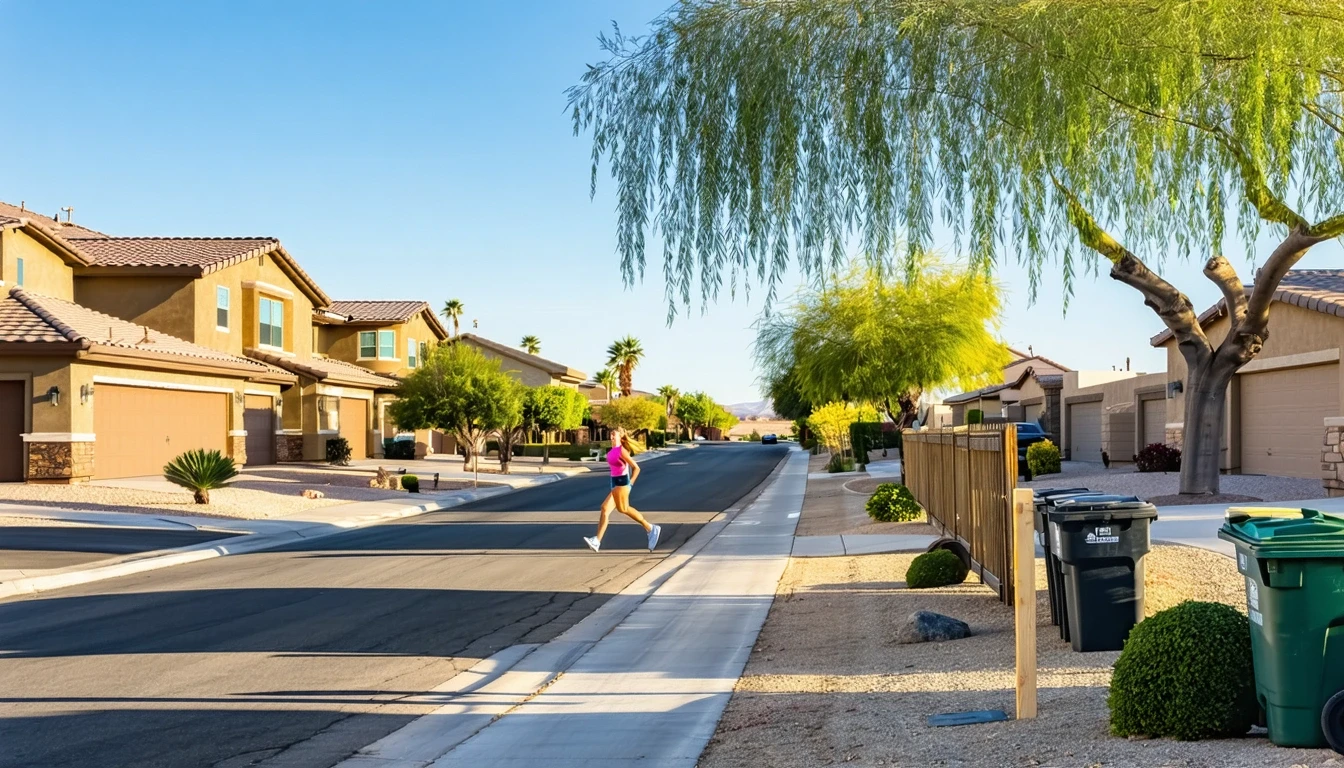
Las Vegas’s housing market reflects decades of rapid expansion, with master-planned communities, age-restricted developments, and sprawling subdivisions radiating outward from the urban core. The median home value sits at $365,300, while median gross rent runs $1,356 per month. Against a median household income of $66,356 per year, the entry price for ownership remains accessible compared to many Western metros—but the cost of living once you’re inside the home is shaped by factors that don’t show up in the listing.
The city’s development pattern creates distinct housing experiences. Walkable pockets near the Strip and downtown feature higher-density buildings, mixed-use corridors, and rail transit access. But most residential neighborhoods sprawl outward in low-rise, car-dependent subdivisions where daily errands require driving and family infrastructure—schools, playgrounds—remains sparse relative to housing density. This bifurcation means that where you live determines not just your commute, but your entire cost and logistics profile.
What newcomers often misunderstand is that Las Vegas’s affordability is front-loaded. The purchase price or lease rate looks reasonable, but the ongoing costs—cooling a home through triple-digit summers, maintaining desert landscaping under water restrictions, navigating HOA rules in master-planned areas—add friction that doesn’t scale with income. The market rewards those who plan for exposure, not just the monthly payment.
Renting in Las Vegas
Renting in Las Vegas offers insulation from the maintenance and governance burdens that define ownership here. Renters avoid direct exposure to cooling costs (often included or capped), landscape upkeep, and HOA restrictions. In walkable core areas with high food and grocery density, renters can also reduce car dependency for daily errands, lowering transportation friction. Rail transit service provides an alternative to driving for some commutes, though most of the city remains car-oriented.
Rental pressure follows the tourism economy’s volatility. High turnover in the workforce creates churn in the rental market, and lease renewals can shift quickly when demand spikes. Renters in high-turnover buildings face less predictability than in slower, more stable markets. Location matters: proximity to commercial corridors and transit reduces logistical burden, while outer suburban rentals often require a car for every trip and offer fewer nearby services.
For short-term residents or those testing the city before committing, renting makes sense. It lets you learn which neighborhoods match your tolerance for heat, commute length, and access to services without locking in long-term exposure. But for households planning to stay, the lack of equity accumulation and renewal volatility become decision points worth weighing against ownership’s predictability.
Owning a Home in Las Vegas
Ownership in Las Vegas means taking on the full cost structure that landlords otherwise absorb. Property taxes, homeowners insurance, and maintenance all become the owner’s responsibility—and in a desert climate with extreme seasonal heat, those responsibilities compound quickly.
Cooling dominates the ownership experience. Air conditioning runs nearly year-round, and older homes or poorly insulated units see electricity bills climb sharply in summer months. At 14.20¢/kWh, the electricity rate isn’t extreme, but the intensity and duration of cooling season make it a primary cost driver. Owners can reduce exposure through insulation upgrades, programmable thermostats, and shading, but the baseline load remains high.
Landscape maintenance operates under water scarcity constraints. Many neighborhoods require or incentivize xeriscaping—low-water desert landscaping—which reduces irrigation costs but demands different upkeep than traditional lawns. Owners who prefer green space face higher water bills and stricter usage rules. This isn’t a one-time decision; it’s an ongoing trade-off between aesthetics, cost, and regulation.
HOA governance is pervasive in master-planned communities, which make up a large share of Las Vegas’s housing stock. Fees vary widely, but they typically cover common-area maintenance, landscaping, and sometimes trash or exterior insurance. In return, owners give up autonomy over exterior changes, parking, and sometimes even interior modifications. For some households, the amenities and predictability justify the cost; for others, the loss of control becomes a friction point that worsens over time.
Property condition risk also varies by neighborhood age and build quality. Rapid construction during boom periods left some areas with deferred infrastructure maintenance, while newer master-planned zones benefit from recent standards. Owners inherit that variability, and unlike renters, they can’t walk away when systems fail.
Apartment vs House in Las Vegas — Cost Behavior Comparison
The table below isolates cost categories where apartments and houses diverge meaningfully in Las Vegas. Rows are included only where local climate, infrastructure, or governance create a distinction worth planning for. Generic differences that apply everywhere are omitted.
| Expense Category | Apartment | House |
|---|---|---|
| Cooling costs | Lower exposure due to shared walls and smaller square footage; often capped or included in rent | Dominant cost driver; full exposure to desert heat, larger square footage, and roof/window solar gain |
| Landscape maintenance | Managed by property; no direct cost or decision burden | Owner responsibility; xeriscaping reduces water use but requires specialized upkeep; traditional lawns face restrictions and high irrigation costs |
| HOA/governance | Rare; tenant rules set by landlord, not community board | Common in master-planned areas; fees add predictability but restrict autonomy over exterior, parking, modifications |
| Transportation dependency | Core-area apartments near rail and commercial corridors reduce car dependency for errands | Suburban houses typically require car for all trips; limited walkability and sparse family infrastructure increase logistics burden |
Why these rows: Cooling and landscape costs are shaped by Las Vegas’s desert climate and water policy. HOA prevalence reflects the city’s master-planned development pattern. Transportation differences follow the bifurcated urban form identified in local infrastructure data—walkable core versus car-dependent sprawl. Categories like base rent, interior utilities, and insurance are omitted because they don’t vary in locally meaningful ways between unit types.
Utilities & Upkeep Differences
Utility exposure in Las Vegas is driven by cooling intensity, not billing structure. Apartments benefit from shared walls, smaller square footage, and often landlord-paid or capped electricity, which insulates tenants from the worst of summer spikes. Houses face full exposure: larger spaces, direct sun on roofs and walls, and no cost ceiling. Owners can reduce load through insulation, reflective roofing, and strategic shading, but the baseline remains high during the extended cooling season.
Water costs follow landscape choices. Apartments typically handle irrigation centrally, with no tenant decision burden. Homeowners choose between xeriscaping—lower water use, different aesthetic, specialized maintenance—and traditional landscaping, which triggers higher bills and stricter usage enforcement. This isn’t a minor trade-off; it’s a recurring cost and control decision that shapes both budget and curb appeal.
Maintenance exposure scales with property age and build quality. Apartments shift repair responsibility to landlords, though deferred maintenance can degrade living conditions without tenant control. Houses make owners responsible for HVAC, roofing, and plumbing—all of which face stress from heat and age. Neighborhoods built during rapid-growth periods may carry deferred infrastructure issues that become the owner’s problem at sale or breakdown.
Rent vs Buy: Long-Term Exposure in Las Vegas
Renting and owning in Las Vegas create different risk profiles over time, shaped by the city’s economic volatility, climate exposure, and governance patterns.
Renters face renewal volatility tied to the tourism economy. When demand surges, rents adjust quickly. When the economy softens, turnover increases and landlords compete for tenants. This creates planning friction for long-term renters, but it also means flexibility: if a neighborhood deteriorates, a job changes, or household needs shift, renters can move without selling. They avoid exposure to property condition risk, HOA disputes, and maintenance surprises, but they also build no equity and retain no control over rent trajectory.
Owners gain predictability in housing costs—property taxes and HOA fees shift gradually, and mortgage principal remains fixed—but they take on exposure to everything else. Cooling costs rise with rate changes and equipment age. Landscape maintenance becomes a recurring decision point under water restrictions. HOA rules can tighten, fees can increase, and governance disputes can’t be escaped without selling. Property values follow broader market cycles, and in a city shaped by boom-and-bust tourism patterns, those cycles can be sharp.
Over time, ownership rewards those who can absorb maintenance shocks, navigate governance, and plan for climate-driven costs. Renting rewards those who value mobility, want to avoid repair exposure, or expect their income or household structure to change. Neither path is universally better; the fit depends on how much control and exposure you’re willing to take on in exchange for equity and stability.
FAQs About Housing Costs in Las Vegas
How much does cooling a house in Las Vegas cost compared to an apartment?
Houses face significantly higher cooling exposure due to larger square footage, direct sun on roofs and walls, and no shared-wall insulation. Apartments benefit from smaller spaces and often landlord-paid or capped electricity. The gap widens in summer months when air conditioning runs nearly continuously. Owners can reduce costs through insulation and shading, but the baseline load remains much higher in a detached home.
Are HOA fees common in Las Vegas, and what do they cover?
HOA fees are widespread in master-planned communities, which make up a large portion of Las Vegas’s housing stock. Fees typically cover common-area landscaping, exterior maintenance, trash service, and sometimes insurance or amenities like pools and parks. In exchange, owners give up control over exterior modifications, parking rules, and aesthetic choices. Fee amounts and governance strictness vary by community, so understanding the HOA’s financial health and rule enforcement is critical before buying.
Does renting in Las Vegas protect you from water restrictions?
Yes, indirectly. Renters don’t make landscape decisions or pay irrigation bills directly, so water restrictions and xeriscaping requirements become the landlord’s responsibility. Homeowners must navigate usage limits, choose between low-water desert landscaping and restricted traditional lawns, and absorb the cost and maintenance burden of either path. This makes renting simpler for households that don’t want to manage water policy trade-offs.
How does Las Vegas’s sprawl affect housing costs for families?
Sprawl increases transportation and logistics costs for families. Most residential neighborhoods are car-dependent, with sparse school and playground infrastructure relative to housing density. Families in suburban areas face longer drives for errands, school drop-offs, and activities, which adds time and fuel costs. Walkable core neighborhoods with better access to services and transit are less common and often more expensive, creating a trade-off between affordability and convenience.
Is buying a home in Las Vegas a good long-term investment compared to renting?
It depends on your tolerance for maintenance exposure, governance, and market volatility. Ownership builds equity and provides cost predictability, but it also locks you into climate-driven upkeep, HOA rules, and property condition risk. Renting avoids those exposures but offers no equity and less control over renewal costs. In a tourism-driven economy with cyclical demand, ownership rewards those who can weather downturns and absorb repair shocks. Renting rewards those who value flexibility and want to avoid long-term exposure to Las Vegas’s unique cost structure.
Making Housing Choices in Las Vegas
Housing costs in Las Vegas are shaped by desert climate, master-planned sprawl, and an economy tied to tourism volatility. Renters gain flexibility and avoid maintenance exposure, but face renewal uncertainty in a high-turnover market. Owners gain equity and predictability, but take on cooling costs, landscape decisions, HOA governance, and property condition risk that don’t appear in the purchase price.
The city’s bifurcated structure—walkable core versus car-dependent suburbs—means that where you live determines your entire cost profile, not just your commute. Families face trade-offs between affordability and access to schools and services. Retirees benefit from purpose-built communities and lower overall costs. First-time buyers find accessible entry prices but must plan for hidden exposures that compound over time.
Neither renting nor owning is universally better. The right choice depends on how long you plan to stay, how much control and exposure you’re willing to take on, and whether your household can absorb the maintenance and governance burdens that define ownership in a desert city. Understanding the cost structure—not just the monthly payment—is what separates a sustainable housing decision from one that creates friction you didn’t plan for.
How this article was built: In addition to public economic data, this article incorporates location-based experiential signals derived from anonymized geographic patterns—such as access density, walkability, and land-use mix—to reflect how day-to-day living actually feels in Las Vegas, NV.