
How Grocery Costs Feel in Las Vegas
Walk into any grocery store in Las Vegas with a week’s worth of staples on your list—bread, eggs, chicken, ground beef, cheese, milk, rice—and you’ll spend somewhere in the neighborhood of what most mid-sized metros demand, maybe a tick less. The city’s regional price level sits just below the national average, which shows up subtly at checkout: not a bargain zone, but not inflated either. For a household of two adults cooking most meals at home, grocery spending becomes one of the more predictable parts of the budget, especially compared to the sharper swings that come with housing or utilities in a desert climate.
But predictability doesn’t mean groceries feel the same for everyone. Singles notice food costs more acutely because there’s no economy of scale—buying for one often means paying per-unit premiums or watching produce spoil before it’s used. Families with kids, on the other hand, feel grocery pressure differently: volume drives the bill up fast, and the gap between discount-store pricing and premium-store pricing widens with every additional mouth to feed. A household earning around $66,356 per year—the median here—has enough room to absorb weekly grocery runs without constant stress, but that assumes intentional choices about where to shop and what to prioritize. Stretch that same income across a family of four or five, and grocery costs start competing directly with other non-negotiables.
What makes grocery shopping in Las Vegas distinct isn’t the prices themselves—it’s the density of options and the accessibility of those options without long drives. The city’s structure supports a broadly accessible grocery environment, with food and grocery establishments exceeding typical density thresholds and appearing throughout residential corridors. Many neighborhoods offer walkable or short-drive access to multiple store tiers, which reduces the friction of switching between a discount grocer for staples and a mid-tier or premium store for specific items. That competitive density matters because it gives households more control over their food budgets through behavior, not just income.
Grocery Price Signals (Illustrative)
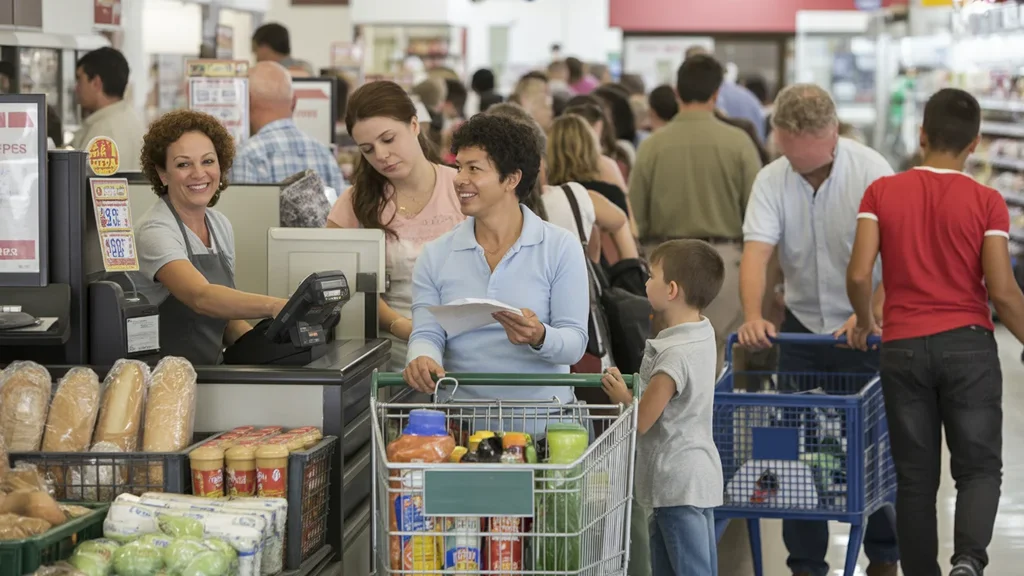
These prices illustrate how staple items tend to compare locally—not a full shopping list, and not a guarantee of what any single trip will cost. They’re reference points that reflect broader price positioning in the region, adjusted for local cost structure. Derived estimate based on national baseline adjusted by regional price parity; not an observed local price.
| Item | Typical Price |
|---|---|
| Bread (per pound) | $1.79 |
| Eggs (per dozen) | $2.50 |
| Milk (per half-gallon) | $3.98 |
| Chicken (per pound) | $1.98 |
| Ground beef (per pound) | $6.55 |
| Cheese (per pound) | $4.70 |
| Rice (per pound) | $1.03 |
Ground beef stands out as the most variable item on this list—it’s where store tier and sale timing create the widest swings. A family buying two pounds a week will see that difference compound quickly depending on whether they’re shopping discount, mid-tier, or premium. Eggs and milk, by contrast, tend to stay more consistent across stores, though premium organic or specialty versions can double the cost. Bread and rice anchor the low end of the budget; they’re stable, affordable, and less sensitive to store choice. Chicken and cheese fall somewhere in between: meaningful enough to notice, but not so volatile that they dominate weekly decisions.
The key takeaway isn’t any single price—it’s the spread. A household that defaults to convenience or proximity without considering store tier will spend noticeably more over a month than one that makes intentional stops at a discount grocer for bulk staples and reserves mid-tier or premium stores for specific needs. In a city where many neighborhoods offer access to multiple grocery formats within a few miles, that choice becomes a behavioral lever, not a logistical burden.
Store Choice & Price Sensitivity
Grocery price pressure in Las Vegas varies more by store tier than by neighborhood or season. The city supports a full spectrum of grocery formats—discount chains, mid-tier supermarkets, and premium or specialty grocers—and most residential areas offer access to at least two of those tiers without requiring long drives. That density creates a functional tradeoff: households can prioritize cost, convenience, or product selection, but rarely all three at once.
Discount grocers deliver the lowest per-unit prices on staples, especially for shelf-stable goods, dairy, and frozen items. They’re where families with volume needs see the most meaningful savings, particularly on ground beef, cheese, and snack items that add up fast with kids in the house. The tradeoff is narrower selection and a no-frills shopping experience—fewer organic options, limited prepared foods, and less emphasis on specialty or international ingredients. For a household focused on stretching a tight budget, that’s not a compromise; it’s the right tool for the job.
Mid-tier supermarkets occupy the middle ground: broader selection, more consistent produce quality, and a shopping environment that feels less utilitarian. Prices run higher than discount stores but not prohibitively so, especially on sale items or store-brand products. This is where many households default because it balances cost, variety, and convenience without requiring multiple stops. Singles and couples who cook regularly but don’t need bulk quantities often find mid-tier stores hit the right balance—they’re not overpaying for premium branding, but they’re also not navigating limited inventory.
Premium and specialty grocers cater to households prioritizing organic, local, or prepared options, and the price gap is significant. A cart filled at a premium grocer can run 30–50% higher than the same items at a discount store, and that gap widens on meat, produce, and dairy. For high-income households or those with specific dietary needs, the premium tier makes sense. For everyone else, it’s a discretionary choice that competes directly with other parts of the budget. The accessibility of all three tiers in Las Vegas means households can mix and match—staples from discount, specialty items from premium—without adding significant drive time or logistical complexity.
What Drives Grocery Pressure Here
Income is the clearest predictor of how grocery costs feel. A household earning near the median of $66,356 can absorb a $150–$200 weekly grocery bill for two adults without severe strain, assuming housing and transportation costs stay within typical bounds. But stretch that income across a family of four, and the same weekly spend starts to feel tight—not unmanageable, but tight enough that store choice and meal planning become necessary rather than optional. Lower-income households, especially those earning below $50,000, experience grocery costs as a persistent pressure point, one that forces tradeoffs between food quality, variety, and other essentials.
Household size amplifies every pricing decision. A single adult might spend $50–$70 a week on groceries and feel fine about it, even shopping mid-tier or premium stores occasionally. A family of four or five, buying the same per-pound prices, will easily triple or quadruple that spend, and suddenly the difference between discount and mid-tier pricing becomes a $50-per-week question. That’s where store tier choice stops being about preference and starts being about financial sustainability. Families feel grocery cost pressure most acutely because volume removes the cushion that smaller households enjoy.
Regional distribution and access patterns also shape the experience. Las Vegas benefits from a competitive grocery environment with high establishment density, meaning most households can reach multiple store formats without long drives or significant time costs. That reduces one common friction point—the “food desert” problem where low prices exist in theory but require car ownership and drive time to access in practice. Here, the infrastructure supports price-conscious behavior. Walkable access to groceries in parts of the city further reduces the hidden costs of shopping, especially for households that can combine errands on foot or via transit rather than making dedicated car trips.
Seasonality affects grocery costs in Las Vegas, though not as dramatically as in colder climates where winter reduces local produce availability. Prices on fresh fruits and vegetables fluctuate with national and regional growing seasons, and certain items—berries, stone fruits, leafy greens—swing noticeably between peak and off-peak periods. But because the city relies on distributed supply chains rather than hyper-local sourcing, those swings feel more like gentle waves than sharp spikes. The bigger seasonal factor is behavioral: summer heat drives up demand for ready-to-eat and hydration-focused items, while winter sees more home cooking and comfort food purchases, both of which shift spending patterns without necessarily raising or lowering total costs.
Practical Ways People Manage Grocery Costs
Store-switching is the most effective behavioral lever households have. Shopping discount stores for shelf-stable staples, dairy, and frozen goods, then supplementing with mid-tier or premium stores for fresh produce or specialty items, captures most of the savings without sacrificing variety. The key is intentionality—defaulting to convenience or proximity without considering price tier erodes the advantage. In a city where multiple store formats are accessible within a few miles for most households, the friction cost of switching is low enough that it becomes a practical strategy rather than an aspirational one.
Meal planning reduces waste and smooths spending. Households that plan a week’s worth of meals before shopping avoid impulse purchases, minimize spoilage, and buy only what they’ll actually use. This matters most for perishables—produce, meat, dairy—where waste directly translates to lost money. Singles and couples benefit especially from planning because their smaller volumes make waste more visible and more costly per person. Families benefit because planning helps them buy in bulk without overbuying, and it reduces the temptation to fill gaps with expensive convenience items mid-week.
Buying store brands instead of name brands delivers consistent savings without requiring extreme couponing or sale-chasing. Most mid-tier and discount grocers offer store-brand versions of staples—pasta, rice, canned goods, dairy, frozen vegetables—at 20–40% below name-brand equivalents, often with comparable quality. Over a month, that adds up. High-income households may not notice or care; budget-conscious households should default to store brands unless there’s a specific reason not to.
Bulk buying works well for non-perishables and household staples, especially for families. Warehouse clubs and discount grocers offer lower per-unit pricing on items like rice, pasta, canned goods, and frozen proteins, and the savings scale with volume. The tradeoff is upfront cost and storage space, which makes bulk buying less practical for singles or couples in smaller living spaces. But for families with room to store and the cash flow to buy larger quantities upfront, it’s one of the simplest ways to lower the effective cost per meal over time.
Avoiding prepared and convenience foods reduces costs significantly. Pre-cut vegetables, rotisserie chicken, meal kits, and grab-and-go items carry convenience premiums that add up fast. Households that cook from scratch—even simple, quick meals—spend less per serving and retain more control over ingredients and quality. The tradeoff is time, which is a real cost, but for households with the capacity to cook regularly, it’s one of the most reliable ways to keep grocery spending in check without feeling deprived.
Groceries vs Eating Out (Directional)
Cooking at home consistently costs less per meal than eating out, and the gap widens with household size. A homemade dinner for two adults might cost $8–$12 in ingredients; the same meal at a casual restaurant runs $30–$50 before tip. For a family of four, the difference becomes even more pronounced—home cooking scales efficiently with volume, while restaurant checks multiply per person. That doesn’t mean eating out is irrational; it’s a trade of money for time, convenience, and experience. But for households feeling grocery cost pressure, frequent dining out competes directly with the budget and often loses when scrutinized.
The tradeoff becomes more nuanced when considering partial substitutions. Buying a rotisserie chicken or pre-made sides from a grocery store costs more than cooking from scratch but far less than a full restaurant meal, and it saves time without the full convenience premium of takeout. Similarly, packing lunches instead of buying them daily creates meaningful savings over a month—$10–$15 per workday adds up to $200–$300 monthly, which is often more than a household’s entire weekly grocery bill. These aren’t all-or-nothing decisions; they’re incremental choices that shift the balance between convenience and cost.
For households trying to manage overall food spending, the most effective strategy is usually to cook most meals at home and treat dining out as intentional rather than default. That doesn’t require eliminating restaurants entirely—it means being deliberate about when and why you’re paying the premium. In a city with accessible grocery infrastructure and competitive store pricing, the tools to keep food costs manageable are available; the question is whether households use them consistently or drift toward convenience out of habit.
FAQs About Grocery Costs in Las Vegas (2026)
Is it cheaper to shop in bulk in Las Vegas? Bulk buying lowers per-unit costs on non-perishables and staples, especially for families with storage space and upfront cash flow. Warehouse clubs and discount grocers offer meaningful savings on items like rice, pasta, canned goods, and frozen proteins, but the strategy works best when you can actually use what you buy before it expires.
Which stores in Las Vegas are best for low prices? Discount grocery chains consistently deliver the lowest prices on staples, dairy, and frozen goods, while mid-tier supermarkets balance cost and selection. Premium and specialty grocers charge noticeably more but offer organic, local, and prepared options. Most neighborhoods offer access to multiple tiers, so households can mix and match based on what they’re buying.
How much more do organic items cost in Las Vegas? Organic versions of staples—produce, dairy, meat—typically run 30–60% higher than conventional equivalents, with the gap widest on animal products and fresh produce. For households prioritizing organic options, shopping premium or specialty stores makes sense, but it’s a discretionary cost that competes with other budget priorities.
How do grocery costs for two adults in Las Vegas tend to compare to nearby cities? Las Vegas sits slightly below the national average for grocery prices, thanks to a regional price level of 97. That means staples cost a bit less here than in higher-cost metros, though the difference is subtle—more of a gentle tailwind than a dramatic advantage. Store choice and shopping behavior matter more than regional price positioning for most households.
How do households in Las Vegas think about grocery spending when cooking at home? Most households treat groceries as a controllable expense—one where intentional choices about store tier, meal planning, and waste reduction create meaningful savings over time. Because the city supports a competitive grocery environment with accessible store options, the friction cost of price-conscious shopping is low, which makes behavioral strategies more practical than in less dense or car-dependent areas.
How Groceries Fit Into the Cost of Living in Las Vegas
Grocery costs sit in the middle of the cost structure for most households—less dominant than housing, less variable than utilities, but persistent and unavoidable. A household spending $600–$800 per month on groceries is allocating roughly 10–15% of a median income to food at home, which is manageable but not trivial. For lower-income households, that share rises, and grocery costs start competing more directly with other essentials. For higher-income households, groceries fade into the background unless dietary preferences or household size push spending higher.
What makes groceries distinct from other cost categories is the degree of control households have. You can’t negotiate your rent or eliminate your utility bill, but you can choose where you shop, what you buy, and how much you cook. That control matters because it means grocery pressure, while real, is also responsive to behavior. Families that shop discount stores for staples, plan meals to minimize waste, and cook from scratch consistently spend less than those who default to convenience and proximity. The infrastructure in Las Vegas supports that control—high grocery density, accessible store tiers, and competitive pricing create an environment where intentional choices translate into real savings.
For a complete picture of how groceries interact with housing, transportation, and utilities to shape overall affordability, see A Month of Expenses in Las Vegas: What It Feels Like. That article walks through the full monthly budget and shows where grocery spending fits relative to other fixed and variable costs. The goal here isn’t to simulate a total food budget—it’s to explain why groceries feel the way they do in this city, who feels pressure most, and what levers households have to manage that pressure without sacrificing quality or variety. If you’re moving to Las Vegas or trying to tighten your budget, understanding grocery cost structure and store tier dynamics gives you a practical starting point for making decisions that fit your household’s needs and income.
How this article was built: In addition to public economic data, this article incorporates location-based experiential signals derived from anonymized geographic patterns—such as access density, walkability, and land-use mix—to reflect how day-to-day living actually feels in Las Vegas, NV.