
Can you live in Joliet without a car? The short answer is: it depends where you live and where you work. Joliet sits in a transportation middle ground—rail service connects the city to Chicago’s job centers, and parts of town show surprisingly strong pedestrian infrastructure, but the daily reality of running errands, getting groceries, or moving around outside core corridors still tilts heavily toward driving. Understanding how people actually get around here means looking past the presence of transit and into the structure of everyday mobility.
How People Get Around Joliet
Joliet’s transportation landscape reflects its role as a regional anchor city in the Chicago metro—close enough to benefit from commuter rail, but spread out enough that most households still rely on cars for daily life. The city’s building density exceeds typical suburban thresholds, and mixed residential and commercial land use creates pockets where walking feels practical. Pedestrian infrastructure in certain areas is robust relative to the road network, suggesting that some neighborhoods were designed—or have evolved—to support foot traffic.
But that walkability doesn’t extend uniformly. Grocery density falls below baseline thresholds, meaning even residents in pedestrian-friendly zones often drive to stock up on essentials. The result is a split mobility pattern: transit works well for linear commutes into Chicago, while cars dominate the multi-stop, errand-heavy rhythms of daily household logistics. Newcomers often overestimate how far transit will carry them beyond the commute itself.
Public Transit Availability in Joliet
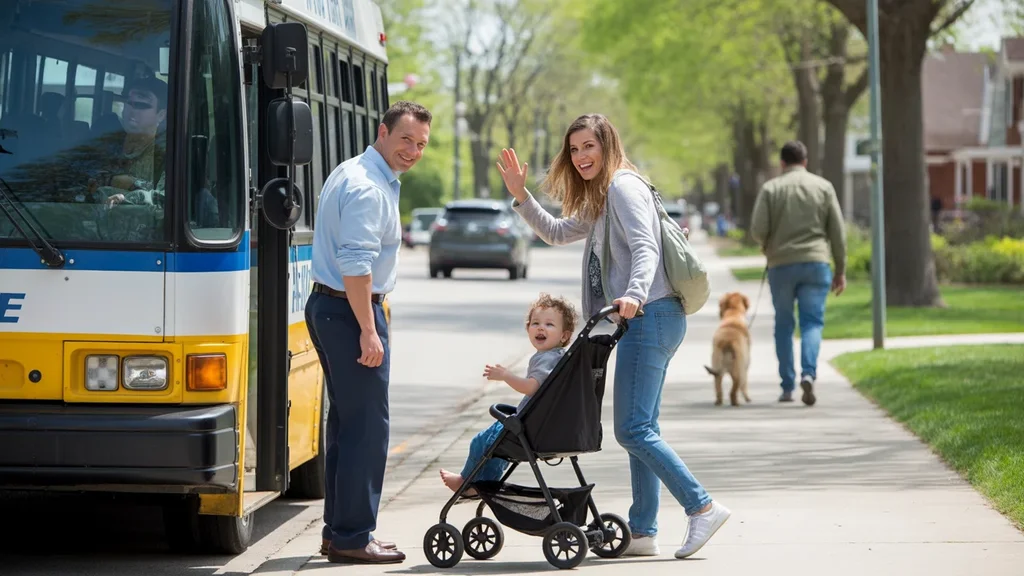
Public transit in Joliet often centers around systems such as Metra and Pace, though coverage and service patterns vary significantly by neighborhood. Rail service is present and plays a meaningful role for commuters heading to downtown Chicago or other regional employment hubs. For workers whose jobs align with rail corridors, transit offers a viable alternative to driving—particularly during peak hours when highway congestion adds unpredictability to car commutes.
Where transit falls short is in comprehensive local coverage. Bus service exists, but the network is better suited to corridor travel than neighborhood-to-neighborhood mobility. Late-night service is limited, and reaching destinations outside the core transit zones typically requires a car. Families managing school drop-offs, weekend errands, or multi-stop trips find that transit doesn’t eliminate the need for vehicle access—it supplements it for specific use cases.
The practical takeaway: transit in Joliet is a tool for commuting, not a replacement for car ownership. It works best when your daily routine aligns with fixed routes and schedules, and when your destination sits near a station or major stop.
Driving & Car Dependence Reality
Most Joliet households own at least one car, and for good reason. The city’s layout—shaped by decades of auto-oriented development—means that driving offers flexibility transit can’t match. Parking is generally abundant and free in residential areas, and even in denser pockets, finding a spot rarely requires the kind of hunting common in urban cores. That ease reinforces car reliance: when parking isn’t a friction point, there’s little structural incentive to leave the car at home.
Sprawl plays a role, too. Joliet’s footprint extends across a wide area, and commercial development clusters along arterial roads rather than within tight, walkable districts. Reaching a grocery store, pharmacy, or big-box retailer almost always means driving, even for residents in neighborhoods with strong pedestrian infrastructure. The car isn’t just convenient—it’s the default mode for anything beyond the commute.
For households weighing whether to go car-free or car-light, the question isn’t whether it’s possible in theory—it’s whether the tradeoffs (limited grocery access, constrained errand flexibility, reliance on ride-hail for off-peak trips) fit your daily reality. For most, they don’t.
Commuting Patterns & Daily Mobility
Commuting in Joliet breaks into two distinct patterns. The first is the rail commuter: someone who lives near a Metra station and works in downtown Chicago or another transit-accessible job center. For this group, the commute is predictable, and the time spent on the train is often more productive or less stressful than navigating highway traffic. The average commute in Joliet runs around 29 minutes, but that figure masks wide variation—45% of workers face longer trips, often because they’re driving to jobs scattered across the metro region rather than concentrated along transit lines.
The second pattern is the multi-stop commuter or household juggling multiple destinations in a single day. For parents managing school runs, daycare pickups, and grocery stops, or for workers whose jobs require site visits or irregular hours, transit doesn’t offer the flexibility needed. About 12.5% of Joliet workers operate from home, sidestepping the commute entirely, but for everyone else, the structure of the day—and the city’s layout—shapes how much time and control you have over your mobility.
Proximity matters more than mode. Living near your job, your kids’ school, or your most frequent errands reduces commute friction regardless of whether you’re driving or riding. But in Joliet, that proximity is easier to achieve with a car than without one.
Who Transit Works For — and Who It Doesn’t
Transit in Joliet fits a specific profile: single commuters or couples without children, working traditional office hours in downtown Chicago or along Metra lines, and living within walking or biking distance of a station. For this group, rail service offers a genuine alternative to driving, particularly when factoring in highway congestion and the mental load of navigating rush-hour traffic.
Transit doesn’t work as well for families. Sparse grocery density and limited local bus coverage mean that even households in walkable pockets still need a car for weekly shopping, pediatrician visits, or weekend activities. Renters in core neighborhoods may find they can reduce car dependency more than homeowners in peripheral subdivisions, but “reduce” is the operative word—eliminating the car entirely requires either a very specific lifestyle or a willingness to rely heavily on ride-hail and delivery services.
Shift workers, freelancers, and anyone whose schedule doesn’t align with peak transit hours face the sharpest tradeoffs. Off-peak service is less frequent, and late-night options are minimal. If your workday ends at 11 p.m. or starts at 5 a.m., transit quickly becomes impractical.
Transportation Tradeoffs in Joliet
Choosing between transit and driving in Joliet isn’t about cost alone—it’s about control, predictability, and how much friction you’re willing to absorb in exchange for flexibility. Transit offers a fixed schedule and a defined route, which can be liberating if your routine aligns with it. You’re not stuck in traffic, you’re not hunting for parking, and you can read, work, or zone out during the ride. But that same rigidity becomes a constraint when your plans change, when you need to make an unplanned stop, or when the train schedule doesn’t match your meeting time.
Driving trades predictability for autonomy. You control your departure time, your route, and your stops. You’re not waiting for a bus that’s running late, and you’re not walking six blocks in the rain because the nearest stop isn’t quite close enough. But you’re also absorbing the variability of traffic, the wear of highway driving, and the mental load of navigation and parking.
For most Joliet households, the tradeoff resolves in favor of driving—not because transit doesn’t exist, but because the city’s structure rewards car ownership. The question isn’t whether you can use transit; it’s whether your daily life fits the corridors where transit actually works.
FAQs About Transportation in Joliet (2026)
Is public transit usable for daily commuting in Joliet?
Yes, if your job is in downtown Chicago or along a Metra line and you live near a station. Rail service is reliable for peak-hour commutes, and many Joliet residents use it to avoid highway congestion. For local trips or jobs outside transit corridors, a car remains the practical choice.
Do most people in Joliet rely on a car?
Yes. While rail transit serves commuters heading to Chicago, the city’s layout and sparse grocery density mean most households depend on cars for errands, shopping, and non-commute travel. Even in walkable pockets, car ownership is the norm.
Which areas of Joliet are easiest to live in without a car?
Neighborhoods near Metra stations with higher pedestrian infrastructure density offer the best shot at reducing car dependency. But “easiest” is relative—you’ll still face limitations on grocery access and local errands. Car-free living is possible for a narrow slice of households, but car-light is more realistic.
How does commuting in Joliet compare to nearby cities?
Joliet’s average commute runs around 29 minutes, but 45% of workers face longer trips—often because jobs are scattered across the metro region rather than concentrated in one transit-accessible core. Compared to smaller suburbs, Joliet offers better rail access; compared to Chicago itself, it requires more driving for daily needs.
Can you bike for transportation in Joliet?
Cycling infrastructure exists in pockets, with bike-to-road ratios in the medium range. Some residents bike for recreation or short commutes, but the city’s layout and traffic patterns make biking less practical for most daily trips. It’s a supplement, not a primary mode, for the majority of households.
How Transportation Fits Into the Cost of Living in Joliet
Transportation isn’t just a line item—it’s a structural factor that shapes where you can live, how much time you spend in transit, and how much flexibility you have in your day. In Joliet, that structure tilts toward car ownership, which means households absorb not just fuel and maintenance exposure, but also the time cost of driving and the constraints of parking and traffic.
For a fuller picture of how transportation fits into monthly expenses, budget planning, cost breakdown, the Monthly Spending guide breaks down where money goes and how different household types experience cost pressure. Transit can reduce some of that exposure—but only if your routine aligns with where trains and buses actually run.
The bottom line: Joliet offers transit options that work well for specific commutes, but the city’s layout still rewards car ownership for daily life. Understanding that split—and being honest about which pattern fits your household—makes the difference between a transportation setup that works and one that constantly fights against the city’s structure.
How this article was built: In addition to public economic data, this article incorporates location-based experiential signals derived from anonymized geographic patterns—such as access density, walkability, and land-use mix—to reflect how day-to-day living actually feels in Joliet, IL.