
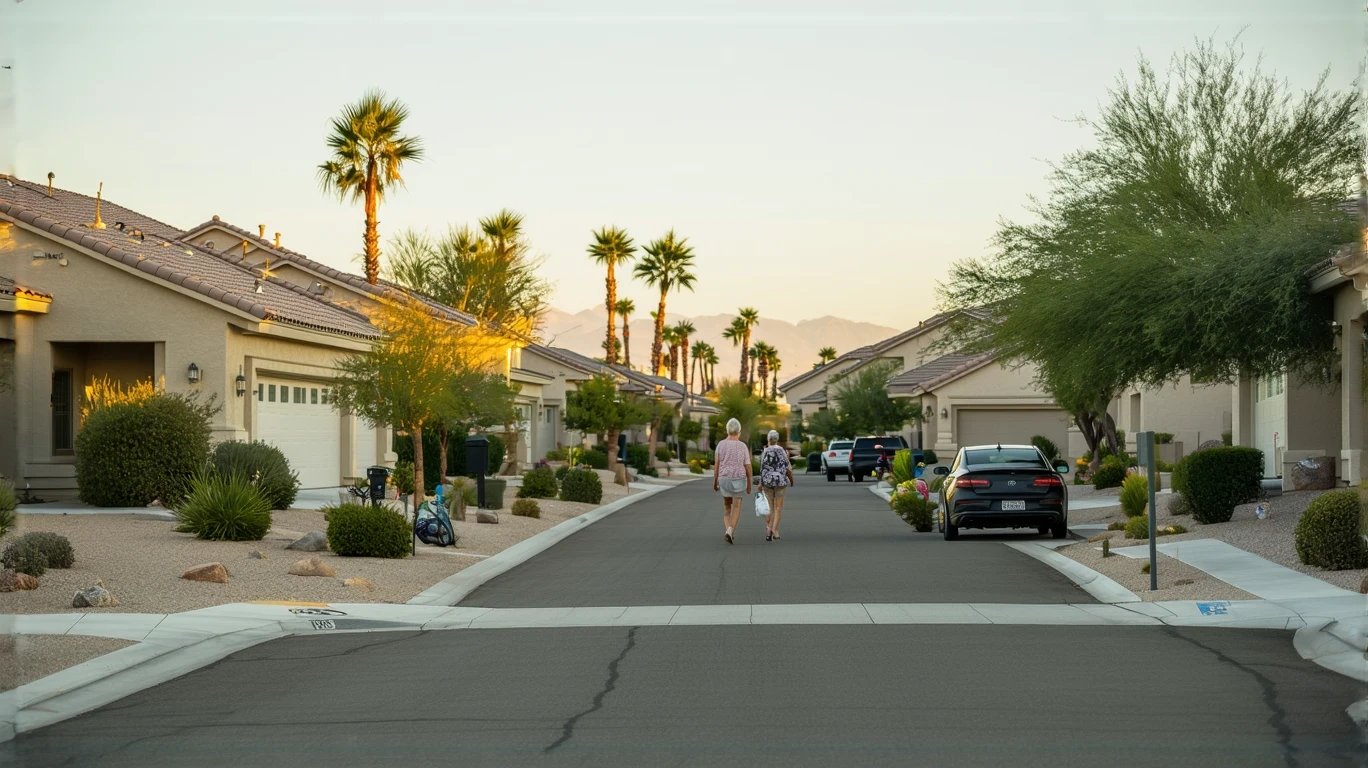
Why Retirees Choose Henderson
What makes Henderson attractive enough to draw retirees from across the country, and does it deliver on the promise of affordable, comfortable retirement living? For many seniors, Henderson offers a compelling combination: no state income tax on retirement income, a warm climate that keeps heating bills low, and proximity to Las Vegas medical centers and entertainment without the density of the Strip. The city has built a reputation as a retirement-friendly suburb, with established 55+ communities, active senior centers, and the kind of infrastructure that supports aging in place.
Henderson earns a retirement suitability score of 72 out of 100. This reflects strong advantages in tax treatment, climate, and cost of living, balanced against considerations like car dependency for most errands, intense summer heat, and the need to travel for hospital services. The median household income of $85,311 per year suggests a stable, middle-to-upper-middle-class community, and the regional price parity index of 97 means overall costs run slightly below the national average—a meaningful edge for retirees on fixed incomes.
The city’s structure supports retirement living in specific ways. Parks and water features are present throughout Henderson, and walkable pockets exist in parts of the city where pedestrian infrastructure is well-developed. However, grocery stores and services tend to cluster along corridors rather than being broadly accessible on foot, which means most retirees will rely on a car or ride services for daily errands. Bus service is available, but the system is designed more for commuters than for seniors running household logistics. This is a trade-off worth understanding early: Henderson is not a walkable retirement enclave, but it does offer the space, amenities, and tax advantages that many retirees prioritize.
Healthcare Access for Seniors
Healthcare infrastructure in Henderson operates on two levels. Routine care is locally accessible—clinics, primary care offices, and pharmacies are present throughout the city, making it straightforward to manage chronic conditions, refill prescriptions, and handle minor health issues without long drives. For retirees managing diabetes, hypertension, or arthritis, this local availability reduces friction and keeps care consistent.
However, hospital services require travel to nearby facilities such as Henderson Hospital or St. Rose Dominican, both part of larger health systems serving the Las Vegas metro. For emergency care, specialist consultations, or surgical procedures, retirees should expect a drive of 15 to 30 minutes depending on location within Henderson. This is typical for suburban retirement destinations and not a barrier for most seniors, but it does mean that proximity to a specific hospital or specialist may influence where within Henderson you choose to live.
Medicare acceptance is widespread in the area, and the presence of multiple health systems means retirees have options when selecting providers. Prescription access is strong—pharmacies are common, and many offer delivery or mail-order options for maintenance medications. Physical therapy, urgent care, and outpatient services are available locally, which matters for post-surgical recovery or ongoing rehabilitation. For retirees with complex medical needs, the key is to establish care relationships early and confirm that your specialists are accessible within the broader Las Vegas metro network.
Senior-Friendly Amenities and Services
Henderson has invested in senior infrastructure, and it shows. The city operates senior centers that offer fitness classes, social programs, educational workshops, and meal services. These centers function as community hubs, and many retirees find that regular participation helps maintain social connections and physical activity. Recreational facilities—pools, walking trails, and fitness rooms—are common in 55+ communities, and some are accessible to the broader public through city programs.
Transportation options are more limited than in denser metros. Bus service is available, but routes are designed primarily for commuters rather than seniors running errands. Some senior centers and nonprofit organizations offer shuttle services for medical appointments or grocery trips, but these require advance scheduling and may not cover all areas. For most retirees, a personal vehicle or access to ride services (Uber, Lyft, or family support) is essential. Grocery delivery has become more common, and many retirees use services like Instacart or store-specific delivery to reduce the need for frequent shopping trips.
Libraries, community colleges, and lifelong learning programs are accessible in Henderson and nearby Las Vegas. UNLV offers programs for older adults, and local libraries host book clubs, computer classes, and lecture series. For retirees who value intellectual engagement, these resources are present and well-maintained. The challenge is less about availability and more about transportation—getting to these programs requires planning if you’re not driving.
Cost of Living for Retirees
Housing costs in Henderson vary widely depending on the type of property and community. The median home value is $427,900, which reflects the single-family market. Many retirees, however, opt for 55+ communities where condos and townhomes are available at lower price points—often in the $250,000 to $350,000 range—and include amenities like pools, fitness centers, and landscaping. For those who prefer to rent, the median gross rent is $1,641 per month, though smaller units in senior communities may be available for less.
Property taxes in Nevada are relatively moderate, and seniors may qualify for exemptions or deferrals depending on income and age. It’s worth confirming eligibility early, as these programs can reduce annual housing costs meaningfully. Homeowners association fees are common in 55+ communities and typically range from $150 to $400 per month, covering exterior maintenance, landscaping, and shared amenities.
Utility costs are shaped by climate. Electricity in Henderson runs 14.20¢ per kWh, which is moderate, but the extended cooling season—May through October, with triple-digit summer heat—drives sustained air conditioning use. A typical household using around 1,000 kWh per month would see an illustrative electric bill of approximately $142 per month before fees, though summer months often push usage higher. Natural gas, priced at $11.96 per MCF, is used primarily for water heating and cooking, as heating demand is minimal in Henderson’s mild winters. Some utilities offer senior rate programs or budget billing to smooth seasonal spikes.
The major financial advantage for retirees in Henderson is Nevada’s lack of state income tax. Social Security benefits, pension income, IRA and 401(k) distributions, and investment income are not taxed at the state level. For a retiree with $50,000 in annual income from these sources, this can represent savings of $2,000 to $4,000 per year compared to states with income tax on retirement income. This advantage compounds over time and is one of the primary reasons retirees choose Nevada.
Monthly Retirement Budget in Henderson
Here’s what a typical monthly retirement budget might look like in Henderson:
| Expense Category | Modest Lifestyle | Comfortable Lifestyle |
|---|---|---|
| Housing (mortgage/rent + HOA) | $1,400 | $2,200 |
| Utilities (electric, gas, water, internet) | $220 | $280 |
| Groceries | $350 | $500 |
| Healthcare (Medicare supplement, prescriptions, co-pays) | $400 | $600 |
| Transportation (car payment/maintenance, gas, insurance) | $350 | $500 |
| Entertainment & Dining | $200 | $400 |
| Miscellaneous (personal care, clothing, gifts) | $180 | $300 |
| Total Monthly | $3,100 | $4,780 |
Estimates based on average senior spending patterns and local costs.
These figures assume housing is either paid off with HOA fees or includes a modest mortgage or rent. A comfortable lifestyle includes more discretionary spending on dining, travel, and hobbies, while a modest lifestyle focuses on essentials. Both budgets assume Medicare coverage with a supplement plan, which is standard for retirees over 65.
Community and Social Opportunities
Henderson supports an active social life for retirees, but participation requires intentionality. Senior centers host regular activities—fitness classes, card games, potlucks, and educational workshops—and serve as natural gathering points for newcomers looking to build connections. Many 55+ communities have their own social calendars, including holiday events, walking groups, and hobby clubs, which can reduce the need to seek external programs.
Volunteer opportunities are available through local nonprofits, libraries, schools, and hospitals. For retirees who want to stay engaged and contribute, these roles provide structure and purpose. Faith communities are present across denominations, and many offer senior-specific programs, fellowship groups, and service projects.
Recreational programs are accessible through the city’s parks and recreation department, which offers classes in everything from watercolor painting to line dancing. The challenge, again, is transportation—getting to these programs requires a car or coordination with others. Walking groups and outdoor clubs take advantage of Henderson’s parks and trails, though summer heat limits activity to early mornings or evenings during the hottest months.
Proximity to family is a common reason retirees choose Henderson. The city is well-connected by air (Las Vegas airport is nearby) and by road, making it easy for out-of-town relatives to visit. For retirees relocating to be near adult children or grandchildren, Henderson’s suburban layout and family-friendly infrastructure support intergenerational connection.
Aging in Place Considerations
Aging in place in Henderson is feasible with planning. Many newer homes and 55+ communities are built with accessibility in mind—single-story layouts, wide doorways, walk-in showers—but older properties may require modification. Home modification services are available locally, including contractors who specialize in grab bar installation, ramp construction, and bathroom retrofits. Occupational therapists can assess homes and recommend changes to reduce fall risk and improve mobility.
In-home care is available through agencies that provide personal care aides, skilled nursing, and companionship services. For retirees who need help with daily activities but prefer to remain at home, these services bridge the gap between independence and assisted living. Costs vary based on hours and level of care, but the infrastructure exists to support aging at home for those who choose it.
Assisted living facilities and memory care communities are present in Henderson and nearby Las Vegas, offering options for retirees whose needs exceed what in-home care can provide. Touring facilities early, even before care is needed, helps families understand what’s available and what costs to expect.
Walkability within Henderson is limited outside of specific pockets. For retirees who lose the ability to drive, day-to-day costs shift as reliance on ride services or family support increases. This is a reality worth planning for—either by choosing a home in a walkable area, near transit, or within a community that offers transportation assistance.
Climate considerations matter for aging in place. The extended cooling season means air conditioning is not optional, and power outages during summer heat can be dangerous for seniors. Having a plan for extreme heat days—whether that’s a backup generator, a cooling center location, or a nearby family member—is part of responsible aging in place in Henderson.
FAQs About Retirement in Henderson
What’s the average cost of retirement in Henderson?
A modest retirement lifestyle in Henderson typically requires around $3,100 per month, covering housing, utilities, groceries, healthcare, and transportation. A more comfortable lifestyle, with additional discretionary spending, runs closer to $4,780 per month. These figures assume Medicare coverage and either paid-off housing or moderate rent. The lack of state income tax on retirement income provides meaningful savings compared to other states.
How good is healthcare access for seniors?
Routine healthcare is locally accessible—clinics, primary care offices, and pharmacies are present throughout Henderson. However, hospital services and specialist care typically require a drive to nearby facilities in the Las Vegas metro, usually 15 to 30 minutes depending on location. Medicare acceptance is widespread, and the presence of multiple health systems gives retirees options when selecting providers.
Are there active senior communities?
Yes. Henderson has numerous 55+ communities with amenities like pools, fitness centers, and organized social activities. The city also operates senior centers that host classes, meals, and programs. For retirees who want an active social life, the infrastructure is in place, though participation requires transportation and initiative.
What are the tax implications of retiring in Nevada?
Nevada has no state income tax, which means Social Security benefits, pension income, IRA and 401(k) distributions, and investment income are not taxed at the state level. Property taxes are moderate, and seniors may qualify for exemptions or deferrals. Sales tax applies to most purchases, but the overall tax burden for retirees is lower than in many other states.
Making the Move: Is Henderson Right for Your Retirement?
Henderson offers clear advantages for retirees: favorable tax treatment, moderate cost of living, warm climate, and established senior infrastructure. For those who value financial predictability, outdoor activity, and proximity to entertainment and medical centers, the city delivers. The trade-offs are equally clear—car dependency for most errands, intense summer heat, and the need to travel for hospital services. These are not disqualifying factors, but they do require planning.
The decision to retire in Henderson depends on your priorities. If you’re comfortable driving, value tax savings, and prefer suburban space over urban density, Henderson is worth serious consideration. If you need walkable access to services, prefer public transit, or have complex medical needs requiring frequent specialist visits, you’ll want to weigh those factors carefully against the city’s strengths.
For those evaluating renting vs owning, Henderson’s housing market offers flexibility—55+ communities provide lower-maintenance ownership options, while rental availability supports those who prefer not to buy. Either path is viable depending on your financial situation and long-term plans.
Ultimately, Henderson works best for retirees who are prepared for its structure: a car-oriented suburb with strong amenities, tax advantages, and a warm climate that requires seasonal adaptation. Visit during summer to experience the heat firsthand, tour senior communities and healthcare facilities, and talk to current residents about their experience. The city’s retirement appeal is real, but it’s not universal—your fit depends on how well its trade-offs align with your needs.
How this article was built: In addition to public economic data, this article incorporates location-based experiential signals derived from anonymized geographic patterns—such as access density, walkability, and land-use mix—to reflect how day-to-day living actually feels in Henderson, NV.