
A first-time renter moving to Grandview faces a monthly housing cost around $945, but that figure alone doesn’t capture the full cost structure. In a city where pedestrian infrastructure sits below typical thresholds and food and grocery density remains sparse, housing affordability intersects directly with transportation dependency and household logistics. A modest rent becomes less modest when every errand requires a car, and every trip must be planned around limited nearby options. For buyers, the median home value of $154,400 opens the door to ownership at a price point well below national norms—but the same infrastructure realities apply. Ownership here isn’t just about monthly payments; it’s about locking in predictability in a place where where money goes depends heavily on how you move through the city and how much friction you’re willing to manage.
Grandview’s housing market reflects its role as a low-rise, car-oriented suburb within the Kansas City metro. The housing stock is dominated by single-family homes, and both residential and commercial land uses are present, but they don’t cluster in walkable nodes. That spatial arrangement shapes cost exposure in ways that don’t show up in rent or purchase price alone. Renters gain flexibility but remain exposed to future rent adjustments and must absorb the full cost of car dependency without the tax or equity offsets available to owners. Buyers gain control over long-term housing expenses and can stabilize costs that renters cannot, but they inherit responsibility for maintenance, utilities, and the ongoing expense of navigating a place where daily errands require intentional planning.
This article explains how housing costs behave in Grandview—not what you can afford, but what each housing choice exposes you to over time, and how the city’s layout amplifies or dampens those exposures.
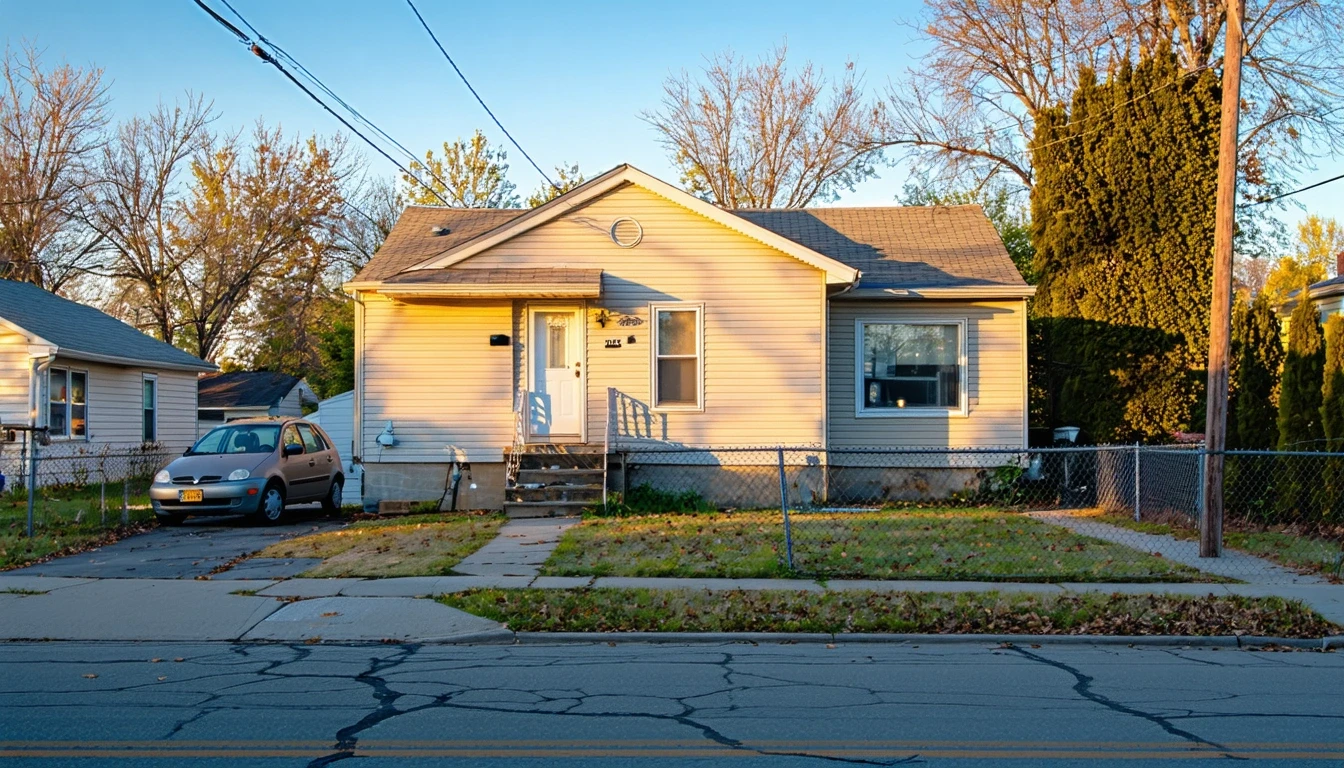
The Housing Market in Grandview Today
Grandview’s housing market is shaped by three overlapping forces: its position within the Kansas City metro, its car-oriented infrastructure, and a housing stock that skews toward low-rise, single-family construction. The result is a market where entry costs remain accessible, but the full cost of living depends on how well a household can absorb the logistics of car dependency and sparse commercial density.
The median home value of $154,400 sits well below national and regional benchmarks, making ownership attainable for households who might be priced out of more centrally located or transit-rich suburbs. But that accessibility comes with trade-offs. Grandview’s pedestrian infrastructure density falls below typical thresholds, and the ratio of walkable paths to road network is low. Bike infrastructure exists in pockets, but it doesn’t form a continuous system. For most residents, the car is not optional—it’s structural. That reality doesn’t just affect transportation costs; it reshapes how housing itself functions. A home in Grandview isn’t just shelter; it’s a base of operations for a household that will drive to work, drive to groceries, and drive to most services.
The rental market reflects similar dynamics. At $945 per month, median gross rent is modest compared to more urbanized parts of the metro, but renters face the same infrastructure constraints as buyers. The difference is that renters can’t offset transportation costs with mortgage interest deductions or property tax stability, and they remain exposed to rent increases that owners can avoid by locking in fixed-rate financing. For renters, Grandview offers lower entry costs but less control over long-term expense trajectories.
What newcomers often misunderstand is that Grandview’s housing affordability is not a signal of low demand or declining quality—it’s a reflection of trade-offs embedded in the city’s spatial structure. The housing stock is well-maintained, and the presence of both residential and commercial land uses indicates a functioning local economy. But the layout prioritizes car access over pedestrian convenience, and that priority filters into every dimension of household cost. Buyers and renters alike must evaluate whether the savings on housing are worth the added friction in daily logistics and the ongoing cost of vehicle dependency.
Renting in Grandview
Renting in Grandview means accepting a trade-off: modest monthly housing costs in exchange for limited control over future increases and full exposure to the cost of car dependency. At $945 per month, median gross rent is accessible for households earning near the city’s median income of $51,048 per year, but that figure represents only the starting point of monthly budget planning.
Rental pressure in Grandview is shaped less by scarcity and more by the broader dynamics of the Kansas City metro. The city functions as a bedroom community for commuters working elsewhere in the metro, and rental availability tends to follow single-family home turnover rather than purpose-built multifamily development. That means rental stock is dispersed, and renters often compete for homes rather than apartments. The upside is more space and privacy; the downside is that renters inherit utility exposure and maintenance responsibilities that would be absorbed by a landlord in a traditional apartment complex.
Location within Grandview matters, but not in the way it does in denser cities. There are no walkable commercial corridors where renters can reduce car dependency, and public transit options are limited. Instead, location affects commute length and proximity to the handful of commercial clusters that do exist. A rental closer to major commuter routes may save time and fuel, but it won’t eliminate the need for a vehicle. Renters should expect that every trip—work, groceries, healthcare—will require driving, and that the cost of maintaining a car (insurance, fuel, maintenance) will run parallel to rent every month.
The rental experience in Grandview also reflects the city’s low-rise, single-family character. Renters are more likely to occupy standalone homes or duplexes than large apartment complexes, which means they often pay separately for utilities, handle yard maintenance, and manage relationships with individual landlords rather than professional property management companies. That arrangement can offer more autonomy, but it also means renters bear more of the operational cost and complexity that ownership would entail—without the equity or tax benefits.
For renters evaluating Grandview, the key question is not whether rent is affordable in isolation, but whether the total cost structure—rent plus transportation plus time spent managing logistics in a car-dependent layout—fits their household’s capacity and priorities.
Owning a Home in Grandview
Ownership in Grandview offers something renters cannot access: the ability to lock in the largest component of housing cost and eliminate exposure to rent volatility. At a median home value of $154,400, buyers can enter the market at a price point that remains accessible relative to incomes in the Kansas City metro, and they gain control over long-term cost trajectories in ways that renters do not.
The primary advantage of ownership here is predictability. A fixed-rate mortgage stabilizes the principal and interest portion of monthly housing cost for the life of the loan, and while property taxes and insurance will fluctuate, those changes are typically gradual and tied to assessable value rather than market rent pressure. In a city where rental stock is limited and rent increases are difficult to predict, ownership provides a hedge against future cost escalation.
But ownership in Grandview also means assuming full responsibility for costs that renters can sometimes avoid or defer. Property taxes, while not provided in the current data, are a recurring obligation that scales with home value and local fiscal needs. Homeowners must budget for these annually, and they should expect that tax rates can shift in response to school funding, infrastructure investment, or municipal budget gaps. Insurance costs are similarly variable, shaped by the home’s age, condition, and exposure to weather-related risk. Grandview’s climate includes both extended cooling seasons and cold winter stretches, and homes must be insulated and maintained to handle that range.
Maintenance is another ownership-specific exposure. In a low-rise, single-family market, most homes come with yards, driveways, and standalone systems (HVAC, water heaters, roofing) that require periodic replacement. These costs are lumpy and unpredictable, and they fall entirely on the homeowner. A renter facing a broken furnace calls the landlord; an owner facing the same problem writes a check. Over time, these costs add up, and they must be planned for even when they’re not immediately visible.
Homeownership in Grandview also intersects with the city’s car-oriented layout in ways that amplify the value of ownership. Because most households will own at least one vehicle and drive frequently, having a garage, driveway, and space to manage vehicle maintenance becomes a functional asset. Renters may lack secure parking or space to handle car-related tasks, but owners can design their home environment to support the transportation patterns the city requires.
The decision to buy in Grandview is not primarily about affordability in the moment—it’s about whether a household values control, stability, and the ability to absorb maintenance risk in exchange for eliminating rent volatility and building equity over time.
Apartment vs House in Grandview — Cost Behavior Comparison
In Grandview, the distinction between renting an apartment and renting or owning a house is not just about space—it’s about which costs you control, which you inherit, and how the city’s infrastructure shapes your exposure to each.
| Expense Category | Apartment | House |
|---|---|---|
| Utilities (Electricity) | Lower usage; smaller footprint reduces cooling/heating load in Grandview’s variable climate | Higher usage; standalone HVAC systems must condition larger spaces through hot summers and cold winters |
| Maintenance Responsibility | Landlord typically covers; tenant calls for repairs | Owner or tenant responsible; all systems, exterior, and yard fall to occupant |
| Parking & Vehicle Storage | Often limited or uncovered; may lack space for vehicle maintenance or multiple cars | Garage or driveway standard; supports car dependency and reduces weather exposure for vehicles |
| Predictability Over Time | Rent can increase annually; tenant has no control over timing or magnitude | Fixed-rate mortgage locks in principal/interest; taxes and insurance shift gradually |
Why these categories matter in Grandview: The city’s car-oriented layout and sparse errands accessibility mean that vehicle storage and maintenance space become functional necessities, not luxuries. Houses provide that space; apartments often do not. Grandview’s climate—hot summers and cold winters—creates utility exposure that scales with square footage and insulation quality, making apartment living more predictable for cost-sensitive households. Finally, because Grandview’s rental stock skews toward single-family homes rather than purpose-built apartments, many renters occupy houses and inherit maintenance responsibilities without the equity or tax benefits of ownership. The table reflects these structural differences, not universal apartment-vs-house rules.
Utilities & Upkeep Differences
Utility and maintenance costs in Grandview are shaped by two local realities: the city’s climate, which demands both cooling and heating across the year, and its housing stock, which is dominated by low-rise, single-family homes with standalone systems.
Electricity in Grandview is priced at 13.12¢ per kilowatt-hour, and natural gas costs $16.48 per thousand cubic feet. Those rates are inputs, but the cost experience depends on how much energy a household uses—and that depends on the home’s size, insulation, and the intensity of seasonal demand. Grandview’s summers bring extended heat that drives air conditioning use, and its winters require heating systems to run for weeks at a time. In a single-family home, both systems are standalone and condition the entire structure. In an apartment, shared walls and smaller square footage reduce the load. The difference is not trivial; it compounds month after month and defines whether utility bills are a minor line item or a dominant cost.
Maintenance exposure follows a similar pattern. Apartments shift most upkeep responsibility to landlords, and even when tenants pay for utilities, they don’t pay for roof repairs, HVAC replacement, or exterior painting. Homeowners in Grandview absorb all of it. The low-rise housing stock means most homes include yards, driveways, and aging systems that require periodic replacement. A furnace or air conditioner in a Grandview home is not a shared building system—it’s a single-family unit that will eventually fail, and replacement costs fall entirely on the homeowner.
The city’s car-oriented layout also affects upkeep indirectly. Because most households own vehicles and drive frequently, homes with garages or covered parking reduce weather-related wear on cars and provide space for maintenance tasks. Renters in apartments may lack that space, which means they pay more for vehicle upkeep over time or accept faster depreciation. Homeowners can design their property to support the transportation patterns the city requires, reducing long-term cost and hassle.
For households comparing housing types, the key insight is that utility and maintenance costs are not fixed—they scale with housing form, and Grandview’s climate and infrastructure make that scaling more pronounced than it would be in a milder or more walkable city.
Rent vs Buy: Long-Term Exposure in Grandview
The decision to rent or buy in Grandview is not a question of affordability in a single month—it’s a question of which risks a household is willing to accept over time, and which costs they want to control.
Renters in Grandview face ongoing exposure to rent increases that they cannot predict or prevent. Lease renewals may bring modest adjustments or sharp jumps, depending on landlord strategy, market pressure, and turnover costs. Because Grandview’s rental stock is dispersed and skews toward single-family homes rather than large apartment complexes, renters have less leverage and fewer alternatives when facing an increase. Moving is costly and disruptive, and it doesn’t eliminate the risk—it just resets the clock. Over five or ten years, cumulative rent increases can erode the initial affordability that made Grandview attractive, and renters have no mechanism to lock in stability.
Buyers, by contrast, trade that volatility for a different set of exposures. A fixed-rate mortgage eliminates uncertainty around the largest component of housing cost, and while property taxes and insurance will shift over time, those changes are typically gradual and tied to home value rather than market rent dynamics. Buyers also gain the ability to build equity, which renters cannot, and they can deduct mortgage interest under certain conditions. But buyers inherit full responsibility for maintenance, and those costs are lumpy, unpredictable, and unavoidable. A roof replacement or HVAC failure can cost thousands of dollars, and there is no landlord to call.
In Grandview specifically, ownership also aligns better with the city’s car-oriented infrastructure. Because most households will own vehicles and drive frequently, having a garage, driveway, and space to manage vehicle-related tasks becomes a functional asset that reduces long-term transportation costs. Renters may lack that space, which means they pay more for parking, vehicle maintenance, and weather-related wear over time.
The long-term cost structure in Grandview favors buyers who can absorb maintenance risk and value predictability, and it penalizes renters who remain exposed to rent volatility without the equity or tax offsets that ownership provides. The question is not which option is cheaper in year one—it’s which option aligns with a household’s capacity to manage risk and their timeline for staying in the city.
FAQs About Housing Costs in Grandview
Is renting or buying more affordable in Grandview, MO?
Renting offers lower upfront costs and flexibility, but it leaves you exposed to future rent increases you can’t control. Buying requires more capital initially but locks in your largest housing cost and allows you to build equity. In Grandview’s car-oriented layout, ownership also provides space to manage vehicle dependency more efficiently, which reduces long-term transportation costs.
How does Grandview’s housing cost compare to the rest of the Kansas City metro?
Grandview’s median home value of $154,400 and median rent of $945 per month sit below many other Kansas City suburbs, but that affordability reflects trade-offs in walkability, transit access, and commercial density. You pay less for housing, but you’ll likely spend more on transportation and time managing errands in a car-dependent environment.
What hidden costs should renters in Grandview expect?
Renters in Grandview often occupy single-family homes rather than apartments, which means they may pay separately for utilities, handle yard maintenance, and manage relationships with individual landlords. They also face the full cost of car dependency—insurance, fuel, maintenance—without the tax deductions or garage space that homeowners can access.
Do property taxes in Grandview increase over time?
Property taxes fluctuate based on assessed home value and local fiscal needs, including school funding and infrastructure investment. While the current data does not include Grandview’s specific tax rate, homeowners should expect that taxes will shift gradually over time and plan for that variability in their long-term budget.
Is Grandview a good place for first-time homebuyers?
Grandview’s below-average home values make ownership accessible for first-time buyers who might be priced out of more centrally located suburbs. The city’s car-oriented layout favors households that already own vehicles and are comfortable with driving for most errands. Buyers gain stability and equity, but they must be prepared to absorb maintenance costs and manage the logistics of a low-density environment.
Making Housing Choices in Grandview
Housing costs in Grandview are shaped by forces that extend beyond rent or purchase price. The city’s car-oriented infrastructure, sparse commercial density, and low-rise housing stock create a cost structure where transportation, logistics, and long-term predictability matter as much as the monthly payment. Renters gain flexibility but remain exposed to rent volatility and the full cost of car dependency without the offsets that ownership provides. Buyers gain control, stability, and space to manage the transportation patterns the city requires, but they inherit maintenance risk and must plan for lumpy, unpredictable expenses.
For households evaluating Grandview, the decision is not whether housing is affordable in isolation—it’s whether the total cost structure, including the time and money required to navigate a car-dependent layout, aligns with their capacity and priorities. Families with vehicles, stable incomes, and a preference for single-family homes will find Grandview’s market accessible and functional. Renters seeking walkability, transit access, or dense commercial corridors will find the city’s layout increases friction and limits alternatives.
Grandview’s housing market rewards households who can absorb the trade-offs embedded in its spatial structure and who value predictability over convenience. For those households, the city offers an entry point into ownership and a cost structure that remains manageable as long as car dependency and logistics planning are treated as fixed costs, not optional ones.
How this article was built: In addition to public economic data, this article incorporates location-based experiential signals derived from anonymized geographic patterns—such as access density, walkability, and land-use mix—to reflect how day-to-day living actually feels in Grandview, MO.