
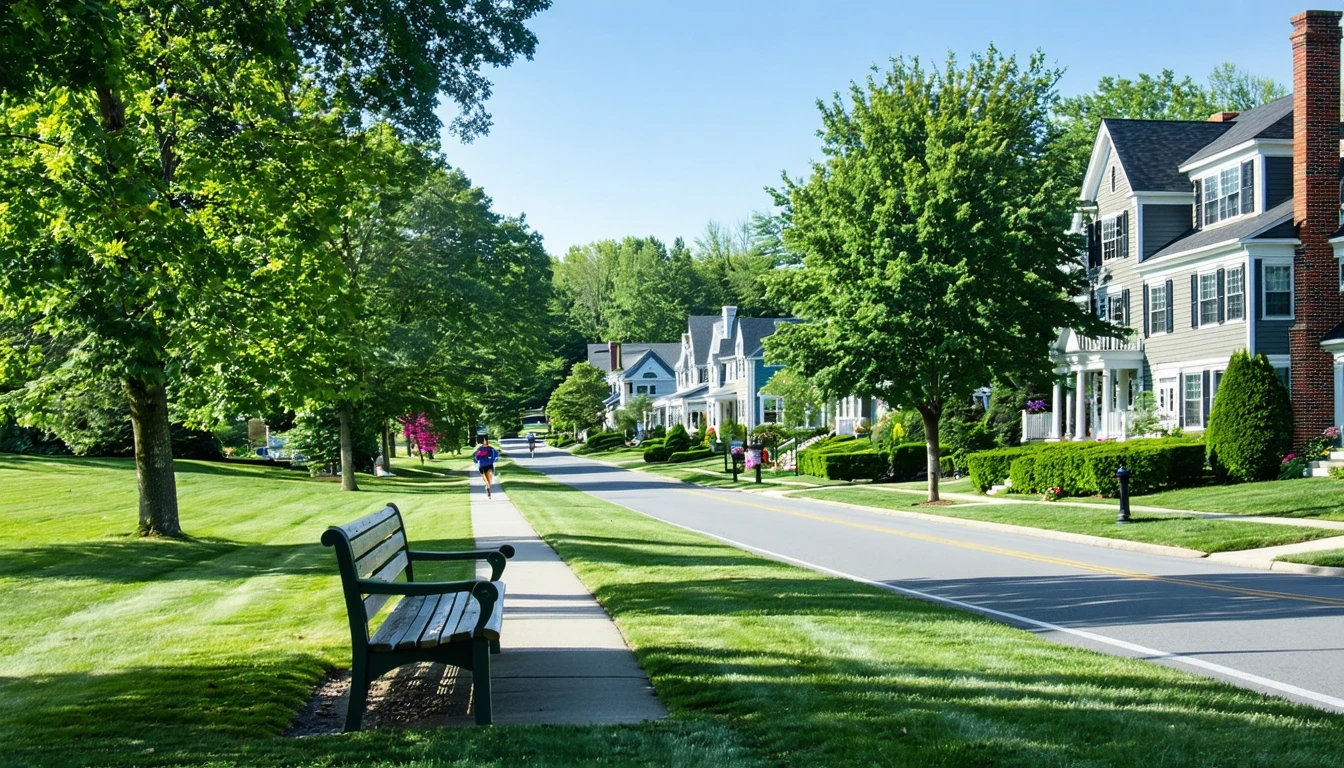
Maya and Jordan had narrowed their search to two towns in the Hartford metro: Glastonbury and Wethersfield. Both offered the suburban feel they wanted, reasonable commutes to Hartford, and access to the same regional amenities. But the cost structures felt different in ways that didn’t show up in a simple side-by-side comparison. Glastonbury’s housing market demanded more upfront, but its walkable pockets and corridor-clustered grocery access meant fewer car trips for daily errands. Wethersfield’s lower entry point made homeownership more accessible, but higher utility rates—especially for natural gas—introduced more volatility into monthly obligations. The decision wasn’t about which town cost less overall; it was about which cost pressures their household could absorb more comfortably.
Both towns sit in Connecticut’s Hartford metro, share similar employment markets, and attract households looking for suburban stability without leaving the region. But the way costs concentrate differs meaningfully. In Glastonbury, housing dominates the cost experience—higher median home values and rents create a steeper entry barrier, but ongoing expenses like utilities remain more predictable. In Wethersfield, the cost structure shifts toward ongoing obligations—lower housing entry points free up initial capital, but higher electricity and natural gas rates introduce more seasonal exposure, especially for households in older or larger homes. For Maya and Jordan, the question became: would they rather stretch for housing and gain predictability, or preserve flexibility at entry and manage more variable monthly costs?
This article explains where cost pressure shows up in each town, how different households experience those differences, and what drives the decision for couples, families, and single adults navigating the Hartford metro in 2026. The better choice depends on which costs dominate your household—and which tradeoffs you’re positioned to manage.
Housing Costs in Glastonbury vs Wethersfield
Housing is where the two towns diverge most sharply. Glastonbury’s median home value sits at $360,900, while Wethersfield’s median is $286,000—a substantial difference in upfront capital required for ownership. For renters, the gap is similarly pronounced: Glastonbury’s median gross rent is $1,657 per month, compared to Wethersfield’s $1,244 per month. These aren’t minor variations; they represent fundamentally different entry barriers and ongoing obligations that shape household budgets from day one.
The housing stock in each town reflects different development patterns and demand pressures. Glastonbury’s higher values correspond to a market where single-family homes dominate, walkable pockets create locational premiums, and proximity to parks and mixed-use corridors adds value. Wethersfield’s lower entry point reflects a more varied housing mix, including older housing stock and neighborhoods where utility exposure (heating and cooling costs) becomes a more significant ongoing consideration. For first-time buyers, Wethersfield’s lower median home value reduces the down payment hurdle and monthly mortgage obligation, making ownership accessible sooner. For renters, the $400+ monthly difference in median rent creates meaningful budget flexibility—or eliminates it, depending on which direction you’re moving.
But housing cost isn’t just about the monthly payment. In Glastonbury, higher home values often correlate with newer construction, better insulation, and lower utility exposure—factors that reduce ongoing volatility even as the mortgage payment rises. In Wethersfield, lower purchase prices may come with older homes that require more heating in winter and cooling in summer, shifting cost pressure from housing into utilities. Property taxes, HOA fees, and maintenance costs also vary by neighborhood and home age, though specific tax rates aren’t available for direct comparison. What matters for decision-making is recognizing that Glastonbury front-loads cost into housing, while Wethersfield distributes pressure across housing and utilities more evenly.
| Housing Type | Glastonbury | Wethersfield |
|---|---|---|
| Median Home Value | $360,900 | $286,000 |
| Median Gross Rent | $1,657/month | $1,244/month |
| Typical Entry Barrier | Higher upfront capital required | Lower down payment and monthly obligation |
| Ongoing Housing Pressure | Concentrated in mortgage/rent payment | More distributed across housing + utilities |
For renters, the choice often comes down to budget flexibility versus location convenience. Glastonbury’s higher rents buy access to walkable pockets, corridor-clustered grocery options, and neighborhoods where daily errands require fewer car trips. Wethersfield’s lower rents preserve monthly flexibility, but households may find themselves more car-dependent for groceries, services, and recreation. For buyers, the decision hinges on whether the household can absorb the higher entry cost in Glastonbury in exchange for lower utility volatility and access to amenities that reduce transportation friction, or whether Wethersfield’s lower purchase price and preserved capital flexibility outweigh the higher ongoing utility exposure.
Housing takeaway: Households sensitive to upfront costs and monthly payment predictability will find Wethersfield more accessible, especially first-time buyers and renters managing tight budgets. Households that can stretch for higher housing costs and value walkable access, newer construction, and lower utility exposure will find Glastonbury’s structure more aligned with long-term stability. Families prioritizing space and lower entry barriers lean toward Wethersfield; couples and professionals prioritizing convenience and predictability lean toward Glastonbury.
Utilities and Energy Costs
Utility costs introduce a different kind of pressure—one that’s seasonal, variable, and harder to control than a fixed rent or mortgage payment. In Glastonbury, the electricity rate is 25.30¢/kWh and the natural gas price is $16.18/MCF. In Wethersfield, electricity costs 27.02¢/kWh and natural gas is $26.56/MCF. These differences may seem modest on paper, but they compound over months of heating season (natural gas) and summer cooling (electricity), especially in older or larger homes where insulation and HVAC efficiency vary widely.
Natural gas pricing is where the structural difference becomes most visible. Wethersfield’s natural gas rate is significantly higher than Glastonbury’s, which matters most for households heating with gas during Connecticut’s cold winters. A household in an older, less-insulated home in Wethersfield will experience more volatile heating bills than a comparable household in Glastonbury, even if both homes are the same size. Electricity rate differences are smaller but still meaningful for households running central air conditioning during summer months or operating multiple appliances, electronics, and lighting year-round. The combined effect is that Wethersfield households face more utility cost volatility, while Glastonbury households experience more predictable monthly obligations.
Housing type and age amplify these differences. Single-family homes—common in both towns—expose households to full heating and cooling costs without the shared-wall insulation benefits of apartments or townhomes. Older homes, more prevalent in Wethersfield’s housing stock, often lack modern insulation, efficient windows, and updated HVAC systems, which drives up both electricity and natural gas usage. Newer construction in Glastonbury tends to include better energy efficiency features, reducing baseline usage even before behavior changes. For families in larger homes, the difference between Glastonbury’s and Wethersfield’s utility rates can mean the difference between stable, predictable bills and monthly swings that require budget adjustments.
Household size also plays a role. Single adults and couples in smaller homes or apartments experience less utility volatility overall, but the rate differences still matter—especially for renters in Wethersfield where utilities aren’t included in rent. Families with children face higher baseline usage (more laundry, longer showers, more cooking, more heating/cooling of occupied space) and feel rate differences more acutely. In Glastonbury, that usage happens at lower rates, keeping monthly costs more predictable. In Wethersfield, the same usage patterns generate higher bills, especially during peak heating and cooling months.
Utility takeaway: Households in older homes, families with high baseline usage, and anyone heating primarily with natural gas will experience more cost volatility in Wethersfield due to higher electricity and natural gas rates. Glastonbury’s lower rates create more predictable utility costs, especially for households in newer construction or smaller homes. Renters and first-time buyers in Wethersfield should budget for higher seasonal swings; households in Glastonbury gain stability but pay for it upfront in higher housing costs.
Groceries and Daily Expenses
| Housing Type | Glastonbury | Wethersfield |
|---|---|---|
| Median Home Price | $450,000 | $325,000 |
| Mortgage (3BR) | $2,500 – $3,000 | $1,900 – $2,400 |
| Rent (2BR) | $1,900 – $2,200 | $1,600 – $1,900 |
Grocery and everyday spending pressure in Glastonbury and Wethersfield isn’t driven by dramatic price differences—both towns sit in the same regional market with similar access to chain grocers, discount retailers, and convenience stores. Instead, the difference lies in how access patterns, store concentration, and household habits interact with cost sensitivity. Glastonbury’s corridor-clustered grocery density means that food and grocery options are concentrated along main roads and mixed-use areas, making it easier to comparison-shop or stop on the way home from work. Wethersfield lacks the same experiential data, but its lower housing costs and similar regional access suggest that grocery shopping requires more intentional planning and car trips, with fewer walkable or incidental options.
For single adults and couples, grocery spending is more flexible—smaller cart sizes, fewer bulk purchases, and more ability to shift between discount grocers, specialty stores, and prepared food options depending on schedule and budget. In Glastonbury, the presence of walkable pockets and corridor-clustered food access means that grabbing a few items on foot or making a quick stop after work is more feasible, reducing the friction cost of grocery shopping. In Wethersfield, the same household will likely consolidate trips, plan more carefully, and rely more heavily on a single primary grocer, which can reduce flexibility but also limit impulse spending and convenience purchases.
Families managing larger grocery volumes experience the cost structure differently. Bulk shopping at big-box retailers becomes more important, and the ability to access multiple store types (discount grocers for staples, specialty stores for fresh produce, warehouse clubs for household goods) creates meaningful savings over time. Glastonbury’s mixed land use and moderate food density support this kind of shopping flexibility without requiring long drives. Wethersfield households may need to travel farther to access the same variety, which adds time cost and car dependence even if prices at the store are comparable. The hidden cost isn’t the groceries themselves—it’s the transportation friction, time spent driving, and reduced ability to take advantage of sales or compare prices across stores.
Dining out and convenience spending follow similar patterns. Glastonbury’s corridor-clustered food access includes more restaurants, coffee shops, and takeout options within short distances, which makes convenience spending easier—and harder to avoid. Wethersfield’s lower housing costs free up budget flexibility, but fewer walkable food options mean that dining out requires more intentional trips, which can reduce frequency but also limit spontaneous spending. For households trying to control costs, Wethersfield’s structure may actually support better discipline; for households valuing convenience and variety, Glastonbury’s access reduces friction but requires more active budget management.
Groceries takeaway: Families and households prioritizing grocery flexibility, comparison shopping, and access to multiple store types will find Glastonbury’s corridor-clustered density more convenient, though it requires discipline to avoid convenience spending creep. Households in Wethersfield gain budget flexibility from lower housing costs but face more transportation friction and planning burden for groceries and dining. Single adults and couples feel the difference less acutely; families managing larger volumes and tighter schedules feel it more.
Taxes and Fees
Property taxes, local fees, and recurring municipal charges shape the ongoing cost structure in both Glastonbury and Wethersfield, though specific tax rates aren’t available for direct comparison. What matters for decision-making is understanding how these costs interact with housing values, home age, and length of ownership. In Connecticut, property taxes are a primary funding mechanism for local services, schools, and infrastructure, which means that homeowners carry a significant share of the tax burden. Renters experience this indirectly through rent levels, but owners feel it directly as a recurring obligation that rises with home value and, in some cases, with reassessments over time.
Glastonbury’s higher median home value means that property tax obligations are likely higher in absolute terms, even if the mill rate (tax rate per $1,000 of assessed value) is comparable to Wethersfield’s. For a household buying a $360,900 home in Glastonbury versus a $286,000 home in Wethersfield, the annual property tax bill will reflect that difference, creating a higher ongoing cost in Glastonbury regardless of rate structure. This matters most for long-term owners and families planning to stay several years, as property taxes compound over time and are less flexible than other budget categories. Households stretching to afford Glastonbury’s higher home prices should account for the corresponding tax obligation, which doesn’t decline even if income fluctuates.
Local fees—trash collection, water and sewer charges, parking permits, and HOA fees where applicable—add another layer of cost that varies by neighborhood and housing type. In some Glastonbury neighborhoods, HOA fees may bundle landscaping, snow removal, or shared amenities, which adds predictability but also raises the baseline monthly obligation. Wethersfield’s lower housing costs may come with fewer bundled services, meaning that households manage more of these costs individually, which can create variability but also more control. Renters in both towns typically see these fees embedded in rent, but owners must budget for them separately, and the structure (predictable monthly fee vs variable usage-based charges) affects cash flow management.
The tax and fee structure also affects different household types differently. First-time buyers in Wethersfield benefit from lower property tax obligations tied to lower home values, which preserves monthly flexibility and reduces the risk of payment shock during lean months. Long-term owners in Glastonbury face higher ongoing tax costs but benefit from the stability and predictability that comes with newer infrastructure, better-maintained public services, and amenities that reduce other costs (e.g., parks, walkable areas, local healthcare access). Renters in both towns are somewhat insulated from direct tax exposure, but the cost is embedded in rent levels, meaning that Glastonbury’s higher rents partially reflect higher property tax obligations passed through by landlords.
Taxes and fees takeaway: Homeowners in Glastonbury face higher property tax obligations due to higher home values, which matters most for long-term residents and families planning to stay several years. Wethersfield’s lower home values reduce ongoing tax pressure, making ownership more accessible for first-time buyers and households managing tighter budgets. Renters in both towns experience tax costs indirectly through rent levels, but the structure (higher rent with more predictability in Glastonbury vs lower rent with more variability in Wethersfield) shapes budget flexibility differently.
Transportation & Commute Reality
Transportation costs in Glastonbury and Wethersfield are shaped less by dramatic differences in gas prices—Glastonbury’s gas costs $3.04/gal while Wethersfield’s is $2.85/gal—and more by how car dependence, commute patterns, and daily errands structure time and money tradeoffs. Both towns are suburban, car-oriented communities in the Hartford metro, meaning that most households rely on personal vehicles for commuting, groceries, healthcare, and recreation. But the intensity of that dependence, and the friction cost of managing it, differs in ways that affect household logistics and budget predictability.
Glastonbury’s experiential signals reveal walkable pockets with a high pedestrian-to-road ratio, corridor-clustered grocery and food access, and some cycling infrastructure in limited areas. This doesn’t mean Glastonbury is a walkable city—it’s not—but it does mean that certain neighborhoods and corridors support car-free errands for households living near those areas. A household in one of Glastonbury’s walkable pockets can walk to a coffee shop, pick up groceries on foot, or bike to a park without needing to drive every time. That reduces not just gas spending, but also wear and tear on the vehicle, parking friction, and the time cost of getting in and out of the car for short trips. For dual-income couples or families managing tight schedules, that convenience translates into real time savings and reduced logistical complexity.
Wethersfield lacks comparable experiential signals data, but its lower housing costs and similar regional position suggest a more uniformly car-dependent structure. Households in Wethersfield will likely drive for nearly all errands, groceries, and recreation, which increases baseline transportation costs (gas, maintenance, insurance) and reduces flexibility for households managing one vehicle or trying to minimize car trips. The $0.19/gal lower gas price in Wethersfield offsets some of this, but the savings are modest compared to the cumulative cost of higher car dependence over time. For a household driving 25 miles round trip daily, the gas price difference amounts to a small monthly savings, but the time cost and logistical burden of car-dependent errands adds friction that doesn’t show up in a fuel budget.
Commute patterns to Hartford or other regional employment centers are comparable from both towns, though specific commute time data isn’t available. Both towns offer reasonable access to I-91 and regional highways, meaning that the commute itself isn’t a major differentiator. What matters more is how transportation integrates with daily life outside the commute. In Glastonbury, walkable pockets and corridor-clustered access mean that a household can reduce car trips for non-commute errands, which lowers total vehicle usage and creates more schedule flexibility. In Wethersfield, nearly every trip requires a car, which increases baseline transportation costs and reduces flexibility for households trying to manage with one vehicle or minimize driving.
Transportation takeaway: Households prioritizing walkable access, reduced car dependence, and convenience for daily errands will find Glastonbury’s walkable pockets and corridor-clustered food access more aligned with their needs, though they’ll pay for it in higher housing costs. Households comfortable with car dependence and prioritizing lower housing entry costs will find Wethersfield’s structure more affordable, though they’ll face higher baseline transportation usage and logistical friction. Single adults and couples managing one vehicle feel the difference more acutely; families with multiple cars and flexible schedules feel it less.
Cost Structure Comparison
The cost structures in Glastonbury and Wethersfield don’t differ because one town is universally more expensive—they differ because cost pressure concentrates in different categories, creating distinct tradeoffs for different household types. In Glastonbury, housing dominates the cost experience. Higher median home values and rents create a steep entry barrier, but once that threshold is crossed, ongoing costs become more predictable. Lower utility rates, walkable pockets that reduce car dependence, and corridor-clustered grocery access all contribute to a structure where the biggest financial hurdle is upfront, and monthly obligations stabilize over time. Households that can absorb the higher housing cost gain predictability, convenience, and lower exposure to seasonal volatility.
In Wethersfield, cost pressure shifts toward ongoing obligations. Lower housing entry points—both for renters and buyers—free up initial capital and reduce monthly mortgage or rent payments, but higher utility rates (especially natural gas) introduce more seasonal volatility. Car dependence is more uniform, meaning that transportation costs remain consistently high, and the lack of walkable errands infrastructure adds time friction and logistical complexity. Households in Wethersfield preserve budget flexibility at entry but must manage more variable monthly costs, especially during heating season or for families in older, less-insulated homes.
For renters, the difference is stark. Glastonbury’s $1,657 median rent buys access to walkable neighborhoods, lower utility exposure, and reduced transportation friction. Wethersfield’s $1,244 median rent preserves $400+ per month in budget flexibility, but that flexibility is offset by higher utility bills, more car dependence, and fewer walkable conveniences. Single adults and couples with stable incomes may prefer Glastonbury’s structure if they value convenience and predictability; those managing tighter budgets or prioritizing savings will find Wethersfield’s lower rent more accessible, even if ongoing costs are less predictable.
For buyers, the tradeoff is even more pronounced. Glastonbury’s $360,900 median home value requires a larger down payment and higher monthly mortgage obligation, which limits accessibility for first-time buyers or households with less saved capital. But that higher cost buys lower utility volatility, better access to amenities, and neighborhoods where daily errands require fewer car trips. Wethersfield’s $286,000 median home value makes ownership accessible sooner, but the higher utility rates and more car-dependent structure mean that ongoing costs are less predictable and more sensitive to household size, home age, and seasonal weather. Families prioritizing space and lower entry barriers will find Wethersfield more accessible; couples and professionals prioritizing convenience and long-term stability will find Glastonbury more aligned with their needs.
Utilities introduce the most meaningful ongoing difference. Glastonbury’s lower electricity and natural gas rates create more predictable monthly bills, especially for households in newer homes with better insulation. Wethersfield’s higher rates amplify seasonal swings, particularly for families in older homes or larger single-family houses where heating and cooling costs dominate winter and summer budgets. Households sensitive to utility volatility—those managing variable incomes, tight budgets, or high baseline usage—will feel the difference more acutely in Wethersfield.
Transportation and daily errands add another layer. Glastonbury’s walkable pockets and corridor-clustered grocery access reduce the friction cost of daily life, making it easier to run errands on foot, consolidate trips, or avoid driving for short tasks. Wethersfield’s more uniform car dependence means that nearly every errand requires a vehicle, which increases baseline transportation costs and reduces schedule flexibility. For dual-income couples managing tight schedules, Glastonbury’s structure reduces logistical complexity; for families with flexible schedules and multiple vehicles, Wethersfield’s lower housing costs outweigh the added transportation friction.
The decision isn’t about which town costs less—it’s about which cost structure aligns with the household’s financial position, priorities, and tolerance for volatility. Households sensitive to upfront costs, first-time buyers, and families prioritizing space and lower entry barriers will find Wethersfield more accessible. Households that can stretch for higher housing costs, value predictability, and prioritize convenience and walkable access will find Glastonbury’s structure more aligned with long-term stability. For Maya and Jordan, the choice came down to whether they’d rather stretch for housing and gain predictability, or preserve flexibility at entry and manage more variable monthly costs. Neither answer is wrong—it depends entirely on which costs dominate their household.
How the Same Income Feels in Glastonbury vs Wethersfield
Single Adult
For a single adult, housing becomes the first non-negotiable cost, and the $400+ monthly rent difference between Glastonbury and Wethersfield determines how much flexibility remains for everything else. In Glastonbury, higher rent buys walkable access and lower utility volatility, which reduces transportation friction and creates more predictable monthly obligations. In Wethersfield, lower rent preserves budget flexibility, but higher utility rates and more car dependence mean that savings from rent are partially offset by seasonal utility swings and baseline transportation costs. Flexibility exists in both towns, but in Glastonbury it’s concentrated in non-housing categories, while in Wethersfield it’s front-loaded into the rent payment itself.
Dual-Income Couple
For a dual-income couple, the cost structure difference becomes less about affordability and more about convenience versus control. In Glastonbury, higher housing costs are offset by walkable errands, lower utility exposure, and reduced transportation friction, which matters most for couples managing two commutes and tight schedules. In Wethersfield, lower housing entry costs preserve capital flexibility and reduce monthly obligations, but the more car-dependent structure and higher utility volatility require more active budget management and logistical planning. The same gross income feels more stable in Glastonbury because ongoing costs are more predictable; it feels more flexible in Wethersfield because the lower housing payment leaves more room for discretionary spending or savings.
Family with Kids
For families, housing space becomes non-negotiable first, and Wethersfield’s lower home values make ownership accessible sooner, which matters for households prioritizing yards, school districts, and long-term stability. But higher utility rates and larger homes amplify seasonal cost swings, especially for families with high baseline usage (laundry, cooking, heating/cooling occupied space). In Glastonbury, higher home values delay ownership or require a larger down payment, but lower utility rates and walkable access to parks, schools, and errands reduce ongoing friction and create more predictable monthly costs. Flexibility in Wethersfield comes from preserved capital and lower entry barriers; flexibility in Glastonbury comes from predictable ongoing costs and reduced logistical complexity for managing kids’ schedules and household errands.
Decision Matrix: Which City Fits Which Household?
| Decision factor | If you’re sensitive to this… | Glastonbury tends to fit when… | Wethersfield tends to fit when… |
|---|---|---|---|
| Housing entry + space needs | Down payment size, monthly mortgage/rent obligation, and upfront capital requirements dominate your budget | You can absorb higher upfront costs in exchange for predictability and walkable access to amenities | You prioritize lower entry barriers and preserved capital flexibility over convenience and predictability |
| Transportation dependence + commute friction | Car dependence, daily errands logistics, and time cost of driving shape your household schedule | You value walkable pockets and corridor-clustered access that reduce car trips for daily errands | You’re comfortable with uniform car dependence and prioritize lower housing costs over reduced driving |
| Utility variability + home size exposure | Seasonal utility swings, heating/cooling costs, and home age affect your monthly budget predictability | You want lower electricity and natural gas rates that stabilize bills, especially in newer construction | You can manage higher utility volatility in exchange for lower housing entry costs and preserved flexibility |
| Grocery strategy + convenience spending creep | Access to multiple store types, comparison shopping, and walkable food options affect your spending discipline | You value corridor-clustered grocery access and convenience but can manage discipline to avoid spending creep | You prefer consolidated trips and fewer walkable temptations, even if it requires more planning and car dependence |
| Fees + friction costs (HOA, services, upkeep) | Property taxes, HOA fees, and recurring municipal charges shape your ongoing obligations beyond rent/mortgage | You can absorb higher property tax obligations tied to higher home values in exchange for stability and amenities | You prioritize lower property tax obligations and fewer bundled fees, even if it means managing more costs individually |
| Time budget (schedule flexibility, errands, logistics) | Managing dual incomes, kids’ schedules, or tight daily routines makes convenience and reduced friction critical |