
“We wanted a place where we could walk to coffee, stay active, and not break the bank—Georgetown checked all those boxes,” says Margaret Chen, who relocated here from Houston two years ago. Her experience reflects a growing trend: retirees discovering Georgetown as a place that balances affordability, accessibility, and quality of life without the intensity of a major metro.
Georgetown offers a compelling retirement proposition for those seeking a Central Texas lifestyle with moderate costs and everyday convenience. With a regional price level slightly below the national average and a mix of walkable neighborhoods and open space, the city appeals to retirees who value both independence and community connection. However, understanding what Georgetown delivers—and what it doesn’t—is essential for making an informed decision about your retirement years.
Why Retirees Choose Georgetown
Georgetown earns a retirement suitability score of 72 out of 100, reflecting its strengths in cost structure, climate, and livability, balanced against considerations around healthcare proximity and infrastructure density. The city’s regional price parity index of 98 means overall costs run slightly below the national baseline, offering modest but meaningful relief on everyday expenses. The median household income of $87,465 per year suggests a stable economic environment, and the unemployment rate of 3.6% signals a healthy local economy that supports services and amenities retirees rely on.
The climate plays a significant role in Georgetown’s retirement appeal. Current conditions of 63°F (feels like 61°F) reflect the mild stretches that make outdoor activity accessible much of the year. However, Central Texas is known for extended cooling seasons and occasional triple-digit summer heat, which means air conditioning becomes a central household expense and a quality-of-life factor for those sensitive to temperature extremes. For retirees managing arthritis or joint conditions, the generally warm, dry climate can be beneficial, though summer intensity requires planning and adaptation.
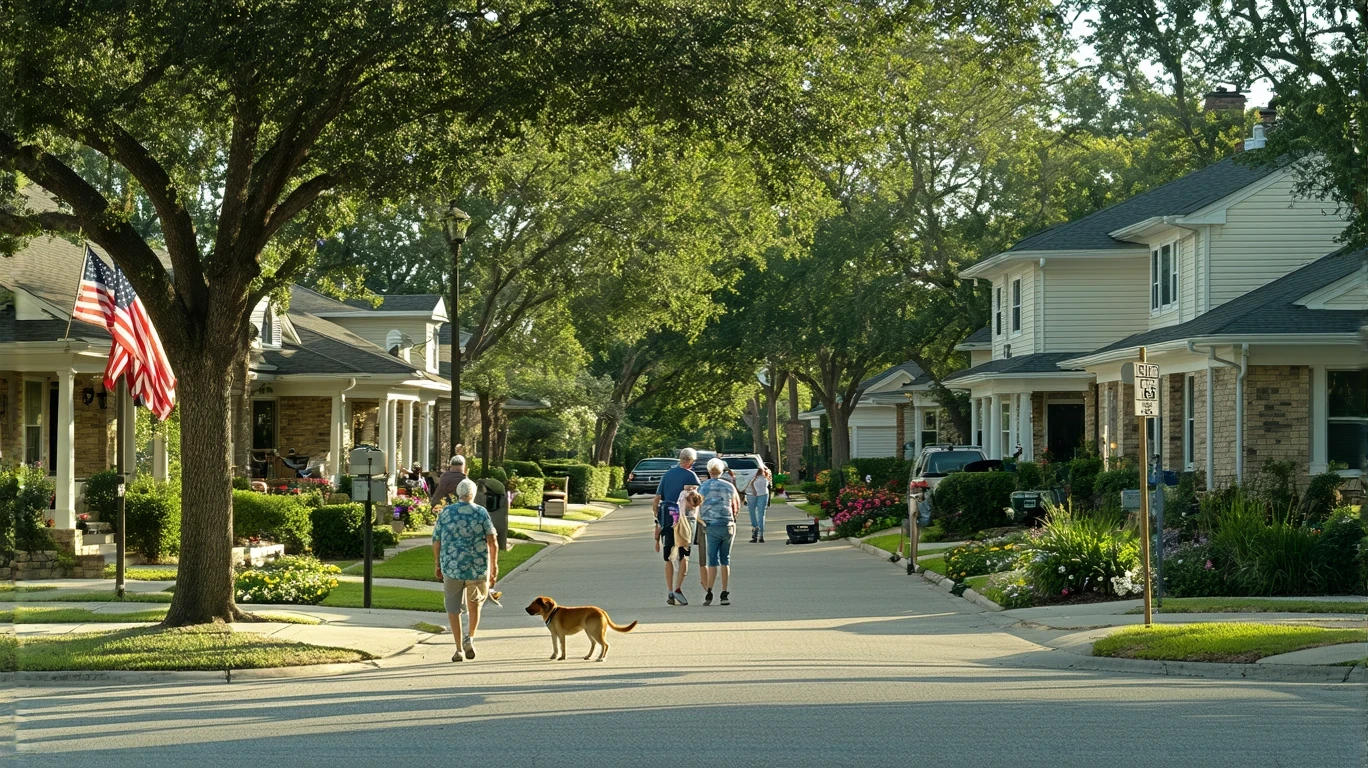
Georgetown’s urban form supports an active retirement lifestyle in specific areas. The city shows walkable pockets with substantial pedestrian infrastructure, meaning certain neighborhoods offer genuine opportunities to run errands, visit cafes, or take daily walks without relying entirely on a car. Food and grocery access is corridor-clustered, with moderate density along key routes, and park access is present with water features adding to the outdoor environment. The low-rise building character and mixed land use create a small-town feel with urban conveniences woven in, appealing to retirees who want accessibility without high-rise intensity.
Healthcare Access for Seniors
Healthcare infrastructure is a critical consideration for any retirement destination, and Georgetown’s profile is defined by routine local access rather than comprehensive hospital presence. The city has clinics and pharmacies available, providing primary care, prescription management, and routine medical services within the community. For many retirees managing chronic conditions or requiring regular check-ins, this level of access supports day-to-day health maintenance effectively.
However, Georgetown does not have a hospital facility within its immediate boundaries, meaning more intensive care—emergency services, surgical procedures, specialist consultations, or inpatient treatment—requires travel to nearby regional medical centers. For retirees with complex health needs or those who prioritize proximity to full-service hospitals, this gap is a meaningful tradeoff. Drive times to major hospital systems in the broader Austin metro area are manageable but not negligible, and planning for medical appointments or urgent situations becomes part of the household routine.
Specialist availability, physical therapy, and senior-specific care services are present but may require coordination across multiple providers or facilities. Medicare acceptance is generally strong in Texas, and Georgetown’s clinics typically work within standard insurance networks, but confirming coverage and provider availability before relocating is essential. Prescription access through local pharmacies is reliable, and many retirees find that mail-order options or delivery services add convenience for ongoing medication management.
For retirees in good health who need occasional care, Georgetown’s healthcare landscape is functional and sufficient. For those with higher medical complexity or who want the reassurance of a hospital nearby, the city’s routine-local profile may feel limiting, and proximity to regional facilities becomes a key part of the decision calculus.
Senior-Friendly Amenities and Services
Georgetown’s amenity landscape reflects its small-city scale and community orientation. Senior centers, recreational programs, and lifelong learning opportunities exist, though the density and variety may be more limited compared to larger metros. Libraries and community colleges offer classes, workshops, and social programming that appeal to retirees seeking intellectual engagement or new hobbies. The presence of parks and water features supports outdoor activity, and the walkable pockets identified in the city’s structure mean that some neighborhoods genuinely support walking routines, errands on foot, and casual social interaction.
Transportation options for seniors who no longer drive or prefer not to rely on a car are more constrained. Georgetown does not have extensive public transit infrastructure, and while ride services and senior shuttles may be available through local organizations or nonprofits, car dependency remains the norm outside the most walkable corridors. For retirees who value independence and mobility, maintaining a vehicle or arranging reliable transportation becomes part of the household logistics.
Shopping accessibility is corridor-clustered, meaning grocery stores and everyday retail are concentrated along main routes rather than distributed evenly across all neighborhoods. This pattern works well for retirees living near those corridors but may require longer drives for those in more residential pockets. Grocery delivery services, meal programs, and online ordering options are increasingly common and can offset some of the friction, particularly for seniors with mobility limitations or those who prefer to minimize driving.
Social infrastructure—volunteer opportunities, hobby clubs, faith communities, and intergenerational programs—exists but may require active seeking out. Georgetown’s smaller scale means that social networks can feel more intimate and accessible, but the range of organized programming may not match what’s available in larger cities. For retirees who thrive on structured activities and diverse group options, this is a consideration worth exploring during a visit or trial stay.
Cost of Living for Retirees
Understanding what shapes the cost of living in Georgetown is essential for retirees planning their budgets. Housing represents the largest single expense for most retiree households. The median home value of $361,700 reflects a moderate market by Central Texas standards, accessible for retirees downsizing from higher-cost metros but still requiring significant capital or financing. For those preferring to rent, the median gross rent of $1,575 per month offers flexibility without the maintenance and tax obligations of ownership, though it also means ongoing monthly exposure without equity accumulation.
Property taxes in Texas are a defining feature of the cost structure, as the state relies heavily on property tax revenue in the absence of a state income tax. While specific rates and senior exemptions vary by jurisdiction and are not detailed in the available data, retirees should anticipate that property taxes will be a recurring and potentially rising cost. Senior exemptions and homestead protections exist in Texas and can provide meaningful relief, but confirming eligibility and understanding the local tax environment is a necessary step before committing to homeownership.
Utilities, particularly electricity, are a significant cost driver due to Georgetown’s extended cooling season. The electricity rate of 16.04¢/kWh is moderate, but usage during hot months can be substantial. For illustrative context, a household using 1,000 kWh per month would face a bill around $160 before fees and taxes, and summer months often push usage higher. Natural gas, priced at $25.56/MCF, plays a smaller role given the limited heating season, but it may still factor into water heating and cooking costs. Retirees on fixed incomes should plan for seasonal volatility in utility bills and consider efficiency measures—programmable thermostats, insulation, and strategic cooling—to manage exposure.
Transportation costs depend heavily on driving patterns and vehicle dependency. With gas priced at $2.49/gal, fuel expenses are moderate, but the need to drive for most errands, medical appointments, and social activities means ongoing costs for fuel, maintenance, and insurance. For retirees living in walkable pockets, some of this pressure eases, but the overall structure still favors car ownership.
Healthcare costs beyond Medicare—supplemental insurance, prescriptions, co-pays, and out-of-pocket expenses—vary widely by individual need but represent a major budget category for most retirees. Texas does not tax Social Security benefits, pensions, or retirement account distributions, which provides meaningful relief compared to states with income taxes on retirement income. This tax advantage helps offset some of the property tax burden and contributes to Georgetown’s overall cost competitiveness for retirees.
Monthly Retirement Budget in Georgetown
Here’s what a typical monthly retirement budget might look like in Georgetown:
| Expense Category | Modest Lifestyle | Comfortable Lifestyle |
|---|---|---|
| Housing (rent or mortgage + taxes + insurance) | $1,600 | $2,400 |
| Utilities (electricity, gas, water, internet) | $220 | $280 |
| Food (groceries and occasional dining) | $450 | $650 |
| Healthcare (Medicare supplement, prescriptions, co-pays) | $400 | $600 |
| Transportation (fuel, maintenance, insurance) | $300 | $450 |
| Entertainment & Recreation | $200 | $400 |
| Miscellaneous (personal care, household items, contingency) | $230 | $350 |
| Total Monthly | $3,400 | $5,130 |
Estimates based on average senior spending patterns and local costs. Individual budgets will vary based on housing choice, health needs, and lifestyle preferences.
These illustrative budgets reflect the range of retirement living costs in Georgetown. A modest lifestyle assumes renting or owning a smaller home with manageable taxes, limited dining out, and careful management of discretionary spending. A comfortable lifestyle allows for a larger home, more frequent dining and entertainment, and greater flexibility in healthcare and travel. Both scenarios assume car ownership and account for the seasonal utility exposure typical of Central Texas.
Community and Social Opportunities
Georgetown’s community character is shaped by its small-city scale and the mix of long-time residents and newcomers drawn by the Austin metro’s growth. Senior groups, volunteer opportunities, and faith communities provide social anchors for retirees seeking connection and purpose. Recreational programs, walking groups, and hobby clubs exist, though the range and frequency may require more initiative to discover compared to larger cities with dedicated senior programming infrastructure.
Cultural activities and seasonal events reflect Georgetown’s local identity, and the low-rise, mixed-use urban form supports casual social interaction in walkable areas. For retirees who value intergenerational connection, the presence of families and younger residents in mixed neighborhoods can be a positive, though the limited density of schools and playgrounds suggests that Georgetown is not primarily oriented toward young families, which may affect the texture of community life.
Proximity to family is a key consideration for many retirees, and Georgetown’s location within the Austin metro area offers accessibility for visiting relatives while maintaining some distance from the intensity of the urban core. The city’s transportation infrastructure—primarily car-dependent outside walkable pockets—means that visiting family or hosting guests typically involves driving, and airport access for out-of-town visitors is manageable via Austin-Bergstrom International Airport.
Aging in Place Considerations
Aging in place—remaining in your home and community as you grow older—depends on both the physical environment and the availability of support services. Georgetown’s low-rise building character and presence of single-family homes mean that many residences are not inherently accessible, and modifications such as ramps, grab bars, and widened doorways may be necessary as mobility needs change. Home modification services and accessibility resources are available, though confirming local providers and costs is an important step in planning.
In-home care availability—personal care aides, nursing services, and companion support—exists but may be more limited than in larger metros, and arranging reliable, ongoing care can require coordination across multiple agencies or providers. Assisted living options and memory care facilities are present in the broader region, and exploring these resources before a crisis arises is a practical step for retirees planning long-term.
Walkability varies significantly by neighborhood in Georgetown. The walkable pockets identified in the city’s structure support aging in place for seniors who can manage errands and social activities on foot, reducing car dependency and maintaining independence. However, outside these areas, car reliance is the norm, and losing the ability to drive can create significant isolation and logistical challenges without alternative transportation options.
Climate considerations are also part of the aging-in-place equation. The extended cooling season and occasional extreme heat require reliable air conditioning and the financial capacity to manage high summer utility bills. For seniors with heat sensitivity or respiratory conditions, the summer months can limit outdoor activity and increase reliance on indoor environments, which affects both physical and mental well-being.
Emergency services and disaster preparedness are generally reliable in Georgetown, though retirees should have plans in place for power outages, extreme weather, and medical emergencies, particularly given the absence of a local hospital. Having a network of neighbors, family, or friends who can check in and provide support during crises is an important part of aging safely in any community.
FAQs About Retirement in Georgetown
What’s the average cost of retirement in Georgetown?
A modest retirement lifestyle in Georgetown typically requires around $3,400 per month, while a more comfortable budget runs closer to $5,130 per month. Housing, healthcare, and utilities are the primary cost drivers, and the absence of state income tax on retirement income provides meaningful relief compared to other states.
How good is healthcare access for seniors?
Georgetown offers routine local healthcare access through clinics and pharmacies, which supports primary care and prescription management effectively. However, the city does not have a hospital within its immediate boundaries, so more intensive care, specialist services, and emergency treatment require travel to regional medical centers. For retirees with complex health needs, this is an important tradeoff to consider.
Are there active senior communities?
Georgetown has senior groups, recreational programs, and volunteer opportunities, though the density and variety may be more limited than in larger cities. The walkable pockets and park access support active lifestyles for seniors who enjoy outdoor activity, and the community’s smaller scale can foster closer social connections. However, retirees seeking extensive organized programming or diverse group activities may need to seek out resources more actively.
What are the tax implications of retiring in Texas?
Texas does not tax Social Security benefits, pensions, or retirement account distributions, which is a significant advantage for retirees on fixed incomes. However, property taxes are relatively high compared to other states, as Texas relies on property tax revenue in the absence of a state income tax. Senior exemptions and homestead protections can provide relief, but understanding the local tax structure and planning for ongoing property tax obligations is essential.
Making the Move: Is Georgetown Right for Your Retirement?
Georgetown offers a retirement experience defined by moderate costs, accessible outdoor spaces, and a community-oriented small-city feel. The city’s walkable pockets and mixed land use support active seniors who value independence and everyday convenience, while the slightly below-average cost structure provides modest financial relief compared to the national baseline. The absence of state income tax on retirement income is a meaningful advantage, and the generally warm climate appeals to those seeking year-round outdoor access.
However, Georgetown’s housing tradeoffs and healthcare profile require careful consideration. The lack of a local hospital means that retirees with complex health needs or those who prioritize proximity to full-service medical facilities will need to factor in travel to regional centers. The car-dependent structure outside walkable corridors can limit independence for seniors who no longer drive, and the extended cooling season creates ongoing utility exposure that affects both comfort and budget.
For retirees who value a balance of affordability, accessibility, and community connection, Georgetown is a strong candidate. For those requiring immediate hospital access, extensive public transit, or dense senior programming, the city’s limitations may outweigh its strengths. Visiting Georgetown, exploring different neighborhoods, and connecting with local senior groups or healthcare providers before making a final decision is the most reliable way to determine whether the city aligns with your retirement vision and practical needs.
How this article was built: In addition to public economic data, this article incorporates location-based experiential signals derived from anonymized geographic patterns—such as access density, walkability, and land-use mix—to reflect how day-to-day living actually feels in Georgetown, TX.