
The 7:42 a.m. train pulls into the Garden Grove station, and Maria steps off with her coffee, joining a stream of commuters heading toward the street. She’s one of the lucky ones—her apartment sits three blocks from the rail line, and her office in Santa Ana is two stops away. No freeway merge anxiety, no circling for parking. But as she walks past the station lot, she sees what most of her neighbors deal with: rows of parked cars belonging to people who drove here to catch the train, because the last mile from home doesn’t connect any other way.
Garden Grove’s transportation reality lives in that gap. Rail service runs through the city. Pedestrian infrastructure is strong in pockets. Grocery stores and daily errands cluster densely enough that some residents can walk to what they need. But the city’s suburban layout means that for many households, a car isn’t optional—it’s the only tool that stitches together work, school, errands, and everything else that doesn’t line up along a single corridor.
How People Get Around Garden Grove
Garden Grove sits in the heart of Orange County, where car-first infrastructure has shaped development for decades. But unlike some purely residential suburbs, Garden Grove has evolved mixed-use corridors, commercial density, and transit access that create alternatives for some residents. The pedestrian-to-road ratio exceeds the threshold that typically supports walking as a practical daily option in certain areas, and both food and grocery establishment density are high enough that errands don’t always require driving.
Still, the dominant pattern is driving. About 9.2% of workers in Garden Grove work from home, which means the vast majority commute somewhere, and most of those trips happen by car. The average commute runs 29 minutes, and 47.8% of workers face what’s classified as a long commute—a reflection of Orange County’s sprawling job geography and the mismatch between where people live and where they work.
What newcomers often misunderstand is that Garden Grove isn’t uniformly car-dependent or uniformly transit-friendly. It’s both, depending on where you live and where you need to go. Proximity to rail, density of services, and the direction of your commute determine whether you’ll rely on a car daily or only occasionally.
Public Transit Availability in Garden Grove
Public transit in Garden Grove often centers around systems such as the Orange County Transportation Authority (OCTA), which operates bus routes throughout the city, and Metrolink, which provides regional rail service. The presence of rail transit is a meaningful structural advantage—stations create anchors for denser development, and they offer a real alternative to freeway commuting for people whose destinations align with the line.
Transit works best along commercial corridors and near rail stations, where density supports frequent stops and where walking to and from transit is practical. In these areas, residents can structure daily life around a combination of walking, transit, and occasional car trips. But coverage thins in lower-density residential neighborhoods, where bus frequency drops and the distance between stops and destinations grows. Late-night service is limited, and cross-town trips that don’t follow major corridors often require transfers that double travel time.
The reality is that transit in Garden Grove serves certain commutes well—particularly those heading toward Santa Ana, Anaheim, or other points along established lines—but it doesn’t replace a car for most households. It supplements driving, or it works for individuals whose routines happen to match the network’s structure.
Driving & Car Dependence Reality
For most residents, driving remains the default. Garden Grove’s layout reflects mid-century suburban planning: residential blocks that prioritize single-family homes, commercial strips designed around parking lots, and a street grid that funnels traffic onto a few major arteries. Even in areas with strong pedestrian infrastructure, the distances between home, work, and services often exceed what’s practical on foot.
Parking is generally available and free in residential areas, which reduces one friction point common in denser cities. But car dependence brings its own costs: exposure to gas price volatility (currently $5.16 per gallon), maintenance, insurance, and the time spent in traffic. The 29-minute average commute understates the experience for those traveling during peak hours or crossing multiple municipalities.
Families with children face compounded car dependence. School drop-offs, after-school activities, and grocery runs don’t align neatly with transit schedules, and the flexibility of a car becomes non-negotiable. Even households that could technically use transit for one commute often keep a car for everything else.
Commuting Patterns & Daily Mobility
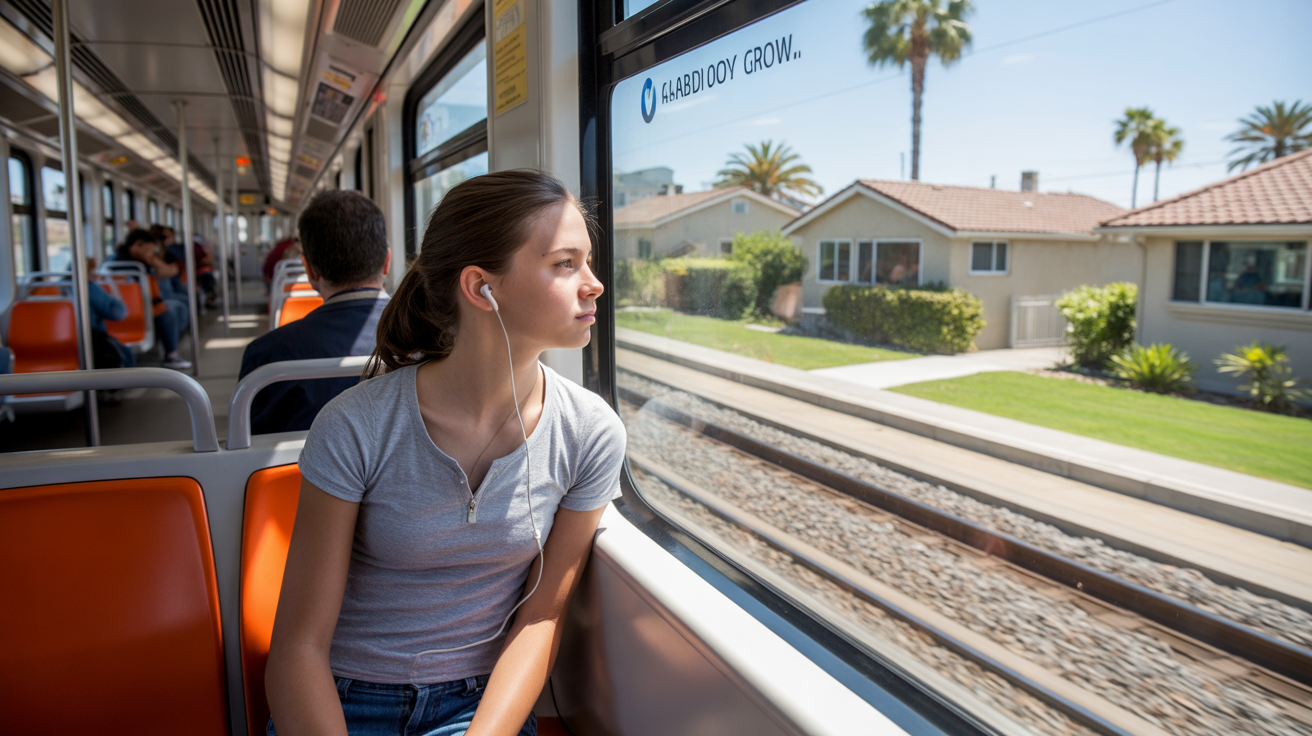
Commuting in Garden Grove rarely follows a simple home-to-office-and-back pattern. Many residents work in nearby cities—Anaheim, Santa Ana, Irvine, even Los Angeles—and the direction and distance of those commutes vary widely. Some jobs cluster near transit lines, making rail a viable option. Others sit in office parks or industrial zones designed exclusively for car access.
The high percentage of long commutes (47.8%) reflects Orange County’s job dispersion. Employment centers are scattered, and housing costs push workers farther from where they’d prefer to live. This creates a daily calculus: drive and control your schedule, or take transit and accept longer travel times with less flexibility.
Multi-stop commutes—dropping kids at school, stopping for groceries, picking up a prescription—favor driving. Single-destination commutes along transit corridors favor rail or bus, especially when parking at the destination is expensive or scarce. The structure of your day determines which mode makes sense, and for many households, that structure changes daily.
Who Transit Works For — and Who It Doesn’t
Transit in Garden Grove works best for individuals who live near rail stations or high-frequency bus routes and who commute to destinations also served by transit. Renters in denser, mixed-use areas near commercial corridors often find they can reduce car dependence significantly, especially if they work in Santa Ana, Anaheim, or central Orange County.
It works less well for families managing multiple schedules, for workers whose jobs sit outside transit-served areas, and for residents in quieter residential neighborhoods where the nearest stop is a mile away. Homeowners in single-family zones typically own at least one car, and often two, because the alternative isn’t practical for daily life.
The distinction isn’t about preference—it’s about infrastructure alignment. If your routine overlaps with where transit goes and when it runs, it’s a real option. If it doesn’t, you’re driving.
How this article was built: In addition to public economic data, this article incorporates location-based experiential signals derived from anonymized geographic patterns—such as access density, walkability, and land-use mix—to reflect how day-to-day living actually feels in Garden Grove, CA.
Transportation Tradeoffs in Garden Grove
Choosing between transit and driving in Garden Grove isn’t about which is cheaper in absolute terms—it’s about predictability, control, and what you’re willing to trade.
Transit offers insulation from gas price swings and eliminates parking hassles, but it requires schedule flexibility and tolerance for longer trip times. Driving offers control and convenience, but it ties household expenses to fuel costs, maintenance cycles, and the condition of regional freeways.
For households near rail, the tradeoff tilts toward transit for work commutes, with a car reserved for errands and off-peak trips. For households farther from transit infrastructure, the tradeoff disappears—driving becomes the only practical option, and the question shifts to managing fuel and maintenance exposure rather than choosing between modes.
FAQs About Transportation in Garden Grove (2026)
Is public transit usable for daily commuting in Garden Grove?
Yes, but it depends on where you live and where you work. If you’re near a rail station and commuting to a destination along the transit network, it’s a practical option. For residents in lower-density neighborhoods or those commuting outside transit-served areas, driving remains more realistic.
Do most people in Garden Grove rely on a car?
Yes. The majority of households own at least one car, and many own two. Even residents who use transit for work commutes often keep a car for errands, family logistics, and trips that don’t align with transit schedules.
Which areas of Garden Grove are easiest to live in without a car?
Areas near rail stations and along high-density commercial corridors offer the best chance of reducing car dependence. These neighborhoods combine transit access with walkable errands, making it possible to structure daily life around a combination of walking, transit, and occasional ride-sharing.
How does commuting in Garden Grove compare to nearby cities?
Garden Grove’s 29-minute average commute is typical for Orange County, where job dispersion and freeway reliance shape daily travel. Cities closer to major employment centers or with more extensive transit networks may offer shorter commutes, but Garden Grove’s rail access provides an advantage over purely car-dependent suburbs.
Does Garden Grove have bike infrastructure?
Bike infrastructure exists in some areas, with bike-to-road ratios in the medium range. Cycling is viable for short trips in certain neighborhoods, but it’s not yet a primary commuting mode for most residents. Infrastructure supports recreational riding and errands more than long-distance commuting.
How Transportation Fits Into the Cost of Living in Garden Grove
Transportation isn’t just a line item—it’s a structural factor that shapes where you can live, how much time you spend commuting, and how much control you have over daily logistics. In Garden Grove, proximity to transit can reduce reliance on a car, but it doesn’t eliminate it for most households. The flexibility of driving comes with exposure to fuel costs and maintenance, while transit use trades convenience for predictability.
For a fuller picture of how transportation costs interact with housing, utilities, and other expenses, see Your Monthly Budget in Garden Grove: Where It Breaks, which breaks down where money goes and how different household types manage competing pressures.
The transportation decision in Garden Grove isn’t binary. It’s about understanding which parts of your routine align with transit, which require a car, and how to structure your housing and commute to minimize friction and cost exposure. The city offers more options than a purely suburban layout, but fewer than a transit-rich urban core. Knowing where you fall in that spectrum is the first step toward making it work.